Tag: General Fiction Page 16 of 46

The Nicotine Chronicles edited by Lee Child is a thing I read

The Nicotine Chronicles

The Nicotine Chronicles

edited by Lee Child

Paperback, 271 pg.
Akashic Books, 2020

Read: September 26-October 19, 2020

I’ve tried to stop smoking.

I know it’s important not to smoke. In fact, it’s stupid to smoke. I smoke, but I try not to smoke. Every time I light a cigarette I think, I should not be doing this.

I want a better life. But it’s an uphill battle, it is an uphill battle because I try to do the right thing, but I don’t do the right thing. And…I smoke anyway.

Fuck it, I don’t smoke that much. The chances that something really bad will happen to me as a consequence of my smoking habit are slim. In fact, the chances that something else might happen to me for other reasons are far greater. Something will happen to me, though.

Sooner or later. That’s guaranteed.

What’s The Nicotine Chronicles

This is an anthology of stories centered around nicotine—users, their delivery system of choice, and how it shapes their thinking/lives. (you can read an excerpt from Child’s Introduction here to flesh this out a bit). There’s one or two that discuss cigars, vaping only shows up once, the rest of these focus on cigarettes (oh, I can think of one mention of a pipe, too). If you care about things like that.

Some of these sixteen stories would fit under the “Crime Fiction” umbrella, one is sort of speculative fiction, and the rest would be “General Fiction.” Not all wax rhapsodically about nicotine or tobacco—in fact, it’s usually portrayed as a pretty negative habit/substance—actually, I think it’s a positive thing only once (and not directly). So even non-/anti-smokers can read this without having to put up with a celebration of smoking or anything.

The Names I Knew

On the whole, these authors were new to me, with four exceptions.

So, I knew Eric Bogosian from miscellaneous roles, and I wasn’t surprised to see that he writes a little. His essay/monologue/first-person rant, “Smoking Jesus,” starts with the paragraphs I started this post with. It’s the best thing in this collection. Sadly, it’s only 4 pages of it. That just isn’t right.

I was surprised to see that Michael Imperioli writes, but I’m glad he does. His contribution was one of the better and more imaginative pieces.

Lee Child and Joyce Carol Oates, are names, of course, that I recognized because I’ve walked into a bookstore/library at least once in the last twenty years. Child’s story wasn’t the kind of thing that fans would expect, but was pretty decent. I appreciated what Oates was doing, but it felt a little…obvious? Unnecessary? Clichéd?

The Names that were New to Me

That leaves 12 names I’m pretty sure I’ve never run across before. None of them moved me to seek out other work of theirs, but there were only two that I actively disliked. I’d be open to reading things from all of them were I to stumble across them.

So, what did I think about The Nicotine Chronicles?

I craved a cigarette right then like I was missing not some foreign chemical but a part of my own, soul, and from each cell of my throat and my lungs, I thanked the universe that I had one.

Every story was well-written, well-executed. I’m not going to complain about the technical aspects—top-notch work, really. But the overwhelming majority of these left me cold. And even with the ones I felt most positive about I could only muster mild interest over.

I have no real animus about this, but no real reason to recommend it. It’s just something I read.

2020 Library Love Challenge


2 Stars

The History of Tom Jones, a Foundling by Henry Fielding: BOOK XIII., v. – viii.

Fridays with the Foundling
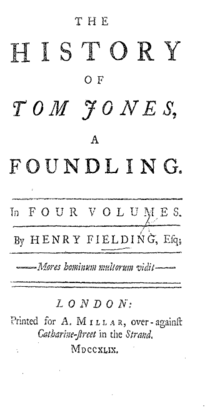
Tom Jones Original CoverThe next day, Tom tries several times to see Mrs. Fitzgerald but gets nowhere. Fed up, he goes back to the Inn he’s staying at (a place Mr. Allworthy stayed at when in London). He hears an altercation and comes to intervene.

I was joking last week about how nice it was to see another fistfight again, and already we have a new one. They’re good for drama, I guess, and to make fast friends of whoever Tom comes to the rescue of (or vice versa). A footman was attacking his employer, and the daughter of the Innkeeper was standing by and screaming (this is what alerted Tom). As handily as the footman was beating his employer, so Tom took care of the footman.

It turns out—and you’ve gotta love this—the footman had been using his boss’s (Mr. Nightengale) copy of Hoyle and had spilled wine on an open page. Nightengale was angered, and the two started arguing over how much the book had been worth before getting ruined, so they could agree on how much to be withheld from his pay. One thing led to another…

Anyway, out of gratitude Nightengale splits a bottle of wine with Tom and they become friends, the innkeeper and her daughter join them and they all get along really well.

The next day, as masquerade invitation and mask arrive for Tom, he assumes this comes from Mrs. Fitzgerald and will be his chance to see Sophia. So he invites Nightengale to come to the ball with him—and then has to borrow cab fare from Partridge so he can afford to go anywhere. There’s no Sophia, or even Mrs. Fitzgerald at the ball, instead, it’s Sophia’s friend, Lady Bellaston, who arranged to meet Tom there.

She grills Tom for hours and finally agrees to arrange a meeting if he promises to leave Sophia alone after that. She gives him fifty pounds and sends him on his way.

Tom gets back to the inn to hear Mrs. Miller (the innkeeper, who I should’ve introduced earlier) talk about a cousin, who married for love and is now destitute and barely hanging on due to illness in the family. Tom pulls her aside and gives her the money Bellaston just gave him.

Now, earlier, Fielding told the reader that he focused on describing Mrs. Miller because she’s going to be important. I wonder how? And I look forward to finding out. A fun few chapters this week, I’m really enjoying Tom’s time in London.

The History of Tom Jones, a Foundling by Henry Fielding: BOOK XII., xiii – BOOK XIII., iv..

Fridays with the Foundling
Tom Jones Original CoverAfter the wedding, Tom and Partridge are back on their way to London. Funds are running low, and Partridge suggests borrowing from Sophia’s hundred to get them some food, they both could use some. Particularly Tom, who hadn’t had anything but a poached egg in a long time, unlike Partridge at the wedding “he had feasted only his understanding.” Tom refuses to steal (or, borrow, but he knows it’d really be stealing) and the two get into a heated argument about it.

They do stop for some food and things cool down. When they leave a stranger asks if he can travel with them—and after a little bit, he pulls a gun on them and demands that hundred. A scuffle (a really tame one by this book’s standards) ensues and Tom gets the guy on his back and disarmed easily. This was his first attempted mugging—the pistol isn’t even loaded—he’s poor, he has five kids with another on the way. Tom gives him a little bit of money (over Partridge’s objections—he’s getting hard to like), and goes on his way.

They end up in London and now Tom has to find Sophia. He tracks down Mrs. Fitzpatrick and tries to get information about Sophia from her. Mrs. Fitzpatrick is convinced he’s Mr. Blifil and doesn’t give him anything. As Tom leaves, her maid clues her in—which involves catching her up on who Tom is, as Sophia left him out of her stories.

In that case, Mrs. Fitzpatrick both wants to meet with him again and to get Sophia’s friend, Lady Bellaston, involved, too. The next day when Tom comes again to try to get information out of Mrs. Fitzpatrick the two ladies make some observations and discuss him at some length after he leaves again.

After fisticuffs being a frequent occurrence for a bit, it’s now been weeks since we had one. And it looks like it’s going to be a few before we get another after this very short altercation. I’m not saying I need them, it’s just something that was common enough that I joked about it, and now it’s gone by the wayside. Instead, it looks like we’re getting into a groove of domestic kind of action—Sophia’s female relatives or friends looking out for her and making Tom jump through hoops. Maybe I’m wrong, but I bet the last little bit is going to repeat itself for a few chapters.

The History of Tom Jones, a Foundling by Henry Fielding: BOOK XII., vii.-xii.

Fridays with the Foundling
Tom Jones Original CoverWhile Jones is catching some Zs, Partridge is having a good time talking with men at the inn. He starts off talking up Tom’s wealth, but then gets into talking about worrying aobut his mental health. THye kick around some schemes to get TOm some help for his madness, but don’t end up pursuing any action because some news comes in about the rebels marching on London.

Tom sleeps a lot for him, and could probably do with some more. But he gets a clue about Sophia’s route and follows up on it—and then finds the boy who took her into London, and discretely pumps him for information. It’s at this point that Fielding talks about Sophia being more offended by Tom’s use of her name in public than any, shall we say, extra-curricular activities he may be involved in. Sadly, she’s upset with the wrong man, Tom’s very careful of her reputation. Partridge, on the other hand… Tom must really be lonely and in need of a traveling companion, that’s all I’ll say.

During a break in their travel, Tom splits a bottle of wine with Mr. Dowling—the attorney who brought news of Blifil’s mother’s death.

Mr Dowling, pouring out a glass of wine, named the health of the good Squire Allworthy; adding, “If you please, sir, we will likewise remember his nephew and heir, the young squire: Come, sir, here’s Mr Blifil to you, a very pretty young gentleman; and who, I dare swear, will hereafter make a very considerable figure in his country. I have a borough for him myself in my eye.”

“Sir,” answered Jones, “I am convinced you don’t intend to affront me, so I shall not resent it; but I promise you, you have joined two persons very improperly together; for one is the glory of the human species, and the other is a rascal who dishonours the name of man.”

No beating around the bush there with Tom, who goes on to explain his problems with Blifil in the starkest of terms before the horses are ready for them to resume.

Tom, Partridge and the boy get lost shortly after this and stumble upon a Romani (not the word Fielding used) wedding party and take some shelter with them during a storm. It’s an interesting interlude, Tom and their “King” engage in good conversation about forms of government and lighter topics. Their conversation ends with this amusing exchange:

the king, turning to him, said, “Me believe you be surprize: for me suppose you have ver bad opinion of my people; me suppose you tink us all de tieves.”

“I must confess, sir,” said Jones, “I have not heard so favourable an account of them as they seem to deserve.”

“Me vil tell you,” said the king, “how the difference is between you and us. My people rob your people, and your people rob one anoder.”

Not a lot actually got accomplished in these few chapters—the plot only inched forward. But there were some interesting/amusing passages, and the closer Tom gets to London, the closer we get (I imagine) to a lot of things happening.

BOOK BLITZ: Falling: A Novella by Chris Bruce

Today I’m pleased to welcome the Book Blitz for the novella Falling by Chris Bruce. This is not your typical novella, give it a look.


Book Details:

Book Title: Falling: A Novella by Chris Bruce
Release date: August 18, 2020
Length: 80 pages
Format: Ebook/Paperback

Book Blurb:

1969, Italy. Change is in the air. A year has passed since students and workers took control on the streets of Paris. Young people everywhere now believe they can improvise a new social order.

Adam, a young English art student, runs into Maria Pia, a photographer — little suspecting the profound consequences their meeting will soon have. She believes self-expression can have no limits. What does it mean to be absolutely free? Casually manipulative, she recruits Adam and his two friends — Laura and Danny — to take part in an experiment where all restraints are removed. But the flimsy ties that hold the self together can unravel.

‘Falling’ takes the reader back to a unique time of revolutionary excitement, for a psychological drama that is both poignant and comedic as it delves into what truly ‘makes a man’.

Purchase Link

Amazon UK ~ Amazon US

About the Author:

Chris BruceChris is a visual artist — painter, photographer and installationist — who lives and works in Cornwall, UK. Later this year he will be represented in the Trinity Buoy Wharf exhibition of contemporary drawings, opening in London before touring the country. He is also a political cartoonist posting daily on Instagram @bruce_works15.

‘Falling’ is the first of his fiction works to be released. Two full-length novels, ‘Beauty on the Streets’, and a sequel, ‘On Wings of Lead’ are due to follow. Having lived for several years in Italy, the country provides the setting for Chris’s stories — concerned with the youth movement of the 1960s and ’70s and the geopolitics of the Cold War.

He says: ‘I’m curious to see many of the same themes being played out again today. There’s a popular movement against a status quo that, for a long while, has seemed fixed. People are taking to the streets again to make their voices heard.’

My thanks to Love Books Group for the invitation to participate in this tour and the materials (including the novel) they provided.

Love Books Group

The History of Tom Jones, a Foundling by Henry Fielding: BOOK XII., iii.-vi.

Fridays with the Foundling
Tom Jones Original CoverWe’ve spent some time with Sophia, her cousin and her father, as they left that Inn and traveled toward London. Now it’s time to get back to Tom Jones, the man this History is about to see what he does when he leaves the same Inn after that eventful night. I really liked the way this week’s chapters started. Fielding being Fielding:

At length we are once more come to our Heroe; and, to say Truth, we have been obliged to part with him so long, that, considering the Condition in which we left him, I apprehend many of our Readers have concluded we intended to abandon him for ever; he being at present in that Situation in which prudent People usually desist from enquiring any farther after their Friends, lest they should be shocked by hearing such Friends had hanged themselves.

But, in reality, if we have not all the Virtues, I will boldly say, neither have we all the Vices of a prudent Character; and tho’ it is not easy to conceive Circumstances much more miserable than those of poor Jones at present, we shall return to him, and attend upon him with the same Diligence as if he was wantoning in the brightest Beams of Fortune.

It’s good to be back with Tom, even if he doesn’t seem much like the man destined for a hanging right now—he’s heartbroken and lost. He actually loses it on poor Partridge shortly after they leave in pursuit of Sophia. They eventually patch it up and Tom figures since everything else in life has gone wrong, he might as well pursue glory and join the army.

Partridge tries to dissuade him, in part with flowery religious talk. Which is almost immediately shown to be empty when a poor beggar crosses their path, seeking aid. Partridge has no patience for him, but Tom chastises him and gives the man some money. The man offers to sell him a notebook, that Tom soon discovers belongs to Sophia—and contains the missing hundred pounds! Tom takes the beggar’s name so he can arrange some award money to be sent to him once he delivers this book to Sophia.

I did enjoy the beggar grumbling to himself as he left about his parents never having sent him to school to read. If only they had, he wouldn’t be in this state.

Tom and Partridge carry on for a while and eventually stop in an in ann which is also playing host to a puppet show. The puppeteer has removed Punch and Joan from his shows so that they’ll teach morality. Tom suggests that the removal makes them dull, and the two argue a bit before the landlady interrupts to complain that no one does Bible stories anymore in those shows.

I’m not sure what Fielding is going to do with this stuff, but I think I’ll find out next week. In the meantime, Partridge convinces him to get a room for the night (wouldn’t want to travel at night) and get some overdue sleep. And we’ll leave it there for now.

It was good to be back traveling with Tom, but I wish I knew where things were going.

BOOK BLITZ: Familiar by T.J. Blake

Today I’m pleased to welcome the Book Blitz for the Familiar by T. J. Blake. This one looks good, folks, be sure to check it out.


Book Details:

Book Title: Familiar by T.J. Blake
Release date: August 17, 2020
Length: 234 pages

Book Blurb:

For the living, it’s closure. For the departed, it’s the last chance to expose the truth.

For as long as she can remember, Arabella has communicated with those who exist only in memory.

Being the centre of attention growing up was uncomfortable, and now, as a renowned psychic medium, it is becoming more of a struggle. Arabella’s ability and reputation always made it impossible to hold onto lasting relationships, but with those who no longer walk this earth, that’s not the case.

Arabella returns to where it all began fifteen-years before – on the very same stage. After an evening reconnecting loved ones and exposing untold stories, Arabella can’t help but wonder about the one unclaimed ‘friend’, and their cryptic message.

In an unexpected turn of events, Arabella finds herself the subject of morning headlines and at the centre of Detective Barnes’ investigation.

Can Arabella use her ability to prove her innocence and uncover the truth about the past?

Purchase Link

https://amzn.to/3lcBjzg

About the Author:

T.J. BlakeLiving in Surrey, UK, some say that T. J. Blake has many split personalities – by day he’s a content marketing specialist, by night he could be any one of his deceptively complex characters.

His latest persona is Arabella, a psychic medium in “Familiar”.

He has a BA with Honours from Kingston University in Creative Writing with English Language & Communications and is author of the five-star psychological thriller, ‘DECEPTION – A Love of Lies’.

My thanks to Love Books Group for the invitation to participate in this tour and the materials (including the novel) they provided.

Love Books Group

Pub Day Post: As the Stars Fall by Steve N. Lee: A Girl and Her Dog. A Dog and His Girl.

As the Stars Fall

As the Stars Fall

by Steve N. Lee

Kindle Edition, 300 pg.
Blue Zoo, 2020

Read: August 19-20, 2020

What’s As The Stars Fall About?

This is told from the perspective of a young homeless dog, struggling to survive on the streets of some town. He scavanges to get by and has learned that dogs who aren’t his mother and siblings and people aren’t to be trusted. He can’t find his pack and isn’t doing a great job of feeding himself when he’s found by a young girl who convinces her Daddy to bring him home.

Slowly, he learns to trust Mia and her Daddy. Soon, Mia is everything to her dog, Kai, who learns that if he just waits long enough (and it’s hard to do), she’ll come home from school.

We spend a few quick years with the two, watching Mia grow up and some other things happen. But no matter what happens, Kai waits.

What Can You Safely Say About the Ending?

This is a classic “Dog Book,” in the vein of Old Yeller, Where the Red Fern Grows, Marley and Me, and so on. Which should tell you everything you need to know about what the ending of the book involves, so you go in fully warned.

That said, this is a different kind of read than those and will approach it in a different way.

What’s the intended audience?

I’m guessing this is aimed at kids—old enough to handle hard things (both those that happen to people and dogs), but it can be enjoyed by teens and adults, too (as long as they can handle the opening chapters coming from the point of view of a very juvenile narrator).

But all the promotional materials invoke A Dog’s Purpose, The Art of Racing in the Rain, Marley and Me, and One Good Dog, none of which are fitting for a kid. So I don’t know what to make of that. I guess I’d call this an All-Ages book (with the provisos I listed above).

So, what did I think about As The Stars Fall?

It was a sweet little story about the love of a dog for his girl, and a girl for her dog. Yes, it gets hard to read because this sweet little story involves some loss, too. But that only makes the high points better.

Actually, I should add that the story about the love of a father and daughter for each other was just as sweet and just as heart-wrenching.

I chuckled frequently—not just at Kai’s antics, but at the way he thinks about his people. I “awwwwed” more than once at Mia’s treatment of her pup.

This is a very nice book (I’m wanting to overuse the word sweet and am having a hard time coming up with an adequate replacement) that I enjoyed, heartily recommend, and can see myself re-reading regularly.

Disclaimer: I received this book from the author in exchange for my honest opinion and this post. I thank him for it.


3.5 Stars

The Rome of Fall by Chad Alan Gibbs: 90s Rock and High School Football Combine for a Shakespearean Tale

The Rome of Fall

The Rome of Fall

by Chad Alan Gibbs

Paperback, 260 pg.
Borne Back Books, 2020

Read: August 15-17, 2020
Grab a copy from your local indie bookstore!

During the tenth month of the year of our Lord nineteen hundred and ninety-four, as foretold in the book of Garth, the gods unleashed a plague upon Rome. Not a plague of frogs, or lice, or locusts—those would have been fine. The Coosa River did not run red with blood—that would have been okay, too. No, the gods were not messing around that October, and they blighted our fair town with a pestilence of heel, toe, do-se-dos that seemingly afflicted everyone in school but Jackson and me. Like a zit, Dixie Dancehall & Taxidermy materialized overnight, filling the void of Main Street cruising with, perhaps, the worse recreational activity in the history of human recreation: Country. Line. Dancing.

What’s The Rome of Fall About?

If you’ve ever asked yourself what would a Julius Caesar fanfic told through the prism of High School Football and 90s Rock look like, have I got a book for you…

Marcus Brinks spent the first semester of his senior year as a new student in Rome, Alabama before moving back to Texas with his father. To say that that semester was radically life-changing is to misunderstand both terms. Twenty-three years later, he returns to Rome to care for his dying mother, and to teach English at his old High School. In the intervening years, Brinks had fronted a very successful 90s indie band (for one album and an aborted tour, anyway), graduated from Harvard, and then spent sixteen years living on a beach in Jamaica, coasting on the fading fumes of his fame.

In 1994, Brinks had been befriended by Jackson and Silas. Jackson was a third-string QB with delusions of grandeur and a gift of gab (and brag, come to think of it). Silas was a white kid obsessed with gangsta rap who dreamed of coaching football—he couldn’t play, as he was on crutches due to Muscular Dystrophy—but he understood the game better than Jackson (or many others) ever could and with a passion that surpassed theirs, too. All of them were the victim of bullying by Deacon, the first string QB, who was as arrogant as only starting football stars can be. Jackson and Silas had a plan to bring Deacon down and disgrace him, but Brinks didn’t want to go along with it—until Deacon beats him up for the crime of being friends with Deacon’s girlfriend, Becca.

* And, we might as well be honest, Brinks wants to be a lot more than friends with her.

In 2017, Becca teaches at the middle school, Jackson’s the High School Football coach, and is pretty much the town’s biggest celebrity. Silas is now wheelchair-bound, and is his offensive coordinator. Something happened between Jackson and Brinks and they haven’t spoken in decades, and Brinks has no intention of breaking that streak. Deacon is a pretty successful local businessman, jealous of Jackson’s status, and is determined to bring him down (and wants Brinks to help). Oh, and adult Brinks can’t help himself and is determined to be a lot more than friends with Becca this time.

We bounce back and forth between the timelines, seeing both how Jackson, Silas, and Brinks plot against Deacon—and what drove them all to it. While eventually, we figure out what drove the rift between Jackson and Brinks, why Deacon and Brinks almost get along, and why they (and others) are plotting against Jackson. Mix in some high school fun, some good times with friends, a budding and rocky romance (in both timelines), some good 90s music nostalgia, a little teaching humor, and a whole lot of heart—and this becomes a novel that’s almost impossible to put down and that’ll hit you on several emotional levels at once.

All the characters are familiar at once, yet feel like Gibbs was one of the first to write about High School sports and those who aren’t part of the Team. Their adult versions all feel like genuine extensions and evolutions from who they were in High School. I’d have enjoyed hanging out with everyone but Deacon in High School and in 2017, I think I could’ve had fun with Brinks, Silas, and Becca. And at times the book almost makes you feel like that’s what you were doing. The relationship between Brinks and his mother was one of the best parts of this book, providing mirth and pathos. I’d likely recommend the book based only on the strength of it—and really, it’s not that important to the book overall.

Talking about the Julius Caesar of it All

On the one hand, Gibbs isn’t even a little bit subtle about the novel being a cover* of Shakespeare’s Julius Caesar, occasionally, maybe even going over the top with it. That said, there were a couple of references that I didn’t pick up on right away, and then felt really dense a few pages/chapters later when I stopped myself to flip back and re-read a little bit.

* Given the general rock music vibe that permeates this novel, I figure I should stick with music terminology whenever I can.

I grant you, it’s been decades since I last read the play (I think it’s one of the two Shakespeare plays I’ve read recreationally and for school), but I think Gibbs nailed it. He got all the major and many of the minor details right while keeping the whole thing feeling fresh and new. Frequently I thought the way he worked things in was pretty clever and unexpected.

What if you’ve never read/watched the play, will you be lost? Nope. It won’t matter at all to you. But if you have, you’ll appreciate the whole thing on another level.

The Little Things…

As with so many areas of life, it’s the little things that move a book from good to memorably entertaining. Yes, there are a lot of funny scenes, moments, and characters in The Rome of Fall, but Gibbs nails the little things in the narration. Things that don’t move the plot forward, or even really reveal much about Brinks or anyone else—but they add just the right bit of flavor to the book.

A non-exhaustive list of examples includes the aforementioned Line Dancing (it gets better from there) scenes, a nice bit about an overcooked steak, Brinks’s theories about things invented by bored teens in Rome, a line about armed teachers, and almost every conversation between Brinks and his mother that doesn’t advance the plot.

So, what did I think about The Rome of Fall?

“Okay, maybe I wasted some of my life, but people do still talk about our band. If we’d followed up with a bunch of shitty albums, no one would care anymore. But we didn’t, and they do. Not doing anything for the last twenty years wasn’t the worst career move.”

If Dear Brutus had been a real thing, I’d have left college before their album was released, and I might not have paid attention to them. But I’m close enough to the right age to remember the feel of that era of music and what those bands—especially of the indie/college rock variety—meant to their fans (yeah, it’s similar today, but with Spotify/Youtube, etc., it’s a little easier to connect with a band/their music than it was in the days of CDs and cassettes). A week or so before I read this book, a one-and-done band from about the same time that I loved launched a Kickstarter for a live album (recorded in the 90s). You wouldn’t believe how fast I contributed—me, and enough people to fully fund within a day—because of what emotions and memories that tapped into.

The Rome of Fall anchors itself in that feeling and then capitalizes on that to tell its stories. Really, the novel has nothing to do with the music of Dear Brutus. At the same time, it’s all about it. It’s about the ideas, the emotions—and the girl—that prompted Brinks to go all-in with his music, it’s about what the band’s dissolution did to him, and then what might lead to more of that music. I can’t say enough about that aspect of the novel.

Beyond that? Strip away the Shakespeare and music, and you have a charming and earnest story about High School and the way it shapes our lives, loves, friendships, and attitudes for the rest of our lives—and just what it takes to (maybe) shake them off. Failing that, how adults can channel the lingering effects of High School into both positive and destructive changes to their lives. It’s a strong novel that’s just a whole lot of fun (that sneakily works in some deeper material). Highly recommended.

N.B.: I won a copy of this book from the author in a giveaway on Witty and Sarcastic Bookclub and just wanted to take the opportunity to say thanks to both! You should probably also check out the post about the book on the site, it’s a good one.


4 Stars

20 Books of Summer

This post contains an affiliate link. If you purchase from it, I will get a small commission at no additional cost to you. As always, opinions are my own.

The History of Tom Jones, a Foundling by Henry Fielding: BOOK XI., ix.-BOOK XII., ii.

Fridays with the Foundling
Tom Jones Original Cover

Those Members of Society who are born to furnish the Blessings of Life now began to light their Candles, in order to pursue their daily Labours for the Use of those who are born to enjoy these Blessings. The sturdy Hind now attends the Levee of his Fellow Labourer the Ox; the cunning Artificer, the diligent Mechanic, spring from their hard Mattress; and now the bonny House-Maid begins to repair the disordered Drum-Room, while the riotous Authors of that Disorder, in broken interrupted Slumbers, tumble and toss, as if the Hardness of Down disquieted their Repose.

Fielding calls this chapter, “The Morning introduced in some pretty Writing. A Stage Coach. The Civility of Chambermaids. The heroic Temper of Sophia. Her Generosity. The Return to it. The Departure of the Company, and their Arrival at London; with some Remarks for the Use of Travellers.” The utter lack of humility aside, he’s not usually given to such, shall we say, thorough, chapter titles but that does a good job of summarizing things. Sophia and her cousin take off for London after giving the Landlord a gift (Fielding leave it up to our imagination), but fails to give one to his wife (she discovers that she lost a hundred pounds somewhere). They arrive in London, and Sophia makes a hasty (but polite) departure from her cousin to head off to the house she hoped to stay in.

Sophia’s not so sure that Mrs. Fitzgerald is really as virtuous as she claims and even doubts some of the story we got in the last few chapters. Fielding gives a little morality lesson to go with this about suspicion. It’s an odd little digression at this point in the narrative, but setting aside the awkwardness, it was a nice little bit of writing.

That’s the end of Book XI, so XII starts off with the typical Chapter 1 discourse. This time, it’s an apology for his use of classical quotations, allusions, and references, and how often he doesn’t attribute them well. It’s not my favorite Chapter 1, but I appreciated his defense, ancient authors are fair game, but he wouldn’t do that to a contemporary and rob them of their due.*

* Okay, it sounds dumb when I summarize it. But Fielding pulls it off with aplomb and style.

We get back to the story, and see what Squire Western’s up to on his pursuit of Sophia. The Squire is all out of sorts, bemoaning his state, and carrying on (as he’s pretty want to do). Parson Supple’s traveling with him, and tries to console him about missing his daughter. Western clarifies things for him, he’s lamenting missing hunting season. They come across a hunting party and ends up spending the day and dining with a fellow squire. He has such a good time that he totally abandons the chase for his daughter and goes home.

Such a devoted father…really, he’s an example to us all.

Back to Tom next week, so we can see how he does on his journey (probably not as well as Sophia, but better than her father, is my guess).

Page 16 of 46

Powered by WordPress & Theme by Anders Norén