Tag: General Fiction Page 19 of 46

City of Hate by Timothy S. Miller is not a book I should have read, but maybe you should.

City of Hate

City of Hate

by Timothy S. Miller

PDF, 236 pg.
Goliad Media Group, 2020

Read: May 27-30, 2020
Grab a copy from your local indie bookstore!

Usually when a book doesn’t work for me (and frequently when it does), there are problems I can point to—thin characters, bad prose, dull language, plot issues, etc. I don’t particularly enjoy talking about those, but they’re easy enough to write about. I hate talking about books that left me cold and disinterested despite being incredibly well-written.

The publisher’s blurb reads:

Recovering alcoholic, lover of secrets, and quickly approaching middle-age, [Hal] Scott discovered his best friend dead in his downtown Dallas apartment. And all fingers point to Scott as the murderer.

There is a conspiracy under way, and it is tied to a gubernatorial campaign, illicit photographs, and a video that will undermine the election. And more than likely get Hal Scott killed.
The only one Scott can turn to is “Lemon” – the self-proclaimed bastard son of Lee Harvey Oswald. Lemon’s mother owns Conspiracy Books, just blocks away from the old Texas School Book Depository, and she used to dance at the Carousel Club, owned by the notorious Jack Ruby. The FBI, the CIA, and the John Birch Society all want what Lemon has discovered in her mouldering attic. What he found is bigger than them all, and there will be a price to pay for it exposure.

Bank teller Hal Scott seems like an unlikely protagonist in a story of murder, blackmail, and conspiracy theories. Scratch that, he is an unlikely protagonist—I don’t understand why so many characters are drawn to him, rely on him, open up to him, or (the most unlikely) find him to be a threat. But they do. So, you roll with it as he investigates the suicide/murder of a friend and stumbles on to the rest. The resolutions to all the storylines feel incredibly appropriate and fitting—yet I found at least two of them dissatisfying.

Skip this paragraph if you want to avoid spoilers. One of the reasons I don’t see why anyone in Scott’s life would rely on him is that the reader can’t. He’s the worst kind of unreliable narrator—I trust his narration so little that I honestly doubt everything he said. There’s not one word in the blurb above that I can be sure actually ever happened (obviously, I’m speaking in terms of the novel itself, I’m aware that it’s fiction).

I didn’t realize when I read the blurb is that Oswald’s son’s important discovery would’ve been tied to what made his father infamous. That’s on me. I don’t know if I’ve ever been interested in any use of the JFK assassination in fiction—and Miller devoting so much of the novel to it was a major turn-off for me.

I think contemporary noir relies too much on vulgarity, I don’t want to open that can of worms right now, though. I think Miller serves as a prime example of this, and too often comes across as unnecessarily crass. It’s entirely and clearly purposeful. Many writers fall into it out of laziness, I don’t think that’s the case here. I just think it’s wasted effort.

The depictions of addiction—its pull, its effect on the choices (both while using and while clean and sober), the destruction it leaves behind—are the highlight and saving grace of this book. They’re powerful, heart-wrenching, and beautiful (in their own way). There’s an account of suicide that’s so well-written I had to stop reading and simply soak in it for a while after I finished it.

This book comes across as being precisely what the author intended—no mean feat. There’s not a wasted word, not a sentence that doesn’t seem painstakingly crafted. While I can’t recommend this novel, any book that comes across that way isn’t going to get panned by me, either.

There’s a pretty clear theme to my observations—this was not a book written for me. I’m cool with that. It describes most books published, most of which are probably not as well written. There are plenty of people who will feel differently—and should. I hope this book finds its way to their hands.

Disclaimer: I received this eARC from the author via Lori @ TNBBC Publicity in exchange for this post—thanks to both for this, I do appreciate the opportunity (despite what it may read like).

This post contains an affiliate link. If you purchase from it, I will get a small commission at no additional cost to you. As always, opinions are my own.

The History of Tom Jones, a Foundling by Henry Fielding: BOOK VII., xi.-xv.

Fridays with the Foundling

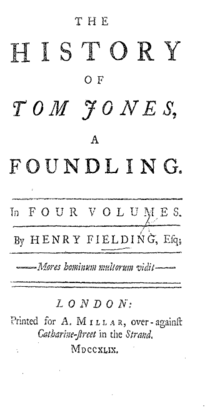
Tom Jones Original Cover

The inn Tom’s staying in is suddenly full of British soldiers and Tom spends some time socializing with them—and buys them a few beers. Making him a well-liked fellow straight-off. The serjeant tells his lieutenant that he has two new prospects—a wonderful gentleman, who’d make a great officer, and Tom, who’d do be okay to serve at the rear rank (as anyone who’s ever marched in a parade behind horses can tell you, this is not a compliment).

Amongst the two companies of soldiers are two lieutenants—the commanding officer an a French lieutenant

who had been long enough out of France to forget his own language, but not long enough in England to learn ours, so that he really spoke no language at all, and could barely make himself understood on the most ordinary occasions.

a childish line, but one that made me grin.

Not everyone gets along with Tom, the other new recruit (Northerton)starts to verbally joust with him a bit. They trade barbs, including this nice little rejoinder from Tom:

“Oh! sir,” answered Jones, “it is as possible for a man to know something without having been at school, as it is to have been at school and to know nothing.”

Things get a little heated when Northerton talks about Sophia sleeping around a lot, and things start to get physical. The “gentleman” smacks Tom with a bottle and drops him. Northerton is confined to quarters and Tom’s bleeding head wound gets him medical care.

We get a little more satirization of the medical profession–Fielding did not have much respect for doctors. I almost hope we see a few more people gravely ill or grievously injured just so we get more of this.

Tom’s been injured pretty bad three times so far–twice because of an assault. For a guy as wild has he supposedly is, he cannot take a punch.

Some shenanigans ensue around a proposed duel between the injured Tom and the assailant Northerton. Things get strange and Northerton books it.

These chapters are a bit more my liking than the last few—Fielding’s wit is easier to find, and there’s plenty of action (the former weighs more than the latter). Really, not much happened—but it was the way in that not much happened that made me enjoy these chapters.

I’m not going to talk about City of Hate by Timothy S. Miller today…

City of Hate

City of Hate

by Timothy S. Miller

PDF, 236 pg.
Goliad Media Group, 2020

Read: May 27-30, 2020
Grab a copy from your local indie bookstore!


I have spent the last two nights staring at my laptop trying to will words on to the screen to tell you about this book. And nothing is coming out. I’ve written and deleted one sentence several times, and it’s getting the best of me–and I’m more than frustrated. I think I’ll take a break tomorrow, and maybe try to write about something else. But City of Hate was published on Monday, and I received an ARC so I feel compelled to say something about it as soon as possible. So, I’m just taking a moment to say that this is a complex novel that demands thinking about before you try to say much.

In the meantime, here’s the blurb:

The Virgin Mother’s image — a moldy shadow with patches of holy light — has appeared under the Triple Underpass right next to the Grassy Knoll. The image of the Virgin Mother — so close to the site where JFK was assassinated — brings believers to pay their respects and to ponder its meaning.

But Hal Scott has more to worry about than the Virgin Mother.

Recovering alcoholic, lover of secrets, and quickly approaching middle-age, Scott discovered his best friend dead in his downtown Dallas apartment. And all fingers point to Scott as the murderer.

There is a conspiracy underway, and it’s tied to a gubernatorial campaign, illicit photographs, and a video that will undermine the election. And more than likely get Hal Scott killed.

The only one Scott can turn to is Lemon — the self-proclaimed bastard son of Lee Harvey Oswald. Lemon’s mother owns Conspiracy Books, just blocks away from the old Texas School Book Depository, and she used to dance at the Carousel Club, owned by the notorious Jack Ruby. The FBI, the CIA, and the John Birch Society all want what Lemon has discovered in her mouldering attic. What he found is bigger than them all, and there will be a price to pay for its exposure.

While I’m at it, here’s the trailer:

You’ll be hearing more about this from me soon (I hope).

The History of Tom Jones, a Foundling by Henry Fielding: BOOK VII., v.-x.

Fridays with the Foundling
Tom Jones Original CoverI assume the problem is with me, I really do. But man, oh, man—Book VII is just not clicking with me. The story’s fine, but I’m not crazy with the pacing. Fielding’s narration isn’t doing much for me, either.

So, there’s some (figurative) kissing and making up between Sophia and her father as well as her father and her aunt. Which starts to give you a dash of hope, but then Blifil and Mr. Western get their heads together and things go downhill. We’ll start with Western talking Sophia into another meeting with Blifil.

Scenes like this, when painted at large, afford, as we have observed, very little Entertainment to the Reader. Here, therefore, we shall strictly adhere to a rule of Horace; by which Writers are directed to pass over all those Matters which they despair of placing in a shining Light;—a Rule, we conceive, of excellent Use as well to the Historian as to the Poet; and which, if followed, must at least have this good Effect, that many a great Evil (for so all great Books are called) would thus be reduced to a small one.

I do appreciate him sparing us that scene.

Blifil is so determined to beat Tom that he cons both Blifil and Allworthy (the former being very predisposed to believe him) into thinking that Sophia’s come around and arrangements are made to get married the next day. Her maid overhears Western making further arrangements and informs Sophia.

Sophia considers suicide at this point, but her maid dissuades her from that. So, she decides to run away from home—she has a friend in London who’ll take her in for a bit.

We get a quick glimpse of Tom—he gets some bad directions and ends up in a different location than he’d intended. He finds himself in an inn with a Quaker gentleman distraught over his daughter’s marriage to a poor man. So, that goes over about as well as you’d think. Details about Tom’s background and circumstance are circulated amongst people at the Inn—suddenly, his Quaker friend makes himself scarce and the landlord decides that he can’t use a room. So, Tom sleeps in the dining room—where it’s easy to keep an eye on this obvious scoundrel.

Hopefully, things get a bit better (in my own mind or the book, whichever is applicable) from here. There’s still a long way to go in this book, there’s plenty of time for that.

The History of Tom Jones, a Foundling by Henry Fielding: BOOK VI., xii.-VII., iv.

Fridays with the Foundling
Tom Jones Original CoverWe start off this week seeing what Sophia was up to in around the letter Tom wrote her as he was leaving town (I really should’ve read this chapter a couple of weeks ago)—there’s not much there, but a little bit of humor involving Black George and his conscience. Mr. Western and his sister get into an argument over the way he’s raised Sophia, and he essentially gives his daughter over to her management.

We then move on to the next Book, and as usual, we begin with Fielding treating us to another digression and commentary. This time his focus is on the world as a stage. Unlike most (for example, Shakespeare), Fielding focuses not on those who strut and fret on the sage, but on the audience. Which is an interesting way to do it, you have to admit. He closes with this reminder about judging:

Upon the whole, then, the man of candour and of true understanding is never hasty to condemn. He can censure an imperfection, or even a vice, without rage against the guilty party. In a word, they are the same folly, the same childishness, the same ill-breeding, and the same ill-nature, which raise all the clamours and uproars both in life and on the stage. The worst of men generally have the words rogue and villain most in their mouths, as the lowest of all wretches are the aptest to cry out low in the pit.

With some encouragement from Blifil, Tom resolves to take to the Ocean, while the Western household is in turmoil—we get more conversations between Sophia and her aunt; Sophia and her father; her aunt and her father all about how Sophia— has to marry Blifil and her steadfast refusal to do so.

These chapters really feature a lot of talking, but very little actual communication—after the last couple of weeks, full of action, this was really quiet. It was all about setting the stage, I just hope the stage is fully set for a bit. I’m really curious about what Tom has in mind for his expedition.

Breath Like the Wind at Dawn by Devin Jacobsen: Obscure When not Vile. A book that Simply Didn’t Work for Me.

 Breath Like the Wind at Dawn

Breath Like the Wind at Dawn

by Devin Jacobsen

eARC, 208 pg.
Sagging Meniscus Press, 2020

Read: May 18-19, 2020

Let’s keep this short for everyone’s sake by kicking things off with the Publisher’s blurb

Spanning two decades, Breath Like the Wind at Dawn tells the epic story of the Tamplin family—of outlaw-twins Quinn and Irving; their brother Edward, who is on the run from a dark past; and their mother Annora, who has been left to defend their haunted Minnesota homestead. Yet at the center of the novel is Les, patriarch of the Tamplins, Civil War veteran, and sheriff of Utica, who is possessed by an indelible lust to strangle his victims. Only when the brothers set about to rob Utica’s bank will the family at last converge in an unforgettable finale when blood will be met with blood.

Combining the multi-perspective family drama of As I Lay Dying with the violent lyricism of Blood Meridian, Breath Like the Wind at Dawn brings a brave new voice to American fiction.

Of the 208 pages in this book, I’m going to estimate that maybe 15 worked for me. I didn’t connect with the prose, the characters, the story, or anything. I thought Jacobsen’s style got in his way, that attempts to be artistic rendered the text obscure; word choice (particularly when attempts were made at a vernacular) was off-putting; and the characters were lifeless (when they weren’t vile or abhorrent).

I’m just not up for enumerating my problems with the novel beyond that. I didn’t see the appeal to any of it. I’m not saying that no one will or could, but it’s incomprehensible to me that anyone would.

Disclaimer: I received this eARC from the author via Lori @ TNBBC Publicity in exchange for this post—thanks to both for this, I do appreciate the opportunity (despite what it may read like).

The History of Tom Jones, a Foundling by Henry Fielding: BOOK VI., ix.-xii.

Fridays with the Foundling
Tom Jones Original CoverWe left Sophia and Tom all but declaring their love for one another in the sweetest chapter thus far, and we rejoin the novel with a chapter called “Being of a much more tempestuous Kind than the former.” Which doesn’t bode well.

So Sophia’s aunt spills the beans to her father—it’s not just that she doesn’t care for Blifil, she’s in love with Tom—and, well:

The idea of a marriage between Jones and his daughter, had never once entered into the squire’s head, either in the warmest minutes of his affection towards that young man, or from suspicion, or on any other occasion. He did indeed consider a parity of fortune and circumstances to be physically as necessary an ingredient in marriage, as difference of sexes, or any other essential; and had no more apprehension of his daughter’s falling in love with a poor man, than with any animal of a different species.

He became, therefore, like one thunderstruck at his sister’s relation. He was, at first, incapable of making any answer, having been almost deprived of his breath by the violence of the surprize. This, however, soon returned, and, as is usual in other cases after an intermission, with redoubled force and fury.

He storms off to come give the pair a piece of his mind, but Sophia’s overcome by fear at the ruckus he makes along the way and faints. The first thing her father sees is her unconscious and he focuses on her well being, forgetting everything else. Until she’s carried away to be cared for, and then like a switch he’s back to being enraged and has to be physically restrained from Tom. It’s suggested by the Parson restraining Mr. Western that Tom get going, and he’s quick enough to agree.

The next day, Allworthy gets done listening to Blifil’s account of how well things went—because Allworthy cares about her character, not her (or her father’s) wealth, he’s pleased. When Western bursts in with a very different story. He gets Allworthy up to speed, swears up and down in a dozen ways that his “Sophy” will be cut off and left destitute if she continues to pursue Tom, threatens violence against Tom, and assures Blifil that he won’t let Sophia marry anyone else before he rushes back home to try to instill some order there.

When Allworthy and Blifil were again left together, a long silence ensued between them; all which interval the young gentleman filled up with sighs, which proceeded partly from disappointment, but more from hatred; for the success of Jones was much more grievous to him than the loss of Sophia.

Blifil takes this occasion to slander Tom, accusing him of drunken carousing while Allworthy was ill and then assaulting both Blifil and Thwackum unprovoked. Thwackum is called as a witness, who backs up that no-good, vindictive twerp (why should I pretend to be unbiased toward the creep?)

Allworthy confronts Tom and Tom agrees to the bare facts, without addressing the motivation for the fight, etc. At which point, Allworthy gives Tom a check to help him get established and kicks him out—vowing to never speak to him again. He closes the speech by saying:

there is no part of your conduct which I resent more than your ill-treatment of that good young man (meaning Blifil) who hath behaved with so much tenderness and honour towards you.”

These last words were a dose almost too bitter to be swallowed. A flood of tears now gushed from the eyes of Jones, and every faculty of speech and motion seemed to have deserted him. It was some time before he was able to obey Allworthy’s peremptory commands of departing; which he at length did, having first kissed his hands with a passion difficult to be affected, and as difficult to be described.

The reader must be very weak, if, when he considers the light in which Jones then appeared to Mr Allworthy, he should blame the rigour of his sentence. And yet all the neighbourhood, either from this weakness, or from some worse motive, condemned this justice and severity as the highest cruelty. Nay, the very persons who had before censured the good man for the kindness and tenderness shown to a bastard (his own, according to the general opinion), now cried out as loudly against turning his own child out of doors. The women especially were unanimous in taking the part of Jones, and raised more stories on the occasion than I have room, in this chapter, to set down.

One thing must not be omitted, that, in their censures on this occasion, none ever mentioned the sum contained in the paper which Allworthy gave Jones, which was no less than five hundred pounds; but all agreed that he was sent away penniless, and some said naked, from the house of his inhuman father.

Yeah, that quotation went on a bit, but I couldn’t help myself.

So, Tom (in a fit of anguish) loses his belongings (including the money), writes a farewell letter to Sophia (not wanting to drag her down with him) and gets his ol’ pal Black George to get that letter to her (via her maid). We learn that George found the money and everything else, but neglected to tell Tom that. Sophia sends a return letter warning Tom from seeing her father and vowing, “that nothing but the last violence shall ever give my hand or heart where you would be sorry to see them bestowed.”

Wow. That’s a lot of plot in a very few pages. A decent amount of fun and sets us up for the next part—which can’t be nearly as exciting, but I’m eager to see what happens.

N.B.: I went a little quote happy with this one, and wasn’t in the mood to do all the typing. So I went with a text file from Project Gutenberg–which doesn’t follow the atypical (for our eyes) capitalization that the book I use does. Makes it a little easier to read, but a little more drab.

Audiobook Catch-Up Quick Takes on Caliban’s War by James S.A. Corey, Jefferson Mays (Narrator); Heartless by Gail Carriger, Emily Gray (Narrator); Demon Born Magic by Jayne Faith, Amy Landon (Narrator); Stardust by Neil Gaiman; Dumplin’ by Julie Murphy, Eileen Stevens (Narrator); Funny, You Don’t Look Autistic by Michael McCreary; Paradise Valley by C.J. Box, Christina Delaine (Narrator)

The point of these quick takes post to catch up on my “To Write About” stack—emphasizing pithiness, not thoroughness. This is a little longer than most of these that I do, I just wanted to get caught up on my Library Book Audiobooks (I’m so thankful that I can get audio downloads from my library right now—I’d be lost without them!)

Caliban's War

Caliban’s War

by James S.A. Corey, Jefferson Mays (Narrator)
Series: The Expanse, #2
Unabridged Audiobook, 21 hrs.
Hachette Audio, 2017
Read: April 6-14, 2020
Grab a copy from your local indie bookstore!

(the official blurb)
90% of the reason I’m doing this in a Quick Take post is because if I don’t cover it in a paragraph or two, I’ll take 15 pages (or the equivalent). I’m kicking myself so hard for not jumping on each installment of this series as soon as it was published (although, if I did, I would be missing out on the audiobooks). I read the first book shortly after publication, but missed the release of this bookso before I realized it I was two novels and over a thousand pages behind, and I just couldn’t find the time to catch up.

Anyway, this might not have been the right time to listen to a novel about an unexpected, largely unknown, biological enemy of all humanity and the inexplicable reactions of several governments to itthrough the eyes of people living in fairly enclosed spaces. Still, it’s gripping, imaginative, wonderfully told and very compelling. I can’t wait to see what’s next (although, I’m pretty apprehensive of it, too). I loved the new characters and hope they stick around.
4 Stars

Heartless

Heartless

by Gail Carriger, Emily Gray (Narrator)
Series: The Parasol Protectorate, #4
Unabridged Audiobook, 11 hrs., 19 mins
Hachette Audio, 2011
Read: April 1-3, 2020
Grab a copy from your local indie bookstore!

(the official blurb)
I think I’m about over this series, but maybe it was just this novel. Alexia seemed to run around oblivious to what was going on for almost the entire booksure, it’s kind of explained by the effect “the infant inconvenience” is having on her mind, but I don’t totally buy that. (maybe that’s my maleness talking). The first couple of chapters and the little bit at the end with the newborn were the highlights for methe climactic battle sequence was fun, I just didn’t like how we got there. Still, it was a fun listen and I enjoy the characters. I hope the series finale is better.

That said, Emily Gray is a delight. I seriously cannot listen to her enough.
3 Stars

Demon Born Magics

Demon Born Magic

by Jayne Faith, Amy Landon (Narrator)
Series: Ella Grey, #4
Unabridged Audiobook, 8 hrs., and 52 mins.
Tantor Audio, 2017
Read: April 24-27, 2020
Grab a copy from your local indie bookstore!

(the official blurb)
Ella now knows where her brother is, but she’s been cut off from her power, so she can’t move on it. Due to her lack of power (and some other stuffincluding a total and inexplicable lack of due process), she loses her job. She and Damien start a private consulting business, make a Faustian deal and will deal with the consequences over most of this book and the next. Along the way, Ella learns why her brother is off the grid.

The luster has really worn off this series for me. I think it’s possible that Faith will stick the landing and I’ll be happy with the set as a whole, but I think she’s squandered a good start. If there was more than one book left, I’m not sure I’d bother.
3 Stars

Stardust

Stardust

by Neil Gaiman
Unabridged Audiobook, 6 hrs., 23 mins
HarperAudio, 2006
Read: April 28-29, 2020
Grab a copy from your local indie bookstore!

(the official blurb)
I remember being disappointed when I read the book a few years ago, because the movie version (that I love) was such a lousy adaptation. The text eventually won me over, but it took a long time. This is backward, I realize, but what are you going to do?

Anyway, I came into this audiobook with low expectations, but I wasn’t in the mood to spend money on an audiobook and everything I wanted from the library was checked out. Listening to Gaiman’s always fun, so I gave this a whirl. Between Gaiman, low expectations, knowing it’s not the movie, and a story that’s really good when you give it a chance, I had a great time.

It’s a fairy tale that isn’t. Gaiman draws on every convention, every trope and uses them the way a child uses a play-doh set.
4 Stars

Dumplin’

by Julie Murphy, Eileen Stevens (Narrator)
Series: Dumplin’, #1
Unabridged Audiobook, 9 hrs., 45 mins.
HarperAudio, 2015
Read: April 29-30, 2020
Grab a copy from your local indie bookstore!

(the official blurb)
This was just cute. Another “don’t make me spend money on audiobooks while I wait for holds to become available” listen. A YA story about a fat girl (her words, not mine) who joins her small-town beauty pagent, and the scandal that ensues. It’s almost entirely predictable, but Murphy’s style makes it feel fresh, and you just don’t care about the predictability. Steven’s narration is spot-on, too. I had a lot of fun with this.
3 Stars

Funny, You Don't Look Autistic

Funny, You Don’t Look Autistic: A Comedian’s Guide to Life on the Spectrum

by Michael McCreary
Unabridged Audiobook, 3 hrs., 37 mins
Annick Press, 2019
Read: March 31, 2020
Grab a copy from your local indie bookstore!

(the official blurb)
McCreary was five when he was diagnosed with Autism Spectrum Disorder, but it had challenged him and his parents far before then. In this short memoir, he talks about growing up with ASD and finding his place in performing and comedy. This wasn’t as funny as you might hope from a comedian’s memoir, but given that the focus of it was on the way he got through life and learning his craft while learning how to live in a neurotypical world, it’d be hard to be funny. Still, there was a light-heartedness to the entire book that made it pretty appealing.

I had plenty of fun listening to this, and gained some insight (much needed, I expect) into ASD. I think the hard copy might be a bit better because there are charts, graphs, etc. he mentions throughout (yes, there are pdf versions available on the publisher’s site, but who listens to an audiobook when they can stop and look at a pdf?).
3.5 Stars

Paradise Valley

Paradise Valley

by C. J. Box, Christina Delaine (Narrator)
Series: The Highway Quartet, #4
Unabridged Audiobook, 10 hrs., 6 mins
Recorded Books, 2017
Read: March 26-30, 2020
Grab a copy from your local indie bookstore!

(the official blurb)
Here we go. Cassie Dewell vs. The Lizard King: The Final Battle. Kyle Westergaard comes along for the ride, toobecause we can’t have a Highway novel without a young person’s perspective. A lot of other characters from the entire series make appearances (important ones), too.

This was a solidhorrifying, but solidconclusion to this arc. And it does set up a way for things to continue beyond this point.

I’m really glad that I started this series (it, too, started with a “don’t make me spend money on audiobooks while I wait for holds to become available” listen)
3.5 Stars

2020 Library Love Challenge
This post contains affiliate links. If you purchase from any of them, I will get a small commission at no additional cost to you. As always, opinions are my own.


Top 5 Saturday: Retellings That Have Stuck With Me

Top 5 Saturday Retellings

The Top 5 Saturday weekly meme was created by Amanda at Devouring Books.

Rules!

  • Share your top 5 books of the current topic—these can be books that you want to read, have read and loved, have read and hated, you can do it any way you want.
  • Tag the original post (This one!)
  • Tag 5 people (I probably won’t do this bit, play along if you want)

The Upcoming Schedule Is:

5/9/20 — Books with a Number in the Title
5/16/20 — Books by Debut Authors
5/23/20 — Books about Plants/Flowers (Can be on cover, in title or plot)
5/30/20 — Books from a Male POV


The Story of Edgar Sawtelle by David Wroblewski

A Retelling of: Hamlet by some obscure playwright

The reason I didn’t call this list “My Favorite Retellings” or something like that is this novel. I didn’t really enjoy much of this one. But man, it was gorgeously written. Before I started this blogged, I wrote a little about it on Goodreads: “Meticulously crafted, wonderfully and intricately written, fantastic characters, a world you’d love to live in, imaginative, creative, a concept so great, so well executed…aaaaaand I had to force myself to read it. I took 3 breaks from this novel, and had to drag myself back to it each time. I feel like I owe this book 5 stars because it deserves them, but I really want to give it 1.75 or so. There is no reason at all that I shouldn’t like it—people should love this work, actually. But I just didn’t.” Still, nine years later, this is the first novel that lept to mind when I started this list and I have vivid memories of a lot of the book. Can’t beat that.


Fuzzy Nation by John Scalzi

A Retelling of: Little Fuzzy by H. Beam Piper

An Avatar-esque story, that’s nowhere near as self-important and a whole lot more entertaining than the Cameron movie. Jack Holloway is a prospector on the planet Zarathustra who discovers a potentially sentient and language using species (that coincendentally are about the cutest things ever). Holloway has to figure out a way to keep the species from being wiped out by an uncaring corporation. This might actually be my favorite Scalzi novel.


Cinder by Marissa Meyer

A Retelling of: Cinderella

A YA SF re-imagining of the Cinderella story featuring a young woman with a cybernetic leg who attracts the attention of a Prince trying to help his people survive a plauge. It launches an epic series (also featuing re-tellings I could have filled this list with). I don’t know that the entire Lunar Chronicles series really delivered on the promise of this book, but I had a lot of fun with it. If you’re going to do a re-imagining, this is the way to do it.

* Jim C. Hines’ Princesses series also comes to mind at this point…maybe I should have included one of them…


Re Jane by Patricia Park

A Retelling of: Jayne Eyre by Charlotte Brontë

Brontë’s novel is one of my All-Time Desert Island Top 5 novels, and I’m a sucker for a retelling of it. This one is set in NYC in the late 1990’s. Jane Re, is a half-Korean, half-American orphan who is hired to be the au pair for a Chinese adoptee. It’s Jane Eyre and more. As I said when I posted about it, it’s a clever re-imagining, and/or a satisfying read.


The Graveyard Book

A Retelling of: The Jungle Book by Rudyard Kipling

I remember reading this to my kids years ago, and being very affected by it myself. It’s haunting, playful, creepy and heartwarming. A brilliant way to retell the story of an lone man-child in a very foreign atmosphere by beings not fit to raise one—and their efforts to help him fit in his native society.

The History of Tom Jones, a Foundling by Henry Fielding: BOOK VI., v.-viii.

Fridays with the Foundling
Tom Jones Original CoverWhile the Westerns wait for Blifil to come to call on Sophia, her aunt comes in and the two talk a bit more about Sophia’s affections, each of them (still) talking about a different man. And just when I’m starting to think we’re in for 20+ pages of this misunderstanding, Sophia asks who her aunt is referring to:

…the Aunt cried, “Mr. Blifil—ay, Mr. Blifil, of whom else have we been talking?” “Good Heavens,” answered Sophia, ready to sink, “of Mr Jones, I thought; I am sure I know no other who deserves—” “I protest,” cries the Aunt, “you frighten me in your Turn. Is it Mr. Jones, and not Mr. Blifil, who is the Object of your Affection?” “Mr. Blifil!” repeated Sophia. “Sure it is impossible you can be in earnest; if you are, I am the most miserable Woman alive.”

There’s some nasty back and forth about how horrible the idea of Blifil is to Sophia and how horrible the idea of Jones is to all that is right and just with the world, and Sophia will do what she’s told, etc. In the end, they agree that Sophia will visit with Blifil that afternoon and get be nice about it, and they’ll see what happens.

They go their separate ways, Sophia unburdens her soul to her maid (who is good enough at eavesdropping not to need it, but plays along). Mrs. Honour tells her to speak her mind to her father, who’s a good man and won’t force her to do anything. In the meantime, she saw Jones down by the river not that long ago. Sophia rushes to go meet him, but misses him because she took too long choosing the right ribbons to wear. Fielding amusingly (at least to me) comments,

—a most unfortunate Accident, from which my fair Readers will not fail to draw a very wholesome Lesson. And here I strictly forbid all Male Critics to intermeddle with a Circumstance which I have recounted only for the Sake of the Ladies, and upon which they only are at Liberty to comment.

Blifil calls upon Sophia, and it does not go well. She’s nice enough, but she’s horrified at the thought of spending time with him, so she doesn’t say a lot and leaves early. Blifil is clueless enough (and enamored of himself enough) to interpret this as shyness—she’s so overcome by being alone with a guy as awesome as he is.

He leaves feeling really good about things and makes Mr. Western feel the same way about the way things are progressing. Sophia takes her maid’s advice and tells her father what she thinks of Blifil. He does not follow the script Mrs. Honourable predicts and flies into a rage, commanding Sophia to marry Blifil or he’ll cut her off.

She’s inconsolable, he’s in a fit and the two separate. Western runs into Jones and tells him about it all, and then asks Jones to go convince Sophia to go along. That’s not at all what Jones wants to do, but he agrees, because he’ll gets the green light to go off and talk to Sophia.

Neither of them come out and declare their love for each other, but the ensuing conversation allows them both to state their interest and their mutual despising of Blifil as a mate. It’s a sweet scene, interrupted by Fielding telling us that it may have gone on too long and is about to be interrupted by something of a very different flavor and so it’ll have to be taken up in another chapter.

Obviously, whatever that is (we’ll see next week) isn’t going to go in the couple’s favor—there’s almost another 700 pages to go, they’re not going to get too many sweet moments anytime soon.

I really like the pace of these last 8 chapters, and look forward to what comes next. I just wish people could have a straightforward conversation without flying off the handle so everyone could act in a reasonable manner.

Eh, where’d be the fun in that? Bring on the talking past each other!

Page 19 of 46

Powered by WordPress & Theme by Anders Norén