Tag: General Fiction Page 34 of 46

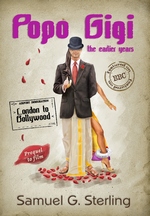
Popo Gigi: the Earlier Years: London to Bollywood by Samuel G. Sterling

Popo Gigi: the Earlier Years: London to BollywoodPopo Gigi: the Earlier Years: London to Bollywood

by Samuel G. Sterling

Kindle Edition, 596 pg.
Jolliwood Books, 2016

Read: March 31 – April 3, 2016


In circumstances difficult to explain, hard to believe, and probably meant to be comical — Popo Gigi and his twin brother, Ramyou, are born while their unwed mother emigrates from India to England. They spend years in poverty, gaining some sort of financial stability when their mother eventually marries. Ramyou is a troubled child with wild appetites (in just about every sense of the word — at least eventually), while Popo distinguishes himself academically. He eventually is admitted to, excels in and graduates from Oxbridge. Following graduation, he sets his mind to seeking some sort of understanding/closure regarding his father and his utter disregard for his twin sons. So Popo travels to India and begins a series of haphazard adventures as he attempts to meet and then bond with his father — hilarity ensues (theoretically), as does romance, a dash of danger, and more.

There is a charm to the writing that I can’t deny — even when the book seemed pointless — and even when the writing was muddled enough that I wasn’t sure what was going on (which happened a lot). Nevertheless, the it felt like sitting down and listening to a charming young man tell a long, rambling story. And, boy, do I mean rambling. Still, you can’t help but like the prose.

It’s the content of the prose that is problematic. It’s hard to believe a lot of the plot — and it’s not that easy to see the links between events that should follow each other, plot lines that are just abandoned (for chapters on end, when not totally). The “humor” is largely dependent on the kind of things I really haven’t found funny since I was in grade school — untimely erections, urine, excrement. I don’t care how many times they’re repeated, bathroom jokes just aren’t funny.

I wanted to like this, but I couldn’t. This was going to be a 2-star read for me, that I kinda felt guilty about, because of the spirit of the novel — I couldn’t help feeling affection for the style and writing, even if I didn’t like it. But the last few chapters killed that for me, it’s like they belonged to a different novel. There’s just no point to reading this book.

Disclaimer: I received this novel from Jolliwood Books in exchange for this post — I appreciate it, even if the book didn’t click for me.

—–

1 Star

Pipeliner by Shawn Hartje

PipelinerPipeliner

by Shawn Hartje

Kindle Edition, 248 pg.
Helen Springs Press, 2016

Read: March 14 – 15, 2016

I just don’t know what to say about this one. It’s a coming-of-age story about a young man in the 1990’s growing up in (what I believe is) a fictionalized Idaho Falls, Idaho. It’s arguable how much Jason Krabb actually comes of age here — you could make a pretty decent case that he regresses throughout the book.

Jason’s main goal in life is to become a rock star in Portland, OR or Seattle, WA — along the way, he’d like to have a girlfriend and party a lot. He spends a lot of time and energy becoming pretty mediocre at guitar, and hangs out with a poser who’s new to town and a couple of older friends who are more interested in scholastic success and their futures (a concept Jason can’t really wrap his brain around). He’s got an older brother studying at Princeton and dating a nursing student, a very successful mother and a less-successful father who’s browbeat by the other constantly.

The writing is uninspired and dull, there’s no life to it at all — just a dry recitation of what’s going on. To be fair, there’s a bit of flair displayed when he writes little Lake Wobegone-inspired descriptions of things from Jason’s mother’s perspective, but I never saw the point of those, they didn’t seem to add anything. The sex scenes are perfunctory and clumsy (fitting for a seventeen year-old’s initial fumblings, I guess), at least those involving Jason. The one with Jason’s parents was just . . . odd and unnecessary. There were a couple of anachronisms that bugged me, but by and large, his history is good — he captures the feeling of the time, while maybe overplaying the pre-dawn of the Internet as we know it a little bit.

Were I an LDS youth of that era, I might be offended at the depiction of both the straight-laced LDS and the backsliders. If I were someone who spent time with a lot of LDS at the time depicted in the book, I might say it was pretty accurate. Either way, it’s going to be divisive.

There’s nothing new here — stylistically, narratively, or in terms of character. It’s all cliché, it’s not original, there’s nothing here you haven’t seen before — and likely better. It’s not bad, but it’s not worth your time and effort. While reading it, I spent a lot of time annoyed by the book — but there’s nothing to rant about here. At Hartje tried to do something, but like Jason, did the bare minimum and it shows (not unlike what I did here).

Disclaimer: I received this book from the author in exchange for this post — sorry Mr. Hartje.

—–

2 1/2 Stars

Snotgirl, Vol. 1: Green Hair Don’t Care by Bryan Lee O’Malley, Leslie Hung

Snotgirl, Vol 1Snotgirl, Vol. 1: Green Hair Don’t Care

by Bryan Lee O’Malley (Script), Leslie Hung (Art)
Series: Snotgirl, #1

Trade Paperback, 144 pg.
Image Comics, 2017

Read: March 7, 2016


I don’t know what Bryan Lee O’Malley was doing here, really. Lottie Person is a fashion blogger, trend setter, and all around would-be Kardashian. She’s a little vapid, a little shallow, but pretty likable (don’t ask me how). Her actual life is a mess — she has horrible allergies — crazy horrible (hence the name), has been recently dumped, and maybe, just mayyyyybe killed somebody. She’s not sure — neither is the reader.

What follows (for about 80% of the book), is Lottie bouncing around between social engagements, possible hallucinations, and run-ins with her ex and his new girlfriend. Throw in a fashion-conscious cop and things get pretty interesting (and confusing).

I loved the art — it was a little strange to see this kind of art attached to O’Malley’s writing, but I really liked Hung’s work. Yeah, her white guys tend to look too much alike to easily tell the difference (that might be intentional) — but otherwise, I really liked it — everything jumped off the page, the drawings were filled with energy and life. Every time I thought about bailing because the story just wasn’t working, the art kept me in.

I just don’t know what to make of this — I enjoyed it, but man . . . I really wish I knew what was going on. I can handle it for a little bit longer — but not much. Volume 2 had better be a little clearer (or a little something else). I’m not going to wave potential readers off, but I’m not going to encourage anyone either.

—–

3 Stars

Legal Asylum: A Comedy by Paul Goldstein

Legal Asylum: A ComedyLegal Asylum: A Comedy

by Paul Goldstein

ARC, 284 pg.
Ankerwycke, 2017

Read: February 14 – 16, 2017


Elspeth Flowers is a career-fixated, libidinous, and conniving Dean of a state college’s Law School. She’s been working for years to put herself and her school into the prime position to launch themselves into national prominence. The School is on the verge of breaking into the Top 5 of U.S. News & World Report‘s ranking of Law Schools — a first for any state school. When that happens, the prospects for the trailblazing leader that got them there are so bright they’d inspire a song by Timbuk3. While Elspeth wants the success for the School, what she wants more than that are for her post-academia plans for herself to come to fruition. But on the cusp of her anticipated victory there are a few things that stand in her way:

  • Cuckolded Assistant Dean Jimmy James Fleenor who keeps (initially inadvertently) blocking her cunning plans.
  • An Enterprising Mail Room clerk, Wendall Ward, who just might be the most influential person we meet in these pages — definitely the most on-the-ball Mail Room clerk since Brantley Foster.
  • A federal investigation into the business practices of the school’s biggest donor.
  • A handful of secrets that are enough to get the accreditation committee to look long and hard at everything around the school.

Did I forget to mention that the ABA’s Accreditation Committee shows up days before everything is going to fall into place for Elspeth? Not just that, but thanks to circumstances and Jimmy James’ fumbling machinations, the committee is full of people who aren’t going to march to the beat of Elspeth’s drum or respond to her wiles. Their arrival shows that Elspeth’s best laid plans may look impressive (especially to her), but in reality are merely a tower of Jenga blocks threatening to topple. The question is: can she keep things standing long enough to get her Top 5 ranking and seize the brass ring — or will she find herself standing in a pile of rubble?

I like to think I learned a lot about the state of legal education today from these pages — even if the details are exaggerated for the purposes of satire there’s enough truth at the heart of them to educate the reader. Competition can drive the most cut-throat amongst us to extremes — and when the rewards for winners are what they can be in this area of academia, there’s a lot of incentive for people to get very competitive.

This is Goldstein’s fifth novel (I believe), and it looks like this is the first that isn’t a straightforward legal thriller. The experience he gained from those other novels probably served him well as he attempts to stop into another, and far trickier, genre. His characters are well-developed and well-used, his pacing is good, and he reveals plot complication after plot complication like a pro. He doesn’t go for cheap laughs and doesn’t demean the targets of his satire — nor does he pull his punches. It’s not a laugh-out-loud funny book, but it’s amusing and he’ll elicit more than the occasional grin as you read it.

One thing I’ve noticed about satirical novels is that endings are the hardest part — I’ve stopped looking for strong endings in satirical novels, I just hope for not terrible endings. Plots just tend to get away from the authors — like Soap Box Derby cars with cheap brakes on steep hills. Things in Legal Asylum threatened to get away from Goldstein, but he largely managed a satisfactory ending. I’m not 100% convinced it wasn’t more by authorial fiat than by being true to the characters (particularly Elspeth), but it was close enough that I could swallow that last chapter without much difficulty.

Do I think I’d find this more amusing if I was in the legal profession, had some experience with Law School, or was closer to my time in higher education in general? You bet. Is all of the humor lost on me because none of the above apply? Nope — and the same is likely for other readers. This is a recommended read for those who like smart books — particularly those about smart people who don’t always act like they are. Strong writing, satire that’s on-target without being mean, good characters and an ending that’s pretty satisfying — it’s hard to ask for more

Disclaimer: I received a copy of this from the author’s publicist in exchange for this post and my honest opinion.

—–

3 Stars

Pub Day Repost: All Our Wrong Todays by Elan Mastai

All Our Wrong TodaysAll Our Wrong Todays

by Elan Mastai
eARC, 384 pg.
Dutton, 2017

Read: November 21 – 23, 2016

Avery Brooks famously asked, “Where are the flying cars? I was promised flying cars! I don’t see any flying cars! Why? Why? Why?” Elan Mastai’s book finally provides the answer. Simply put: we had it — flying cars, routine space flights, robots/other tech dressing us, feeding us, doing the everyday jobs that need to be done so that humans can focus on working in labs to make the world an even better place, to make the next technological leap forward. Essentially, everything that Science Fiction of the 1950’s told us to expect, we lived in George Jetson’s world.

Until July 11, 2016 when the first time machine was turned on and things went wrong, resulting in 40 years of history being rewritten and one man — Tom Barren — was the only one to know that we are now living in a dystopia. It’s a dystopia for everyone on Earth, but Tom, that is — his life in the 2016 that we know is much better than it was in the “original” 2016. So now Tom has to decide, does he try to restore the timeline (if he can even figure out how to do so), or does he keep things the way they are?

That’s less than you can see on Goodreads/Mastai’s site/Web retailers — and yet I think I gave away too much. But really, that’s barely scratching the surface.

There’s a great mix of detail to the science (at least the ideas and theories behind it), yet keeping it at the level where we don’t get bogged down in technicalities (and kept Mastai from having to work them out) — he gets away with it by comparing it to the way that we don’t really understand how hydroelectric dams or incandescent light bulbs work.

There’s the literary equivalent to that scene from The Wire‘s 4th episode — it’s a mixture of genius and profanity and poetry. Mostly profanity.

We’re going to be talking about Elan Mastai the way we recently talked about Ernest Cline or Andy Weir next year (assuming I can predict anything) — and he deserves it. The voice grabs you right away from the humor, the honesty — the trouble with time travel grammar. I really wish that Jonathan Tropper’s endorsement of the book wasn’t right there on the front cover, because it feels like a cheat to compare Mastai to him now, but I want to. He’s got the same mix of humor, heart, drama, inspiration as Tropper, he just blends science fiction themes in with those.

Tom Barren’s a great character (a questionable person, but a great character) that you’ll love spending time with. There are really a lot of great characters here, but he’s the only one I feel safe discussing. There are characters with warts, strengths, weaknesses, courage, bravery, humanity in all shapes and sizes — some noble, some despicable, some pathetic. As is frequently the case, seeing multiple versions of the same characters in the various timelines tells you a lot about the people and/or worlds they live in.

Tom’s father, the one who developed the time machine — has some fantastic theories about time travel — it’s not just about time, it’s about space (between the earth’s rotation, movement through space, etc.), and for time travel to be really possible, both have to be addressed. Not only does it clear the TARDIS from every critique of time travelers/machines mentioned in the book, but it’s a really, really good point.

It’s one of those magic books that you don’t want to end, because you’ll have to leave the characters and world — but that you can’t get through fast enough because you just have to know how it turns out.
Is it flawless? No, I’m sure it’s not, but unlike ever other book I’ve read this year (including the ones I’ve loved), I can’t think of a single problem. That says a lot to me.

I have not been able to stop talking about this book for a week now — I think my wife and kids have started ignoring me when I bring it up. All Our Wrong Todays is a book that practically demands over-hyping — it’s only a huge amount of restraint that keeps me from spilling everything. I have a list of people I want to buy this for (started compiling it when I was about 10% finished), and the list is currently long enough now that I wouldn’t be able to buy any books for myself until June 2017 — so, sorry everyone, buy your own.

I don’t know if I’ll be able to watch/read more time travel again — especially time travel involving love stories — but man, it’s absolutely worth it if this was my last. Pre-order this one now so that you can dive into it as soon as possible.

—–

5 Stars

Disclaimer: I received this eARC from Dutton via NetGalley in exchange for this post — thanks to both for this.

Today Will Be Different by Maria Semple

Today Will Be DifferentToday Will Be Different

by Maria Semple

Hardcover, 255 pg.
Little, Brown and Company, 2016

Read: December 2 – 3, 2016


It is 100% completely unfair to compare this book with Semple’s previous novel, Where’d You Go, Bernadette — but, man — it’s hard not to. The protagonists, their lifestyles, their problems, their families, their children’s schools, their problems, what got them to Seattle and the career’s they left behind — they all beg comparison. But I’m going to try not to — and it’ll be to Today‘s benefit if I can pull that off.

Here’s the problem with the book — well, the main one — it’s there in the title, Today. It takes place over a day, no real change, no real resolution, no real anything can happen in a day. You can resolve to make changes, you can take steps towards anything happening. But real lasting whatever takes time. Not that you can’t have a good novel in that time frame, but not this kind of novel.

The pluses? The storyline about Eleanor’s sister — there were so many ways this could’ve gone wrong, become cliché, or turned into a mere punchline. It’s uncomfortable, it’s troubling, and it’s real. Eleanor’s kid, Timby was interesting and I enjoyed his relationship with her ex-colleague. Most of all, it’s the voice. Eleanor’s voice is strong, it’s developed, it’s clear, and there’s a confidence to her (while realizing she’s a giant mess).

But that ending? I could write pages about how bad it was.

In the end, while reading Today Will be Different, I had a blast and was hooked throughout — it was funny, tragic, thoughtful, painful. But the instant that I closed the book, all I could think of was how many things I didn’t like and problems I had with the story. It’s not just because Eleanor’s story was different from Bernadette’s — I was relieved, by that — but that this one didn’t deliver what it could have.

—–

3.5 Stars

The Flight of the Pickerings by John Grayson Heide

The Flight of the PickeringsThe Flight of the Pickerings

by John Grayson Heide

Kindle Edition, 324 pg.
2016

Read: December 14 – 17, 2016

Time and innocence don’t dance together for long.

Guy and Dorothy Pickering have known each other for sixty years and change — they might not have been the closest of friends as kids, but they were constant presences in each others’ lives. Eventually, they married and have spent the intervening years building their lives and family together. But time, cancer and dementia have taken their toll, and Dorothy doesn’t have much time left on earth.

Guy’s not willing to turn her care over strangers — or even their daughter — but he doesn’t know how to handle things. It’s not long before he finds himself asking his cat, “How the hell do you kill your wife?” Not knowing why he’d need to stick around without her, and begins coming up with plans that will kill them both. So the readers get to see the beginning of their relationship in flashbacks while Guy tries to design and execute the end of it.

Which was a great combination of heart-warming and tragic — making the odd dose of whimsy here and there seem out of place. Heide shows us the thoughts/commentary of the vehicles and animals Guy encounters. It was a choice that, while amusing, made no sense to me.

And then Guy’s grandson, a teenager rebelling against everyone in reaction to his parents’ divorce (and his age), comes to stay with them (not that anyone bothered to consult Guy about this). From almost the instant that Tory showed up, things start to change — the chip on his shoulder beings to get filled in, Guy gets to care for someone other than Dorothy, and things start to spiral out of control.

What is it about fiction set in Florida? I’m sure I’ve read a fairly straightforward book set in the state, but I can’t think of one. In my experience, at a certain point, plotlines in Florida become the fictional equivalent of reductio ad absurdum — between a nosy neighbor, an unsympathetic police officer, a petty airport manager, biker gang, shuttle launch, would-be star reporter, and some heavy-duty “medicinal” brownies (among many other things) — this sweetly tragic story is surrounded by laugh-inducing goofiness.

Yet but none of the extremes in tone ever take over — how Heide pulls this off, I’m not sure. I wish more people could. I’m not for a second going to say that I agree with Heide’s agenda — beyond wanting people to talk about end of life issues — but he told this story in a compelling, sympathetic and entertaining way. I spent the first few chapters just dreading finishing this — I liked these people, and didn’t relish seeing them go through the pain ahead (particularly as I got to know them better in the flashbacks). But I ended up really enjoying this book. Give this one a shot.

Disclaimer: I received this novel from the author in exchange for my honest opinion, which did not influence anything I said, or even when I read the book. Sorry it took so long, Mr. Heide.

—–

3 Stars

All Our Wrong Todays by Elan Mastai

All Our Wrong TodaysAll Our Wrong Todays

by Elan Mastai
eARC, 384 pg.
Dutton, 2017

Read: November 21 – 23, 2016

Avery Brooks famously asked, “Where are the flying cars? I was promised flying cars! I don’t see any flying cars! Why? Why? Why?” Elan Mastai’s book finally provides the answer. Simply put: we had it — flying cars, routine space flights, robots/other tech dressing us, feeding us, doing the everyday jobs that need to be done so that humans can focus on working in labs to make the world an even better place, to make the next technological leap forward. Essentially, everything that Science Fiction of the 1950’s told us to expect, we lived in George Jetson’s world.

Until July 11, 2016 when the first time machine was turned on and things went wrong, resulting in 40 years of history being rewritten and one man — Tom Barren — was the only one to know that we are now living in a dystopia. It’s a dystopia for everyone on Earth, but Tom, that is — his life in the 2016 that we know is much better than it was in the “original” 2016. So now Tom has to decide, does he try to restore the timeline (if he can even figure out how to do so), or does he keep things the way they are?

That’s less than you can see on Goodreads/Mastai’s site/Web retailers — and yet I think I gave away too much. But really, that’s barely scratching the surface.

There’s a great mix of detail to the science (at least the ideas and theories behind it), yet keeping it at the level where we don’t get bogged down in technicalities (and kept Mastai from having to work them out) — he gets away with it by comparing it to the way that we don’t really understand how hydroelectric dams or incandescent light bulbs work.

There’s the literary equivalent to that scene from The Wire‘s 4th episode — it’s a mixture of genius and profanity and poetry. Mostly profanity.

We’re going to be talking about Elan Mastai the way we recently talked about Ernest Cline or Andy Weir next year (assuming I can predict anything) — and he deserves it. The voice grabs you right away from the humor, the honesty — the trouble with time travel grammar. I really wish that Jonathan Tropper’s endorsement of the book wasn’t right there on the front cover, because it feels like a cheat to compare Mastai to him now, but I want to. He’s got the same mix of humor, heart, drama, inspiration as Tropper, he just blends science fiction themes in with those. 

Tom Barren’s a great character (a questionable person, but a great character) that you’ll love spending time with. There are really a lot of great characters here, but he’s the only one I feel safe discussing. There are characters with warts, strengths, weaknesses, courage, bravery, humanity in all shapes and sizes — some noble, some despicable, some pathetic. As is frequently the case, seeing multiple versions of the same characters in the various timelines tells you a lot about the people and/or worlds they live in.

Tom’s father, the one who developed the time machine — has some fantastic theories about time travel — it’s not just about time, it’s about space (between the earth’s rotation, movement through space, etc.), and for time travel to be really possible, both have to be addressed. Not only does it clear the TARDIS from every critique of time travelers/machines mentioned in the book, but it’s a really, really good point.

It’s one of those magic books that you don’t want to end, because you’ll have to leave the characters and world — but that you can’t get through fast enough because you just have to know how it turns out.
Is it flawless? No, I’m sure it’s not, but unlike ever other book I’ve read this year (including the ones I’ve loved), I can’t think of a single problem. That says a lot to me.

I have not been able to stop talking about this book for a week now — I think my wife and kids have started ignoring me when I bring it up. All Our Wrong Todays is a book that practically demands over-hyping — it’s only a huge amount of restraint that keeps me from spilling everything. I have a list of people I want to buy this for (started compiling it when I was about 10% finished), and the list is currently long enough now that I wouldn’t be able to buy any books for myself until June 2017 — so, sorry everyone, buy your own.

I don’t know if I’ll be able to watch/read more time travel again — especially time travel involving love stories — but man, it’s absolutely worth it if this was my last. Pre-order this one now so that you can dive into it as soon as possible.

—–

5 Stars

Disclaimer: I received this eARC from Dutton via NetGalley in exchange for this post — thanks to both for this.

‏Eleanor & Park (Audiobook) by Rainbow Rowell, Rebecca Lowman, Sunil Malhotra

Eleanor & ParkEleanor & Park

by Rainbow Rowell, Rebecca Lowman & Sunil Malhotra (Narrators)

Unabridged Audiobook, 8 hrs., 57 min.
Listening Library (Audio), 2013
Read: May 31 – June 1, 2016


Okay, so yesterday I talked about a book that was hurt by the audio narration — this is one that’s helped by it (but not much, because it really doesn’t need much). I read this back when it came out, and gave it 4 Stars — which boggles my mind, was I a harsher grader back then? I remembered liking it more than that, though. Anyway, this audiobook is the perfect example of what the medium can be.

It perfectly captured the flavor, the emotion and the detail of the original. Now, it didn’t become all about the performance, the narrators brought the words to life, but not at the expense of the text.

Lowman and Malhotra were spectacular — they were Eleanore and Park. You fall for them while the characters were falling for each other, and when they expressed emotion, you certainly felt it. Well, I don’t know about “you,” but definitely me.

I’m really not sure what else I can say. This is a perfect story about first love, how it defines who you are in a way you didn’t expect — how it reveals the best of you and improves the worst of you. Using these two social misfits to tell this story grounds it in a way that the Prom King and Queen couldn’t — I just loved it. It’s probably the best thing Rowell’s done, and it’s one of the best audiobooks I’ve ever heard.

—–

5 Stars

United States of Books – Spartina by John Casey

SpartinaSpartina

by John Casey

Author: Laura at 125Pages

This week takes us to Rhode Island with Spartina by John Casey.

Entertainment Weekly says – Dick Pierce works in Narragansett Bay, but his true passion is is the unfinished boat in his backyard. The tale may be standard, but Casey’s lyrical descriptions of the Rhode Island sea are anything but.

“If Rhode Island were a country, it would be part of the Third World. The largest employer is the military. Tourism is the major moneymaker, although most Rhode Islanders benefit from it only in service positions. The bulk of choice real estate is in the form of second homes or resorts run by absentee corporations. “There is a seafaring tradition, and there is—still—a fishing fleet. By comparison to the high-tech factory ships of Russia, East or West Germany, Japan, or the tuna clippers of our own West Coast, the boats and methods are quaint. But it is still possible—barely possible—to wrest a living from the sea.”

Spartina is one of those books that should be a total winner. Poetic writing, vivid descriptions, a real world to sink into.

A blue heron wading in the marsh on her stilts, apparently out for a stroll—suddenly freezing. An imperceptible tilt of her head—her long neck cocking without moving. No, nothing this time. Wade, pose. Abruptly, a new picture—a fish bisected by her bisected beak. Widening ripples, but the heron, the pool, the marsh, the sky serene. The clouds slid across the light, the fish into the dark.

Unfortunately, the main character Dick Pierce was just an ass. He was at first a crusty older man and I was fine with that. He had very much of a him versus the world attitude and believed that anyone from money was to be looked down at. He ran some cons and did a few shady deals, but he did it to support his wife and children. Nothing wrong with that, he was doing his best to survive. Then the story took an turn and I lost all respect for good ol’ Dick. He began to match his name and started a torrid affair with a woman in the neighborhood. First, I hate when adultery is used as a plot point. I have no patience with it and hate reading about it. Second, he had absolutely no remorse about his actions. He did not care if he was going to hurt the woman he promised to cherish or his children. Other stuff happened that was interesting, but I could not move past my hatred of Dick to enjoy the story. In the end he sadly did not get the comeuppance he should have and Dick continued to be just that as he sailed off into the sunset.

3 Stars
See all of the United States of Books here.

Page 34 of 46

Powered by WordPress & Theme by Anders Norén