Tag: General Fiction Page 37 of 46

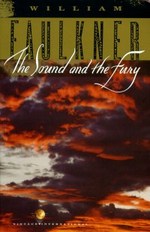
United States of Books – The Sound and the Fury by William Faulkner

The Sound and the FuryThe Sound and the Fury

by William Faulkner

Paperback, 321 pg.
Vintage, 1929


Wow, it took like 2 minutes for me to remember just how much work this guy is to read. This is not the kind of book you take to the breakroom at work for a few minutes during lunch. The Sound and the Fury, like all of Faulkner that I can remember, takes work. You have to think — especially here in Part 1. Don’t get me wrong, Part 2 is no walk in the park, but Benjy’s narration is just so difficult to wade through given his cognitive ability.

Maybe I should back up a bit — this is the story of the fall of the Compson family — a great Southern family from Jefferson, MS, through (primarily) various stream of consciousness points of view. Part 1 is told through the point of view of Benjy. Benjy is 33 year-old developmentally disabled man, and his section is almost impossible to follow. There’s no chronological sense to it, it’s impossible to follow on first read as Benjy talks about a variety of events over the course of his life. Which is not to say there’s not a certain poetry, a power to it. But man . . .

Part 2 is possibly more difficult to understand, honestly, despite being told from Benjy’s older brother’s POV. But I don’t want to talk about the details — I just hate spoilers (even if you’ve had around 90 years to catch up). There are other POVs (including — thankfully, an omniscient third-person).

The plot is one thing — the experience of reading the novel is another. You want to know the power of the English language? Read William Faulkner. I don’t know what else to say. I’m not sure I’m equipped to talk about this, really — P.I.s, wizards, werewolves, dogs? Sure. The kind of thing that wins Nobel Prizes? That’s just beyond me. This is the stuff of history — of legend, really.

There is horrible language used throughout — the kind of thing that gets books banned from schools and classrooms, so if you’re easily offended, skip this. But it’s how people talked (still do), it’s honest, it’s brutal, it’s ugly, it’s human.

This is not my favorite novel by Faulkner — nor is it something I recommend to someone who’s never read the man before (maybe, As I Lay Dying?). That said, it’s full of fantastic writing, insights into the human condition, strange southerners, tragedy, and complexity that I cannot describe. Faulkner, as always, stands so far above the pack that it’s almost not fair to other books. Of course, 5 stars, how could it be anything else?

—–

5 Stars

A Few Quick Questions With…Tiffany McDaniel

I’ve really enjoyed my email correspondence with Tiffany McDaniel — she’s charming, friendly, and can laugh at herself. Even if I didn’t spend a couple of days under the spell of her words, I’d want her to find success with this first publication. Here’s a lil’ Q&A we did this week. As usual, I kept it short and sweet, because I’d rather she work on her next book than take too much time with me.

1. Tell me a little about your road to publication.
It was a long road, twisty and dark with the type of rocks perfectly-sized to leave a billion wounds to scar over on my soul. Perhaps too dramatic, but I wrote my first novel when I was eighteen-years-old. I wouldn’t get a publishing contract until I was twenty-nine for The Summer that Melted Everything, which isn’t my first written novel. So it was an eleven-year struggle, hence the dramatics. With all the rejection, I came to believe I would never be published. I thought I’d leave this world with my ghost moaning in defeat. I know I’m very fortunate to be in the position I am now, about to see my book on the shelf. It’s been moving through the publishing house for two years, so with all the years added up, I’ve been waiting thirteen long years to see one of my books on the shelf. July 26th is going to be a very special day indeed. I feel as if I might sprout wings, or something equally magical will happen. Truly I’ll probably just spend the day in the bookstore, staring at my book and smiling.
2. What’s the one (or two) book/movie/show in the last 5 years that made you say, “I wish I’d written that.”?
There are so many books I love. Not necessarily in the last five years. Coming to mind, Dandelion Wine by Ray Bradbury, We Have Always Lived in the Castle by Shirley Jackson, The Secret History by Donna Tartt, Bluest Eye by Toni Morrison. But what makes these books, and every book special is the fact that they were written by these very people. Every book has its true author. The stories and characters belong to them. There’s no book I wish I would have written, because their true author has already written it so much better than I ever could.
3. I know that most authors would say that names of characters are important — but yours seem more important than usual, and steeped in meaning. Can you talk a little about your naming process? Alvernine, Grand, Dresden, Fielding — all are great. Be as general as you want, except for Autopsy, I’ve got to know, beyond the meaning — why name someone that?
For me, my characters are real people. These are their true names. They are their names long before I’ve put them down on paper. My job as the author is to listen to the characters. In the case of Autopsy’s name, I had seen the word “autopsy” that day I was trying to know him. I really do feel like these are the hints to me from the characters. Autopsy was telling me his name. As they all do. I just have to listen. I always say I’m surprised myself how the story comes out. That’s true. So when Autopsy was typed there on the page, I didn’t yet know how massive a theme that was going to be in the novel. I had yet to see for myself . . .
4. I don’t want to ask where you get your ideas, but how did you get to the point where you said, “You know what I want to write about? Satan’s summer vacation.”
First off, I love that last line of yours: “Satan’s summer vacation.” Perfect.

I always say my ideas come from the elements that make me. That somewhere in the chaotic clouds swirling in my atmosphere to the calm rivers coursing down my soul, there exists the source of my ideas. As it exists for every author. That’s a rather intense answer. But creativity is intense. It’s chaos and order, a big bang and a small tap. All these things turning, turning, until the wheel is rolling, the story rolling with it, getting to the point when the story is ready to come out.

5. I know you’re neck deep (at least) in promotion for this book, but what’s next for Tiffany McDaniel?
I have eight completed novels. I’m currently working on my ninth. The novel I’m hoping to follow The Summer that Melted Everything up with is When Lions Stood as Men. It’s the story of a Jewish brother and sister who escape Nazi Germany, flee across the Atlantic Ocean and end up in my land of Ohio. While here they create their own camp of judgment where they serve as both the guards and the prisoners. It’s a story about surviving guilt, love, and the time when lions did indeed once stand as men.
Thanks so much for your time, and I hope your launch week meets with a lot of success.

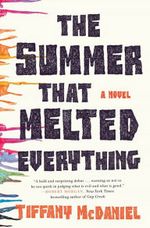
The Summer that Melted Everything by Tiffany McDaniel

The Summer that Melted EverythingThe Summer that Melted Everything

by Tiffany McDaniel

eARC, 320 pg.
St. Martin’s Press, 2016

Read: July 18 – 19, 2016

The greatest trick the Devil ever pulled was convincing the world he didn’t exist.

Yeah, Keyser Söze’s paraphrase of C. S. Lewis’ appropriation of Charles Baudelaire isn’t part of this book, but it might just encapsulate it. Maybe.

It’s the summer of 1984 in Breathed, OH, and it’s hot. Really hot — and about to get a lot hotter. 1984 is a big year — HIV is identified as the virus that leads to AIDS, Apple releases the Macintosh, Michael Jackson’s Pepsi commercial shoot, and the following advertisement runs in the local newspaper, The Breathian:

Dear Mr. Devil, Sir Satan, Lord Lucifer, and all other crosses you bear,

I cordially invite you to Breathed, Ohio. Land of hills and hay bales, of sinners and forgivers.

May you come in peace.

With great faith,
Autopsy Bliss

Autopsy Bliss is the local prosecutor, who wants to see for himself what evil looks like. Hence the advertisement.

So who shows up in response? A bruised, short black boy dressed in tattered and torn overalls who simply seems to want some ice cream and to say hi to the man who invited him. Autopsy’s son, Fielding, is the first one in town to meet the boy and takes him home to his father (sadly, no ice cream is available in town — unbelievably — for the remainder of the Summer). The Bliss family ends up taking the lad in, and starts calling him Sal. He and Fielding become fast friends and are almost inseparable for the rest of the summer. One by one, almost everyone in this sleepy community is touched by the appearance of Sal — either first-hand or by proxy — demons (figurative), troubled family and personal histories are exposed, latent corruptions come to light, and accidents strike many. No one in Breathed will be the same after the day Sal first appears to Fielding.

The book is narrated by Fielding about 70 years after that summer looking back on the time, thinking of all the regrets he’s had since then and all the ways his time with Sal has overshadowed the ensuing decades. It honestly reminded me of A Prayer for Owen Meany because of this — little kid who talks oddly, is smarter than any of his (apparent) peers, and divides a community, while leaving an indelible mark on his closest friend (who’s not always a friend).

Almost every name (maybe every name, and I’m not clever enough to get it all) is rich in meaning and symbolism — there’s symbolism all over the place, but McDaniel gets her money’s worth with the names in particular. This book will reward close readings, and probably repeated readings as well.

There are so many depictions and descriptions of child abuse and spousal abuse that it’s almost impossible to believe that there households in that world where someone isn’t getting hit on a pretty regular basis. Thankfully, we’re spared watching characters going through it (the vast majority of the time), but there are many mentions of it.

This is not fun read, really, but I loved the whole experience, it is a rewarding read. McDaniel writes with such richness, such depth, there are phrases throughout this that will knock you out. There’s one sentence that I went back to at least a half-a-dozen times one evening — not because I needed to try to suss it out, but because I just liked it so much. The variety of ways she can describe the horrible and debilitating heat wave that struck that part of Ohio those months is pretty astounding — I’m just glad I had some sort of air conditioning most of the time I spent reading the book. Sal’s descriptions of Hell and his fellow prisoners there are full of haunting images that will stick with me for a while (some good haunting, some less-so). I’m troubled by some of what this book said about God, but since the Devil is the one who told about God, I’m not sure we’re supposed to trust his characterizations. On the other hand, just about everything that the book says about the devil seems to be spot-on.

There are no easy answers to be found here — is Sal the devil? Is someone else in town? Is there a devil at all? Are the naturalistic explanations offered here and there throughout enough? I just don’t think you can think about this book without dealing with the Baudelaire/Lewis/Söze thought.

Can’t help but wonder how things would’ve gone if he’d just gotten a little ice cream.

Disclaimer:I received this eARC via NetGalley at the author’s invitation in return for this post. My thanks to NetGalley, St. Martin’s Press, and Tiffany McDaniel for this.
N.B.: As this was an ARC, any quotations above may be changed in the published work — I will endeavor to verify them as soon as possible.

The Summer That Melted Everything Book Trailer

This book comes out next week, and I’ll hopefully have a post up here tomorrow about it — and a Q&A with the author. Think about getting your hands on the book soon. In the meantime, enjoy this trailer.

United States of Books – In Country (Audiobook) by Bobbie Ann Mason, Jill Brennan

In CountryIn Country

by Bobbie Ann Mason, Jill Brennan (Narrator)

Author: Teri at Sportochick’s Musings

Synopsis:

The bestselling novel and deeply affecting story of a young girl who comes to terms with her father’s death in Vietnam two decades earlier.

In the summer of 1984, the war in Vietnam came home to Sam Hughes, whose father was killed there before she was born. The soldier-boy in the picture never changed. In a way that made him dependable. But he seemed so innocent. “Astronauts have been to the moon,” she blurted out to the picture. “You missed Watergate. I was in the second grade.”

She stared at the picture, squinting her eyes, as if she expected it to come to life. But Dwayne had died with his secrets. Emmett was walking around with his. Anyone who survived Vietnam seemed to regard it as something personal and embarrassing. Granddad had said they were embarrassed that they were still alive. “I guess you’re not embarrassed,” she said to the picture.

Review:

In Country takes place in Hopewell, Kentucky and is the story of recent high school graduate Sam and her Uncle Emmett, a Viet Nam war vet. Sam is searching for the answers to the past regarding her dad and why her Uncle is so messed up. Emmett is just trying to survive and live one day at a time after returning broken from Viet Nam.

Sam has a strong desire to know more about the father she never meet, a farm boy, who went to Vietnam and never came back. So she begins her search by asking any one she knows about her dad. There is a point where I felt she would drive me crazy with the persistent questions but the author smooths out this roughness with resolutions to some questions via talking to her paternal grandparents and her mother Irene. Through a series of letters and a diary she finds answers that bring her peace and upheaval as well. This upheaval causes her to be able to finally make a decision on how to move forward with her life.

Another part of the story that drove me crazy was her constantly hounding her Uncle about all the things she felt was wrong with him medically. I understand her love for him and her desire for him to not die but yikes the constant harping what was wrong with him was too much. She was a hypochondriac for him.

Emmet and some of his war friends portray an intricate part to the story with their inability to have relationships, work, and socialize plus their various health issues. But also added to the story were other war vets that were able to have normal lives. This balance greatly added to the story and it’s correctness to real life. The scene where Tom, a war vet, spent time with Sam was painful and sad causing me to wonder was there ever a time after that that he was able to love someone and be fulfilled.

At one point in the book Emmet says, “There’s something wrong with me. I’m damaged.” that I started to cry. There was overwhelming pain for all of them and grief for my part in disassociating myself from this area of life. It dawned on me that we were all damaged in some way from this war.

    My Thoughts:

  • US involvement for the Vietnam War lasted from 1955-1973 and consisted of approximately 58,200 Americans deaths and over 300,000 wounded.
  • In 1973 the military draft (only for males) ends and an all-volunteer military is formed creating opportunities for women.
  • In 1973 I graduated from high school with no good thoughts about our involvement in the Vietnam War. I lived through my friends’ fear of being drafted, death of loved ones, draft evasion, war protest, and the burning of college campuses. For me I disassociated myself from this war like many others and to this day I am ashamed to say I don’t get it. What I do get is how poorly we as a people and government treated the returning military.

This book caused me to think and open my mind to a time in my life that I had shutdown.

But it is much more than that for me; it brought forefront in my mind the suffering of the returning vets in regards to their families, health, mental wellbeing, as well as how the government and society in general treated them. This book profoundly affected me.

Though this book and its narration may not be for everyone, I listened to it three times because of its impact to me and how it caused me to see things from a new perspective. For this reason I give it 4 STARS.

United States of Books – The Witch of Blackbird Pond by Elizabeth George Speare

The Witch of Blackbird PondThe Witch of Blackbird Pond

by Elizabeth George Speare

Author: Wendy at booklovercircumspect4

Synopsis from Goodreads

Orphaned Kit Tyler knows, as she gazes for the first time at the cold, bleak shores of Connecticut Colony, that her new home will never be like the shimmering Caribbean island she left behind. In her relatives’ stern Puritan community, she feels like a tropical bird that has flown to the wrong part of the world, a bird that is now caged and lonely. The only place where Kit feels completely free is in the meadows, where she enjoys the company of the old Quaker woman known as the Witch of Blackbird Pond, and on occasion, her young sailor friend Nat. But when Kit’s friendship with the “witch” is discovered, Kit is faced with suspicion, fear, and anger. She herself is accused of witchcraft!

Review

The Witch of Blackbird Pond is an historical novel and a love story. The main character, Kit, was raised by her grandfather in Barbados. When her grandfather dies, she leaves Barbados on a ship named the Dolphin to find her aunt and uncle in Connecticut. Needless to say, her aunt and uncle doesn’t know that she is coming.

Upon her arrival to her Aunt Rachel and Uncle Mercy’s home in Wethersfield, Connecticut, where she also has two cousins, Mercy (who is handicapped) and Judith. Kit’s life is far different from her life in Barbados, where she is forced to do chores and attend church, which she clearly hates. Kit becomes happier when she and Mercy began teaching the younger children in her town. An incident happens at the school and it is shut down, and Kit runs away and she meets Hannah Tupper, an older lady that has been outlawed from the colony. While visiting Hannah, she again runs into Nat Eaton, son of the captain of the Dolphin, and Kat falls in love with him.

A deadly illness sweeps through the town and Hannah is accused of being a witch and is to be killed. Kit warns Hannah who escapes with the help Nat and his boat. The town is also accusing Kit of being a witch and she must prove her innocence when Nat returns to Westherfield.

Does Nat return help Kit? Is Kit found to be a witch? Or is she able to escape Connecticut and return to Barbados? You will have to read the book.

I give this book three out of four onions. This book is rich in American history and is a commonly read book for older grade schoolers. It also has a nice mixture of romance, politics and suspense. It really is a good read especially for young adults.

Where’d You Go, Bernadette (Audiobook) by Maria Semple , Kathleen Wilhoite

Where'd You Go, BernadetteWhere’d You Go, Bernadette

by Maria Semple, Kathleen Wilhoite (Narrator)

Unabridged Audiobook, 9 hrs and 39 mins
Hachette Audio, 2012
Read: June 10 – 13, 2016


For whatever reason, when I talked about this book last time, it had been months after I read it, and I could’ve done better. I’m not sure that I’ll fix that now, but you never know . . .

First thing you’ve got to know about this book is that it’s funny. Flat out funny. Some of it may not come across that way when you read it, actually, I think it’d be pretty easy to think this is a serious novel about a disturbed or tragic woman. But you’d be wrong to think that (and probably wouldn’t like the book at all).

Sure, it’s clear that something went wrong with Bernadette in the past, and that she’s still dealing (or, better, not dealing) with it. But that doesn’t stop things from being hilarious as she struggles with leaving the house, fighting with the neighbor ladies/moms from school.

Her daughter, Bee, is great. She’s a tribute to brainy-daughters everywhere — her understanding of and devotion to her mom is what humanizes Bernadette. After her mother goes missing, she compiles emails, articles, and other documents from a variety of sources to explain the last few months and put everything into context. I wasn’t sure this aspect of it would translate into audiobook — or be understandable. It was perfect. More on that in a moment.

The story is compelling, heartwarming, and funny (more funny the second time around, it turns out). It’s one of my favorite books from the last few years. Either version is well worth the time.

What made me give this a higher rating this time? Well, I had a clearer idea about the whole thing and could just enjoy the ride. But mostly, it was Kathleen Wilhoite (and boy did I ever feel stupid for not recognizing her voice once I googled the name). The accents, the voices, the emotions, the mirth — the heart and soul — she put into her performance blew me away and made the whole thing more compelling than Semple did (which is saying something). Again, that she was able to take the strange format of the book and make it easy to track with the various “sources” Bee used. Really, just a great audio performance.

—–

4 1/2 Stars

United States of Books – The Wapshot Chronicle by John Cheever

The Wapshot ChronicleThe Wapshot Chronicle

by John Cheever

Author: Elisha at Rainy Day Reviews

Entertainment Weekly says – Cheever’s glorious 1957 debut novel about a decidedly unconventional Massachusetts family was an instant classic, combining both humor and pathos in equal doses. It was also the first Book of the Month club pick that used the F-word.

Synopsis:

When The Wapshot Chronicle was published in 1957, John Cheever was already recognized as a writer of superb short stories. But The Wapshot Chronicle, which won the 1958 National Book Award, established him as a major novelist.

Based in part on Cheever’s adolescence in New England, the novel follows the destinies of the impecunious and wildly eccentric Wapshots of St. Botolphs, a quintessential Massachusetts fishing village. Here are the stories of Captain Leander Wapshot, venerable sea dog and would-be suicide; of his licentious older son, Moses; and of Moses’ adoring and errant younger brother, Coverly. Tragic and funny, ribald and splendidly picaresque, The Wapshot Chronicle is a family narrative in the tradition of Trollope, Dickens, and Henry James.

Review:

I was hesitant to read this book even though the author is obviously talented, because the title threw me for a loop. However, the author proves himself to be quite the eloquent and talented writer. You can tell the timeframe of this book by not only the syntax but by how and why Cheever framed the story.

There were themes within this book that were very relatable to any family in this story. Even in today’s modern and fast paced world, and I think that takes some talent when this story was not written for today’s world because our world today was only thought about futuristically. I enjoyed the fact that Cheever gives the reader a chance to get to know the characters within the story without giving it all away and instead lets us read the characters and learn about them and what makes them an individual through our reading.

I was surprised to see quite a bit of lust and fantasizing in the story, but it wasn’t graphic. But I also found that perhaps lust was equated to love in this story. Because of this, whenever a person was fulfilled in their love, I found myself smiling. The older wealthy ladies on the other hand, Honora for example, I found a little irritating. Their way of thinking is almost the exact opposite of mine and because of this I would find it difficult and challenging to be around them on a daily basis.

I would recommend this story, not simply because it is a classic but, because the story between Captain Leander Wapshot and his sons as well as Lender’s diary, make this a very interesting read.

United States of Books – Lonesome Dove by Larry McMurtry

Lonesome Dove Lonesome Dove

by Larry McMurtry

Author: C.H. Armstrong at C.H. Armstrong Books & Blog

When I learned I would have the pleasure of reviewing Larry McMurtry’s Lonesome Dove, I quite literally did a fist pump of victory. Simply stated, this is one of my all-time favorite novels, and one of the very few I would consider reading more than once. For that reason, I’ll not beat around the bush: I enthusiastically give this novel a full 5-star review. If I could give it more than 5-stars, I most certainly would.

So what’s it about?

I asked this question of those who originally recommended it to me, and the answer I received didn’t inspire enthusiastic thoughts: It’s the story about a bunch of old cowboys who go on a cattle drive.

Huh? How is that even remotely interesting? Why would I want to read about a cattle drive?

The answer is this: Just do it. I promise: You won’t be sorry.

Lonesome Dove is about a cattle drive, but it’s more than that. It’s about the strong ties of friendship between two former Texas Rangers, Captain August “Gus” McCrae and Captain Woodrow F. Call, two men who couldn’t be more different. While Call is stoic and serious, McCrae is often seen as more laid back and carefree. But the truth is that the two men, for all of their differences, are like yen and yang or two sides of the same coin. It’s almost a love story without the romance element. They complement each other and, while they seem to have nothing at all in common, they are simply not the same without the other.

Besides the main characters is a series of supporting cast members who round out the story…a 17 year old boy, the son of a prostitute, who suspects that Call might be his father; a young prostitute, Lorie, who just wants to get out of town; and the reprehensible coward, Jake Spoon, who abandons her and leaves her defenseless against the elements and those who would do her harm.

In truth, I sat down to read this book because I wanted to silence someone who insisted I read it…and so I talked my best friend (700 miles away) into reading it with me, just so I would have some company in what I thought would be a grueling read. To my surprise, it was action-packed, funny, heartbreaking, and truly one of the best books I’ve ever read.

Trust me – you don’t want to miss this book. If you read nothing else this year, pick up a copy of Lonesome Dove. You won’t be sorry!

We’re All Damaged by Matthew Norman

We're All DamagedWe’re All Damaged

by Matthew Norman

Paperback, 268 pg.
Little A, 2016

Read: June 8 – 9, 2016

It’s a cruel fact that if your wife cheats on you, the guy will have a name like Tyler. Something cool–something your parents never would have had the guts to name you.

This particular Tyler is involved in Andy Carter’s wife leaving him (he’s not the cause, as Harry Burns’ buddy, Jess, would remind us, “Marriages don’t break up on account of infidelity. It’s just a symptom that something else is wrong.”). Karen uses the symptom as an excuse to dump Andy at an Applebee’s in the funniest and most tragic first chapter since Tropper’s This Is Where I Leave You.

Actually, there are several similarities between this book and This Is Where I Leave You — which is not to say that Norman’s ripping Tropper off or anything (although, it’d be a good book to steal from). It deals with some similar themes in a similar tone with similar heart. A few times Norman made me think of Tropper (I bet next time that the next time I re-read Tropper’s book, I’ll think of Norman’s).

Following the Applebee’s disaster, Andy sort of fell apart, I’ll spare you the details because Norman does a much more entertaining job of relating them than I could. But long story short, he quits his nice job and moves to from Omaha to New York and becomes a bartender, and is sort of adopted by a stray cat named Jeter (as has been well established, I’m not a cat person, but I liked Andy’s relationship — for lack of a better term — with Jeter). While licking his wounds — or whatever — he pretty much cuts off communication with his family and friends. Not out of spite or anything, but it just seems to take too much energy.

For a while now, I’ve had to keep reminding myself that I’m a nice person. Like, nice nice. Midwestern nice. Half the people who signed my high school yearbook told me so–it’s documented. A few of them even mentioned that I should never change, never ever. I once helped a blind lady walk across a grocery store parking lot in the rain. I used to run 5Ks on Saturday mornings to fight cancer and juvenile diabetes and all of that horrible shit.

Time moves on, as it tends to outside of SF novels, anyway. Before he knows it, Andy’s being stood up for a blind date and he gets a call that his grandfather is about to die. A grandfather that Andy’s pretty much ignored for over a year. So Andy goes home, after promising his boss/friend that he won’t have anything to do with Karen.

Want to bet he keeps that promise? Yeah, me neither.

He doesn’t recognize his parents, the kind of house they live in, or the notoriety his mother (a conservative radio talk show host) is enjoying. His grandfather, suffering from dementia (amongst many other things), doesn’t recognize him, either. Andy is recognized by his former best-friend/ex-brother-in-law, his brother, his parents, his ex-father-in-law, a few people he’s never met. Including someone claiming to be his sister. Oh, and Tyler.

She calls herself Daisy, “smeller of books and a marker-upper of books,” and actually has a pretty good reason to calling herself his sister. But she has other plans for him — inspired by the stories his grandfather’s been telling her, Daisy has decided to fix Andy. She sports multiple tattoos, has no discernible source of income, and marks up books. Really, not the kind of person a respectable young man should be associated with — even a formerly respectable young man. But man, I really, really liked Daisy (marking up books notwithstanding), I can almost guarantee you will, too.

You’ll probably like Andy, his grandfather, father, niece and ex-friend, too. Forget about liking Tyler, just not going to happen. I’m not sure where you’ll come down on Mom. I’m not sure where I come down on mom, either.

I’m not sure you’re supposed to have a firm opinion about her, either. My one complaint with the book has to do with Mom. The novel takes place in the weeks leading up to the
Obergefell v. Hodge
decision, and since Mom’s a conservative talk show host on the verge of nationwide fame, the case is mentioned a lot. No one, on either side of the issue, deals with it in a substantive manner — it’s all sound-bites and bumperstickers. Frankly, something so important should’ve been dealt with gravitas, not in sloganeering and cartoonish representatives. Sadly, by and large that’s all that the Internet, TV and radio gave us — so that really Mom (and her vocal opponents) were realistic representations of a lot of our country. Not the best part of it, sadly, just a large part. I can’t fault Norman for focusing on them just because they were realistic just because I wish they weren’t.

So, while maybe coming out of the ruins he’s made of his life and personality, Andy mends some fences, further ruins some more, connects with his father in a way he hadn’t in a long time, and maybe even gets a little closure. He also makes a fool out of himself, gets punched, and has to attend his grandfather’s funeral. Thanks to Daisy’s pushing, he may not be living a good life — but it’s one a lot more interesting than just wallowing in the past.

At a certain point, you pretty much figure out exactly how things are going to go in the book — and you’ll be right (except for the once or twice where you’ll be really wrong). But it doesn’t matter, because things work out the way they should, and Norman works them out in a pleasant, engaging style.

I liked Andy’s ambivalent relationship to technology — the imaginary conversations he has with Siri made me grin. And then there’s his first brush in months with Facebook.

I’ve given it some thought, and, seriously, there’s just no way Facebook can be good for you. I’m sure there have been studies, so this probably isn’t some brilliant revelation, but I’ll say it anyway. On the surface, it’s harmless enough, I guess. How bad can it really be with its endless baby posts, food pictures, and beachy foot selfies? But it’s not that simple. Mixed in with all of its silly bullshit, Facebook is the literal manifestation of all our regrets, looping and looping, for free, on our computers and phones. People who should be gone and safely out of forever are there again, one cryptic little glimpse at a time, reminding us of all the things we should or shouldn’t have done.

Seriously, Norman deserves some sort of literary prize for the “literal manifestation of all our regrets” line, right?

There’s also a cameo in here that was such a nice touch.

This was a very amusing book — frequently funny. This was also a touching book — I might have gotten misty once or twice. More than anything else, this was engaging — I was right there with Andy the whole time, cringing when he was being stupid, grinning when he was being charming or mature. I enjoyed this one so much that I can’t quite figure out how to say it. Norman belongs up there with Nick Hornby, Jonathan Tropper, Rainbow Rowell and Jennifer Weiner — he can make you laugh, make you cry, make you feel, all while telling a pretty good story. I should go back and re-read his other novel, just to be able to prove this. But until I do, just take my word for it and give this a shot.

—–

5 Stars

Page 37 of 46

Powered by WordPress & Theme by Anders Norén