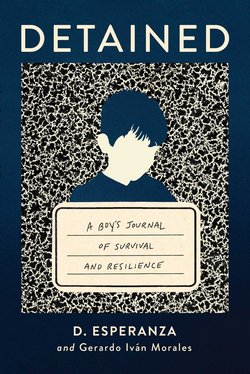
 Detained: A boy’s journal of survival and resilience
by D. Esperanza and Gerardo Iván Morales
DETAILS:
Publisher: Atria/Primero Sueno Press
Publication Date: May 13, 2025
Format: Hardcover
Length: 241 pg.
Read Date: July 20-August 1, 2026


The Politics of Immigration
Is something that I won’t be addressing. And really, neither does this book, no matter what your first impressions are. (I had similar ones, too) Yes, the primary author clearly acted in a way that indicates a certain perspective on it—as much as a 13-year-old from Honduras might have one.
Anyway, the book isn’t about that. I’m not going to talk about that either—and I will trash any comments that do, too.
But enough of that:
What’s Detained About?
After his grandmother died, 13-year-old David Esperanza tries to provide for himself and his cousin in their small Honduran home. His parents went to the States when David was so young he can’t remember them, really. Aside from the weekly phone calls, anyway.
David finally admits he can’t make enough money to keep them fed and housed, so he and his cousin decide to join his parents in Nashville. David doesn’t relate this information to them, sure they’d forbid it. But he feels that he has no choice. They have great misconceptions about how long their journey will take, but it doesn’t take long for them to learn that lesson.
They stop in Guatemala to spend a day or two with an aunt, who sends her two sons with them for many of the same reasons. Hope for work, hope for food, hope for peace exists in the U.S., not where they live.
It’s not easy to get through Mexico—but they manage, relatively unscathed. One cousin has to turn back, but the rest make it. They get separated on the other side of the border and David spends months bouncing around from one facility to the next, waiting to learn what will happen to him. Throughout it all, he journals as often as he can.
Those journals—cleaned up and filled out a little bit—make up this book. Telling his story from before his grandmother’s death through his days in the various facilities.
Well, This is Just Too Eerie
So, so, so many of the events that happen to David and his cousins on their journey North—and what happens to David when he crosses the border felt familiar.
There’s a young character in Winslow’s Cartel trilogy who goes through so many similar things—I believe he’s sent North by his mother to prevent him from being forcibly initiated into a gang, so he can live with his aunt and uncle (it’s been a few years, so forgive me if my details are wrong). But the more exciting events on the walk/ride through Guatemala and Mexico are pretty much what befell David and his cousins (except condensed into one person), and a good deal of the events in the States were similar, too.
I have to wonder if Esperanza was interviewed by Winslow—although I can’t imagine that his experiences are all that unique, either. Anyway, it was just one of those parallels that I couldn’t stop thinking about.
Why did I pick this up? Why did I keep reading?
A local bookstore was selling this as a fundraiser for a charity that I felt interested in supporting—and the book looked like it could be interesting, too.
I kept reading because I wanted to see how the kid came through it all—and maybe how. I wanted to see how many adults treated him decently, how he clung to and/or found some hope…something.
What does this book tell us about humanity?
On July 13, 2018—roughly two and a half months after he was apprehended by Immigration officers—David wrote:
…ever since this morning, I’ve been thinking a lot about a story in the Biblia that Padre Juan talked about at church once in Naranjito. It’s about a man who gets beat up and thrown in a ditch by a gang, just like what happened to Damián. He’s hurt and lying in this ditch, and a priest walks past without helping him, because it’d be too much work or he’s afraid it’s a trap or he doesn’t want to get his clothes bloody or whatever. The man only gets saved when a buen Samaritano stops to help him. In a way, even though the priest didn’t do anything, he was just as bad, or almost as bad, as the gang that beat the man up. Padre Juan says the priest in the story was bad because he didn’t do anything. I thought it was interesting that Padre Juan told us about it, even though the bad person is a priest like him.
The point is, there are two ways you can hurt people. You can hurt a person actively, like by punching them or stealing from them or whatever. But you can also hurt a person passively, by refusing to give them help when they need it, or by pretending you don’t see them, or by acting like they don’t exist.
Since leaving Naranjito, there have been a few adults who have tried to hurt me actively—like the hombres del cartel who shot at us while we were riding La Bestia, or the pissed-off Migra guys who put me and my cousins in a refrigerator to freeze half to death. And all that was horrible, obviously. But in a way, when someone hurts you actively, the damage is mostly just physical. Back home, gangs are a fact of life, and even though I was always lucky—I was never directly targeted until the cartel chased me off La Bestia—there’s always a risk that someone will hurt you in an active way. But that doesn’t give me this horrible, whole-body feeling of worthlessness. In Naranjito, I never saw anyone get passively hurt. I’m sure some kids had parents and family who were bad to them, but in some ways, anyone’s kids were like everyone’s kids. Ifa kid was hungry, obviously it was their parents’ job to feed them, but if thelr parents were missing for some reason, the rest of the pueblo wouldn’t just let the kid starve to death.
Since crossing the border though, until breakfast this morning, I don’t think a single adult in los Estados Unidos would have cared if I’d starved. In los Estados Unidos, the passive pain has been the worst feeling of all. Passive pain is a little harder to explain than active pain, but I’ll try;
It hurts in a different way. The adults who have tried to actively hurt me aren’t as bad as all the adults who stand around, seeing what’s happening doing nothing. Looking bored. This has been everywhere since I got to el Norte. There have been a million examples: the woman behind the desk at oficina de la Migra who called Papa and filled out my registration on her computer before her buddies in green uniforms stuck me in a refrigerator. The bus drivers who shuttled me and a vehicle full of innocent kids from one kind of jail to another and never stopped to ask what we did to deserve this, why we weren’t in school, why we weren’t with our parents, why we were crying, why we were dirty, why my foot was oozing blood and pus and stinking up the entire bus like roadkill. The servers in the cafeteria who see this food is making us sick but won’t do anything about it, who won’t let us grab another box of Frosted Flakes. The worst of all are the tíchers, these useless tíchers who call us by our bed numbers, these grown-ups who speak fluent English and could really do something to help us, but who just stand around looking tired and annoyed while kids like me are kept from our parents for no reason, tíchers who don’t sound any alarms when nine and ten-year-olds are passing out on the campo de fútbol because they’re afraid to drink water, because they’re afraid to use the bathroom.
Sometimes it makes me want to grab a piece of cardboard and write I’m a kid, do something on it. It makes me want to grab a megaphone and scream “I’m a person! I’m supposed to matter!” But more often, it makes me wonder if maybe I don’t matter, it makes me want to collapse, it makes me want to give up, it makes me want to melt into my bunk, it makes me want to climb down the porta-potty pit and dissolve in the chemicals. It makes me never want to look anyone in the eye again.
The hope-giving thing there is that “until this morning”—but that event (a tícher letting them have an extra serving of Frosted Flakes—without knowing that was unacceptable) isn’t common. This book doesn’t paint a particularly pleasant picture of humanity—especially in the United States.
So, what did I think about Detained?
As I said at the outset, this is not a book about Immigration politics. It’s about how we treat people—particularly children—who have been apprehended by Immigration officers. It’s about how a children are treated little better than animals—despite everyone assuring them, in practically a gaslighting way, “You’re safe.” A sentence that I can’t believe David would ever believe again.
There are moments of joy, of relief, of hope. David’s first experience with Elote, the day before they cross the border brought a smile to my face (and made me crave some). And there are more moments with that tícher above. Like, in Henry: A Polish Swimmer’s True Story of Friendship from Auschwitz to America, there are moments of friendship and happiness to be found in the camps, too.
Is the writing the best? No. But it’s based on a semi-literate (even in his native language), barely educated 13-year-old’s journals—you’re not going to find Gabriel García Márquez-level prose here.
But the story David tells is engaging, gripping, heartbreaking, and tension-filled. You will get drawn in very quickly and you won’t be able to stop reading until the end. You won’t be able to stop rooting for him—even if you’re not crazy about his choices (or downright disapprove), it’s more than easy to understand them.
The book will exercise your compassion. It’s definitely worth the (minimal) effort to read—and you’ll find it rewarding. I strongly commend it to your attention.
This post contains an affiliate link. If you purchase from it, I will get a small commission at no additional cost to you. As always, the opinions expressed are my own.