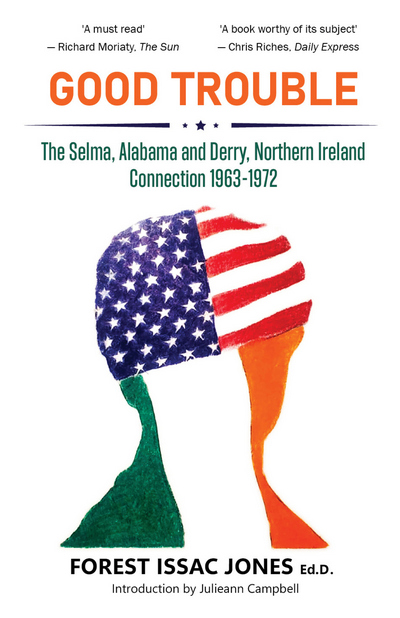
 Good Trouble:
The Selma, Alabama and Derry, Northern Ireland Connection 1963-1972
DETAILS:
Publisher: First Hill Books
Publication Date: April 1, 2025
Format: eARC
Length: 200 pg.
Read Date: May 1-3, 2025


What’s Good Trouble About?
It’s really simple, based on several interviews as well as plenty of research, Jones shows the connections between the Catholic Rights movement in Northern Ireland and the Civil Rights Movement in the Southern US in the late 60s and early 70s.
Essentially, groups and individuals in Northern Ireland saw what the non-violent protests in the U.S. were able to accomplish, how they went about it—and the costs they paid. Drawing inspiration—at the least—and borrowing methodology, they sought to follow in the footsteps of their predecessors.
Selma
After a chapter or two covering Michael Collins, the Easter Rising, and the rise of the IRA to set the stage, Jones turns his focus to the Eastern US—he discusses the Student Nonviolent Coordinating Committee, the March on Washington, and the Selma to Montgomery March. It’s a real mix of hope, joy, and trauma.
The bulk of this section is on the Selma to Montgomery March—the first-person accounts from those who participated in the March adds so much to this.
Derry
Jones then shifts to his discussion of the Catholic Rights movement—the way they self-consciously (and likely) unconsciously appropriated the methodology of the Black marchers and demonstrators on the other side of the Atlantic. They used similar thinking, learned lessons from the missteps of the Civil Rights marchers, and even used the song “We Shall Overcome.”
Despite some promising moves, and rallying after devastating counter-protests and police action, things did not stay non-violent in Northern Ireland, as we all well-know. Jones doesn’t spend as much time on that (if for no other reason than it stopped drawing inspiration from the South), but he does give a solid overview of it. Again, the first-person accounts he weaves into things like the account of the Long March from Belfast to Derry in 1969 are genuinely effective.
Some Minor Issues
I’m not sure that Jones inserting himself into the narrative quite as often as he did helped things that much. His friends fit in better—largely because they were among the first-person accounts mentioned before—but I’m not sure he needed to give them the same introduction every time. His parents might have been mentioned too often—they also didn’t need the same introduction almost every time they were mentioned. Nor did we need to be told twice in the same chapter how surprised they were to see Obama elected.
The repetition there makes me think of my main gripe—too many of the sentences and structure of various sections just needed a little more work. It really felt like another draft or two would’ve helped. The prose needed a little more tightening and a little less redundancy.
I don’t know that I’d have mentioned this in other circumstances, but it feels like a book talking about topics and themes that are this important should have writing to match—and this just doesn’t. I’d like for Jones to have elevated his prose to match this.
So, what did I think about Good Trouble?
In the movie The Commitments*, the band’s manager tells them:
Do you not get it, lads? The Irish are the blacks of Europe. And Dubliners are the blacks of Ireland. And the Northside Dubliners are the blacks of Dublin. So say it once, say it loud: I’m black and I’m proud.
Despite it being the wrong part of Ireland, that kept running through my mind while reading this book—and it only got louder when protestors in Derry started calling themselves “White Negroes.” Sure, it was a lighthearted moment in the movie—it wasn’t lighthearted (at least not for long) for those in Derry. This identification with the cause in the States underlines just how similar the causes and how precarious the situations for both groups were (this is particularly helpful for U.S. readers who may not be as familiar with “the Troubles” as we might want to be). Jobs, health, housing, and access to government—it all hung on getting the people and the government to sympathize with, to make systemic changes for these minority populations.
While hopeful—at least ultimately—this was not an easy read, the reminders, refreshers, or first-looks (depending on the reader) at the struggles, the hardships, the injustices before, during, and after the marches and the movement are harrowing and hard to read. Man’s inhumanity to man because of some perceived superiority is frightening and sickening—and Jones makes sure the reader sees that. And it won’t be easy to move on from that.
Yeah, there were some flaws with the book (hopefully some of them were caught before the final printing)—but they are overshadowed by the power of the book.
More than that—there’s a playbook to be found here for those who might be looking at mass demonstrations and marches in the future. They’re paths that are well-trodden, with various levels of success. Just knowing that others have faced these challenges and stuck to their non-violent convictions as much as possible can—and hopefully will—help others to do the same.
I’m glad I read this book—and think you will be, too.
* Probably the novel, too. But, it’s dangerous for me to check that unless I’m prepared to end up re-reading the whole thing.
This post contains an affiliate link. If you purchase from it, I will get a small commission at no additional cost to you. As always, the opinions expressed are my own.
My thanks to The Write Reads for the invitation to participate in this tour and the materials they provided.