Tag: Interview Page 1 of 20

LITERARY LOCALS: A Q&A About Writing in Idaho with Tomás Baiza

Literary Locals logo
I’m really excited to introduce you all to Tomás Baiza today. I spoke to him briefly a few weeks ago, and his books look great. Get to know him a little bit and then click the links below and give his books a look.


Before we get into things, why don’t you give the reader a brief introduction to you and your work.
I’m originally from San José, California, and have lived in a lot of different places since moving away from the Bay Area. I started writing relatively late and tend to write fairly flawed characters trying to figure out who they are, where they fit in or don’t, and what they might do about it. I’m fortunate to have had three books published: Delivery (Running Wild Press), A Purpose to Our Savagery (RIZE), and Mexican Teeth (Inlandia).

What brought you to Idaho in the first place? What is it about Idaho that keeps you here?
I came here for work and stayed in order to provide my daughter with a stable home base through high school.

Are you tied into some sort of local author/bookish group/culture? If so, tell us about it and how it helps you as an author. If you’re not, is there a reason for it?
I’m loosely tied with a handful of local writers. It started through Storyfort and spread into involvement with a couple of writing/critique groups. I’ve met more people through readings (my own and others) and literary events and places like Campfire Stories and Oldspeak. I’m not an innately social person, so I owe my contacts really to the kindness of others who have been very welcoming.
For the sake of those who aren’t in the area and/or are so crowd averse that they avoid all the -fort things in Boise (read: me), describe Storyfort a little – and how you’re involved. Also, I don’t think I’ve heard of Campfire Stories before – what’s that?
Storyfort is one of the various “-forts” that happen simultaneously with Treefort. It was created by Boise-area writer, Christian Winn, and is now run by Sam Berman. It’s a great series of literary events that feature national, regional, and local writers. There are feature readings, panels, and themed readings throughout the week. It’s an excellent program for both the artists and the reading public. I first got involved in Storyfort when one of my early stories was picked for a reading at one of the events. Since then, I’ve done a few readings, and I’ve had the privilege of riding the coattails of Rebecca Evans, a local writer who organizes a themed panel each year.

Campfire Stories is a monthly event that takes place from March through October. It is organized by Christian Winn and features 3-5 readers each month. Last year I was brought on to host a couple of events and I’ll do the same this year. Each month focuses on a theme. The theme can be abstract or very topical. In recent years, the Modern Hotel has hosted the event. It’s a great night where people can come early, grab dinner, and then stick around for stories.

What kind of events in the area do you attend—either to sell/promote your books or to network with authors?
I try to stay involved with Storyfort each year, and I’m always interested in public readings. My books have all come out through independent publishers, which means they’re tragically under-marketed and the readership will always be limited, so I try to do as much in public as possible to get them as much attention as I can without being really obnoxious about it.

What’s the breakdown of your audience—do you have a strong local base, or are your readers from other parts of the world?
Most of my readers have some kind of local tie, but I have also had people reach out from other places. I’ve done some remote class visits and random folks will occasionally contact me to comment on my writing, which is always a welcome surprise. Since I often (but not always) write through the lens of identity and Latinidad, my readership is more limited. I don’t tend to write things that are likely to have a very broad audience.
Most of the authors I’ve talked to about class visits are people going into elementary schools to read to the children—Latinidad vibes or not, you don’t strike me as that kind of author (by all means, set me straight if I’ve misjudged you). So what kinds of classes are you visiting? Writing classes?
I’d LOVE to go into classrooms and talk to kids, but since my writing is pretty adult, I don’t get those kinds of requests. I’ve done some remote talks with college writing courses and I’ve really enjoyed the experience. In one case a class was reading a collection of environmental stories that had one of my stories (“A Seal’s Song”). One of the students enjoyed it enough to track me down on Instagram. She ended up working with the instructor to have me Zoom in. In other “visits,” I’ve spoken with early writers on the ups and downs of publishing. I have a lot of hard-earned experience there, so I hope that those talks are helpful to the students.

Do you think there are particular challenges or advantages to being a writer in the Treasure Valley? (possibly both)
It’s a small community with a lot of scrappy, talented writers. It can be both supportive and intensely and passively competitive. Depending on your mindset, that “fishbowl” environment can be either motivating or dispiriting, or both.

Do you bring Idaho (or some sort of Idaho-sensibility, assuming one exists) to your work? Whether or not anyone else sees it, can you look at some aspect of your writing and think “That’s Idaho” or “I would do ____ differently if I was a Kentuckian or from Illinois?”
I write from the perspective of a dyed-in-the-wool Californian who happens to live in Idaho. I write as an outsider because that’s my natural voice and perspective, for better and for worse. I definitely don’t try to larp around as an “Idahoan.” This is a great place that I’m fortunate to have found for as long as I’m here.
I love the idea of Idahoan LARPing…what comes to mind isn’t very flattering, but I’m amused by it.

One final question, is there a book (or two…or 18, if you get really carried away), that embodies Idaho/the Idaho spirit to you to recommend to my readers?
It’s not Idaho, per se, but I always recommend Edward Abbey’s DESERT SOLITAIRE to anyone who’s interested in the American West and our attitudes towards the environment. He had a few problematic views, but I’ve always loved Abbey’s rebellious, anti-establishment perspective. He lived his values, which I respect.
I’d never heard of this book before, but it looks promising—and at least fairly Idaho-adjacent (beyond the obvious literal adjacentness)
Yeah, Abbey was a GREAT writer. I don’t always love how he depicts women and particularly Native people in his stories, but I do believe that his writing has done far more good than harm. I think what resonates with me the most is that he was a white dude destined for privilege who decided that it was far more important to challenge evil systems of exploitation than settle into a comfortable writer’s life. It shows in his writing.

Thanks for your time and participation! Hope you enjoyed it!


Literary Locals logo

LITERARY LOCALS: A Q&A About Writing in Idaho with Michael Weitz

Literary Locals logo
Intro


Before we get into things, why don’t you give the reader a brief introduction to you and your work.
Thanks! I’ve been a reader my whole life, I’m lucky to have had parents who actively encouraged it. My first book was a 9-page Star Wars rip-off I wrote for a 3rd Grade class assignment. (Sorry, Mr. Lucas!) The first novel I wrote was horrible, but a great learning experience. It led to my Ray Gordon books; a trilogy of mysteries within the world of professional and amateur chess. My latest novel, We Be Dragons, is a coming-of-age story set in 1986 and takes readers on a journey into Dungeons & Dragons and a world where the power of friendship, the importance of imagination, and standing up for what’s right is what really matters in life. All my books are available on Amazon, and We Be Dragons is available at a few of our local area bookstores as well.

Amazon: https://www.amazon.com/stores/Michael-Weitz/author/B00J496B38

Michael Weitz author site: www.michaelweitzbooks.com
I’m curious—how long of a gap was there between the please-don’t-come-after-him-Lucasfilm-lawyers story and that first novel? And then between that “horrible” book and getting to the point of feeling ready to release Ray Gordon #1?
I was in 3rd grade when I tried my hand at science fiction and the horrible manuscript I learned even more from was written when I was around 23. I believe I was around 25 or so when I wrote the first draft of Even Dead Men Play Chess, the first Ray Gordon book. It went through a few more drafts over the years, little tweaks and edits, and it wasn’t until I was 40 years old when it was picked up by a small publisher.

Are you a native Idahoan? What is it about Idaho that keeps you here?
I’m originally from Washington but grew up in a small town about a half hour away from Moscow, so I spent a lot of time there when I was growing up. What brought you to Idaho in the first place? I received a BS from the University of Idaho and really enjoyed living and working in Moscow during those years. I loved the area, but work and life took me on a roundabout path before landing back in Moscow for a time before moving to Boise where I’ve been enjoying life for more than 14 years now.
Another Vandal in the area—it can feel lonely sometimes.
Sometimes, but we’re out here!

Are you tied into some sort of local author/bookish group/culture? If so, tell us about it and how it helps you as an author. If you’re not, is there a reason for it?
I’m a member of MMMWriters. It’s through them that I have been able to attend book fairs and meet other authors and readers!
I don’t think I’ve heard of MMMWriters. Glad to hear about another group. Other than patching you into events to attend, what are some ways it’s helped you? Here’s you chance to recruit!
Their newsletters and website have some helpful articles geared toward writing, publishing, editing, and all things regionally “writerly”. You can find them online at mmmwriters.com.
Oh! I have heard about them a few times, but the name slipped my mind.

What kind of events in the area do you attend—either to sell/promote your books or to network with authors? Are there any outside of this area that you hit regularly and wish we had something like it here?
I attend the Idaho Author Book Fairs in the Spring and Fall, and any other similar events I can around the Treasure Valley. I love to support local shops and have enjoyed signing books at Barnes & Noble and Rediscovered Books in Boise, Book People in Moscow, and Shared Stories in Caldwell. These are great opportunities to meet readers and talk about my books as well as what they enjoy reading.

What’s the breakdown of your audience—do you have a strong local base, or are your readers from other parts of the world?
I believe most of my readers are in the Pacific Northwest, but I have met people from New York, Los Angeles, Phoenix, Pennsylvania, and other places around the country who’ve read my work. I know a few copies of my books have been sold in Germany, England, and Brazil as well, so that’s fun!
You’re international! Nice!
Thank you! Now I need a T-shirt to go with it.

Do you think there are particular challenges or advantages to being a writer in the Treasure Valley? (possibly both)
The digital world has evened out the field for writers everywhere. I think any advantages or challenges for writers in the Treasure Valley are more personal rather than geographical. If an author’s work is all about Idaho, there’s a built-in audience – people enjoy reading about places they recognize, as well as about local history, but those stories may not capture the imaginations of outside readers. Or they might. But the Internet offers writers of all genres the same opportunities to get their work in front of readers.

Do you bring Idaho (or some sort of Idaho-sensibility, assuming one exists) to your work? Whether or not anyone else sees it, can you look at some aspect of your writing and think “That’s Idaho” or “I would do ____ differently if I was a Kentuckian or from Illinois?”
I think the themes I write about in We Be Dragons are certainly Idaho sensibilities. Strong friendships and standing up for what you believe is right, I see those here in Idaho.

One final question, is there a book (or two…or 18, if you get really carried away), that embodies Idaho/the Idaho spirit to you to recommend to my readers?
Besides mine? 😊 I’m not a huge western fan, but True Grit by Charles Portis has the Idaho spirit. If you’ve only seen the movie(s) you’re in for a treat.
There’s always room here for True Grit love. Good pick! I don’t know that I’d have thought about it as having an Idaho spirit, but…I see it.

Thanks for your time and participation! Hope you enjoyed it!
I did enjoy it! I hope you did as well. Thank you for thinking of me. Your questions made me think a bit more about myself and my writing.


Literary Locals logo

Some Questions About Cover Art With…Candra Hope and Shannon Knight

Shannon Knight is back with Candra Hope, the cover artist for Catamorphosis (there was a cover reveal for it last week) for a Q&A about the cover, how it was designed, and some other stuff. Before we dive in, let me remind you about the unsettling cover.
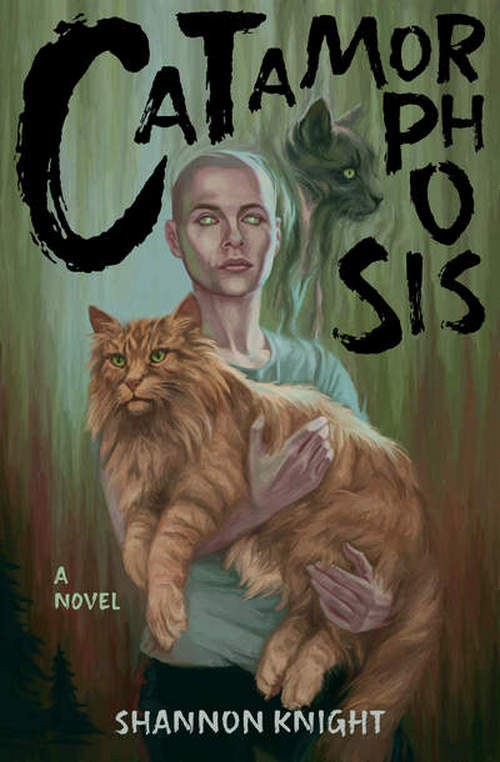
Cover for Catamrophosis by Shannon Knight

I typically call these posts “A Few Quick Questions”—but we leave “Few” and “Quick” in the rearview mirror. So I’m going with “Some” (because that’s as creative as I am today). Why don’t we get to them now?


Candra: Since my readers have met Shannon a couple of times already, why don’t you give my readers a quick introduction to you and your work–including whatever titles, websites, links, etc. you’re in the mood to share.
Hi, my name is Candra Hope, and I do art 🙂 That’s usually how all my bios begin. But that’s me in a nutshell. More specifically, I do art inspired by fantasy, horror, and science fiction. Art that’s also inspired by books and movies and cool tv shows and music and history and mythology and all sorts of other things. I suppose I’m a bit of a magpie, gathering inspiration from anything I think is cool. I work mostly digitally now for commissions, but I come from a traditional painting background, so a lot of my art keeps that vibe. I don’t really have links to titles or specifics, but if people want to see examples, my web portfolio is https://www.candrahopeart.com/ .

I really like that phrase, “I do art.” You’ve talked about this a little on your site, I know, but how does someone get into the freelance cover design business?
Oh, don’t ask me, I’m not an expert on this by any means. I don’t really work professionally, I just do occasional commissions if something interesting comes along. But if anyone is serious and starting out, a good place to begin is to follow professional artists on social media and also look at sites like Muddy Colors which has mountains of information about all aspects of the professional illustration business.

Shannon, how did you come across Candra? Can you remember what it was about her work that made you interested in them working on this cover?
I originally noticed Candra’s work some years ago on the old Twitter. She has a really great movie-poster style that incorporates multiple characters and the setting along with multi-color tones and a sort of gritty quality that vibed with this story. Catamorphosis has an ensemble and a lake setting that I thought she could capture well.

Now I’m just imagining you with a list of names/links to portfolios, collected over the years, with potential cover artists. Is that something you set aside time for, or just whenever you come across something that clicks with you, you jot a note to yourself?
I like art. When I first saw Candra’s work, I had a literary agent and my mind on trad pub. There would’ve been no need or opportunity to select a cover artist myself. Then and now, I note artists that I like because I like art, and one of the wonders of the internet is that we can look through portfolios without needing access to published art books. And by note, I mean a mental note. There’s no formal list.

As I searched more frantically last December, I started by looking through my own social media list of people I follow. These days, though, I might follow an artist thinking of them as a future professional resource rather than simply a recreational follow. I only set time aside for it, per se, if I’m actively selecting an artist for a project.

Candra, any advice for those looking for an artist that SK didn’t mention? Obviously, the short answer is hiring you. But let’s pretend you can’t take on a client, what should they do?
I follow a lot of artists and have some of them following me on social media. It’s the same for a lot of us. So if someone is looking, a good place to start is other artists’ following lists. I can’t speak to professional lists, but I think there are also some out there.

What do you want to know about a book before you accept a gig and/or start sketching? Do you want character descriptions, an idea of the plot/tone? Or do you not care about anything beyond what the client is thinking about for the cover?
Candra: I prefer to hear a rough description of the story and if the client has an idea in mind for the cover. I don’t have a lot of time to spare for reading books in advance and often too much information can be a distraction so it’s nice to have a concise concept to start from.
Shannon: I’ve found that different artists have different preferences. I’ll keep Candra’s words about a distraction in mind in the future. I usually start with something concise. If they’re interested in the job, I tell them more. I’ve had other artists say the more the better, including images, but if I send a long email, I’ll generally end it with a numbered list repeating my top priorities so that the focus is clear. For instance, 1) horror genre, 2) cats.

Shannon, Do you recall what ideas you came to Candra with for this project?
I suggested a character-focused cover with a woman and a cat, a bit like Ripley and Jonesy from Alien. I knew that would work in Candra’s style. But I also provided a summary of themes and the plot plus more detailed descriptions of the character cast. I emphasized the horror mood and that I was open to abstract and weird. I knew Candra could do a bigger ensemble painting beautifully, but a small book cover wouldn’t show a bunch of characters as well as a large movie poster.

Could you both walk us through your typical process of designing a cover? I wanted to break this down part by part, but I don’t think I know enough to try that. So I’m going to go with a broad question.
Shannon: I don’t have a typical process, and this round was rather high-stress for me because I had figured from the start that I would work with Savanna Mayer again on this piece because it was another horror cover, but I should have reached out sooner because they didn’t reply to any of my emails, so I had to move past the time of waiting for them to get around to replying and realize that they were simply not responding at all. I have no idea why. Then I needed to find a new artist. As much as my other artists had been lovely, their styles felt too smooth and fantasy-coded for this project. (I still almost contacted Eli Peiró because she was so great to work with, and she might have had ideas or another style she was interested in trying. I highly recommend her to anyone looking for an artist!) So, this meant digging through portfolios, imagining what the cover art would be in their style, and contacting them with a commission query. I had initially been looking for something abstract, very weird, and cat and fish-centered. But it was December, and no one was replying, and I was growing more and more frantic as I created cover design after cover design, each tailored for certain art styles in my mind, and then I queried, and then just…silence. Nothing. Not even when I contacted agents, whose entire job is to reply to commission requests. I felt cursed. Like maybe everyone is getting so inundated with AI slop spam that genuine commission requests were getting lost in the slop. Finally, I had one artist reply with availability to start in six months and double the max price I had hoped to pay. Their work is terrific, but I passed. I had another reply in a way that made me instantly uncomfortable. Instead of answering my questions, they replied by asking me the exact same questions. When I followed up, explaining that their response had made me uncomfortable, they didn’t reply. Back to the silence. And finally, finally, I happened across Candra’s portfolio again, and I immediately saw how a portrait-style cover could work well for the story and that her unique style matched the tone of the story. I contacted her, and she replied right away in a totally professional style, clearing up all my concerns, and letting me know when she’d be available after the holiday for us to hammer out all the details. Then it was a very smooth process.
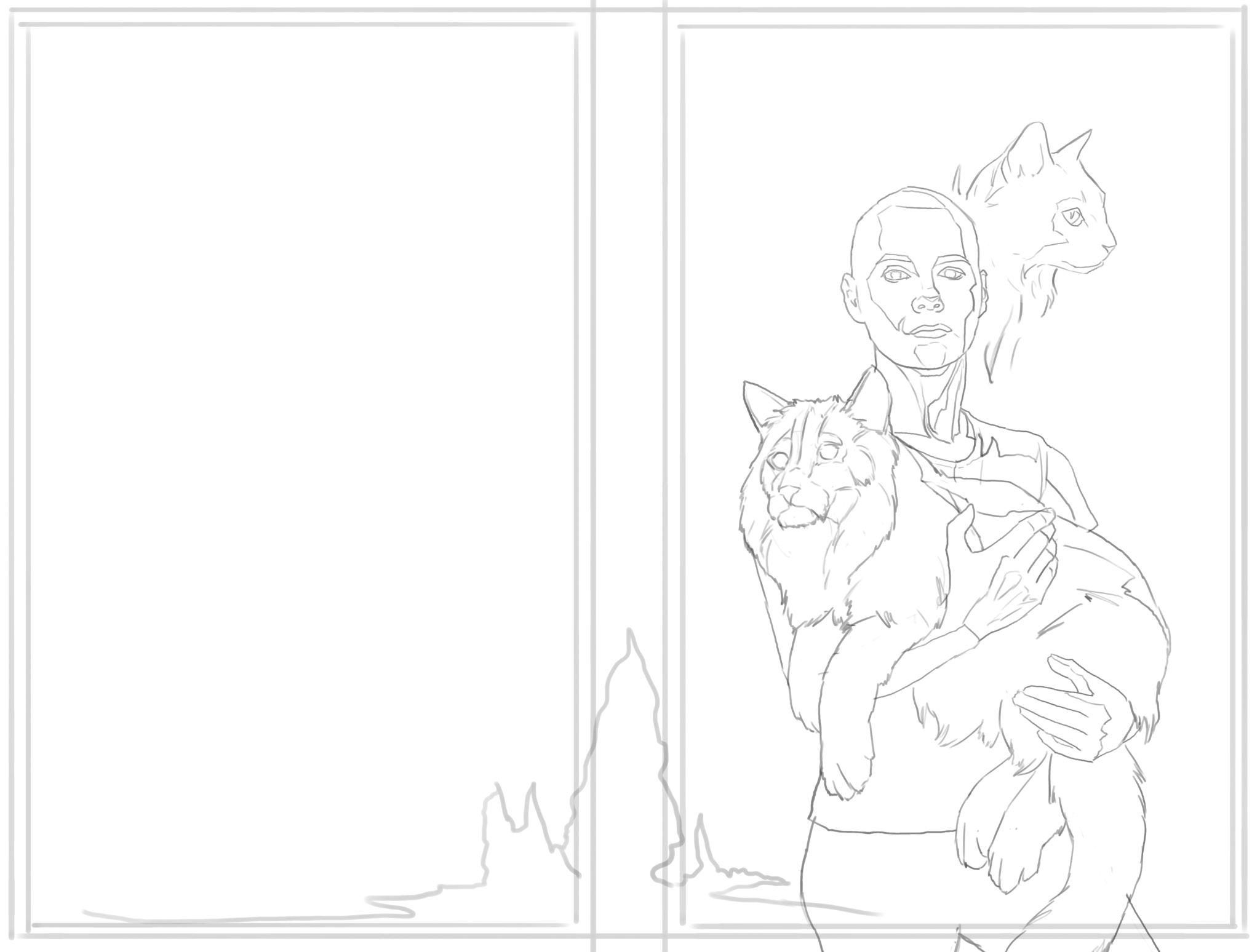
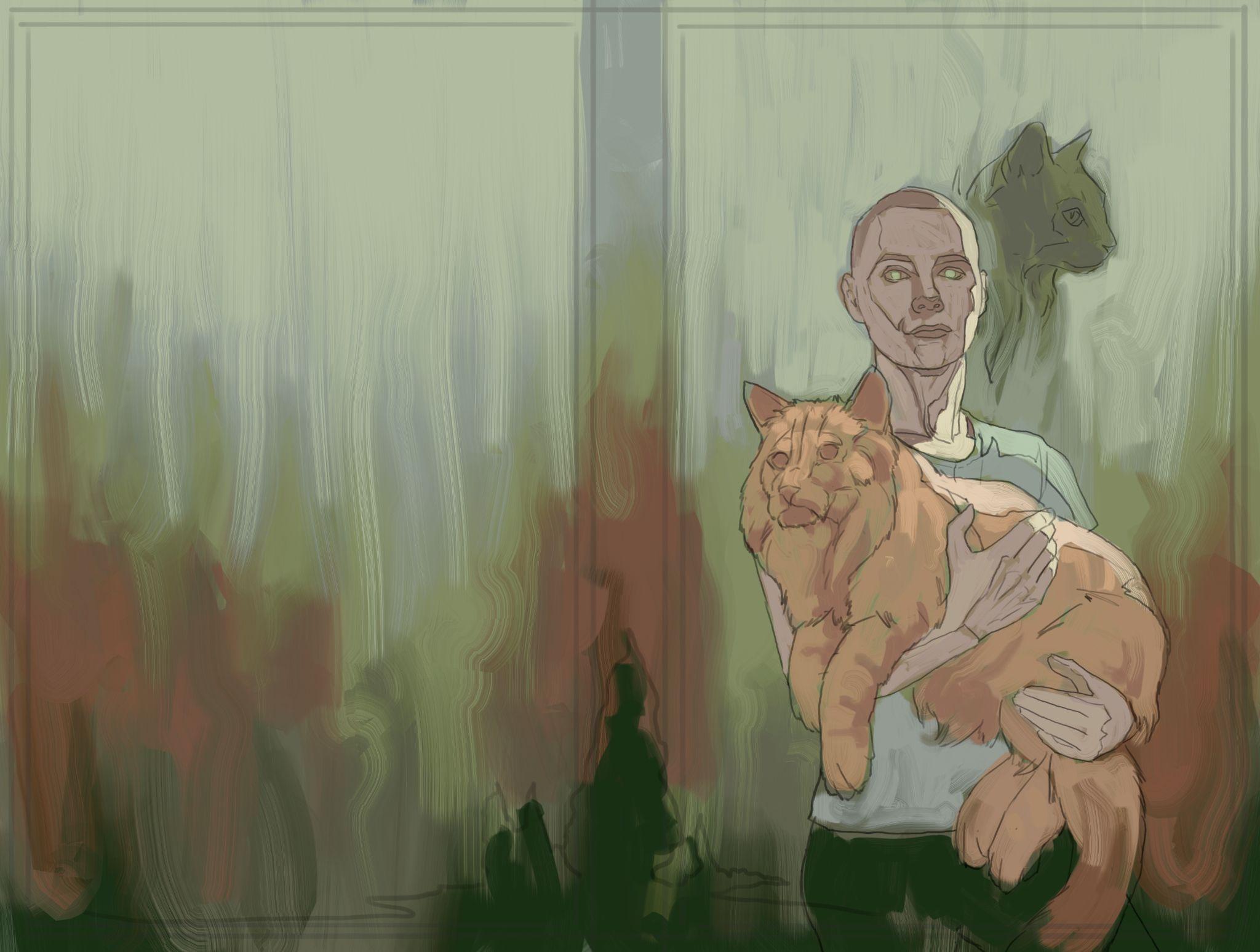
Candra: I also don’t have a set process. I like to take each project on its own merits and work with the author/client as a new individual. I immediately liked Shannon’s pitch because she told me what she was looking for, and was really clear from the outset, so I had no problem imagining the cover. It also sounded like a cool story, so that probably helped. But once we got started it felt like we were both on the same page and could bounce ideas around easily and understand when things weren’t working or needed changing. The part of my process that usually stays the same is to sketch the idea, show the client, develop the idea, show the client, get references and paint the idea, then do any remedial work at the end. It sounds really basic, but that is the bare bones of what I do. One thing that really helped this time was Shannon gathering all the reference photos. She has a lot of cat photos, and everything else she found was perfect so that saved me a big step. Thanks, Shannon!

What do you know? The internet’s obsession with cat photos comes in handy after all!
Shannon: Rather than internet photos, I started with photos of my own cats. This story began because of the death of my cat Gandalfr. He’s a 17.5-pound, gray cat, and my fictional cat is the same size. I shared photos of G for the cat the protagonist is holding. However, I made my fictional cat a ginger tabby, so we also needed references of that. The cat that appears behind the woman is modeled after my current cat, Little Bat. In fact, the woman’s head is modeled after my head. Candra made changes, but she referenced my previous cat, my current cat, and myself in the painting.
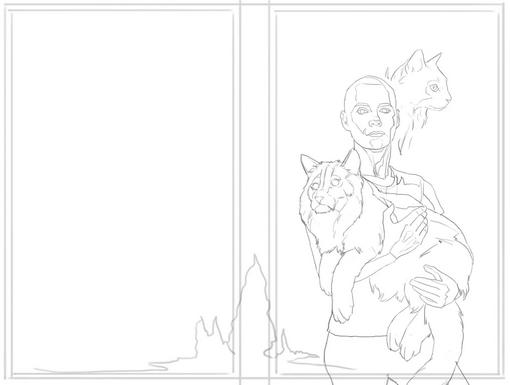
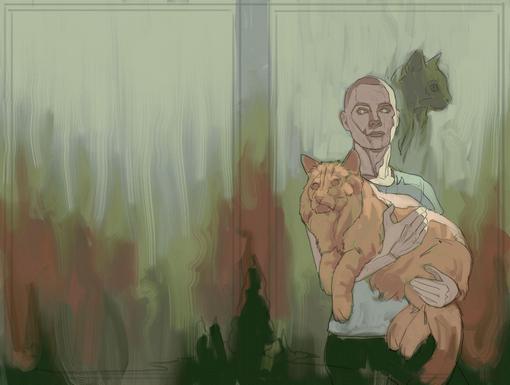
Pencil sketch of the Catamorphosis coverPainted cover of Catamorphosis

(click the images for a larger version)

For both of you: When pitching ideas, do you literally show existing covers by others and say “like this one, but without X” or “something that feels like/has the same vibe as this”? Or do you leave other peoples’ work out of the conversation?
Shannon: I tend to refer to an artist’s own work to point out the styles I like best. When it comes to describing my own story, I refer to artists’ work if it’s relevant. In this case, I referred to Jen Bartel’s girl gang art, but the only references that Candra was interested in were personal photo references that she could use for the painting. This included a photo of me with my head bald from Covid inflammation and lots of cat photos, including images of the cat who inspired this story.
Candra: I try to describe what I’m trying to say with words but if there’s a specific painting that shows that, I’ll refer to it. But like Shannon, it’s organic and not something I do all the time. Sometimes other paintings can muddy the waters and be a distraction.

Candra, are there genres that you won’t do/don’t think you can do at this stage of your career? Or are you at an “I’ll do anything” stage? Are there genres that you haven’t done a cover for that you’d like to try?
I’m open to most things but would probably not attempt something in the romance or romantasy genres. If people look at my portfolio, they’ll see for themselves that my work is mostly horror, fantasy and science fiction based, so that’s where my skill set lies.

Fair, I think it would take a very particular romantasy story for someone to look at your site and say, “Yeah, her.”
Candra: lol yeah. That said, the Interview With The Vampire series is essentially a romance and I love it so something like that would be amazing to tackle.
Shannon: The newest one with Jacob Anderson and Sam Reid is such a great interpretation of the books!

Another blogger and I have used the word “unsettling” about this cover. I’m assuming you’d take that as a compliment. Do you think in terms of “unsettling” or “horror” or whatever adjectives the client is shooting for as you’re working, or after agreeing on the concept with the client, are you just doing your thing and it comes out Candra-esque? While we’re on the topic, how would you describe the finished project in a word or three?
I very much take “unsettling” as a compliment, thank you! Though I don’t think in terms of effects like unsettling while I work necessarily. I’m aware it’s a horror story but my focus is on getting across what the author is trying to say with their story. And I think that’s why I prefer their description rather than reading it myself so I don’t get bogged down by my own interpretation. As the cover artist it’s not my job to give my own ideas about the story, I’m there to help the author sell their book. And this story felt like it was personal to Shannon, and unsettling in the things that happen to the character in the book. I wanted to respect both aspects so I made deliberate decisions about how things looked and felt in the painting, along with character expressions and body language, which is possibly why you’re picking up on that from the art. It means I did my job of translating the story description into picture form. As the artist I’m too close to the work so I don’t have a three word description, just happy to have done a good job for Shannon.

Candra, another blogger and I have used the word “unsettling” about this cover. I’m assuming you’d take that as a compliment. Do you think in terms of “unsettling” or “horror” or whatever adjectives the client is shooting for as you’re working, or after agreeing on the concept with the client, are you just doing your thing and it comes out Candra-esque? While we’re on the topic, how would you describe the finished project in a word or three?
I very much take “unsettling” as a compliment, thank you! Though I don’t think in terms of effects like unsettling while I work necessarily. I’m aware it’s a horror story but my focus is on getting across what the author is trying to say with their story. And I think that’s why I prefer their description rather than reading it myself so I don’t get bogged down by my own interpretation. As the cover artist it’s not my job to give my own ideas about the story, I’m there to help the author sell their book. And this story felt like it was personal to Shannon, and unsettling in the things that happen to the character in the book. I wanted to respect both aspects so I made deliberate decisions about how things looked and felt in the painting, along with character expressions and body language, which is possibly why you’re picking up on that from the art. It means I did my job of translating the story description into picture form. As the artist I’m too close to the work so I don’t have a three word description, just happy to have done a good job for Shannon.

Are there examples of cover art/design recently that have made either of you stop and say–“I’d love to try something like that one day”? (or I guess…”if I tried for something like that, it’d come across as just aping so-and-so’s work, so I’m going to stay far away”)
Shannon: My focus is really on writing books rather than what the project’s cover would look like. I would still like to write something that would pair well with pastel cover art. But if we’re simply admiring work, in the horror genre, I like what Corey Brickley has done with bright colors, perspective, and characterization. I’ve also had my eye on Elsa Velasco for their symbolism and sweeping lines.
Candra: There are a lot of amazing artists out there and while I love and am inspired by their work, I don’t always want to emulate them. I love horror stories but not always horror cover art. So I try to bring my own fantasy roots to everything I do. I like the fantastical realism you can get from that and it’s fun trying to bring that vibe into the horror genre. But artists working now that inspire me are Donato Giancola, Jeremy Wilson, Vanessa Lemen and Greg Ruth. I loved what Vanessa Lemen did with The Left Hand of Darkness a few years ago. And Jeremy Wilson’s graphic abstractions mixed with realism always set my inspiration radar off.

I didn’t know a single name either of you mentioned above, but I liked what I went and found by all of them (I have seen Wilson’s covers before, it turns out). Shannon, you need to work with Brickley some time. Something about that portfolio screamed your name.
That’d be cool for sure. However, I think Candra created a terrific cover for this project. Thanks, Candra! I hope everyone will read Catamorphosis and judge for yourselves!

Good idea, Shannon! I really appreciate both of you taking your time for this.

A Few Quick Questions

HC Chats with Glen Gabel about Through the Corner of Circles and some other stuff

HC sat down with Literary Local, author, screenwriter, and all around good guy, Glen Gabel to talk about his mother’s passion project, <b.Through the Corner of Circles

You can see HC’s written Q&A with Glen here: https://irresponsiblereader.com/2025/05/20/literary-locals-a-qa-about-writing-in-idaho-with-glen-gabel/
Glen’s website: https://glengabel.com/
and Meg Ashely’s website: https://meg-ashley.com/

(repost) LITERARY LOCALS: A Q&A About Writing in Idaho with Jerome Goettsch

This author asked me to repost this, and given the subject of his book, Veteran’s Day seemed to be a fitting day.

Literary Locals logo
Goettsh’s memoir had only been in print for a couple of weeks before I met him at the Library Book Fair. I wish I’d noticed that before I sent him my questions–I’d have tweaked them a little bit–not that there’s any problem with his responses, I’d just have framed things in light of the date.


Before we get into things, why don’t you give the reader a brief introduction to you and your work.
I’m a veteran of 9 years in the Marine Corps, 16 years in the Army, and 7 years working as a Navy civilian. I did 2 tours of duty in Vietnam. The first tour the book is based on as a rifleman and Fire Team Leader for 13 months, and a second tour for 12 months in ordnance. Over 25 years in the military I worked as a rifleman, an ordnance man, a military policeman, a rifle, and shotgun coach, and in administration. As a civilian for the Navy, I worked on the docks unloading munitions off ships and as a document editor. I edited operations manuals for navigation systems on nuclear submarines.

What brought you to Idaho in the first place? What is it about Idaho that keeps you here?
My wife and I moved here 21 years ago to be with our children. We have 2 children, 2 grandchildren, and 2 great-grandchildren in Idaho now.

Are you tied into some sort of local author/bookish group/culture? If so, tell us about it and how it helps you as an author. If you’re not, is there a reason for it?
This is all very new to me. I’m learning to tread the waters of authorship. I have a Facebook page: The Cocoa Kid, and I belong to a few Facebook groups: The Writer’s Forum, Writers For Writers, and Creative Writing. Also, the Kindle Community is very supportive.

What kind of events in the area do you attend—either to sell/promote your books or to network with authors? Are there any outside of this area that you hit regularly and wish we had something like it here?
I did my first book fair at the Nampa Library where we met. I made a few good contacts there. I’ve been talking with local librarians and hope to have something in the future. I need to reach out to new bookstores and book clubs. It’s challenging balancing my book promotion with my artwork.

What’s the breakdown of your audience—do you have a strong local base, or are your readers from other parts of the world?
My readers are from all over the US, but mostly veterans like myself. However, I like to point out the book is not just all about the war. It’s not all shoot ’em up bang bang. It’s about a young man’s journey from childhood to war. About struggle, loyalty, and sacrifice in the face of adversity. It’s about survival and moving on.

Do you think there are particular challenges or advantages to being a writer in the Treasure Valley? (possibly both)
It’s not just Treasure Valley. It’s the book community in general. Lots of people are going to e-books. Paperback books are slowly but surely going the way of hardback books. They will be obsolete collectors’ items someday. I’m not a Luddite; or a technophobe in today’s vernacular. I’m going to be putting an e-book version out soon.

Do you bring Idaho (or some sort of Idaho-sensibility, assuming one exists) to your work? Whether or not anyone else sees it, can you look at some aspect of your writing and think “That’s Idaho” or “I would do ____ differently if I was a Kentuckian or from Illinois?”
I consider myself an Idahoan as I’ve been here 21 years now. I have family and roots in Idaho. But I was born and raised in Green Bay Wisconsin. Later I lived in Milwaukee Wisconsin, Chicago Illinois, Dallas Texas, Phoenix Arizona, and California. After joining the military I was stationed in California, Texas, Virginia, Oklahoma, and Indiana. I did 2 tours (still not sure why they call them tours) in Vietnam. I’ve visited Mexico, Japan, China, Greece, Africa, and most of Western Europe. Working as a civilian for the Navy I traveled to Washington DC, Washington state, New York, Florida, and Georgia. I’m like a sponge, and have picked up some of the customs and language of most everywhere I’ve been.

One final question, is there a book (or two…or 18, if you get really carried away), that embodies Idaho/the Idaho spirit to you to recommend to my readers?
I’m a rockhound and photographer, as well as a writer and artist. I love to explore Idaho, so I have several books such as Rockhounding Idaho, Roadside Geology of Idaho, and books on Idaho’s history. I found reading about how Idaho’s Capitol was moved from Lewiston to Boise most interesting. I would highly recommend reading about the State Capitol’s history. Overall I’m a history buff, and I’m in the habit of reading a few books at a time. I like to pick one up and read a chapter or two, then put it down, pick up another, and repeat. I am presently reading Eiffel’s Tower by Jill Jones, The Greater Journey by David McCullough, and a book written in 1890, How the Other Half Lives by Jacob A. Riis. Riis was part of a movement that led to changes in society such as the Audy Home that I was locked up in, and which is in my book. Riis wrote his book in 1890 and the Audy Home was created by the women of Hull House in 1899.

Thanks for your time and participation! Hope you enjoyed it!


Literary Locals logo

A Few Quick Questions With…Adam Holcombe

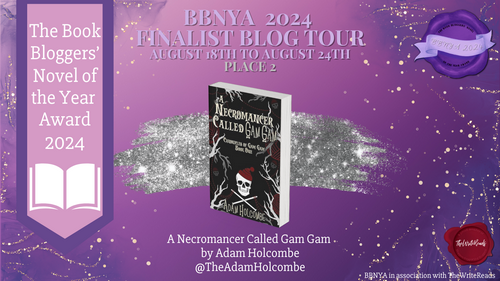
A Necromancer Called Gam Gam Tour Banner
Okay, we’re wrapping up my Tour Spot for A Necromancer Called Gam Gam with some actual new content! (gasp!!) Holcombe was gracious enough to take some time out from camping to answer a few quick questions for me…I hope you enjoy these answers!


Why don’t you take a moment to introduce yourself to the readers, and tell us about your path to publication?
Hello all! I’m Adam Holcombe, author of the Chronicles of Gam Gam series as well as the upcoming sci-fi epic, Bounty Inc. My path to publishing is much like the tick’s path to getting burned off of someone. Except the people I latched onto were all very nice and helped me instead of burned me! I’m very grateful for that.

But what I mean specifically is that I was able to follow some of my favorite indie authors through social media, and ended up finding ways to get involved, such as an accountability thread on a Discord server where I ended up getting to know some of my favorite people. With their help, I was able to find my way to publishing A Necromancer Called Gam Gam, and much of my success is owed to how kind and wonderful everyone in this community has been to helping ticks like me grow into our own authors.

Who are some of your biggest writer inspirations/influences. Whether or not we readers can see them, but you know they’re there.
Two of my biggest inspirations to writing come from different media sources than the traditional book, actually. The first is Eiichiro Oda, the mangaka for One Piece, and the second is James Gunn, writer and director of the Guardians of the Galaxy movies, among several other things. And both of these are for very similar reasons: they both blend humor and emotion so seamlessly it’s incredible how it works, and it’s what I’m constantly striving for myself. I want to create a story that leaves one laughing before they suddenly find themselves silenced by a powerful, heart-wrenching scene. And then maybe ending on a laugh, I don’t know, guess you’ll have to read to find out!

That’s not to say I don’t have authors who are inspirations to me as well! In the same vein of things, M.L. Wang writes emotion so well, she’s been one of the few authors who have ever really brought tears to my eyes. Krystle Matar writes characters so well, it’s hard to imagine they invented these people, they feel real, pulled straight from whatever plane of existence Krystle can peer into. C.M. Caplan can dial the unhinged to eleven and just make it work, something that is so very hard and something I hope to get the chance to do more and more as I continue writing. Those are just a few, but so many stories I’ve read, and authors I’ve talked to have influenced my work in tiny ways, and will continue to do so as I keep pushing more out.

I want to ask about tone—because you strike this balance (or do an intricate dance around and between tones, whichever metaphor you prefer) between cute/cozy and emotionally-wrought with a side of creepy. Was this something you had in mind from the beginning? Was this something you discovered along the way and then wrote/rewrote to turn into it? Or is this just Adam Holcombe in a nutshell?
Ha, maybe my previous answer gave some of this away, but deep/serious moments and light/silly moments are two things I work hard to balance and I’m happy to see that it seems to be working from your perspective! For A Necromancer Called Gam Gam, there were a few ideas I wanted to incorporate from the beginning that set up this balance, but so much of the actual work came when the writing started. If something felt too creepy and too serious when I wanted it to be lighter, I would adjust and make sure something silly was incorporated so it wouldn’t go too far in one direction. And in the same way, if it was getting too whimsical, I’d look for a way to ground things once more. It took a lot of toying to get the feel that I was satisfied with.

This is the point where I like to ask about a supporting character or two that caught my attention. But you’ve done a good job of taking these supporting characters and giving them short stories. When did you decide to do those? Was it because of people like me who were asking questions about them, and this was a quick and effective way to shut us up? Do you have any plans to keep these coming? I think The Wishing Stone provides several potentials.
A lot of authors offer a newsletter magnet, usually a novella of sorts that ties into their story and brings people to their newsletter while also giving readers a chance to try their work and hopefully hook them. I wanted to do something similar, but with A Necromancer Called Gam Gam already being a novella, it felt odd doing a second novella to sell the first. Or giving away that for free to join a newsletter that had nothing else to offer. In the end, the idea came from several anthologies I’ve read where the authors would tie the short story into a series of theirs, giving the reader a taste and a chance to hop onto that series if they liked what they read. A short story seemed a lot more doable for coupling with A Necromancer Called Gam Gam than a second novella or something similar might be.

So, I decided to look at which characters I felt really deserved more backstory, and started with Sir Gibblet in The Knight Revenant, and of course Nugget would need more story in Nugget’s Tenth Life. He’s demanding like that. I also wanted to provide these stories for free, so that anyone who wanted to see what the Chronicles of Gam Gam was about could easily do so. And, for people who are better at reading physically, I also decided to provide them in the physical copies so a reader wouldn’t have to read it digitally if they have a preference. After the first book, pairing up with The Knight Revenant, I thought it would be a lot of fun to do this for each book in the series. Each main book is planned to be partnered with a short story to expand on side characters that don’t get to hog as much spotlight.

The Wishing Stone offers up a lot of fun decisions on who can be next, but as a sneak peak just for you and your readers, the next short story will be following Emil who runs into some shenanigans in the city after the events of the second book.

You display a certain knowledge of knitting—and I like the way that Gam Gam uses it to describe magic. Is this the result of research for the character? Or is this a hobby that you inserted for the image of an elderly necromancer?
Okay, so a peek behind the curtain here, I know nothing about knitting. Give me yarn and two knitting needles, and you’ll get a big ol’ knot back. Maybe the two knitting needles, too. I owe everything knitting related to my wife, who is a huge fan of knitting, crocheting, and many other forms of crafting. I’ll do my own research, but then I run it by her, and she helps me phrase it in a way that actually makes sense. Her teaching me what a perl was probably tested her patience.

Interestingly enough, not that long ago I had to ask her about some big cable knitting thingy to see if it made sense to exist yet in the world of Gam Gam, and she got a big kick out of me trying to talk about it and ask about it. She even dared to say I “was cute.” In the end, though, I decided that in a world with enchanted, magical items, the big cable thingy can exist too. (The big cable thingy is circular knitting needles for those who know more than me.)

I have a guest question from Jodie at Witty and Sarcastic Book Club. I think I read somewhere that Gam Gam started as a D&D character idea, was that a natural jump from the game to writing? Do any of your other characters share that origin? Does being a DM affect how you write/structure a story?
Gam Gam certainly started as a D&D character, but she was quite a bit different! One of my favorite things about D&D is being able to play as ridiculous and fun characters, and sometimes, I take that to the extreme. How she came about was that I wanted to be the party’s grandma if I ever played her, baking cookies, and caring for everyone, but I needed to figure out what kind of class this grandma would be. The funniest to me was having her raise the dead as a Necromancer because it was such an odd combination. And lastly, it’s fun to be insane, so I originally had her animating the bones of some dear loved ones. This was not in a cute way, but a rather horrifying way. At the time, I was a forever DM (meaning I never played characters, so all my character ideas lived and died quickly, never finding freedom on the fields of imagination and dice rolling), so when I had a character idea I was obsessed with, she kind of stuck around until I talked about Gam Gam and was coerced into writing about Gam Gam.

The transition was relatively natural, but I had a character and no story. And the character was a bit insane, so that definitely needed adjusting. Maybe it could have worked, but that was the character I wanted to be to mess around with my friends, not necessarily the one I wanted to read about. I tamed her down, gave her an actual reason for being a necromancer, and found a story that fit just right for her, and the rest came quickly after that. I’m much happier with Gam Gam the story character than I probably would have been had she remained the D&D character.

Right now, Gam Gam has earned the sole distinction as D&D character turned book character. I have a lot of influences from D&D coming into my books (a character in Bounty Inc. is kind of like a lizardfolk or dragonborn, and I have a different character in the third Gam Gam book that is kind of like another creature from the world of D&D), but nothing so direct as the Gam Gam transition. I don’t know if it will be likely either, that seemed to kind of be a one shot wonder that worked in the right place at the right time. I’m getting to play characters now, but it feels like their stories belong in my D&D group, not a story, and so they’ll likely not see the page.

Being a DM feels like writing mostly worldbuilding with the barest frame of a story at times. I can control what my players do to a point, but we never really know where the story is going, and I don’t want to pull them away from something interesting, especially if I’m also very interested. Whereas, for writing, I usually need some beats of plot to really begin on it, and that tends to be central (after I’ve already figured out characters, I do need those before plot). So, my brain actually splits these completely apart, and I tend to not overlap them in many ways. Like, what works for D&D doesn’t always seem to work for a story and vice versa. I’ve had many a great story moments ruined because my players just did other things haha. It feels less like one builds on the other, and more that they compliment each other in completely different ways, and I love that because I’m not always feeling like I want to write one way verses the other. This is, of course, a disclaimer that this is from my own experiences of how I DM and write my own way, and this definitely varies between authors/DMs.

While we’re here, do you want to give a plug for Bounty Inc.? What’s on the horizon for Adam Holcombe, author, after that?
Yes, I would love to! Next on my release docket is a huge swing away from Chronicles of Gam Gam with Bounty Inc. This was the book I was working on before A Necromancer Called Gam Gam came knocking on my brain, so it’s been cooking for some time. If you’re interested in a sci-fi epic that has the same blend of humor and seriousness as Gam Gam, but brought into a more action-packed, vulgar adventure through space, helping to improve the galaxy one bounty at a time, then be sure to check it out! It releases October 15th, 2025!

I am also hard at work on The Knitting Club (book 3 of Chronicles of Gam Gam) and hoping to have that out early next year (though that may be pushing it). I plan to send that out to beta readers by the end of the month. Emil’s short story will be sometime in there too, I’m sure.

I have plenty more Gam Gam and Bounty Inc. left in me, I just need to find the time to work on it all!

Thanks for your time and participation! I’m a big fan and I hope we get to keep reading your work for years to come!
Thank you so much for having me and for enjoying your time with Gam Gam and Mina! I hope to be around for years to come, I’ll need them for everything I have planned.


A Few Quick Questions

HC Chats About the Business Side of Self-Publishing with A.J. Calvin

Self-Published Author Appreciation Week '25 Banner

HC chats with Nebula Award-winning author A.J. Calvin about the business side of Self-Publishing.

You can (and should) learn more about A.J. and her books at:
Bluesky
Instagram
Twitter
Sign up to A.J.’s mailing list

Also, be sure to see her contribution to Spreading the Self-Pub Love in 2025!

HC Chats About the Business Side of Self-Publishing with Vanessa Ricci-Thode

Self-Published Author Appreciation Week '25 Banner

HC chats with Nebula Award-winning author Vanessa Ricci-Thode about the business side of Self-Publishing.

You can (and should) learn more about Vanessa and her books at:
Website
Bluesky
Instagram

Also, be sure to see her contribution to Spreading the Self-Pub Love in 2025!

HC Chats About the Business Side of Self-Publishing with JCM Berne

Self-Published Author Appreciation Week '25 Banner
HC sat down with author, bon vivant, and all-around hoopy frood, JCM Berne, to talk about the business side of Self-Publishing.

You can (and should) learn more about JCM and check out his books, YouTube Channel and more at:
Website
Bluesky
Twitter
Facebook
Instagram
YouTube

Also, be sure to see his contribution to Spreading the Self-Pub Love in 2025!

HC Chats About the Business Side of Self-Publishing with Tom Bookbeard

Self-Published Author Appreciation Week '25 Banner
HC sat down with podcaster and almost-debut author Tom Bookbeard to talk about the business side of Self-Publishing.

You can (and should) learn more about Tom and check out his reviews, podcast, etc. at:
Secret Scribes
Tom Bookbeard | FanFiAddict
The Four Beardsmen of the Bookpocalypse

Also, be sure to see his contribution to Spreading the Self-Pub Love in 2025!

Page 1 of 20

Powered by WordPress & Theme by Anders Norén