
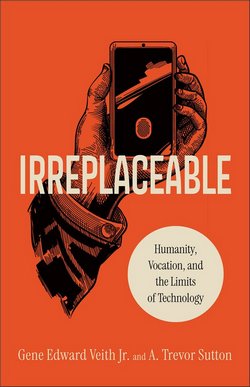
 Irreplaceable:
Humanity, Vocation, and the Limits of Technology
by Gene Edward Veith Jr. and A. Trevor Sutton
DETAILS:
Publisher: Baker Books
Publication Date: October 6, 2026
Format: TEXT
Length:TEXT
Read Date: TEXT


We may be God’s agents, but we also have our own agency. God works through us when we love and serve our neighbors, but we also resist him using the very gifts he has given us to love and serve ourselves, even when that means harming our neighbors. That is to say, we are sinners. We sin in our vocations. And we sin in and through and by means of our technology. In fact, if technology is a medium that extends and strengthens our human powers, it can extend and strengthen our sinfulness as well.
What’s Irreplaceable About?
Essentially, the authors set out to take the Protestant (particularly Lutheran) idea of vocation and apply it to the technology of the mid-2020s. Automation, algorithmic decision making, generative AI, and similar technologies make big promises—but how do they relate to human work, human service, human vocation?
How do we harness technologies as a tool and use them as such, rather than let them displace human workers and diminish them?
Where the Book Succeeds
“Chapter 1: Mediated Work: Our Tools and God’s Tools,” is the best part of the book—and it’s not even close. There’s a lot of wisdom here and it should be meditated on.
A lot of the later chapters about “Technology in ____ Vocations—dealing with work, family, society, church and so on, have a lot to offer as well. Some things that aren’t really worth talking about, too.
The more abstract the book gets, the better it is. It’s when Veith and Sutton try to get their hands dirty and deal with particulars that I find them struggling.
Where the Book Falters
Primarily it’s in what the book doesn’t do or try to address.
“H.C.,” you say, “is that fair? No book can do everything.” This is very true—it can’t and I shouldn’t expect it to. But in a book exploring ethical responses to emerging technology from a Christian perspective, I would like to see some things addressed. The ethics behind the development of this technology—the exploitation of the workers, the theft of intellectual property, the goals and methods of the producers. The impact this technology and its growth can have on the word around us—politically (both in party and governmental senses as well as in what it does to human society) and environmentally. Lastly, the effects it can have on the human mind, not just human vocation.
ChatGPT and the Writing of the Book
Chapter 3 starts with a dialogue between one of the authors and ChatGPT—copied and pasted for our benefit, as an illustration (at least partially). I thought it was interesting—particularly because I thought doing so clashed with a point made later in the chapter.
But I have to think a little—how much more of this book was done aided by it (or a similar product)? While I’d prefer the authors to be able to say straightforwardly “There was no AI involved outside this one illustration,” (or, not at all). I’d really like to read what else they got some help with.
Why did I pick this up?
To say that Gene Veith’s book God at Work: Your Christian Vocation in All of Life, was formative for me is to understate it. I can still hear passages and concepts from it as I think through things today. So another book by him related to the idea of vocation? Sign me up without hesitation or forethought. (which is literally how I got this copy, as soon as I saw the title and author, I requested it immediately)
Secondly, I’ve found myself in conversation and books this year about AI/Large Language Models/Generative AI-or whatever you want to call it. Really only one book was a conscious decision to explore it more (I really thought I could dip into things with Doctorow’s book and walk away, rather than getting curious enough to dive deeper)—and thoughts from a Christian who thinks seriously about things (as I assume his co-author did, too), seemed like a good follow-up.
So, what did I think about Irreplaceable?
While the present technological landscape will soon change, God’s plan for human work as a locus for loving our neighbors will remain. While new and difficult questions will arise with each new technological development, God’s callings on our lives and our vocational identities will remain. The more that technology changes the world, the more important it will be to discern God’s work in us and through us and how it has the power to bring about enduring faith, hope, and love.
If I had written this a day or two after finishing the book, I’d have been a lot more positive. But the more I think about it, the more problems and questions I have. So I’d better get this written now, before it becomes a pan, eh? (that was a joke, it’s not pan-worthy).
I do think the book fails to address the AI industry as it actually is, instead presenting it in a way as it’s sold on being and working. Were this book written a few years ago, before the folks at OpenAI had released anything, and instead focused on emerging technologies, social medias, and that sort of thing, I’d be speaking much more positively about it. This it too much about the idea of AI, not the reality as it now is (and seems to be headed).
I don’t need Veith and/or Sutton to be running around like a Chicken Little (even a correct Chicken Little), but I think we should take off the rose-colored glasses for a bit. I did write down a couple of times in my notes, “this is too pie in the sky.” And I probably could’ve done that more.
I like the thoughtfulness of the book. I really did think about some things in a fresher way—and anyone who can invoke the Sewing Riots, the Luddites, and Milton from Office Space within a page or two to build an argument, deserves reading.
We need more books like this, we need more people interacting with Biblical wisdom, insights from the ages past, and contemporary technology—both the doomsayers and the proponents. The conversation started here needs to continue.
Irreplaceable just didn’t deliver everything it should’ve—it took the easy way out on some topics, and skirted others. I think the authors are capable of more, and just didn’t deliver. But, I encourage those curious about addressing the ideas and issues from a conservative Protestant prospective, to pick it up and wrestle with it.
And maybe to come back and tell me where I’m wrong.
Disclaimer: I received this book as a participant in the Baker Publishing Group Nonfiction Reviewer Program—a book that I requested. However, as always here, the opinions expressed are my own.
This post contains an affiliate link. If you purchase from it, I will get a small commission at no additional cost to you. As always, the opinions expressed are my own.