

I tried to come up with a punny post title about the novel carrying a lot, like a bag. Just didn’t work.
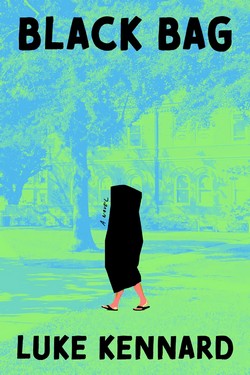 Black Bag
by Luke Kennard
DETAILS:
Publisher: Zando
Publication Date: March 17, 2026
Format: eARC
Length: 352 pg.
Read Date: March 7-11, 2026


What’s Black Bag About?
A struggling character actor (who seems to primarily pay the bills with dinner theater gigs) receives an unusual offer—a local university professor wants to hire him as part of an experiment. He is to attend three class sessions a week wearing a large black satchel—only his lower legs and feet are to be visible. He is to not interact with anyone—no speaking, no gesturing, no reacting to anything while on campus.
In exchange, Black Bag gets a roll of cash each week.
Easy enough, right? But it’s harder to not interact with other people than our actor realizes. And while this inspires him to look for other atypical roles, they’re not that easy to get (and he’s not that sure he wants them). His childhood friend—a game streamer—starts to see ways to monetize Black Bag (I’m not saying his friend’s hallucinogen use inspires these ideas, but I’m not saying they don’t). Also, another professor starts to take an interest in Black Bag for their own purposes.
So, what did I think about Black Bag?
Let me start by saying that the opening paragraphs to this are among my favorite in the last year or so—the rest of the book is worth the time, too.
Beyond that…I’m finding it difficult to really talk about what the novel seems to want to talk about without talking about events and things said in the last 10-20% of the book. I’m not sure how important it is to avoid plot points when discussing this particular novel, because the plot seems tertiary (at best) for Black Bag, but I have an aversion to doing that.
I’m not entirely convinced that Kennard has an agenda that he’s trying to push—and if he does, he’s certainly not leading anyone by horns to it—but he wants the reader to think about certain ideas/themes. Some prominent ones (I won’t try to be exhaustive here, I’d fail) are: the place of art in society and how it should try to shape discourse; the intensity of online communities—and how fragile they are; sex without emotional attachment; monetization of personal details online; post-humanism; academic politics; contemporary expressions of masculinity—and the various movements cropping up to address the “crisis” of it; the need for attachment to others.
If the plot is tertiary, the themes and issues in focus are definitely primary. I think the characters are, too. At times—and even now—I’m tempted to see the characters as flat, merely placeholders for Kennard to attach arguments/points of view on. Arguably, this is a valid reading. But each of the characters is more than that—they’re all fairly well-drawn, and the depth of each one is seen in the way they react to and interact with Black Bag. Just as Dr. Blend intended.
Do they project their desire for a get-rich-quick scheme onto it? Or perhaps they see it as a tool for sexual pleasure. One student sees the bag as a solid point to discuss the class with (at?) in place of the erratic professor. And then there’s the narrator himself, at times in danger of becoming more than Black Bag—detached from humanity, his career, his reality—losing himself to fantasy during the lectures, observing those around him, doing little more than noting their reactions to him. The more we consider how the characters respond to Black Bag, the more we see about them. And, breaking the fourth wall (the narrator does this himself, inviting the reader to do the same), the way the reader reacts to Black Bag at various points of the novel reveals something about ourselves, too.
The narration itself is deceptively breezy and light. It is possible to lose yourself in the pacing and ease of the narrator’s conversational address to the reader and gloss over details—inherently, this is a strength. It would be very easy for this book to fall over under the weight of its own pretensions, but Kennard protects it from that. It keeps the reader engaged and entertained—Black Bag is frequently funny, both in how he bumbles through life and how he describes that to the reader.
I also find myself asking at this point, how would I react to the novel on a re-read? Knowing where all of this is happening, what meaning that Black Bag finds (for example) in the experiment, how would I react to him at the beginning, and in his early sessions. As a thought experiment, I’m getting nowhere—but I can’t stop wondering.
Surreal and absurd in the best way, full of challenging ideas, and brought to life through a very oddball collection of characters, Black Bag is a novel you won’t soon forget (nor will you want to).
Disclaimer: I received this eARC from Zando Projects via NetGalley in exchange for this post which contains my honest opinion—thanks to both for this.
This post contains an affiliate link. If you purchase from it, I will get a small commission at no additional cost to you. As always, the opinions expressed are my own.
