I’m tempted here to take 90% of post about Hive from last May, switch out the titles and say, “good enough.” Because…it really would be. I won’t, because that feels like cheating. But…if things sound eerily similar, there’s probably a reason. I plagiarize myself all the time in real life, I might as well do it here, too.
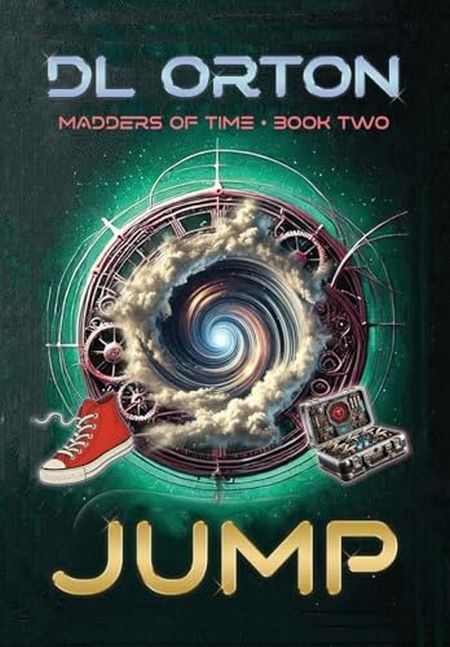
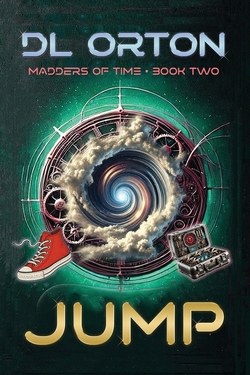 Jump
Jump
by D. L. Orton
DETAILS:
Series: Madders of Time, Book Two
Publisher: Rocky Mountain Press
Publication Date: November 4, 2025
Format: Hardcover
Length: 406 pg.
Read Date: February 14-16, 2026


What’s Jump About?
This picks right up from the end of Hive, but we get to see a more global scale—it’s not just around the Denver area that things are bad all over the world. And getting worse. There are a handful of efforts to save the world—more efforts to save portions of humanity (read: powerful and rich, with a few smart ones to keep things running)—and, of course, our rag-tag group of scientists and dimension-travelers.
And, I really don’t know what to say without getting way too complicated (it ain’t easy recapping multiverse stories and all their varying apocalypses). What’s Jump about? It’s about what happens after Hive, and before Dome (coming soon from D.L. Orton). While the world races past dystopia toward chaos, mass starvation, and general devastation—some people try to save it. Or at least another universe from falling into the same hole.
Why did I pick this up? Why did I keep reading?
I picked this up because I was curious about where Orton was going to go with things.
Why did I keep reading? That’s simple—once you read a few pages, you can’t help keep going—I could probably come up with a list of things I could fault Orton’s writing for if I wanted to (I don’t want to, see no need to, etc…I’m just saying I could). But getting the reader to keep turning the pages as fast as they can wouldn’t show up anywhere near that list. Her writing is like that old Pringles slogan, “Once you pop, you just can’t stop.”
What does this book tell us about humanity?
Nothing good, sadly. Well…let me take that back. Before I get too far with the thing that has really captured my mind over the last day, something I thought about while reading is just how immutable certain things in the multiverse may be: Diego and Isabel (in whatever variants of spelling/language/nicknames they may be known by) are gaga over themselves. Have the same interests and pursuits—and name their kids the same thing (although they don’t all have them, they plan on using the same ones). Dave is an evil, manipulative, scumbag everywhere (with some minor variation of degree possible). Matthew is basically Matthew wherever.
Compare that to the multiverses in Fringe for example—some parts of Olivia are the same on both sides, but not nearly as much. The Walters are freakishly different. And so on. Or even the variations in the Spider-Mans in the last movie—differences in powers, Mary Janes, villains, life experiences (only one has been to space!).
Whatever minor variations Orton does show, they are so small as to be negligible. I just think that’s strange.
Now back to the nothing good—there are essentially three groups of people we see in this book (more than Hive).
First, you have the overwhelming mass of humanity—they’re starving (and it’ll get worse), their access to electricity, heat, medicine, is severely limited. It’s a barbaric existence for them—and it’s about to get so much worse. It’s all about survival from one day to the next for them.
Then you have the “Elite”—they’re rich, they’re powerful, they use government resources (and then pretty much ignore all the governments that are helping them) to “save humanity.” As long as that humanity helps them get richer (because that’s important), can give them access to the disappearing resources of Earth, and/or can keep things running. They couldn’t care less about the people outside of the Domes, and will do horrific things to preserve said Domes.
Even our “good guys” who are—to be the one to travel. Period. End of discussion. So what does he do? He takes off on a risky mission for the sake of the woman he loves—and (no offense, Isabel) she really doesn’t seem to have a role to play in the “saving the world” bit. I’m not saying let her die, or anything—but we’re talking about the fate of humanities, here. Also—the princess can save her self, thank you very much.
You still like them, you’re still rooting for them, you still smile at their jokes—but, when the book is done and you can breathe and reflect? They may end up saving multiple realities (or even just one!), but I’m not sure they’re heroic. Which is not necessarily a bad thing, you just prefer them to be a bit more so.
So, what did I think about Jump?
It’s exactly the kind of escapist read that helps you unwind after a long day.
It moves, it’s fun—yes, it’s full of existential despair, but it keeps the focus on the non-despair inducing/horrific things—the characters and situations are compelling. And there’s part of you (well, part of me, and hopefully I’m not alone in this) that keeps thinking “if I just stick with it, I’ll actually understand all the various multiverse strands.” That part isn’t quite as important, but if I tried to diagram it all, it wouldn’t be pretty. It’d also be pretty inaccurate.
I’d love for Orton to show us all how she kept everything straight.
The tech is very cool—particularly the “baby” version of the old AI we meet in Hive. Orton gives you enough to understand how it all works and to visualize it clearly without bogging down the pace with paragraphs and paragraphs of details. The plausibility of it all? Eh, it’s SF, it’s plausible enough if you come with a standard level of suspension of disbelief needed for time travel/multiverse travel.
Because of the pacing, Orton’s able to get away with a few things that maybe she couldn’t in a slower-moving book. The depth of the characters that could be brought out are merely nodded to, or you have to assume them. You have to assume there’s something about the tech elites that got them where they are, despite being horrible people who can miss a whole lot of things their underlings are doing—and to keep working together despite the clear animosity.
I thought this last time, and I’m more certain of it now, most of my problems can be laid at the feet of the pacing—to keep things moving, she can’t develop these things with much more than a nod. I’m not necessarily wild about how things work out because of that, but I understand the reasoning, and can sit back and enjoy it.
I want to stress, however, in the moment, you don’t think about this (and if you do, you brush it off because you don’t want to step out of the movement). Everything works, everything clicks while you’re reading and speeding off to the next twist/revelation. It’s only after you get to the ending that leaves you holding onto the cliff’s edge with your fingers that this might occur to you if you stop and think about it. Mostly, you’re going to be thinking about how long it will be until you can get your hands on the next book, Dome.
It’s easily enjoyable, engrossing, and entertaining. You should give it a try.
This post contains an affiliate link. If you purchase from it, I will get a small commission at no additional cost to you. As always, the opinions expressed are my own.