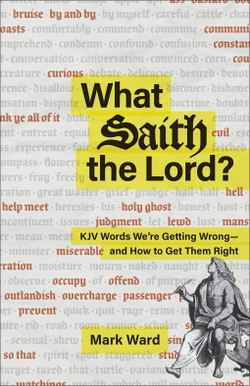
 What Saith the Lord?:
KJV Words We’re Getting Wrong—And How to Get Them Right
by Mark Ward/a>
DETAILS:
Publisher: Baker Books
Publication Date: November 3, 2026
Format: eARC
Length: 304 pg.
Read Date: November 11, 2026


What’s What Saith the Lord? About?
Ward starts off with a basic premise—languages, like English, change over time. There are several reasons for this—some good, some bad, some…just happen. This is how languages work. So despite Elizabethan (more specifically, Jacobean) English and contemporary English both falling under the category of “Modern English,” there are a lot of ways they differ—even when it comes to specific words. So a book published in 1611 is going to use many words differently than even a highly educated and well-read person in 2026—much less your man/woman/child on the street today.
One such book published in 1611 is the Authorized Version of the Bible—better known as the King James Bible. Ward sets out to look at 38 words that most of us think we understand (and we do), but not in the way the translators of the KJV did.
Ward’s goal is not to discredit the KJV—he uses it and appreciates it (and wrote a whole book talking about how it can/should be used today, Authorized: The Use and Misuse of the King James Bible—a book I meant to read 7 years ago, and was only reminded of when I started this). His goal is to help users understand it better—and to equip them to do so.
Ward’s Method (also a weakness for reading the book)
Yes, Ward wants to impart some understanding of the 38 words he selected in this book (he has a list of 150 that would’ve worked as an appendix). But his approach follows the pattern of “give a man 38 fish, you’ve fed him for 38 verses (or so); teach a man to fish, you’ve fed him for a whole translation.”
He has five steps to use for one of these “false friends” (as he calls them)—and walks through those steps in each chapter—giving each chapter pretty much the same outline (he varies how much space he uses on each step per chapter).
This is the biggest weakness of the book—it gets a bit repetitive if you read it in big chunks like I did (it’s probably just as repetitive if you read a couple of chapters at a time, but it’s just not as mind-numbing)
Another problem I have is how often he repeats certain disclaimers—for example, no, he doesn’t think the KJV translators got a word wrong, they just didn’t realize what would happen to the language over 400 years. I didn’t bother counting how many times he said that—but I do wish I had to make this illustration better. I assume this was done because he can’t assume the reader will go cover to cover, but might just tap into a chapter here and there: “What’s up with ‘passenger?'”, “‘By and by’ used to mean something else?”, “I always wondered why Pastor said, ‘drink ye all of it'”
These don’t detract from the value of the book, it just makes reading the book in one sitting a little sluggish (okay, one sitting with a nap-mid way through)
Strengths
This is a word-nerd’s delight—especially if you’re into Bible Study. I picked up so many handy insights and trivia, along with a better understanding of some phrases/words that I’m calling this a win. There were only a couple of chapters that didn’t interest me (“ass” and “bastard” are good examples, everything he gave was pretty obvious to me in them—although his application of 1 Cor. 14 in the “ass” chapter made it worth it—we need to make sure the words we use mean what we think they do for the unbeliever in our midst)
He makes few outright jokes (and those he does are pretty good), but throughout he keeps things light and fun. Because there aren’t a lot of people that relish the history of the meaning of “sodden” or “replenish” the way Ward and I do, so his light tone is the proverbial spoonful of sugar for most readers. And it’s just a nice bonus for the nerds among his readers (he uses the term for himself in this context, it’s not derogatory).
He Was Maybe Too Successful
Frankly, I walked away from this book thinking that people should really rely on the KJV less than they do. I’m not going to get into textual criticism or any of the other things Ward (wisely) avoids. He’s trying to make the KJV more accessible, which is a fine motivation. But I think he was too successful in showing the damage these words can do to one’s understanding.
The old line that so many give (and he repeats here), “if you have a question, use a Dictionary” is good and sound. But there several words he focused on here that Ward didn’t realize were a problem until he started writing the book—some he learned about just before he wrote a chapter (i.e., it wasn’t on his original outline for the book). If the guy who’s whole shtick is “watch out for these tricky words” didn’t know he wasn’t seeing a problem, how are us non-Biblical scholars?
Also, the tools he recommends using aren’t cheap. And really should be used with a decent understanding of Biblical Hebrew and Koine Greek. So, he might have tried to teach me to fish, but he really didn’t take into account that I get my metaphorical fishing gear from thrift stores and charity shops—and I think most of his readers are at similar levels.
So, what did I think about What Saith the Lord??
Other than where I think he overshot his goal, this book is great.
It’s incredibly approachable—readers from 7th grade to 90 years can read and benefit from it. The tone is good, the information is solid and useful.
And for those who have the means and the time, his research steps would be very helpful, I think. I can see myself doing them (if I read the KJV often).
I strongly recommend regular users of the KJV pick it up—especially if you don’t think you need a book like this. Word nerds who looked at any of my examples above and said, “ohhh?” should also get it. Really, anyone interested in the use of the KJV or semantic drift would benefit from this.
Really, it’s a winner all around. Maybe even better than the author meant it to be.
Disclaimer: I received this eARC from Baker Books via NetGalley—my thanks to both for this. This post contains my honest opinion about a book I chose (and asked) to read.
This post contains an affiliate link. If you purchase from it, I will get a small commission at no additional cost to you. As always, the opinions expressed are my own.