

I think this is coherent, there are five different attempts at writing something represented below. I finally filled out my outline, but I’ve spent so much time on the post, I’m not sure how much it makes sense.
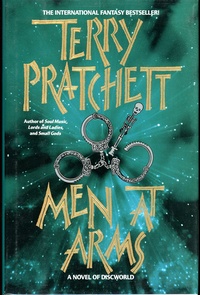 Men at Arms
DETAILS:
Series: Discworld, #15; City Watch, #2
Publisher: HarperPrism
Publication Date: January 1, 1993
Format: Hardcover
Length: 341 pg.
Read Date: August 1-5, 2025


“You see,” said Colon, “thieves are organized here. I mean, it’s official They’re allowed a certain amount of thieving. Not that they do much these days, mind you. If you pay them a little premium every year they give you a card and leave you alone. Saves time and effort all around.”
“And all thieves are members?” said Angua.
“Oh, yes,” said Carrot. “Can’t go thieving in Ankh-Morpork without a Guild permit. Not unless you’ve got a special talent.”
“Why? What happens? What talent?” she said.
“Well, being able to survive being hung upside down from one of the gates with your ears nailed to your knees,” said Carrot.”
What’s Men at Arms About?
The Night Watch is in flux—Captain Vimes is on the verge of retiring, and there are questions about who his successor will be. There’s a class of recruits that need to be trained—including a (gasp) woman. Our friends from the first book are trying to navigate this, train these recruits—and get their job done.
The job is made a bit more complicated when a murder victim shows up—killed by some sort of weapon no one on Discworld has seen before. Two guilds are implicated in this, the tensions between two non-human races are stoked due to the investigation, and the Night Watch has only a little time to get to the bottom of this all.
Fantasy Races
It was a state of permanent inter-species vendetta and, like all good vendettas, didn’t really need a reason any more. It was enough that it had always existed. Dwarfs hated trolls because trolls hated dwarfs, and vice versa.
I don’t remember Guards! Guards! doing a lot with the whole fantasy race thing—there were humans and dwarves, right? Maybe some mentions of others, but I don’t recall it being that big of a deal.
Here we have more dwarves and trolls—and a lot of animosity between the two races. We also have plenty of reasons to see how ridiculous expressions of this animosity (and probably even the grounds for it) really are.
I really found this a compelling aspect of the book, particularly the way that two of the Watch’s trainees (one from each race) learned to work together—it’s not in an after-school special way, but one that felt genuine.
The Gonne
A handheld firearm has found its way into Discworld, and the results are devastating.
Several people want it destroyed—and definitely don’t want it replicated. But when they get it into their possession, they can’t seem to destroy it. In fact, many become obsessed with it, it’s like they start to take orders from it.
Back in 1993 (original date of publication), Terry Pratchett saw the attraction of the power that comes from wielding a handgun and depicted it in a way that feels incredibly of the moment. Obviously, this has been something humans have been dealing with for a long time—it’s nothing new—but I don’t remember coming across something so clear, so incisive along these lines until more recently.*
* Sure, this may say more about what I’ve read than it does about Pratchett…but even the more sensitive treatments I read that are older than this don’t seem to get it as well.
So, what did I think about Men at Arms?
Colon thought Carrot was simple. Carrot often struck people as simple. And he was. Where people went wrong was thinking that simple meant the same thing as stupid.
I didn’t find this as funny as Guards! Guards!. It was quirky, and odd, and amusing—yes. Which isn’t to say that it wasn’t riddled with great lines. It was entertaining as all get out—and I enjoyed it almost as much. But it was more focused on character development, story, and social commentary than yucks and guffaws. It’s probably a better novel over all, honestly. But not as fun.
So it really wasn’t what I expected, which is a shade disappointing. But what I got instead is a superior product—with some great avenues for future stories. I didn’t expect to have emotional reactions to what happens to characters in a fantasy novel that I expected to laugh my way through! (the reactions might have been small since I didn’t know them that well, but still, it was outsized for how many pages I’d known them for)
As much as I enjoyed Captain Samuel Vimes and what happened with him—I really didn’t appreciate Sybil Ramkin. I thought she was great in Guards! Guards!, but she was a giant let-down here. I expect that to change in the future. I’m really excited about the possibilities for Vimes going forward.
Carrot…good ol’ Carrot. As great a character as I thought he was coming into this—he was far, far better throughout. Especially what we got to see of him through the eyes of other characters—particularly Lance-constable Angua von Überwald (who’s just a great addition regardless). It’s one thing to give us things from his perspective, or from the omniscient narrator’s point of view—but for us to see what others see in him, particularly the intangible stuff, and how they’re confused by his success—utterly fantastic.
Whatever my issues with Pratchett were before Guards! Guards!, they are well and truly dead and buried. I’m going to work on devoting more time to him in 2026 (if not before). This was a great read with depth I didn’t expect (but maybe should’ve) in one of the strangest fantasy worlds I’ve encountered. Funny, thoughtful, deep (in the right ways), absolutely silly (in the right ways).

This post contains an affiliate link. If you purchase from it, I will get a small commission at no additional cost to you. As always, the opinions expressed are my own.
