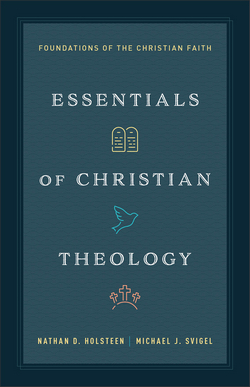
 Essentials of Christian Theology:
Foundations of the Christian Faith
by Nathan D. Holsteen, read by Michael J. Svigel
DETAILS:
Publisher: Bethany House Publishers
Publication Date: November 18, 2025
Format: Paperback
Length: 304 pg.
Read Date: January 12-18, 2026


What’s Essentials of Christian Theology About?
About a decade ago, these editors edited a trilogy called Exploring Christian Theology. It seems to be written by Dallas Theological Seminary faculty (I didn’t spend a lot of time looking, so I’m not going to state it strongly).
Now, the editors have taken that set and compressed it into one volume, covering Scripture, The Trinity, Humanity and the Fall, Salvation, The Church, and Eschatology. The emphasis is on the areas of agreement throughout Evangelicalism (and beyond, when possible), and points to some areas of controversy.
Each chapter also contains the following elements:
- “In Short…” provides brief surveys of each doctrine with points of unity and diversity.
- “Passages to Ponder” explains key Scriptures related to each doctrine.
- “Realities to Remember” presents the foundational truths for each doctrine.
- “Errors to Avoid” exposes false teachings associated with the doctrine.
- “Lessons to Live” explores practical implications and applications for each doctrine.
- “Snapshot of History” summarizes the history and development of each doctrine.
So, what did I think about Essentials of Christian Theology?
So, I clicked the wrong button when picking some books for Baker’s Review Program, and didn’t intend to get this book. I didn’t have any active disinterest (or worse), I just didn’t expect this to be for me—I’ve read enough of Svigel online to know that our traditions are enough that I’d have plenty of quibbles (at best) with this. Also, the last thing I was in the mood for is another survey of the essentials of the Faith—I’ve just read too many in the last few years.
But this was in the box, so I gave it a shot. And…it wasn’t bad. It’s not the kind of thing I’m going to be handing out to anyone—but I’m not going to pan this. There’s a lot of good here—just not enough.
My biggest issue doesn’t actually come from the areas I disagree with—it’s just that it’s too shallow. It’s to be expected—it’s about one-third as long as the series it’s based on. So, right there, a lot is going to be missing. Also, and this reminds me of the Christian Essentials set I talked about a few years ago—it’s trying too hard to be something for everyone. It’s a noble ideal, but you can’t do justice to the swath of American Evangelicalism’s (sadly present) diversity in a few pages.
The editors clearly tried their best, but it’s too hard—you come out with something that’s just too shallow. I’d have preferred a stronger Dallas Theological Seminary perspective that I’d have stronger issues with than a watered-down take. I do have some questions about how they present some historical perspectives, and some theological points—but the text is vague enough that I can’t be bothered to talk about them.
Well, except for the Eschatology chapter—which is to be expected. But I went into it, expecting something a DTS-flavored eschatology. But I don’t think they did a good job of representing amillennialism or postmillennialism—and I’m not crazy about the limited perspective they have of Eschatology’s place in Christian Theology. But as far as the position they were most interested in advancing and describing? It was just bland and not particularly compelling. Like just about everything else.
I thought the sections on the Trinity were helpful, and I had no great exceptions to the rest of the book. I also didn’t feel challenged or pressed to look into anything more. I didn’t expect that, but I was hoping.
This is a perfectly fine book. But it could’ve been stronger if they’d narrowed the audience they hoped to reach. I wouldn’t discourage anyone from buying it or reading it—in fact, I know a few people who’d probably appreciate it. I just think you could do better. I imagine the Exploring Christian Theology trilogy that served as a basis for this book would be one place.
Disclaimer: I received this book as a participant in the Baker Publishing Group Nonfiction Reviewer Program. However, as always here, opinions expressed are my own.
This post contains an affiliate link. If you purchase from it, I will get a small commission at no additional cost to you. As always, the opinions expressed are my own.