
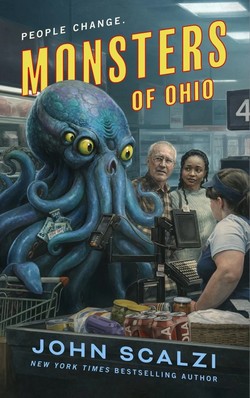
 Monsters of Ohio
by John Scalzi
DETAILS:
Publisher: Tor Books
Publication Date: November 3, 2026
Format: eARC
Length: 272 pg.
Read Date: October 16, 2026


What’s Monsters of Ohio About?
Mike Boyd, whose job in DC was recently eliminated due to sweeping cuts, returns to the small Ohio town of his birth to live with his dad and his second wife (not really a stepmother, as Mike was an adult when his father remarried). His dad’s wife isn’t crazy about giving up her crafting room for him—or pretty much anything else about Mike. For that matter, she seems to think of his father in pretty much the same way (which is reciprocated).
But hey, free rent.
Several people that Mike grew up with are still in Richland—as are their families. Almost everyone works for one employer. And those that don’t work in industries supporting them. So with the growing rumors of the plant closing soon, Richland is on the verge of closing soon, too. It’s a bad time to come back home.
Mike’s closest friend in town is the Chief of Police. Dave is also the entire police department. It’s that small of a town. Shortly after Mike comes home, Dave is called to a farm to investigate something that happened to a prize-winning cow.
It’s truly difficult to describe what happened to the cow—and what starts happening throughout the town. So I won’t try—but it takes a mind like John Scalzi’s to cook it up.
Why did I pick this up? Why did I keep reading?
I picked this up for three reasons:
1. John Scalzi
2. That cover—I don’t care who wrote it, but that cover deserves investigation. Seriously, go look at it again—even better, go look at a larger version, too. Great work.
3. I heard Scalzi read the Prologue at a signing last year—and I just had to know what came next.
I kept reading for reasons 1 and 3. Reason 1 means it’s a fun, funny, and quick read that just makes you want more. And number 3 did not prepare me at all for what I got—which was perfect.
What does this book tell us about humanity?
I think the main thing here is adaptability. Which isn’t always a good thing, but it is something that really defines a lot of humanity.
There are some characters who’ve gone through changes before the events in this book—changes in their lives that forced them to change (or, provided opportunities to change). Some of these changes were for the better—being forced to change careers, for example. Others weren’t—becoming isolated, jaded and radicalized to the point that your own family wants nothing to do with you.
Then all of these characters are put in a situation that no one could’ve expected or predicted—and, if they had, no one would’ve believed them. And after some initial shock—they adapt. Most of them rather quickly
People, when dropped into situations they’re unprepared for, have an amazing tendency to find ways to cope, and this book celebrates that. People, uh, find a way.
(yes, not all the ways people do this in reality are that great. Not everyone survives this kind of thing, either, tragically. I’m talking in broad generalities here)
Also, shortly before publishing this post, I realized that the words “People Change” are on the cover. This whole section is just a wordy and unnecessary restatement of the tagline.
So, what did I think about Monsters of Ohio?
This was ridiculously fun. There’s an amazing lack of realism to this—which is utterly fine, if you roll with it, you’ll be okay. If you can’t handle it, this isn’t a book for you, just know that going in. Don’t suspend your disbelief, save yourself the subscription rate and just cancel it for the duration.
I think I read something describing this as a cozy horror, and I can think of no better way to put it. The science behind it is pure fantasy (but would’ve been considered science-y in a 1950s movie). The metaphors are strained, but apt. The politics are absolutely not subtle.
Most of the characters we meet—even those we don’t spend a lot of time with—are given a solid, believable backstory. And those backstories are given to the reader in such a way that my reaction to them was basically, “Can I get three chapters just with this person?” Honestly, I don’t think we got enough of any of them. There’s one young character in particular (keeping as vague as possible), that I felt very short-changed with. Their arc was satisfactorily resolved—I just enjoyed them enough I wanted more of them.
For example, one of Mike’s high-school buddies is Richland’s answer to Kirk Gleason, man of a thousand jobs. One of Bill’s jobs is delivering pizza. What that job enables him to learn about people—and the fact that he does so—tells us a lot about Bill (as well as shedding some light on a couple of other characters). It’s a great way to get to know someone.
Is the ending maybe a little too feel-good? Maybe bordering on cheesy? Yes and yes. Did I care? No and No. This is escapist SF fun, with a little social commentary thrown in along the way. The bad guys get beaten and everyone else may not get a Happily Ever After, but they do get a Happier Ever After—and that’s good enough.
This is one part 50s Sci-Fi/Horror flick. One part comedy. One part cozy. And all parts fun. Strongly recommended.
Disclaimer: I received this eARC from Tor Publishing Group via NetGalley—my thanks to both for this. This post contains my honest opinion about a book I chose to read.
This post contains an affiliate link. If you purchase from it, I will get a small commission at no additional cost to you. As always, the opinions expressed are my own.