I don’t normally publish review-ish posts on Saturday, but I have a deadline—and after weeks of trying, I have a draft I can live with (deadlines are my friend). So, hope you don’t mind this out-of-place post.
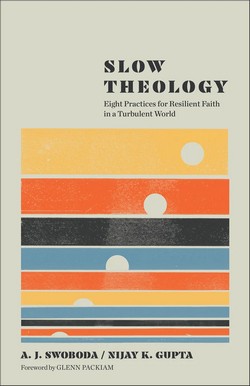 Slow Theology:
Eight Practices for Resilient Faith in a Turbulent World
DETAILS:
Publisher: Brazos Press
Publication Date: September 23, 2025
Format: Paperback
Length: 208 pg.
Read Date: January 4-11, 2026


Wouldn’t it be great if we were simply given simple and immediate answers to all our questions? Lord knows, it certainly would make all our lives easier if God sent us a quick note the way a friend would send us a text message. But the deepest questions do not necessarily deserve quick answers. In fact, the quick answer very well may cheapen the sacredness of a holy question. Moments like these—when we seek to understand as best we can the theological conundrums that Christians have been meditating on for centuries—actually demand from time to time that we resist the temptation to offer quick answers and shallow hot takes. Deep questions deserve deep responses, which require lots of time, energy, and toil. Sometimes, deep Christian formation is possible only when we embrace the unanswerable. To try to solve a question that has been wrestled with for thousands of years with a short tweet, YouTube clip, or pithy bumper sticker is the most dangerous and flippant of responses.
Not every question that we may ask about God can come back to us as a neat and tidy package with a pretty bow on top. We believe that the importance of creating space for unanswered or unresolved questions is modeled by the inspired Scriptures.
What’s Slow Theology About?
We live in a hurried world, where untold information is at our fingertips (and the amount of it grows all the time), rushed “hot takes,” we demand answers—fast—and seem to receive them on all subjects at all hours, we want instant results from exercise/financial investments/diets/self-improvement schemes. This is the atmosphere we in the West are immersed in, believe in, and live by. Quick Fixes, Fast Solutions.
But the Bible doesn’t tell us to be that way—particularly when it comes to our understanding of God, His revelation, or our sanctification. Instead, we’re told to patiently slow down, persevere, listen, and think.
The authors give us eight practices—practices, not disciplines, not steps, not a “just add water” approach—to help build this into our lives, minds, and hearts.
They include: taking a long view of faith, applying the Sabbath to our theology, talking to God through our difficulties, believing with the Body of believers, appreciating mystery, and perseverance.
That’s probably an oversimplification of the book—but if I don’t oversimplify, you’re going to get a novella-length summary. And neither of us has time for that (especially when we could be reading/re-reading/chewing on this book instead)
Highlights
My practice with Non-Fiction books is to talk about the parts of the book that I found particularly helpful, informative, or whatever. In keeping with that practice, I should note Chapter 1, Chapter 2, Chapt—yeah, that’s just not going to help. This book started off strong and went from strength to strength.
But there were a couple of things that really stood out to me. There’s a good section on Asaph and Psalm 73. I admit to a little bias there—ever since a sermon series my pastor delivered in the 90s, the psalms by Asaph and his sons have been my favorite. But I think this section on Psalm 73, and the honest and faithful way Asaph dealt with challenges would’ve stood out to me regardless. Things don’t all work out for Asaph in this psalm, but he knows his God is with him as he works through them.
I’d also point out the section on lament. I’ve pointed to books discussing it well a few times in the past (I’m sure, don’t ask for examples), and here’s another one worth turning to time and again. The authors focus on Jesus and David in this exhortation, and it struck home to me. In response to so much of the news lately—this is a practice I fear we’re going to need to focus on.
There is a wise saying that gets passed around: “To cry is human. But to lament is Christian.” Lament is the biblical practice that we have been given to process our hurt and anger with God and not just against God. Lament actually invites us to be openly upset with God, not to push him away but to invite him to respond. Not long after Jesus questioned the presence of God, he was raised from death to life. Lament, in the end, is hope-filled desperation.
Drawbacks
I’m sure there are some. I didn’t take note of them on an initial read. Hit me up after a few re-reads, if you’re dying to hear about any quibbles.
So, what did I think about Slow Theology?
You ever read one of those books, and by the time you’re mid-way through, you just know that it’s going to be living in your head for the rest of the year or so? That was the case with this one by Chapter Two. Nothing happened to change my appreciation after that. This is going to be one of those books I’m going to be bouncing off of for at least 12 months.
I should say that I’ve never listened to the podcast by the authors with the same title. I probably should start.
This is a book full of wisdom. It’s something to chew on—meditate on—to come back to and reason with. This shouldn’t be something read once and discarded, thinking you’ve got it down cold. It’s not about information or answers, it’s about practice. (mentally insert the Heidelcast’s riff on the “Not a game, not a game. It’s about practice” quotation here, if you know what I’m talking about)
I strongly encourage you, reader, to pick this one up. I think you’ll be rewarded.
Disclaimer: I received this book as a participant in the Baker Publishing Group Nonfiction Reviewer Program. However, as always here, I read this book because it interested me and the opinions expressed are my own.
This post contains an affiliate link. If you purchase from it, I will get a small commission at no additional cost to you. As always, the opinions expressed are my own.