

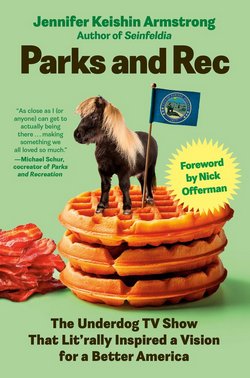
 Parks and Rec:
The Underdog TV Show That Lit’rally Inspired a Vision for a Better America
DETAILS:
Publisher: Dutton
Publication Date: April 7, 2026
Format: Hardcover
Length: 268 pg.
Read Date: August 13-28, 2026


What does the Dust Jacket Flap Say About Parks and Rec?
More than fifteen years after Parks and Recreation premiered, it has become a streaming staple. It’s beloved for its jokes, characters, and expressions—the show even created a now widely observed holiday, Galentine’s Day. How did it all happen and how did the show transform from a ratings disappointment into a cult classic? Pop culture historian Jennifer Keishin Armstrong reveals all this and more in the authoritative history of the show, which is as full of humor, optimism, and heart as Parks and Recreation itself.
Through new and exclusive interviews, as well as deep insight and smart and entertaining pop culture analysis, Armstrong tells the story of how Parks and Recreation came to be: how it grew from The Office’s success and Obama-inspired optimism, how producers assembled one of TV’s most lovable casts but barely survived a mediocre first season, how the show found its voice by getting more political and more romantic, and how it became a cultural force despite middling ratings during its network run, going on to become a television savior of the Trump era and a modern classic.
Lovingly told and deeply researched, Parks and Rec is the ultimate history of the show that taught us what’s important in life: friends, waffles, and work.
The Heart of the Book
The subtitle tells the reader what to look for: “The Underdog TV Show That Lit’rally Inspired a Vision for a Better America.” But it’d be clear without that. The Introduction, as it should, points you in the right direction, but the ninth chapter, “‘A Singularly Compelling Representation of the Liberal Spirit’: Political Philosophy in Parks and Rec,'” is Armstrong cutting loose and saying most of what she wants to say about the show, what she’s been slipping in here and there throughout.
The final chapter, “‘Rupture and Repair’: Parks and Rec Meets the Modern Moment,” comes close to that—it focuses on the lasting impact of the show, the popularity on streaming (especially during the pandemic years of 2020/2021), as well as the brief reunion show during the early days of the pandemic.
It felt to me that these two chapters were what Armstrong really wanted to talk about, and she did the rest of the research and writing as an excuse to get them on paper. I’m sure that’s not true, but it really felt that way to me. Honestly, I’d have taken more of Chapter 9—either as a lengthier chapter or with a follow-up chapter on a similar theme. One, because they did seem like Armstrong’s voice and perspective came out clearer there than in the other chapters—but also because I think she probably had more to say on the topic.
My one question about it, however, is the placement. After a few chapters focusing on the individual seasons, we cut away for a look at the political philosophy—before returning for the last two seasons. It was jarring to be taken out of the BTS of the seasons for this discussion, and then jarring to go back to it. There’s a little overlap with the themes of the chapters on either side of it, but it wasn’t enough for me to feel comfortable. It also seems like a good wrap-up chapter before the last chapter.
The One Drawback
Armstrong—as I’m sure she was trained to do—keeps the prose straightforward and fairly dry. Yes, it’s clear that she loves the show, knows a lot about it (probably before her research, too), and appreciates the humor.
But none of that humor comes through. Compare that to What’s Next, about The West Wing (a drama), the authors are joking throughout—about the actors, the characters, stories/scenes. But this book about a comedy? Outside of the foreword, it’s practically without humor (it might even be more than practically, but I might have forgotten a little)
Although, if you really want all that, you can check out Jim O’Heir’s Welcome to Pawnee.
The Foreword
I don’t want to say too much about Nick Offerman’s foreword other than it’s possibly the best one I’ve read this year. It’s funny and heartfelt—it’s everything a fan wants to read a cast member from a beloved show say about that beloved show.
So, what did I think about Parks and Rec?
This was a strong and loving tribute to the show, the spirit of the show, and the ideals it was built on. What Armstrong gained from the interviews and relayed was great. Sure, some of it differs from, if not downright contradicts, what I’ve heard in interviews with various cast members—but that probably says more about the cast’s individual memories than it does Armstrong’s work. (it’s probably safer to believe her version)
One of the primary things I judge a book about a TV show on is: does it make me want to watch the show? Yes, yes it does. Granted, almost anything does—but this book really made me want to pull out my Blu-Ray box set and ignore the world for a couple of days.
I gained a greater appreciation for a lot of what the writers and actors were trying to accomplish; I loved some of the BTS material about episodes/scenes that mean a lot to me. And hearing about the appreciation that the cast had for each other, that guest stars had for their experiences, and that the writers and crew had for the project, just made me enjoy it all the more.
If you’re a fan of the show—or think you should be one—grab this.
This post contains an affiliate link. If you purchase from it, I will get a small commission at no additional cost to you. As always, the opinions expressed are my own.
