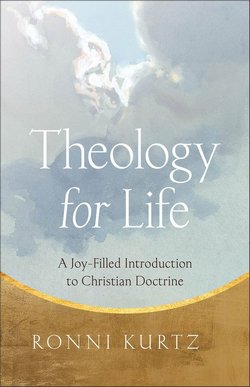
 Theology for Life: A Joy-Filled Introduction to Christian Doctrine
by Ronni Kurtz
DETAILS:
Publisher: Baker Books
Publication Date: September 8, 2026
Format: Hardcover
Length: 256 pg.
Read Date: September 27-October 4, 2026


This book is built on a rather simple conviction: One of the most practical things we can do in the Christian life is get an eyeful of the beauty of the Lord. In a world overflowing with to-do lists and self-help manuals, where pragmatism feels like a gravitational pull, giving sustained attention to the glory of the Lord is among the most preeminent ways to cultivate our souls and shape ourselves as persons.
Contemplating the beauty and glory of the Lord might not feel practical, if by practical we mean helping to meet some utilitarian goal like getting that promotion or being a better whatever. On the contrary, if getting an immediate payoff is the full depth of what it means for something to be useful, then much of theology would be useless. However, if we reconsider what it means for something to be useful and desire more than a shallow behavior or circumstantial modification; if instead we strive for the much more difficult goal of being formed as a person, where we are not merely modified but truly conformed, then what was once “useless” theology will show to be gloriously purposeful.
For example, take the apostle Paul’s instruction for the church in Corinth: “And we all, with unveiled face, beholding the glory of the Lord, are being transformed into the same image from one degree of glory to another. For this comes from the Lord who is the Spirit” (2 Cor. 3:18). Notice Paul’s goal for his readers: to be “transformed into the same image from one degree of glory to another.” The image Paul is referencing in this vital verse is none other than the image of Christ. Paul wants the Corinthian Christians to not merely modify a few behaviors or become a better version of themselves. Rather, Paul wants them to be transformed into the image of Christ. What is easy to miss in this passage, however, is that Paul not only gives the Corinthians a goal—to be transformed into the image of Christ—but also tells them the way they will achieve this goal. It is through beholding the glory of the Lord that believers will be transformed into the image of Christ.
What’s Theology for Life About?
To accomplish this—or at least to introduce readers to this lifelong practice—Kurtz examines “ten doctrines and theological ideas” of Christianity, examining them in a way that is approachable—but that might challenge some readers.
After defining and describing them, he looks for some ways (not exhaustively) that these ideas and doctrines will help the reader to behold the glory of the Lord and be transformed in them.
These doctrines/ideas are:
- The Trinity
- The Divine Attributes
- Creation (and not just in a focus on creationism vs. other ideas)
- Scripture’s Authority
- The Incarnation
- Justification
- Union with Christ (one could argue that this should come before Justification, but…eh)
- Preservation
- Ecclesiology
- Eschatology
Each item on that list gets about twenty pages—enough to satisfy the reader of an introduction, and enough to make someone want to learn more about some of these—with good footnotes to indicate further reading. I know I added a couple of titles.
Doctrine that Leads to Delight
…in this book, we will turn toward Christian doctrine not just to become better thinkers and theologians but with a particular goal in mind: delight. To put it plainly: Delight is what this book is after, and beholding God in Christian doctrine is the intended means to get us there.
It’s a truism oft repeated, but not oft (enough) seen in practice that good theology leads to doxology. And really, that the latter depends on the former.
Kurtz doesn’t invoke that phrase, but it lives within these pages. Each chapter ends with a section focusing on delighting in the subject—and the whole chapter leads to it. All the theology and discussion of the Scriptures is setting the stage for the idea: how does this lead to delight? How does this lead to worship and joy in my life?
I knew that the book intended to focus on this idea, but I didn’t understand how much it would be bent this way until I dug in. I’d have been more eager to read it if I had.
Preservation: Delighting in Your Security
That’s the title of Chapter 8, and I’m going to pause for a moment on it. I like to focus on a chapter or two per book that really strikes home for me in this type of book. We’ll count the previous section as one of those aspects, and Chapter 8 is the second.
It starts off with a discussion about Preservation of the Saints vs. Perseverence of the Saints, and as I’ve long abandoned any affection for the TULIP, I started to tune out (sorry, Dr. Kurtz). But as he moved on from that into discussion of assurance (or, as he prefers, preservation) in general, I engaged a bit more.
He then begins the “Delighting” section by noting this isn’t an academic doctrine to be argued about.
Rather, the doctrine of preservation of the saints is a doctrine for the pew, for the hospital bed, for desperate prayers, and for the dark nights of the soul. God’s preserving faithfulness ought to be a balm for the weary and life-giving in days of suffering.
He then spends some pages focusing on resting and repenting in light of it, and my notes simply read, “Gold.”
So, what did I think about Theology for Life?
This reminded me, in scope and purpose, of Essentials of Christian Theology, that I read earlier this year. I do think that this is more successful as an introduction—partially because Kurtz didn’t try to do as much as the editors of Essentials did in roughly the same number of pages—but also because of his focus on “Doctrine that Leads to Delight.”
I haven’t focused on the explaining/defining parts too much—Kurtz does a really good job lining out the essentials, showing why it matters and helping his readers to have a good handle on the ideas. As I said above, there’s enough to launch the reader into further reading, too. Solid effort throughout.
But it’s the delighting, the beholding the Lord in such a way that transformation can occur, where this book shines. That’s why we should study theology. Kurtz not only makes the argument, but he shows how to do it. The book is worth your time for this alone.
But it’s worth your time for the rest, too, I should stress.
Basically, this is a book more than worth your time and more than worth the effort in reading (which isn’t that great)
Disclaimer: I received this book as a participant in the Baker Publishing Group Nonfiction Reviewer Program—a book that I requested. However, as always here, the opinions expressed are my own.
This post contains an affiliate link. If you purchase from it, I will get a small commission at no additional cost to you. As always, the opinions expressed are my own.