Tag: Science Fiction Page 38 of 39

Three Parts Dead by Max Gladstone

Three Parts DeadThree Parts Dead

by Max Gladstone
Series:Craft Sequence, #1

Hardcover, 333 pg.
Tor Books, 2012
Read: June 1 – 3, 2015

Good grief. I don’t know what to say. Three Parts Dead is a unique reading experience. I spent a lot of time not exactly sure I understood everything going on, but I was riveted (and yes, I understood things eventually — just some of the magic took awhile to register).

The closest thing I can come up with to compare this to is Michael R. Underwood’s Shield and Crocus without the super-heroes, but with Wizard-Lawyers, Vampires, and Gargoyles that can eat Anton Strout’s Stannis for lunch.

Forget my attempt at plot summary, it’s just not going to work — click the links above and read Gladstone’s (or whoever put together his site). This is smart, compelling — occasionally gorgeous — writing. The world building is fantastic. These characters — I’m going to be thinking about them for awhile. Actually, that’s true for the book as a whole. I’m going to be thinking about all of it for awhile. Love it when I read a book like that — this one is going to stick with me.

There’s SF elements, fantasy elements, some mystery, a little legal thriller, some oddly pro-cigarette imagery… a little bit of something for everyone, tied together to make something that’ll knock your socks off.

I can pretty much promise you that you’ve never read anything like Three Parts Dead. That may not be enough of a reason to pick it up, but it you really should.

—–

4 1/2 Stars

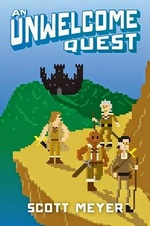
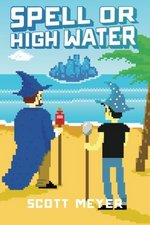
Off to Be the Wizard by Scott Meyer

Off to Be the WizardOff to Be the Wizard

by Scott Meyer
Series: Magic 2.0, #1

Kindle, 374 pg.

47North, 2014

Read: May 23 – 26, 2015

4 Stars

The first thing Martin always did when he found some new data file was to search for his own name. It may seem egocentric, but Martin wasn’t worried about that. He had spent a lot of time thinking about himself, and had come to the conclusion that he was definitely not self-absorbed.

There’s a great temptation — and frequently a rush — when discussing an amusing/funny book in SF or Fantasy to compare it with, well — the name rhymes with Schmouglas Schmadams — this can be damning, because almost nothing can live up to it. So I’m going to resist even saying the name. If anything, I think you could say this was reminiscent of Schmon Schmalzi — only funnier.

Martin Banks is the rather unimpressive hero here — a college dropout, living in a poorly-furnished apartment, working in “a cubicle farm, . . . a fluorescent-lighted, beige-walled abattoir for the human spirit where he had to spend most of his time,” and doing some minor hacking on the weekends, just to amuse himself. He stumbles upon a way to manipulate reality, to change things just a little bit here and there around him. Being human, it takes very little time before he begins using that ability in a way to draw the attention of the Federal Authorities. Which is not all that comfortable, so he heads off to England in the Middle Ages where he figures he can do okay for himself, living as a wizard using these abilities.

That’s when things start to get really entertaining (and I had no complaints up to this point). Anything more I say on this front is a horrible spoiler, so we’ll just leave it with really entertaining.

This is a coming of age tale — and, as it’s about a Millennial, it’s a delayed-coming-of-age story. But Martin’s not one of those protagonists that you have to see mature before you like him — you connect with him right away (or you’re probably wasting your time reading on). He definitely doesn’t mature in your typical way, which is part of the fun. I can’t help comparing Martin to Wesley Chu’s Roen Tan. But without the stakes that Roen had to deal with (and a nicer mentor).

Most of the characters we get to know are met after Martin’s time jump — so don’t worry if you find everyone in 2012 a little shallow and undeveloped. They are, but other people won’t be.

There are several things in the book that won’t hold up to much scrutiny — like his ability to get a smartphone signal in Dover, England in 1150. Adapt the advice Joel and the ‘bots used to give us, “just repeat to yourself . . . you should really just relax.” It’s worth it.

The book is just littered with wit — from the extended jokes, the funny visuals, or little asides like: “The fact that wristwatches weren’t invented yet made it difficult to look impatient, but he managed.” On nearly every page, there’s something to make you chuckle or laugh — or at least grin. I laughed enough that it was annoying to my family — not that I cared, mind you. But it’s not just a yuk-fest, there’s a well-written story here, in a great world with some characters you want to spend time with.

I’m looking forward to the rest of the trilogy and have promised myself that I won’t have to wait too long for it. A great mix of SF, Fantasy, Magic, Computers, the Middle Ages and laughs. What are you waiting for?

—–

4 Stars

Fairest by Marissa Meyer

How’s this for embarrassing? As I typed this up, I noticed I hadn’t blogged about the previous volume in the series, Cress. Man, I hate that.

—–

FairestFairest

by Marissa Meyer
Series: The Lunar Chronicles,#3.5

Hardcover, 222 pg.
Feiwel & Friends, 2015
Read: April 25, 2015
Most of the time, when I see a .5 in a series, it’s a 30-70 page tale to fill in a narrative gap, or keep the fan base appeased, or something that doesn’t come across as unintentionally offensive. Leave it to Meyer to toss in a 200 page .5 instead.

So ever wonder what turned The Lunar Chronicles Queen into the evilest royal this side of the Brothers Grimm? Yeah, me either. But, Meyer answers the unasked question. From her horrible childhood to her mortifying adolescence to her even worse adulthood (aside from ruling the Moon), this book takes us through the Levana’s development — descent? — while planting all the seeds we need to see how the events of Cinder etc. are set in motion.

At the end of the day, I didn’t need this book. Sure, it humanized Levana a bit, but the Chronicles doesn’t demand that (well, I might be wrong on that front — I might revise this after I read Winter). But, it was a quick read. It was interesting enough to see the wheres, whys, and hows behind the Moon’s approach to Earth. It kept my interest, and more than once, I forgot I was reading a prequel. That’s a plus in my book.

—–

3 Stars

Firefight by Brandon Sanderson

FirefightFirefight

by Brandon Sanderson

Hardcover, 416 pg.
Delacorte Press, 2015
Series: The Reckoners, #2
Read: January 30 – February 2, 2015

…as she’d left, I’d glanced at her gun.
This time, when she’d pointed it at me, she’d flicked the safety on. If that wasn’t true love, I don’t know what was.

We’ve all been there, right?

In the months since David did the impossible by killing the Epic Steelheart, he and the rest of the Reckoners have continued their war against the Epics — successfully enough, that Newcago is beginning to rule itself (sure, with the puppet government that Steelheart allowed, but it’s starting to come into its own). The last few of these have been sent by the Epic that runs Babilar (Babylon Restored = Manhattan), Regalia. So, David, the Prof, and Tia leave the rest of the Newcago crew to keep order, and head to Babilar to see what they can do about Regalia.

Meanwhile, David’s trying to convince the Reckoners that Megan wasn’t a traitor and murderer, and while an Epic, she deserves a second chance. And not just because he’s gaga for her.

It’s possible that the city of Babilar is the happiest city in contemporary YA dystopias. It’s definitely one of the most upbeat depictions of Manhattan that I’ve ever read/seen. Which is saying something, considering that it’s pretty much flooded (and ruled by an Epic who can control water). But thanks to a religion/philosophy/frame of mind (depending who you ask) — possibly Epic-induced, possibly spontaneous — the people of Babilar are a lot more positive, have a certain joie de vivre, and are a lot less interested in the work of the Reckoners than anyone else we’ve heard of in this world (and poor Dave is rather befuddled by this). I don’t want to get too descriptive of it — Sanderson will do better than I ever could, anyway — so let me leave it with this: I’m not crazy about the water, and I might be persuaded to move to Babilar.

One thing I’d forgotten from Steelheart was Dave’s general goofiness and voice. I did remember how bad his metaphors were (particularly, as it was pointed out to him that they aren’t even metaphors at all), but I didn’t remember how fun Dave was as a character when he wasn’t being more driven and vengeful than a teen-aged Bruce Wayne. Maybe Sanderson didn’t stress it as much last time out, or given Steelheart’s death, he’s lightened up. My guess it was a failure of my memory — but I really enjoyed Dave’s voice here (think Peter Parker à la Bendis), and would’ve kept with the book just for it , even if I stopped caring about the rest of the story (little chance of that happening, I should say).

But even with Dave’s snappy narration and Babilar’s vibe, there’s a lot of suspense in Firefight. A lot of deception, treachery, and danger everywhere. In the brightest of moments lurks a real possibility of the world becoming a darker place than it has been since Calamity and the advent of the Epics. Sanderson attempted a real balancing act here, and pretty much pulled it off. Up to, and including a great cliffhanger that makes the wait for the final volume of this series all the worse.

The only other note I can think to say here is that Sanderson has the most creative use of Fortune cookies in fiction here. Inspired. Read it for yourself.

Fun, fast-paced, exciting tale of super-powered dictators and the people resisting them — give Firefight a read if you’ve already enjoyed Steelheart. But go back and grab Steelheart first if you haven’t.

—–

4 Stars

Near Enemy by Adam Sternbergh

Near EnemyNear Enemy

by Adam Sternbergh

Hardcover, 306 pg.
Crown, 2015
Read: January 14 – 16, 2015I will admit to being a bit nervous about this — Shovel Ready hit me in a sweet spot and I wasn’t sure that Sternbergh was going to be able to follow it up with an unnecessary (I thought) sequel. Also, as long as I’m being honest — without looking at my post or notes, I’m not sure I could’ve described what about Shovel Ready appealed to be so much. It took less than 2 pages of Near Enemy for it to come back to me — yeah, good story, world building and all; but it was the voice and the distinctive way Sternbergh employed the voice that really worked for me. Obviously, in two pages I had no idea if he could pull it off in terms of story/character/etc., but that voice was there, so I was going to enjoy finding out.

Even more than Shovel Ready (I think), this is a Cyberpunk novel as told by Elmore Leonard. It’s been a year since we left Spademan and the rest, and if there’s anyone who expected a happily ever after for any involved, well, I think they didn’t pay close enough attention to the book. Perseophone and her baby are tucked away upstate, and Spademan’s back to work. Once again, though, he doesn’t complete a hit. He finds the target, Lesser, while he’s in the Limnosphere, and is persuaded to wait a moment until he emerges. Lesser gives the wildest story about what happened to him inside — so wild it’s technically impossible. Spademan’s curiosity is piqued, so he lets Lesser live while he looks into the veracity of his claims.

Spademan’s investigation leads him into a maze of politics, police corruption, Islamic activism, assassins that make Spademan look amateurish, and a strange quasi-religious/quasi-Luddite group. The plot’s really not that twisty — it can’t be while being told in Sternbergh’s minimalistic style — but it’s definitely not straight-forward. And though I saw the big surprise twists coming — their reveals were very satisfying. It’s violent — but not as violent as you’d think a novel about an assassin in a very dystopian New York would be.

One example of the violence is a fight scene in the Limnosphere that suggests the climactic battle in The Matrix missed a golden opportunity by not taking fuller advantage of the impossible and/or strange that would be possible in a virtual world.

Of course the ugliness isn’t limited to the damage that people can do to others’ bodies — there’s plenty of other trauma to be found. One example is Spademan’s description of how the City reacted to the last major terrorist attack:

Cops came after midnight.
Special ops. Special cops. The lethal kind, who never bothered to memorize Miranda rights.
Clad in black. Move in tandem.
Red laser dots dancing over locked doorways.
Hand signals. Gloved hands. Give the go-ahead.
Boots unleashed on doors. Doors caved in with a clatter. Suspects scrambling as they’re yanked from their beds, still tangled up in the sheets. Some half-dressed, some half-cursing, dragged into hallways under sweeping flashlight beams, wrists zipped up in plastic cuffs, then shoved down the staircase. Some more than shoved.
A few unfortunate escape attempts shot down as they fought back. Or at least that’s how it got written up in the reports.

At the same time, in the midst of the blackness, there’s moments of happiness, contentment, camaraderie.

There’s a real heart to this character, real sadness — maybe even hope. When you thinking you’ve got Spademan figured out — he does something you don’t see coming. There’s this flashback to a High School (maybe Junior High) English teacher working with Spademan that’ll tug on your heartstrings.

Near Enemy successfully builds on Shovel Ready expanding the world, characters and story strongly, as well as setting things up for (I’m guessing) a final climactic novel that is going to knock my socks off.

This is the kind of book that makes you want to call in sick, blow off appointments and resent the fact that you have loved ones that want to spend time with you (and that, ordinarily, you want to spend time with, too). It’s as immersive as the Limnosphere, with none of the side effects, and just as addictive.

Note:I received this book for free from Blogging for Books for this review. Which was generous and cool of them, but didn’t impact what I said about the book.

—–

4 1/2 Stars

The Infinite Sea by Rick Yancey

The Infinite Sea (The 5th Wave, #2)The Infinite Sea

by Rick Yancey
Series: The 5th Wave, #2

Hardcover, 300 pg.
Putnam Juvenile, 2014
Read: October 4 – 5, 2014
Man, talk about trepidation. Did I want to pick up this book? Was there any chance it could live up to The 5th Wave? Slim to none. But man, I wanted to find out what happens to the Earth. I wanted to know if we ever figure out what the aliens want with the Earth, why they’re eliminating humanity in the way they are. So, prepared to be disappointed, I cracked the cover.

And Yancey doesn’t try to match — or even try to top — The 5th Wave. He writes a very different book. Not one that grabbed me as thoroughly, but one that works in its own way. Where The 5th Wave was a bullet train that you just tried to hang on to — The Infinite Sea was roller coaster you’re riding while blindfolded — the ride lopping, diving, screaming around a corner with no warning, leaving your stomach behind you.

Yancey can’t even give us a Prologue to reorient ourselves to this world, to get our feet under us so we can say, “Oh yeah, this is what’s going on…” before resuming the action. Sure, it starts to seem like that, but nope. He’s right there to pull the rug out from under us at the first possible moment, in a way that catches the reader just as off-guard as the bits of remaining humanity will be.

I read some criticism lately about The 5th Wave that complained about the lack of motivation given for the aliens to do what they’re doing — it makes no sense, and therefore the reviewer couldn’t buy into the book with a motive-less enemy. But to me, that’s why the book worked. Humanity doesn’t understand what’s going on, so there’s no reason we human readers should either. Try as they might, there’s just no figuring out what’s going on other then their great need to survive.

On the whole, we spend time with the characters we met in the first book, those that survived — and, in flashbacks, some that didn’t, Cassie, Sam, Ben/Zombie, and a few others I won’t name because I can’t be sure I won’t spoil something by doing so. We say good-by to some of them, too. We meet a few other characters, too. Some of which we’ll see again. It’s that kind of series. But we get to know almost all of them better, the last book was all about getting to know a couple of these characters really well. This time, we get backstories on everyone, even if it’s pages/paragraphs before they die. This is important, I feel more grounded in this world the more I get to know characters who aren’t Cassie, Evan or Ringer.

And we get some more mature, experienced — and in some cases, informed — hints at what’s really been going on. Still, not enough to placate that other reviewer, I bet — or, really anyone. At one point, Cassie’s complaining about her interactions since Day 1 with Evan.

Every time I edge too close to something, he deflected by telling me how much he loved me or how I saved him or some other swoony, pseudo-profound observation about the nature of my magnificence.

I chuckled as I read it, because this is pretty much Yancey’s modus operandi — just when you get close to learning something, being told something, a character figuring something out, etc. — something explodes or someone starts shooting. Or both. Not a way to tell a narrative that satisfies everyone or to show off brilliant world-building. But a it’s great way to keep pages turning.

I found this to be a very satisfying read. As I said, I didn’t expect to be as taken with this book as I was its predecessor, and I wasn’t — but in a way, I’m sucked into this series more than before. I really don’t know the last time I said “son of a — “* out loud at a book as much as I did with this one. It’s probably not since Butcher’s Changes that I’ve called a writer so many names as I’ve read. Yancey just keeps throwing me for loops. Not the best book I’ve ever read, not high literature, but edge-of-your-seat thrills, convincing characters, and honestly come by surprises. Really entertaining stuff. That’s all I ask for.

—–

* I seriously don’t finish the sentence, because I’m too busy shaking off whatever trauma is thrown my way and getting back into things to bother.

—–

4 1/2 Stars

Sleepy Hollow: Children of the Revolution by Keith R.A. DeCandido

Sleepy Hollow: Children of the RevolutionSleepy Hollow: Children of the Revolution

by Keith R.A. DeCandido

Paperback, 304 pg.
Broadway Books, 2014
Read: October 24, 2014DeCandido has given us the best possible first tie-in for Sleepy Hollow — it’s a good follow-up to the second episode, “Blood Moon,” (which I didn’t even realize needed a sequel until I read this); it captures the essence of the show; and tells a good story to boot.

This takes place about four months after “Blood Moon” — 8 half-moons, to be exact. We’re told it’s January 2014, but I’m not exactly sure where that locates things in the first season. Somewhere between episodes 10 and 11, by my reckoning. A coven is trying one more time to resurrect Serilda, using a collection of medals commissioned by General Washington for a group of heroes of the Revolution — including Ichabod, of course.

DeCandido touches base with the characters and most of the events that stand out in the first season, all the touchstones are there. Macey Irving, Sheriff Corbin, Andy Brooks (I’m pretty sure his name is dropped), Henry Parrish, the Golem . . .

The book is filled with random historical musings from Ichabod — though the part where he criticizes (to put it very mildly) the recreation of Ft. Ticonderoga was a bit too much like his dressing down of the docent about Paul Revere. But you know what? It was just as amusing — and what else are you going to to with our favorite time-displaced Witness?

Really, the key to this book (like the show) is getting the two central characters right. Let’s look at two brief snippets:

Abbie spent most of the drive up Interstate 87 to Ticonderoga being simultaneously charmed by Crane and seriously wanting to strangle him.
Thinking about it, that defined a lot of her relationship with him.

Captures Abbie’s attitude, her swagger, and her humor.
and then:

. . . he pulled out the device that was referred to as a “cell phone.” He assumed the modifier “cell” was a joke referring to how much modern humanity was imprisoned by such devices, as it seemed that the citizens of the twenty-first century relied on them to an appalling degree.

Even though that’s in the Third Person, if you don’t hear Tom Mison’s voice in your head there? Something’s wrong with you.

He captured the friendship, the feel of the characters and their voices — both in narration and in dialogue. Couldn’t ask for more.

This tie-in captured the show’s tone, its feel, its characters and its world while telling a compelling story. Great stuff.

Note:I received this book for free from Blogging for Books for this review. Which was generous and cool of them, but didn’t impact what I said about the book. It was strong enough to gain my respect on its own.

—–

4 Stars

The Deaths of Tao by Wesley Chu

The Deaths of Tao (Tao, #2)The Deaths of Tao

by Wesley Chu
Series: Tao Trilogy, #2


Mass Market Paperback, 462 pg.
Angry Robot Books, 2013
Read: October 17 – 24, 2014
It’s been a few years since the events of The Lives of Tao, and things have not gone well for Roen Tam, either personally or in the war. He’s basically dropped out of everything, going rogue, running covert ops for Tao while ignoring Prophus’ command structure. Tao’s sure he understands what’s going on in the world better than anyone else, and so he pushes Roen to leave everything behind and find evidence for Tao’s theory.

Meanwhile, Jill — and Raji — have wormed their way into the corridors of power in the Capitol, moving and shaking on behalf of Prophus while also keeping her cover as a Senatorial aide intact. This is where Prophus seems to be holding its own – but barely.

We bounce around between Roen, Jill, and a new Gengix host, Enzo, who is trying to find a level of dominance very quickly for himself in the Gengix hierarchy. He’s rash, impetuous, and egotistical — not the signs of a great leader. But the Gengix he’s hosting is wise, methodical, honorable and tries to impress these characteristics on this host.

But like I said, things aren’t going well for the Prophus — they’re on the verge of losing this war once and for all, clinging to power and influence some areas, absolutely losing it in others. They’re so close to the brink that they eventually are driven to one final act of desperation that will change everything forever.

As the title suggests, The Deaths of Tao is darker (like any good 2nd volume of a trilogy), not as fun (understandable given the darkness, but would’ve been helpful), and slower paced than The Lives of Tao. But, still, I was enjoying it enough to keep going — and I wanted to see what happened to Roen and the rest. Hopefully get to see my favorite Prophus host whip that Gengix Enzo around a bit. But Chapter 29? Made everything up to that point worth it. And excitement, the pace, and the stakes picked up after that (not the stakes for the whole armies, obviously, but for Roen and Jill)

Still, it took until Chapter 29 for this really to come together for me — and that’s far too long. Which is strange, because up until that point, I’d say this was better structured than its predecessor. It built better in plot development, character and tension. But Chapter 29 made me rethink that, it’s just too much of a jump in development and voice.

I find it hard to understand — except for strength in numbers — just how the Gengix are winning this thing. The Prophus seem to come out on top — if not even with — the Gengix almost every time we see them. It’s difficult to extrapolate from this to them almost losing this war. Yet that’s exactly the situation they’re in, and you believe it, up until you think about it a day or two later.

Giving it three stars — as good as the last 150 pages or so were, as huge as the ending was — it was a slog up until that point. I just couldn’t connect with Roen or Tao (or anyone else). But believe you me, I’m anticipating The Rebirths of Tao and expect it to blow me away. Just wish this had done that.

—–

3 Stars

The Girl With All the Gifts by M.R. Carey

The Girl With All the GiftsThe Girl With All the Gifts

by M.R. Carey

Hardcover, 403 pg.
Orbit, 2014
Read: September 22 – 23, 2014

I HATE ZOMBIE STORIES, I should get that out of the way up front.

So why this book? Well, I put this book on my TBR list based on a tweet from the director of the most recent Much Ado About Nothing movie and a vague, yet promising, book blurb. If I’d waited until it was reviewed, or more detailed descriptions were available, I probably wouldn’t have started this. Having started it, and then figuring out what it’s about, I stopped reading it several times during the first two hundred pages — but I kept finding myself in waiting rooms, or just waiting for something, with nothing else to read — or was curious about how the next chapter would deal with plot point X. Before I knew it, I was 50% done, so I might as well finish.

There’s a little more to it than that — this book just got me, and I couldn’t stop reading it, really. Little Melanie — in all her innocent, caring, devoted, Zombie genius glory, is delightful. This book is a wonderful combination of childhood optimism, stark darkness, hope, love, despair and megalomania . . . told in a voice that’s in the same breath amusing and gut wrenching.

This is another one of those that I don’t know how to talk about without spoiling in on multiple fronts. Carey (author of the Felix Castor UF books and The Unwritten comics — and many other things I haven’t gotten around to) has created something special here, something unlike anything else I’ve read from him. Think Let the Right One In, but endearing and without the creepy sexual vibe. That’s not entirely accurate, but it’s not inaccurate, either.

I guess let’s just leave it as this: it’s a zombie novel, that I couldn’t put down and almost gave 5 stars to. Pretty remarkable accomplishment by my standards.

—–

4 1/2 Stars

Doctor Who: Silhouette by Justin Richards

Doctor Who: Silhouette (New Series Adventures, #53)Doctor Who: Silhouette

by Justin Richards

Series: Doctor Who

Trade Paperback, 256 pg.
Broadway Books, 2014
Read: September 18, 2014

I’d just said few weeks back how I hadn’t read any tie-in novels for a bit, when the good people at Blogging for Books offered this. Seemed like a good way to get back into them.

Things got off to a rough start when the argument that the Doctor and Clara were having about their next destination (she wants to meet King Arthur, he wants to go somewhere else) reminded me too much of the argument in “Robot of Sherwood” — but there’s a great punchline that redeemed it. They don’t head off to Camelot, because the Doctor finds some sort of sign of nuclear power in Victorian London which seems far more urgent.

The Doctor doesn’t want to trouble Madam Vastra and her crew when they can take care of this themselves. Besides, The Great Detective is investigating a locked-room murder, and Strax is off looking into the death of a friend. I’m sure no one at all will be surprised to discover that the investigations are soon intertwined. And we’re off to the races — peril, aliens, impossible weapons, The Shadow Proclamation, Strax being Strax. Loads of fun.

This story is best suited for a novel rather than a TV episode — it’s just unfilmable. Too many special effects, too large a cast, plot couldn’t be boiled down into the less than 60-minutes necessity. But it feels like an bonus-length episode, right kind of pace, right kind of mix of tension and humor. In other words — exactly what this kind of book is supposed to be.

Here’s the only thing I didn’t like about this — Richard’s characterization of The Doctor. Which, yeah, is a pretty significant piece in a Doctor Who novel. But here’s the thing, this thing came out September 9 and season 8 premiered August 23. So, I’m betting while Richards had plenty of access to scripts and whatnot, he hadn’t seen a final cut of an episode starring Capaldi before he finished this (maybe one or two — definitely not a lot of them). So he couldn’t really capture the full flavor of the Twelfth Doctor. He could get some of it — the stuff that’s in the script — but all the intangibles, gravitas, the full je ne sais quoi that only happens when an actor becomes the character wasn’t available for Richards. I’d like to read something he writes after the end of season 8 just to see if he can capture it — I’m betting he can (he nailed the characterizations of Clara, Vastra, Jenny and Strax).

Still, this is just the sort of thing for the fan who can’t be satisfied with twelve episodes of TARDIS-based adventure.


Note:I received this book for free from Blogging for Books for this review. Which was generous and cool of them, but didn’t impact what I said about the book.

—–

—–

3 Stars

Page 38 of 39

Powered by WordPress & Theme by Anders Norén