Tag: SF Page 18 of 30

Reposting Just ‘Cuz: Golden Son by Pierce Brown

Here we are with the second of today’s Pierce Brown reposts. Even if Golden Son isn’t really volume 2 of a trilogy anymore, everything else I said about it still stands. There are few writers who can jerk me around like Brown can—he plays with emotions and expectations like Yo-Yo Ma on a cello. And I wish he’d lighten up on his readers, but I don’t expect that he will anytime soon (and I really don’t want him to, it just feels like it).

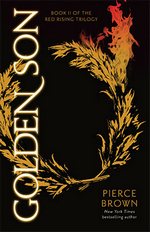
Golden SonGolden Son

by Pierce Brown
Series: Red Rising, #2

Hardcover, 442 pg.
Del Ray, 2015
Read: February 3 – 4, 2015

I glimpse Gray police standing over arrested Brown vandals who covered an apartment complex with the image of a hanging girl. My wife. Ten stories tall, hair burning, rendered in digital paint. My chest constricts as we pass, cracking the walls I’ve built around her memory. I’ve seen her hanged a thousand times now as her martyrdom spreads across the worlds, city by city. Yet each time, it strikes me like a physical blow, nerve endings shivering in my chest, heart beating fast, neck tight just under the jaw. How cruel a life, that the sight of my dead wife means hope.

As you start this book you’re thinking, this is going to be Red Rising continued — Darrow’s got a good steam and he’s going to continue to rise and learn. And then, you finish the first chapter and see how horribly wrong you were.

The important thing to remember while reading Golden Son: this is the 2nd volume in a trilogy. What does that mean about the book as a whole, especially the ending? Think: The Empire Strikes Back, Kinslayer, Catching Fire, The Deaths of Tao, The Two Towers, and so on. It’s going to get dark, it’s going to be messy, things are going to look bad for Darrow and his group.

Time and time again, Brown suckered me with this book. I got comfortable, got in a groove with the narrative, figured he’s about to zig and he’d zag. 30-50 pages later, we’d do the same thing again . . . and again. Up to, and including the final zig when I was sure he was about to zag. The number of times that a narrative gut punch was delivered as Brown was pulling the rug out from underneath you was enough to make you feel like you were one of Darrow’s crew on a bad day.

I read this at what turned out to be a busy time for me, so I couldn’t get to blogging about it then — I don’t remember many of the details (pretty sure the good ones are spoilery anyway), so I can’t get too specific about things. But I do remember the experience of reading it. This was just a brutal read — and each time Brown sent me reeling, I wanted more.

This was the second book in 2015 that I gave 5 Stars to. Since then I’ve read better books — some of which I’ve rated lower — but the way this book grabbed me, the way it made me feel while reading it? It earned the 5 Star then and still deserves it now.

I can’t wait for the conclusion, Morning Star this coming February.

—–

5 Stars

Reposting Just ‘Cuz: Red Rising by Pierce Brown

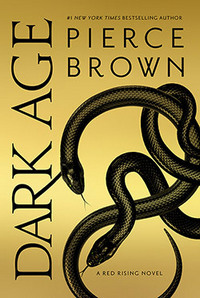
Time got away from me this past weekend—and not just because I wrote one post that turned about about 3x as long as I’d figured (which is fine, I had a lot of fun with my family, just didn’t write as much as I wanted to). That’s just a nice way of saying that I couldn’t shut up (you’ll see in a couple of hours). But I wanted to get something else up today, and since I’m knee-deep in Brown’s Dark Age at the moment, I figured I’d repost what I wrote about the first two books in the series. Glancing over it, I agree with everything I said, but kept shaking my head like Leslie talking to Ann: “You are a beautiful, naïve, sophisticated newborn baby.” This was one of my Top Reads of 2014 and the series is one of my most beloved. I urge you to jump on this runaway train if you haven’t yet.

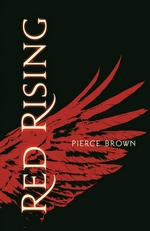
Red Rising (Red Rising Trilogy, #1)Red Rising

by Pierce Brown
Series: Red Rising, #1

Hardcover, 382 pg.
Del Rey, 2014
Read: Feb 26 – Mar 6, 2014

I’m having a hard time deciding what to say about this one. To really talk about it would require me spoiling every plot point that I loved (most of which I didn’t see coming). So I won’t. I’ll just say that I really, really dug this book.

I don’t want to just compare this to The Hunger Games, as much as reviews/blurbs/etc. make a guy want to. There are some surface-level similarities, yeah. And you could make the case (as I did when just starting the book) that Brown’s Mars was just the place for people who thought Collins’ Panem was a bit easy. In fact several parts of this feel like The Hunger Games dialed up to 11. The working/living conditions for Darrow and his family are more severe, what Darrow has done to him to prepare him for what’s to come makes what Cinna et al. do to Katniss look like child dress-up, Darrow plays a deadly game on a larger scale than Katniss, and so on. But Darrow’s motivation is different than Katniss’ — she’s trying to survive, he’s trying to do far more (and much of the time, survival’s pretty low on his list) — the stakes he’s playing for are greater, and he will go to lengths that Ms. Everdeen doesn’t have to.

There are a few moments when things seem too slow, or meandering, or even redundant — but each time, I was wrong, and Brown made it all pay off. Visceral was the word that kept coming back to me as I read the book. I had almost visceral reactions to some of the horrors depicted, I could feel the grime and muck (literal and metaphorical) that Darrow crawled around in.

This shows every indication of leading to something epic in the next volume, leaving Mars behind and moving to other planets and/or the space between. As well as seeing if Darrow can retain his self and purpose — and how far will he be willing to go to carry it out.

There is a classic SF reference in Part IV that made me giggle with delight (in the middle of a pretty grim part of a fairly grim book, so I appreciated the placement). I won’t spoil it, but Pierce Brown has bought a lot of loyalty from me with two simple words.

Go grab this one.

—–

5 Stars

A Few Quick Questions With…Maggie Lynch

Earlier, I gave some brief thoughts about Maggie Lynch’s Gravity, a fun Space Opera/SF adventure, and now I get to ask the author a few questions. I start off talking about The Obsidian Rim series as a whole before we narrow in on Gravity and Lynch herself. There are some great answers here, and I’m blown away that she’d spend so much time on them. Hope you enjoy!

How did The Obsidian Rim project come about? Who picked who was taking part?
When I was planning my 2019 and 2020 writing schedule I decided I wanted to write more SF, but with a romantic subplot. My fiction writing career started with SF and I published short stories in magazines and anthologies back in the 1980’s and 1990’s. It was always my first love in writing. But I’ve been writing romance novels for the past decade and love the genre, and have a following. So, I wanted a way to combine the two genres with a leaning toward real science fiction.

I looked at what was labeled Science Fiction Romance and really didn’t care for the trend of shifters and mating rituals, alien lovers or world saviors, and very hot males where sex often came before relationship building. I wanted a series that was really based in a well-conceived science fiction world—preferably space opera for some fun and adventure. But I had no following in that genre. I did some research of the market and found, what I believe, was a missing niche. That is SF for smart women who liked the science but also wanted the relationships. That fit what I love to write. Character-driven stories, based in science but with definite romantic relationships that make a difference in the story. But I knew I couldn’t do it alone and get a following quick enough to make it work.

So I approached my friend, Jessa Slade writing as Elsa Jade, who’s story telling ability I love. Even when she’s writing shifters, paranormal, or alien lovers she is still writing smart fiction. She creates strong women characters who are as much in control of the situation as the men in the romances. She has been part of a number of multiple author group projects, and enjoyed the experience. So I asked if she would be interested in us co-coordinating this one. Fortunately, she agreed.

We both created the basis of the Obsidian Rim world. What you read on the Obsidian Rim website regarding the World background is what Jessa and I came up with. I’m the more sciency of the two of us, so things like metric measurements, wormhole time dilation etc. is from my research. The concept of Quantum Energy Drives and Bombs is Jessa’s idea and how that actually plays out in the science is both of us. The details of things like language, weaponry, etc. were contributed by individual authors as they built their own stories and is attributed.

Once we had the background, rules of the world, and contract details we began recruiting writers we knew personally who we believed could write these kinds of stories (based on what they’ve written in the past) and who we knew to be reliable. Because we have an aggressive release schedule with a new book every two weeks, we needed people who could get their books finished and through an editor on time. As we began recruiting in February, several of the people we approached were unable to join us because their annual release schedule was already full. But we are happy with the writers we have and if everything goes well this year, will open up to additional writers in 2020.

Just judging by Gravity, there was a lot of worldbuilding involved in The Obsidian Rim—how much of that was group effort, how much was you?
As I indicated above, the basis of the Obsidian Rim world was created by Elsa Jade and me. However, each author has the ability to go beyond those basics and create whatever he/she needs to make her story work. The only rules are: there are no aliens in this world; and because of the magnetic barrier at the rim no one can go beyond the galaxy rim. Everything else about the individual planets, planetoids, asteroids or space stations are up to each author as are the characters, creatures, and other developments. We do talk to each other in a closed Facebook Group just to keep everyone informed. And we do try to intersect with each other’s books in some way in order to keep readers interested in reading beyond one particular author they may already know.

So, in Gravity, the concept of cryoborns is mine and their special gift for navigation is a central piece of my trilogy in the Obsidian Rim world. The characters, their background stories, and the type of travel and planets visited are all mine. The book begins on Ydro-Down which is a mining planet that Elsa Jade created for her trilogy in the world. She gave me the outline of what was there in her mind and the basic corporate structure, and we agreed on an intersection with one particular character who would be the hero in her first book. I took it from there. When I finished the section that took place on Ydro-Down, I sent it to her for review in case I took too many liberties with her world or portrayed the intersection character inaccurately. We were both writing our drafts at the same time, so we were both figuring things out as we wrote. Fortunately, there were only a couple of easy changes to make it mesh.

Tell me a little about the participants in the project and their corners of the universe.
As I haven’t read all the books that have been published I don’t know a lot of details. I only know the blurbs that we have on the website for each book, and what the authors have shared as they try to use and pickup tidbits from each other. What I can say is that, each author has built their own worlds within the Galaxy and has committed to intersecting with at least one other author’s book. What I can tell you is that we have planets with toxic plants; a variety of criminal elements from pirates to royalty; some cool companion robots like dogs; and in one case cats with special powers to get humans to do what they need. Actually, that describes my own cats right now. ☺

We have recently put up a revised map of approximately where the different worlds are in the galaxy that have been a part of a book so far. As people share what living environments they’ve created, we try to place them in the Rim in our best guess as to how it works with the rest of the bookso and the intersection of stories. It is definitely NOT exact or even close, as the further out you go along the spiral arms the less we know right now which means less to extrapolate for the future. Also, distances even within one sector of the galaxy are still tens of thousands of light years apart.

I would love to share a little bit about each author in the 2019 round of novels.

I’ve already talked quite a bit about Elsa Jade., my co-conspirator in this undertaking. In addition to writing great stories, she is also a developmental editor and has won two Rita awards for her editing on author’s books. Jessa Slade/Elsa Jade now has 50 books published, with the more majority in SFF Romance and continues to write amazing character-driven stories that keep readers coming back. Her Obsidian Rim trilogy features the primary mining planetoid for qubition—the ore that powers ships to get through wormholes and also powered Q-bombs that destroyed most of the galaxy.

Jane Killick lives in the U.K. She works for the BBC as her day job and her love of SF started with movies and UK series television. Her most popular book, Stasis Leaked Complete, is based on interviews with the cast and crew of the successful space comedy, Red Dwarf.  Another popular nonfiction work is her five book series going behind the scenes of Babylon 5. Her most recent SFF fiction series is The Perceivers, A YA telepathy thriller series of four books. Her Obsidian Rim trilogy features freelancersplying their trades throughout the Rim.  It’s a great backdrop for exploring both the good and corrupt parts of commerce in the future.

Shree Aier is our only freshman writer. Her Obsidian Rim book, Coexistence, is her first published novel. I like Shree because she is even nerdier than me. Until recently, Shree has been pursing academic interests in science. She has two undergraduate degrees in business, psychology and biochemistry, and a Masters in materials science & engineering. She’s worked on research projects in psychology, biochemistry as well as cancer therapeutics using nanotechnology. Her trilogy features the Earth Conservatory, a place where original stocks of plants, seeds, and animals that came on generational ships are stored and monitored—not always with the best interest of humanity.

Shona Husk is a well-published writer, with 45 books published across several romance genres. The majority feature fantasy and science fiction worlds. She lives in western Australia and brings a definite knowledge of writing with multiple author series. Her Obsidian Rim trilogy, Dead Suns, features a royal family with a criminal element and mercenaries that sometimes work with them and at other times against them. Lots of page-turning adventure and great character-building within the Rim world. Her stories feature insights into social hierarchy, politics, and power and their impact on a personal level.

Jody Wallace is our humorous author, both in person and in her writing. Like any good comedian, she finds humor in the strangest situations. This is proven by her choice of planet for her trilogy—Trash Planet. Yes, it is literally a planet devoted to collecting and recycling all the trash from the Rim. With over 30 books published she has a great track record for delivering humor with good stories. Other writers may know her in her alter ego as the Grammar Wench, and/or the “cat lady” who has run a “meankitty” blog since 1999. Like Jessa Slade, Jody is also a freelance editor.

Sela Carsen is the author I’ve personally known the longest. We first met in an author critique group about 15 years ago. We were both starting on our novel writing journey in romance at that time and created a group of seven authors. Sela is particularly skilled at writing shorter works—short stories and novellas. Something I admire, as to me a short story is at least 8K words. The majority of her titles are in fantasy, a large number in the Nocturne Falls world created by Kristin Painter. Sela loves legends and fairy tales, so you are likely to see some of that seeping into her SF books as well. She agreed to tackle this slightly longer form for the Obsidian Rim novels and we are glad she’s joined us.

CJ Cade is another writer with a large backlist. With over 35 novels to date. Her SF Romances are written as CJ Cade, whereas her contemporaries and paranormals are written as Cathryn Cade. Right now the two pen names are running neck and neck for number of titles. Cathryn is also an author with a history of working in multiple author series, so she brings that experience of collaboration to the table. Her Obsidian Rim trilogy features a world where the plants are actually toxic to most humans, but some have adapted. An interesting dilemma indeed.

Let’s focus on Gravity now—what came first—characters or the story?
All of my SF works, whether novel length or short stories, begin with an idea. Then I try to find a character that can embody that idea and personalize it. Also, I’m one of those writers who tends to explore the same themes in every book—no matter the genre—that is how we make decisions and through that process learn to be our best selves (or not in the case of villains).

For me, I began this trilogy with the idea of how the Rim was populated or how humans were able to go tens of thousands of light years away from earth. I knew there needed to be generational ships and that likely meant most of the colonists would be in cryosleep. But what happens to people in cryo during the Oblivion War when large quantum waves wash over them? Something had to change, and that is where the special navigational abilities arise.

For me characters, and particularly with a romantic element, need to have opposing needs. I had a good idea of Kash. Though he starts the book enslaved, he has a memory of a past that was peaceful and loving before being put in cryo and that shapes his view of what is possible. That is juxtaposed by Lehanna who was raised a criminal, a pirate, and has no basis for believing anything good about the world unless she gets it or take sit herself. But these two are thrown together with these different world views and need to work it out. How do humans do that? And what pulls one to the other, even when the worldview is so opposite? I find that ultimately interesting and the basis for problem solving all the scrapes they get in. Both of their skills are needed and both of their worldviews are needed, because neither one has the entire truth.

Keeping spoiler-free, can you talk about Adira and Layla—both seemed inspired to me, don’t get me wrong, I enjoyed all the characters, but there’s something about these two and the role they played that really got to me.
I’m so happy you liked them. It’s funny, to me, how secondary characters take on a life of their own. I am what I fondly call a “plantser.” That means my native way of writing is as a “pantser” starting and writing into the mist (or the dark) and solving problems as they come along. However, the more books I’ve done and the faster I’ve learned to write, I’ve learned that plotting at least a little makes it easier to get to the end by deadline. ☺

But characters are the best part of “pantsing” for me, because they come from my heart and they are there to create questions or other views in the protagonist(s) life. It is not at all unusual that these secondary characters eventually get a story of their own.

Adira was created out of a need to steal something from the evil slave overlord on Ydro-Down. Because he was truly evil, I had to develop a character who somehow survived him no matter what trauma she felt, and yet kept her humanity because she also remembers (like Kash) a time in her life when things were beautiful and peaceful. Adira also serves as a good mirror to Lehana—who also comes from trauma but has shut down her ability to feel or sublimated it with anger and aggression.

Layla is actually a personification of my cat, Layla. ☺ She was so named because the name, from the Arabic, means “dark beauty” or one born at night. My cat, Layla, is primarily black with streaks of golden brown around the face. She is very calm, but also astute and can lay in wait for an attack for hours if needed. Layla in my book therefore is also dark skinned, calm, but very astute. I made her unusually tall to emphasize that juxtaposition between largeness and peace. Also, compared to Adira who is small, like Lehanna, it seems like another subtle way to show how diversity still brings commonality.

I don’t know yet, how Adira and Layla are going to feature in the next two books or if they will eventually get stories—or series—of their own. For now, in many ways, they are the centering force for extremes that occur with my protagonists.

Can you talk a little about what’s next for your storyline?
Magnetism is the next book in the Cryoborn Gifts trilogy. It will be released in early September. It is going through first round edits now and I hope to have actual ARCs available for reviewers in mid-August. It will take our protagonists to another level in their relationship and we get to know the children in this next book. The crux of the entire trilogy is how much is one willing to change in order to save themselves, their family, or an entire universe?

I think for many people, that is an ongoing question in our lives. How much should I, can I, do to help make things better. From stories of jews being protected in WWII at the risk of the protectors lives, to those who dedicate their life to causes that are beyond challenging and take you away from everything you know—those who fight for climate justice, homelessness, science, the arts—whatever the cause it can become all consuming and is that good?

These heroic stories are always ones that interest me. What kind of people make those choices and what price do they pay? At the end, I and the reader are left to answer the question if the price was worth it. Life is not black and white, and I like exploring the complexity of those questions.

Will Lehanna and Kash choose to change so much that they can never go back to “normal” again? Or will only one choose? Or will they find a way out of total commitment? All answers are possible and all choices are ones that help.

Tell us about your road to publication—was your plan/dream always to become a novelist and your education/other jobs were just to get you to this point, or was this a later-in-life desire?
I was a creative child growing up. I wrote poetry, music, and stories from the moment I could conceive them. In high school I was playing a violin in the orchestra, writing my own kind of folk music, a regular member in drama club and doing theater. And occasionally wrote stories or scripts. However, I also grew up as the oldest of nine children and not a lot of money for things beyond food.

I didn’t plan to go to college because I couldn’t afford to go. However, my father guilted me into using my savings from working as a waitress for three years to go to one year of college instead of moving out. He was a smart man and I loved the challenge of learning. I never considered pursuing a creative path because I was paying for it all myself and I knew it would never pay me enough to live on my own. My career and eventually academia was a great way to satisfy my love of life-long learning and get paid for it.

My need for creative outlet was satisfied by writing short stories on the side—occasionally getting them published in magazines and anthologies. I have about 60 out of more than 100 I wrote that were published. I participated in community theater until into my early 40’s and occasionally got a small part in a B movie being filmed near where I lived. One week of filming at base SAG rates was more income than I got paid in a month of working as a therapist at a university. But those films only came around once every couple of years.

Somewhere around age 45 I realized that the best way for me to pursue a creative life was to be a novelist. I’d had nonfiction work published in books, along with a variety of articles—from academic to every day articles in local magazines or tourist features. Being ever the planner, I decided if I started my novel career by the time I was 50, and could write three books a year while working full time. I would have built up 30 books by my retirement and have a following.

It didn’t work exactly how I planned, but that’s another story. I retired early, at 56, and began writing full time then. I’m up to about 20 books but picking up steam. I don’t know that I’ll ever achieve the income I had in academia or consulting. But I make enough to keep food on the table and a roof over our head and I love what I do.

What’s the one (or two) book/movie/show in the last 5 years that made you say, “I wish I’d written that.”?
I’m going to stretch your timeline a bit, because the truth is I haven’t had much time to watch movies or read books beyond what is required for my writing. So, my list is limited. I can say that in the last decade the movie that affected me the most was Avatar. In some ways it mirrored the fantasy series I was writing at the time—The Forest People—in that it explored a group of beings that revered the natural ways of nature in both a spiritual and a practical way. There is a lot I disliked about that movie—particularly how the ending was done—but I liked the themes.

In terms of a book, in 2008, a good friend told me about Suzette Haden Elgin’s trilogy. She is a linguist who created an entire language, Laadan, specifically for women in her fictional series. She wrote a series of books about a future time when the 19th amendment was repealed. Women had been stripped of their civil rights. Yet, it is the women who have the skills to communicate with alien races. And those skills create the language Laadan which gives them power and

Though the trilogy was published 1984-1987 I’d never heard of it. It was the first time I’d read a book that might be described as feminist. She played with form and function and made them a part of the story. I personally liked the story as a whole, and liked that the women never gave up communicating with each other and with trying new ways to communicate with aliens. It was a “smart” book for smart readers and I appreciated that. It opened my mind to new levels of writing I hadn’t considered.

Thanks for your time—and thanks for Gravity, I enjoyed it, and hope you have plenty of success with it.
Thank you, for taking the time to read my book! I love learning what people see or don’t see in a finished book. Certainly, as the writer, I put things in that speak to me and the themes I am exploring and hope that some of those speak to the reader. However, I’m always excited to hear what other things become important to the readers.

Ultimately, once a book is in a reader’s hands, the story becomes their story and they may see things I never thought/knew were there. That is the beauty of creation and sharing it with others. If I kept it to myself, I’d never learn more about how we as humans can make connections that are common even within such diversity of thought and experience.

Gravity by Maggie Lynch: A Promising Start to a Space Opera Saga

I’d like to take a beat to apologize to Maggie Lynch, I’d intended to get this posted a couple of weeks ago, but other priorities/commitments/energy levels kept intervening.

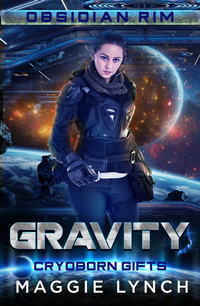
GravityGravity

by Maggie Lynch
Series: The Obsidian Rim, #1Kindle Edition, 235 pg.
Windtree Press, 2019

Read: July 9 – 11, 2019

Lehana is a smuggler known throughout the Outer Rim as one who’ll take just about any job if the price is right. That’s actually about all that anyone knows about her, really. Thanks to a small computer problem, Lehana crashes onto a mining planet, seriously impeding their production for a couple of days. To appease the owners of the mines, as well as to get a little assistance, she agrees to one of those jobs she has turned down before.

Because of a bad experience she had with the man who runs the mine, Lehana decides to take one of his slaves with her as she leaves. What she doesn’t know is that she helped other slaves—a man and his two cryogenically frozen children—leave the planet. She’d have been well within her rights to turn them over, but that didn’t sit right with her. She’s no supporter of slavery, but she’s not a revolutionary either and would prefer to just do her own thing without getting embroiled in anything. Still, she can’t hand over kids.

Taking that many slaves is enough to get her current clients to send people after her, and the rest of the book revolves around the questions: can she successfully deliver her cargo and make a profit off of it, before those coming to collect the brand new price on her head show up to collect? Can she—does she want to—save the lives of the stowaways? Will she work again after this stunt?

I really appreciated the way that Lynch set up these characters and introduced us to this world. It feels familiar to people who’ve read a smattering of Space Operas before, but it’s not a clone of any that I know of. A mix of the routine and the new makes for an easy entry into the world for the reader. This applies for the way the characters were introduced to each other and became a team, as well as the world they exist in.

Lehana’s a solid character to build a series on, and the other characters that were prominent were pretty strong, too. I don’t feel comfortable getting into the characters as much as usual, I think you should get to know them in the novel rather than me getting into a discussion too deep, I’m just afraid I’d spoil too much. On the whole, I liked the characters—there were a couple of people on Lehana’s crew that were sidelined most of the time, but the others really clicked well for me. I’d have preferred more time with just about all of them over the stuff that I’ll talk about in the next paragraph. Now, the characters that I found the most interesting (at least one of them) were not the characters that Lynch found the most use for. I grant you that I may be more curious about them than I am others because Lynch didn’t focus on them as much, so there are more questions about them.

My biggest gripe would have to be about the way that Lehana and Kash interacted with the ship to help the navigation—it just didn’t make sense. I mean, I got it—both the way it was described and the way that Lynch used it to spur some character development in Lehana. But it’s not something I could really buy/accept. I don’t think this is a reflection on Lynch’s writing, it’s the concept behind it. It’s hard to talk about briefly and without ruining the story for anyone, but I just didn’t like it. This wouldn’t be a big deal, except for the prominence it took in the storytelling. It’s not a deal-breaker, but I found it annoying and boring at the same time. On a related note, I think the amount and detail of sexual references could’ve been toned down, but I skew prudish, I know.

I had a good time reading this—it was fast, it was fun, set in an intriguing world with well-constructed and entertaining characters. I think I’m curious enough about what’s going on to come back for more—and maybe to check out some other works in this universe, just to see how they’re different/similar. If you’re in the mood for a nice space opera, this could just be the thing for you.

Disclaimer: I received a copy of this novel from the author in exchange for this post, but I read it because I wanted to and the opinions expressed are my own and not influenced by her.

—–

3 Stars

LetsReadIndie Reading Challenge

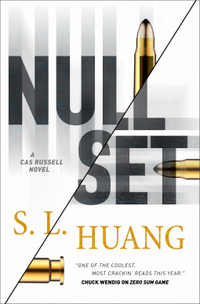
Pub Day Repost: Null Set by SL Huang: Cas Russell — the world’s most violent mathematician — gets proactive fighting crime.

Null SetNull Set

by SL Huang
Series: Cas Russell, #2

eARC, 288 pg.
Tor Books, 2019
Read: June 17 – 19, 2019

In the aftermath of Zero Sum Game, Cas and her associates are seeing the fallout from taking down those telepaths who’ve been reigning in expressions of human corruption, and it’s not pretty. So, she takes it upon herself (with a little help from her friends) to fight crime in LA — à la that rich guy in Gotham, that lawyer in Hell’s Kitchen, or the sole survivor of the Cavendish ambush of the Texas Rangers. She’s making a difference, but not as much as she wants, until she decides to take a more proactive approach.

I’ll skip the details, but what she comes up with (and talks her team into helping with) is a combination of technology, psychology and her genius. It’s so successful that every major criminal figure in LA would happily kill her several times over if they only knew what she was doing and who was doing it. Of course, many of these people are former/potential future customers. This little dance she does, while trying to get the goods on one player in particular, is a whole lot of fun to watch.

It’s also fascinating watching Cas’ develop a conscience, and then let it take her in ways that bring her into conflict with her team. They go along with her, but with reservations. In many ways, she’s grown from the woman we met in the opening of Zero Sum Game — but in so many ways she hasn’t. The heavy drinking she indulges in/retreats to testifies to that.

One thing that happened at the end of the previous novel was that a telepath triggered something in her — how much of an effect this had, or whether it was time, or something else (probably a combination of the three) has loosened something in her subconscious. Memories — partial, confusing, scattered — are coming back to her — from a time that Cas had given up on ever remembering. The memories come back, unbidden, at the worst possible times and make her vulnerable when she needs to be focusing. They also point to mysteries, questions and so many unknown things that Cas decides she’s not going to acknowledge that this is problematic for her, her work and those who depend on her.

My problem is that I think Huang overestimated how interested people were in Cas’ background and trying to learn about it/deal with it. Maybe it just feels that way to me because I can’t muster up the level of enthusiasm that the novel seems to want me to have, and everyone else will be hanging on every word. What Cas is going through has roots in the conclusion to Zero Sum Game and in her murky past. Instead of dealing with the memories and issues they raise, she spends most of the novel running from the problems, not in denial, just in a refusal to work through them — until she can’t any more (and even then . . . ). If I knew her better, if I was given more of a reason to be curious about her past, I think this could be a very interesting plot line But we don’t, and we’re not — and I had a hard time getting above the level of mild interest in this part of the novel. Which isn’t good — because this is what the novel really wants to talk about, not Cas’ innovative solutions to fighting crime.

For people who haven’t read Taylor Stevens’ Michael Munroe novels, this paragraph won’t do much for you. You should read those, by the way, if you like Cas Russell. In the second book in this series, The Innocents, Stevens takes Munroe — her complicated, almost impossible to believe, hyperviolent protagonist with a self-destructive bent (hmmm, who does that sound like?) — and has her deal with some of her problems, taking a deep dive into her psyche at the risk of the job she’s taken on — and the innocents she’s supposed to be rescuing/saving. I’d liked Munroe in her first book, and continued to, but I struggled getting through that book — but once Munroe had dealt with (in some way) what was getting to her, she was a stronger and more interesting character. I cannot tell you how often while reading Null Set that I thought back to The Innocents. True, very different books, different problems plaguing the protagonists — but their reactions to the issues and how they intend to deal with the problems raised, remind me greatly of each other. I’m hoping what comes next for this series is as strong as it was for Stevens’.

Everything else about this novel was just as absorbing and captivating as Zero Sum Game. The supporting characters were, if anything, more interesting than they were last time — and the two new characters in Cas’ circle were welcome additions. The ethical dilemma posed by Cas’ actions was pretty interesting, and a good twist on the similar conundrum posed in (and, arguably, less clear — although, I’m with Checker in not seeing it that way). The characters’ reactions to her plans (and carrying them out) seemed authentic and not just something to create drama. If Huang had wanted to and just dialed back the A-Story and dialed up the B-Story, I’d have been more enthusiastic about this — probably as much as I was about Zero Sum Game, maybe moreso.

And you just cannot beat Huang’s combination of math and fight scenes — others dabble in it, but most don’t go as far (they’re probably not that good at math) or do it as well. I don’t know why these scenes work so well for me, but I just love them. Think of River Tam wielding a gun in “War Stories” — but if she was able to tell you what she was doing and why without sounding a little . . . well, River-like. I’m not doing a great job of describing it, but it’s hard. But if Huang decided she just wanted to publish a novella or two that really just consisted of fight scenes without a whole lot of plot? I’d be all over them. Nothing against plot or characters, but sometimes they just get in the way.

I did like Null Set — just not as much as I expected to, or wanted to. But I’m still in for more of this series. What Huang’s set up for the next novel (or more) — really has my interest. The possibilities for book three have really got my curiosity churning. Having (somewhat/largely) dealt with these issues around Cas, the door is wide open for what comes next — I literally can’t wait. This isn’t what I wanted from the second Cas Russell novel, but it’s good — and will likely be a strong foundation to build on. Recommended.

Disclaimer: I received this eARC from Macmillan-Tor/Forge via NetGalley in exchange for this post — thanks to both for this.

—–

3.5 Stars

Null Set by SL Huang: Cas Russell — the world’s most violent mathematician — gets proactive fighting crime.

Null SetNull Set

by SL Huang
Series: Cas Russell, #2

eARC, 288 pg.
Tor Books, 2019

Read: June 17 – 19, 2019

In the aftermath of Zero Sum Game, Cas and her associates are seeing the fallout from taking down those telepaths who’ve been reigning in expressions of human corruption, and it’s not pretty. So, she takes it upon herself (with a little help from her friends) to fight crime in LA — à la that rich guy in Gotham, that lawyer in Hell’s Kitchen, or the sole survivor of the Cavendish ambush of the Texas Rangers. She’s making a difference, but not as much as she wants, until she decides to take a more proactive approach.

I’ll skip the details, but what she comes up with (and talks her team into helping with) is a combination of technology, psychology and her genius. It’s so successful that every major criminal figure in LA would happily kill her several times over if they only knew what she was doing and who was doing it. Of course, many of these people are former/potential future customers. This little dance she does, while trying to get the goods on one player in particular, is a whole lot of fun to watch.

It’s also fascinating watching Cas’ develop a conscience, and then let it take her in ways that bring her into conflict with her team. They go along with her, but with reservations. In many ways, she’s grown from the woman we met in the opening of Zero Sum Game — but in so many ways she hasn’t. The heavy drinking she indulges in/retreats to testifies to that.

One thing that happened at the end of the previous novel was that a telepath triggered something in her — how much of an effect this had, or whether it was time, or something else (probably a combination of the three) has loosened something in her subconscious. Memories — partial, confusing, scattered — are coming back to her — from a time that Cas had given up on ever remembering. The memories come back, unbidden, at the worst possible times and make her vulnerable when she needs to be focusing. They also point to mysteries, questions and so many unknown things that Cas decides she’s not going to acknowledge that this is problematic for her, her work and those who depend on her.

My problem is that I think Huang overestimated how interested people were in Cas’ background and trying to learn about it/deal with it. Maybe it just feels that way to me because I can’t muster up the level of enthusiasm that the novel seems to want me to have, and everyone else will be hanging on every word. What Cas is going through has roots in the conclusion to Zero Sum Game and in her murky past. Instead of dealing with the memories and issues they raise, she spends most of the novel running from the problems, not in denial, just in a refusal to work through them — until she can’t any more (and even then . . . ). If I knew her better, if I was given more of a reason to be curious about her past, I think this could be a very interesting plot line But we don’t, and we’re not — and I had a hard time getting above the level of mild interest in this part of the novel. Which isn’t good — because this is what the novel really wants to talk about, not Cas’ innovative solutions to fighting crime.

For people who haven’t read Taylor Stevens’ Michael Munroe novels, this paragraph won’t do much for you. You should read those, by the way, if you like Cas Russell. In the second book in this series, The Innocents, Stevens takes Munroe — her complicated, almost impossible to believe, hyperviolent protagonist with a self-destructive bent (hmmm, who does that sound like?) — and has her deal with some of her problems, taking a deep dive into her psyche at the risk of the job she’s taken on — and the innocents she’s supposed to be rescuing/saving. I’d liked Munroe in her first book, and continued to, but I struggled getting through that book — but once Munroe had dealt with (in some way) what was getting to her, she was a stronger and more interesting character. I cannot tell you how often while reading Null Set that I thought back to The Innocents. True, very different books, different problems plaguing the protagonists — but their reactions to the issues and how they intend to deal with the problems raised, remind me greatly of each other. I’m hoping what comes next for this series is as strong as it was for Stevens’.

Everything else about this novel was just as absorbing and captivating as Zero Sum Game. The supporting characters were, if anything, more interesting than they were last time — and the two new characters in Cas’ circle were welcome additions. The ethical dilemma posed by Cas’ actions was pretty interesting, and a good twist on the similar conundrum posed in (and, arguably, less clear — although, I’m with Checker in not seeing it that way). The characters’ reactions to her plans (and carrying them out) seemed authentic and not just something to create drama. If Huang had wanted to and just dialed back the A-Story and dialed up the B-Story, I’d have been more enthusiastic about this — probably as much as I was about Zero Sum Game, maybe moreso.

And you just cannot beat Huang’s combination of math and fight scenes — others dabble in it, but most don’t go as far (they’re probably not that good at math) or do it as well. I don’t know why these scenes work so well for me, but I just love them. Think of River Tam wielding a gun in “War Stories” — but if she was able to tell you what she was doing and why without sounding a little . . . well, River-like. I’m not doing a great job of describing it, but it’s hard. But if Huang decided she just wanted to publish a novella or two that really just consisted of fight scenes without a whole lot of plot? I’d be all over them. Nothing against plot or characters, but sometimes they just get in the way.

I did like Null Set — just not as much as I expected to, or wanted to. But I’m still in for more of this series. What Huang’s set up for the next novel (or more) — really has my interest. The possibilities for book three have really got my curiosity churning. Having (somewhat/largely) dealt with these issues around Cas, the door is wide open for what comes next — I literally can’t wait. This isn’t what I wanted from the second Cas Russell novel, but it’s good — and will likely be a strong foundation to build on. Recommended.

Disclaimer: I received this eARC from Macmillan-Tor/Forge via NetGalley in exchange for this post — thanks to both for this.

—–

3.5 Stars

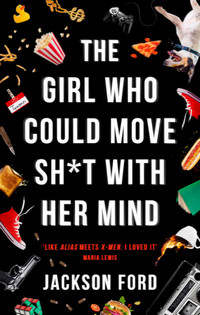
Pub Day Repost: The Girl Who Could Move Sh*t with Her Mind by Jackson Ford: The Title Says Almost Everything You Need to Know About this Rollicking Adventure

The Girl Who Could Move Sh*t with Her MindThe Girl Who Could Move Sh*t with Her Mind

by Jackson Ford
Series: Frost Files, #1

eARC, 496 pg.
Obit Books, 2019
Read: May 28 – 29, 2019

Not unlike James Alan Gardner’s All Those Explosions Were Someone Else’s Fault from 2017, the title, The Girl Who Could Move Sh*t with Her Mind tells you all the important things about this book that you need to know before picking it up — although I think this book does a better job of following through with the tone of the title throughout the book. The voice, the attitude and the defining characteristic of the protagonist (at least as most people are concerned) is all right there. If the title turns you off, don’t bother buying/borrowing this novel, you’re going to hate the experience. The same goes for the first few pages — if you’re not amused and/or intrigued by Teagan’s personality and narration within the first chapter, just stop and go find something else. If you’re amused and/or intrigued? You’ll be in for a good time. If you’re amused and intrigued? Well, my friend, settle back and enjoy.

Teagan Frost is our titular girl, and she…well can move sh…aving cream with her mind. She has psychokinetic abilities (not telekinetic, she’s touchy about that distinction) — or pk, as she calls is. Teagan will slowly describe her abilities to us as she has opportunity — and eventually will spell out to someone where those abilities came from (surprisingly far from the beginning — which I appreciated). But for the initial plot all you need to know is what the title said.

She’s part of a pseudo-governmental espionage team that acts a lot like judge and jury without bothering with the formalities. No one, or almost none of her team wants to be on it, but the shadow-y figure that calls the shots is forcing them all to be part of it (including Teagan — don’t get the idea that she wants to be some pk wielding super-hero/secret agent — she wants to work in a kitchen somewhere until she’s good enough to start her own restaurant). The rest of the team have various skills that prove handy in their tasks, but she’s the only one has any kind of extra-ordinary abilities. Actually, as far as anyone knows, Teagan is the only person alive who can do what she does.

That is, until a dead body is discovered — and the victim could not have been killed by anyone but a psychokinetic. Naturally, there’s a tie to both Teagan’s teams recent activities and the location they were in the night before. The police are looking for them (not that they have an explanation for how the victim died, but they expect someone can), and some of the higher ups in the government want to take care of Teagan without worrying about due process (those who live by the sword and all) — and if that “take care” involves dissection or vivisection so they can figure out how her pk was given to her . . . well, who’s to complain? Teagan doesn’t have a lot of time to clear her name, but she’s going to try. As are most of her associates — if she does down for this, they will to.

Time prevents me from talking about all the things I want to, but that should be enough to whet the ol’ appetite. It’s a fun book and not one you need to know much about first. There’s a lot of action, plenty of snark, some violence, some banter, some mystery, some heartbreak. There’s a very Cas Russel/Peri Reed feel to this book and this world. But something that feels entirely fresh at the same time. I’m not sure that’s technically possible, but it seems it. So it can appeal both to fans of Cas and Peri, as well as those who didn’t care for them/don’t know who they are.

There’s a lot of depth to the characters, a lot more than you’d expect — which is one of the great parts about this book. As you learn more and more about what’s really going on around the murder victims the more you learn about Teagan and her team/found family (ditto for Teagan, actually). There are plots revolving around romance and friendship plots that are legitimately surprising — in a pleasant way, nice to see someone going the way Ford does, making the choices he makes for his characters. While I’m on the subject, it wasn’t just in characterizations/relationships that Ford surprised me — he did it throughout. Even when I was saying “Well of course, ____ was really doing ___, there’s no other explanation” to myself, that was a heartbeat after I said, “What??!?! No, that can’t be right!” I’m not saying I couldn’t see anything coming, but the ratio of surprises to telegraphed moves comes out in Ford’s favor.

There are a number of X-Men parallels, going on here — all of which would appeal to Teagan (some of which she mentions). Which is a nice touch. It’s probably also something that deserves more space than I’m giving it — I’m stopping myself, because I think I could go a long way down this particular rabbit hole. I’d love to ask Ford about it.

Now, there’s one character that I think Ford messed up — he’s part of a government clean-up crew that comes to take Teagan into custody. For some reason, he hates Teagan with some sadistic vengeance, and isn’t afraid to tell anyone that. It’s senseless and motionlessness (yeah, I know sometimes people hate others for no reason — I can accept that in real life, I can’t accept it in fiction. There has to be a reason). Which is strange, as little as we understand this jerk, we know the murderer and the individual prompting them to act. Technically, we know more about the killer than we do about Teagan for most of the book. Which just makes the clean-up guy even stranger.

I expect in future installments, we’ll get an explanation for the hatred and I’ll shut up. But not until then. Ford may be playing a long game here, but this is a short game world. Ford’s set up a lot for future installments, really (you won’t figure out just how much until the end — unless you’re smarter than me, then maybe you’ll see some of it coming) — but that doesn’t stop this from being a wholly satisfying experience.

So much of the time when I’ve been reading lately I get wrapped up in evaluating a book (for good or ill), wondering why an author did this or that, and what that might mean for the book as a whole, what that might say about the writer, etc. There’s nothing wrong with that — at all. But every now and then, it’s nice to stop the critical thinking and just enjoy a book. I’m not saying I did that wholly (and my lengthy notes can testify to that) — but in a real sense I did. I got lost in Teagan’s voice, the action, and wondering just how far the killer (and the individual pushing him to be one) would go, and who’d be lost in the process. I didn’t worry about what I was going to write, but about what Jackson Ford had written. I appreciate that.

I think this is one that could be better on a second (and then maybe on the third) read, once you can take your time and not race to find out what happened, or be dazzled by Teagan’s personality. If I’m wrong, and Ford’s just razzle dazzle — well, you’re left with a fun read with snappy prose and an more-entertaining-than-most protagonist/narrator. Either way, The Girl Who Could Move Sh*t with Her Mind is a book I recommend without a hint of hesitation (if you pass the simple tests from my first paragraph).

Disclaimer: I received this eARC from Orbit Books via NetGalley in exchange for this post — thanks to both for this.

—–

4 Stars

✔ A book with a curse word in the title.

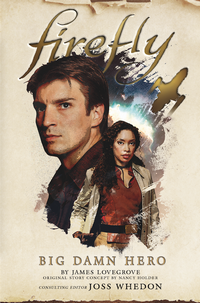
Firefly: Big Damn Hero by Nancy Holder, James Lovegrove: Take me back out to the black

Firefly: Big Damn HeroFirefly: Big Damn Hero

by Nancy Holder, James Lovegrove
Series: Firefly, #1

Hardcover, 334 pg.
Titan Books, 2018

Read: May 13, 2019

           Inara gets these faraway looks — don’t know what t means, but I know not to ask. Still got the Tams on board, and Jayne hasn’t tried to sell ’em out since we got those medical supplies on Osiris, so that’s a plus. Shepherd’s sill reading his book of fairytales. Zoë’s still my first officer, and I wouldn’t have any other. Kaylee keeps us running, and Wash keeps us flying.

Is it a good life or a bad one? The answer doesn’t matter.

It’s the only life we have.

I was a fan of Firefly from the first episode that FOX aired — and was crushed by the cancellation. Serenity was a great send-off for the characters, but like for so many, I wanted more. However, for reasons I don’t understand, I haven’t read any of the comics that came out after (which bothers me). Maybe I was just trying to move on — aside from the bi-annual (or so) rewatch of the series and movie. But when I saw that Titan Books was going to be doing a series of novels, I had to give them a shot. And then let it sit on my shelf for months.

Whoops. That was a mistake that I’m glad I rectified.

Before I talk about the novel, I’ve got to say that this is probably the nicest tie-in novel I own. It’s just a high-quality production, from cover to printing, to ribbon bookmark.

Sometime between “Heart of Gold” and “Objects in Space,” the crew finds themselves on Persephone picking up some cargo to make a run for Badger. In the chaos that ensues during a bar fight, Mal is kidnapped and Zoë and Jayne can’t find a trace of him anywhere. With a clock ticking on the delivery, the crew decides they have no choice but to deliver Badger’s goods, even with Mal in danger. Book stays behind to see what he can discover.

What he finds is evidence that Mal’s been taken by a group of Browncoat vets still embittered by their loss to the Alliance. They’ve got a little track record of finding “traitors” to the cause, trying them in a kangaroo court and executing them. The ringleader of this group seems to have a particular hatred for Malcolm Reynolds and it doesn’t seem that Mal’s got long before he’s convicted and executed.

Meanwhile, Mal’s trying to make sense of what’s happening to him and takes a trip down memory lane, going back to his childhood/early adolescence and reliving the days at home leading up to signing up with the army for the Independent cause. What we see is an immature Mal, with very little to tie him to the man he is — the same mouth, certainly, and a little bit of the same style. But it’s the war that turn him into the man that we all know and love.

Shepherd Book gets a nice little adventure on his own, able to use an old contact of his to extract information about what might have happened to Mal that Zoe and the rest can’t get. Inara gets a moment or two to shine, as does just about everyone else. Zoë gets the spotlight thoughout (as she never quite got in the show, sadly), which was great. River’s . . . River-ness(?) was on full display and was great. A lot of care was show in getting the characters — all of them, either the crew or otherwise — just right. And they did a great job of that.

It was a lot of fun exploring Mal’s roots. I’m not sure what kind of background I’d imagine him having, but it wasn’t this one. I could’ve bought another childhood/adolescence for Captain Tightpants, but this works just as well. Watching it come back to bite him seems fitting, really.

I wasn’t crazy about the end — the way that the crew left things with the kidnappers seemed a bit harsh. But the ‘Verse they fly in is a harsh one, and sometimes you have to let things be rough. So I’m not going to complain too much, but it left a bad taste in my mouth.

Will this work for people who didn’t like the show? No — well, probably not. But why would they be picking up the book? Will it convince anyone not familiar with the show that this is a universe they want to spend more time in? Mayyyyybe. Will those people enjoy the novel? Same answer. Will this help fill the void that the premature cancellation left in the hearts of so many fans? Yes. It’ll also get them asking for more — this is a fanbase that doesn’t seem to understand the concept of satiation. I know when it comes to these stories, I don’t.

It’s a very satisfying story, exciting, capturing the feel of the show and the characters. I loved getting to spend more time with these people and I hope Titan gives us several more books.

—–

4 Stars

The Girl Who Could Move Sh*t with Her Mind by Jackson Ford: The Title Says Almost Everything You Need to Know About this Rollicking Adventure

The Girl Who Could Move Sh*t with Her MindThe Girl Who Could Move Sh*t with Her Mind

by Jackson Ford
Series: Frost Files, #1


eARC, 496 pg.
Obit Books, 2019

Read: May 28 – 29, 2019

Not unlike James Alan Gardner’s All Those Explosions Were Someone Else’s Fault from 2017, the title, The Girl Who Could Move Sh*t with Her Mind tells you all the important things about this book that you need to know before picking it up — although I think this book does a better job of following through with the tone of the title throughout the book. The voice, the attitude and the defining characteristic of the protagonist (at least as most people are concerned) is all right there. If the title turns you off, don’t bother buying/borrowing this novel, you’re going to hate the experience. The same goes for the first few pages — if you’re not amused and/or intrigued by Teagan’s personality and narration within the first chapter, just stop and go find something else. If you’re amused and/or intrigued? You’ll be in for a good time. If you’re amused and intrigued? Well, my friend, settle back and enjoy.

Teagan Frost is our titular girl, and she…well can move sh…aving cream with her mind. She has psychokinetic abilities (not telekinetic, she’s touchy about that distinction) — or pk, as she calls is. Teagan will slowly describe her abilities to us as she has opportunity — and eventually will spell out to someone where those abilities came from (surprisingly far from the beginning — which I appreciated). But for the initial plot all you need to know is what the title said.

She’s part of a pseudo-governmental espionage team that acts a lot like judge and jury without bothering with the formalities. No one, or almost none of her team wants to be on it, but the shadow-y figure that calls the shots is forcing them all to be part of it (including Teagan — don’t get the idea that she wants to be some pk wielding super-hero/secret agent — she wants to work in a kitchen somewhere until she’s good enough to start her own restaurant). The rest of the team have various skills that prove handy in their tasks, but she’s the only one has any kind of extra-ordinary abilities. Actually, as far as anyone knows, Teagan is the only person alive who can do what she does.

That is, until a dead body is discovered — and the victim could not have been killed by anyone but a psychokinetic. Naturally, there’s a tie to both Teagan’s teams recent activities and the location they were in the night before. The police are looking for them (not that they have an explanation for how the victim died, but they expect someone can), and some of the higher ups in the government want to take care of Teagan without worrying about due process (those who live by the sword and all) — and if that “take care” involves dissection or vivisection so they can figure out how her pk was given to her . . . well, who’s to complain? Teagan doesn’t have a lot of time to clear her name, but she’s going to try. As are most of her associates — if she does down for this, they will to.

Time prevents me from talking about all the things I want to, but that should be enough to whet the ol’ appetite. It’s a fun book and not one you need to know much about first. There’s a lot of action, plenty of snark, some violence, some banter, some mystery, some heartbreak. There’s a very Cas Russel/Peri Reed feel to this book and this world. But something that feels entirely fresh at the same time. I’m not sure that’s technically possible, but it seems it. So it can appeal both to fans of Cas and Peri, as well as those who didn’t care for them/don’t know who they are.

There’s a lot of depth to the characters, a lot more than you’d expect — which is one of the great parts about this book. As you learn more and more about what’s really going on around the murder victims the more you learn about Teagan and her team/found family (ditto for Teagan, actually). There are plots revolving around romance and friendship plots that are legitimately surprising — in a pleasant way, nice to see someone going the way Ford does, making the choices he makes for his characters. While I’m on the subject, it wasn’t just in characterizations/relationships that Ford surprised me — he did it throughout. Even when I was saying “Well of course, ____ was really doing ___, there’s no other explanation” to myself, that was a heartbeat after I said, “What??!?! No, that can’t be right!” I’m not saying I couldn’t see anything coming, but the ratio of surprises to telegraphed moves comes out in Ford’s favor.

There are a number of X-Men parallels, going on here — all of which would appeal to Teagan (some of which she mentions). Which is a nice touch. It’s probably also something that deserves more space than I’m giving it — I’m stopping myself, because I think I could go a long way down this particular rabbit hole. I’d love to ask Ford about it.

Now, there’s one character that I think Ford messed up — he’s part of a government clean-up crew that comes to take Teagan into custody. For some reason, he hates Teagan with some sadistic vengeance, and isn’t afraid to tell anyone that. It’s senseless and motionlessness (yeah, I know sometimes people hate others for no reason — I can accept that in real life, I can’t accept it in fiction. There has to be a reason). Which is strange, as little as we understand this jerk, we know the murderer and the individual prompting them to act. Technically, we know more about the killer than we do about Teagan for most of the book. Which just makes the clean-up guy even stranger.

I expect in future installments, we’ll get an explanation for the hatred and I’ll shut up. But not until then. Ford may be playing a long game here, but this is a short game world. Ford’s set up a lot for future installments, really (you won’t figure out just how much until the end — unless you’re smarter than me, then maybe you’ll see some of it coming) — but that doesn’t stop this from being a wholly satisfying experience.

So much of the time when I’ve been reading lately I get wrapped up in evaluating a book (for good or ill), wondering why an author did this or that, and what that might mean for the book as a whole, what that might say about the writer, etc. There’s nothing wrong with that — at all. But every now and then, it’s nice to stop the critical thinking and just enjoy a book. I’m not saying I did that wholly (and my lengthy notes can testify to that) — but in a real sense I did. I got lost in Teagan’s voice, the action, and wondering just how far the killer (and the individual pushing him to be one) would go, and who’d be lost in the process. I didn’t worry about what I was going to write, but about what Jackson Ford had written. I appreciate that.

I think this is one that could be better on a second (and then maybe on the third) read, once you can take your time and not race to find out what happened, or be dazzled by Teagan’s personality. If I’m wrong, and Ford’s just razzle dazzle — well, you’re left with a fun read with snappy prose and an more-entertaining-than-most protagonist/narrator. Either way, The Girl Who Could Move Sh*t with Her Mind is a book I recommend without a hint of hesitation (if you pass the simple tests from my first paragraph).

Disclaimer: I received this eARC from Orbit Books via NetGalley in exchange for this post — thanks to both for this.

—–

4 Stars

✔ A book with a curse word in the title.

Don’t Panic by Neil Gaiman, David K. Dickson and MJ Simpson: An Indispensable Guide to Douglas Adams and his Work

I’d intended to get this up and ready for Towel Day last week — but, obviously, I failed. Schemes once again, Gang aft a-gley. It’s pretty fitting, really that this is late.

Don't PanicDon’t Panic: Douglas Adams & The Hitchhiker’s Guide to the Galaxy (Third Edition)

by Neil Gaiman; Additional Material by David K. Dickson & MJ Simpson
Series: The Hitchhiker’s Guide to the Galaxy Trilogy (related)

Hardcover, 207 pg.
Titan Books, 2003
Read: May 22 – 23, 2019

          
The idea in question bubbled into Douglas Adams’s mind quite spontaneously, in a field in Innsbruck. He later denied any personal memory of it having happened. But it’s the story he told, and, if there can be such a thing, it’s the beginning. If you have to take a flag reading THE STORY STARTS HERE and stick it into the story, then there is no other place to put it.

It was 1971, and the eighteen year-old Douglas Adams was hitch-hiking his way across Europe with a copy of The Hitchhiker’s Guide to Europethat he had stolen (he hadn’t bothered ‘borrowing’ a copy of Europe on $5 a Day, he didn’t have that kind of money).

He was drunk. He was poverty-stricken. He was too poor to afford a room at a youth hostel (the entire story is told at length in his introduction to The Hitchhiker’s Guide to the Galaxy: A Trilogy in Four Parts in England, and The Hitchhiker’s Trilogy in the US) and he wound up, at the end of a harrowing day, flat on his back in a field in Innsbruck, staring up at the stars. “Somebody,” he thought, “somebody really ought to write a Hitchhiker’s Guide to the Galaxy.”

He forgot about the idea shortly thereafter.

Five years later, while he was struggling to think of a legitimate reason for an alien to visit Earth, the phrase returned to him. The rest is history, and will be told in this book.

I distinctly remember purchasing the first edition of Don’t Panic from BookPeople of Moscow in the fall of 1991 — I remember being blown away by the idea that someone would write a book about Douglas Adams’ work. I had no idea who this Neil Gaiman fellow was, but I enjoyed his writing and loved the book he wrote — and read it several times. It was a long time (over 2 decades) before I thought of him as anything but “that guy who wrote the Hitchhiker’s book.” The Hitchhiker’s Trilogy had been a favorite of mine for years by that point, and getting to look behind the scenes of it was like catnip.

This is the third edition, and as is noted by Gaiman in the Forward, it “has been updated and expanded twice.” The completist in me would like to find a second edition to read the original 3 chapters added by David K. Dickson in 1993, but the important change was in 2002, when “MJ Simpson wrote chapters 27-30, and overhauled the entire text.” If you ask me, Gaiman’s name should be in the smaller print and Simpson’s should be the tall letters on the cover — but no publisher is that stupid, if you get the chance to claim that Neil Gaiman wrote a book, you run with it. Overhauled is a kind way of putting it — there’s little of the original book that I recognize (I’m going by memory only, not a side by side comparison). This is not a complaint, because Simpson’s version of the book is just as good as the original, it’s just not the original.

This is a little more than the story of The Hitchhiker’s Trilogy, but it’s certainly not a biography of Adams — maybe you could call it a professional biography. Or a biography of Adams the creator, which only touches upon the rest of his life as needed. Yes there are brief looks at his childhood, schooling, etc. But it primarily focuses on his writing, acting, producing and whatnot as the things that led to that revolutionary BBC Radio series and what happened afterward. Maybe you could think of it as the story of a man’s lifelong battle to meet a deadline and the lengths those around him would go to help him not miss it too much.

Once we get to the Radio series, it follows the The Hitchhiker’s Trilogy through each incarnation and expansion — talking about the problems getting it produced (in whatever medium we’re talking about — books, TV show, movie, stage show) and the content. Then the book discusses other Adams projects — Dirk Gently books, The Last Chance to See, his computer work, and other things like that.

It’s told with a lot of cheek, humor, and snark — some of the best footnotes and appendices ever. It’s not the work of a slavish fanboy (or team of them) — there are critical moments talking about problems with some of the books (some of the critiques are valid, others might be valid, but I demur). But it’s never not told with affection for the man or his work.

Don’t Panic is a must for die-hard fans — and can be read for a lot of pleasure by casual fans of the author or his work. I can almost promise that whatever your level of devotion to or appreciation of Adams/his work, it’ll increase after reading this. Any edition of this book should do — but this third edition is an achievement all to itself. Imagine someone being able to say, “I improved on Gaiman’s final draft.”

I loved it, I will return to this to read as well as to consult for future things I write about Adams, and recommend it without hesitation.

—–

5 Stars

Humor Reading Challenge 2019

Page 18 of 30

Powered by WordPress & Theme by Anders Norén