Tag: SF Page 26 of 30

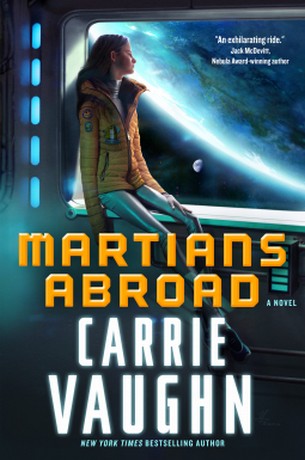
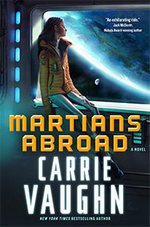
Martians Abroad by Carrie Vaughn

Welcome to Part II of the Book Tour for Martians Abroad by Carrie Vaughn — if you missed the first part, go check it out and enter the giveaway for a free copy.

Martians AbroadMartians Abroad

by Carrie Vaughn

eARC, 288 pg.
Tor Books, 2017

Read: January 11 – 12, 2016


There are so many things that I want to say about this book, I don’t know if I’ll be able to get to them all — seriously, I have a checklist that’s daunting — but let’s give it a shot.

I remember while growing up back in the 20th century that SF was fun. Maybe fun isn’t the right word, but stick with me — sure, the stories were serious, there were real stakes (usually), not every ending was happy, and so on — but there was an overall sense that the future would be okay, that space travel and aliens (at least the ones not trying to kill us/take over the world) were positives, and that there as something in humanity that made it all worthwhile. But more and more that went away, and the future became (when not downright dystopian) a grim place with people struggling to survive. By and large, who wants to live in the future depicted in SF now? Sure, there are exceptions, but most of those are in the Douglas Adams’ tradition (Scalzi and Clines would be good exceptions to this) — “light” or humorous SF. I’m not saying that I want an end to those stories, or that I don’t enjoy the darker SF. But I wouldn’t mind more SF that makes me feel okay about the future, rather than wanting to return to the carefree days of the end of the Hoover administration instead of getting to 2040 and beyond.

Enter Carrie Vaughn and Martians Abroad — an update of Heinlein’s Podkayne of Mars (not unlike Scalzi’s take on Little Fuzzy in Fuzzy Nation). Now, I’ve not read Podkayne, but I assume that it could use a little update and some tweaking. Not necessarily to improve it, but to make it “fit” the readers of today. Like a good cover song, such an update can revitalize an older work, showing different aspects of it, without having to replace it (see Parton and Houston’s “I Will Always Love You”). Since I didn’t read the original, I have no real idea how much of the plot of this book came from Heinlein and how much is straight from Vaughn herself — and I really don’t care outside of some vague curiosity. What I do know, is that Vaughn took some classic ideas and did something that only she could do with them. She gives us a vision of the future that’s not perfect, but seems like an okay place to be. This doesn’t make it better (or worse) than other SF works — just a refreshing change of pace.

From Lowood Institution to Trinity High School to Welton Academy to Hogwarts (and many others), there’s something about boarding school stories that just works. You get a little bit of a fish out of water story, usually an oppressive administration, some unofficial traditions shaping actions (frequently at least brushing up on bullying), and a heckuva story ensues. Sure, as a kid (and even now) I always wondered why anyone would attend/send their kids to one, but apparently it’s a thing. Add the Galileo Academy to the list — it’s a school for the children of Earth’s elites, as well as those of a few select space stations and colonies. Charles and Polly Newton are the first students from Mars to matriculate there — by “from Mars” I mean that they’re from the human colony on Mars, not some sort of fully alien life.

But really, in so many ways, they might as well be wholly alien — ditto for the students form various space stations or the Moon, etc. Due to differences in gravity, having to breathe pumped-in air, etc., their muscle structure bone density — and even digestive systems — have adapted to their environments to the extent that it’s easy to tell an offworlder by sight. How serious are these changes? Let’s put it this way — the non-Earth born kids can’t eat bacon. I know, I said this wasn’t a grim or dystopian view of the future, but that one fact makes me rethink that whole idea.

Now, the last thing Polly wants to do is come to Earth — she has a plan for her future, and this isn’t anywhere near it. It fits right in with her mother’s plans (Polly just doesn’t know how), Charles convinces his sister to go along with his mother’s plan without much fuss — it’s not like they could stop things, anyway. The trip from Mars to Earth isn’t as bad as she expects and she begins to have a little bit of hope – only to have that crushed as soon as she starts to meet students and administrators from the Academy. Basically offworlders are seen as lower-class/working-class, not as sophisticated or healthy as those born and raised on Earth. Polly, Charles and the other offworlders find themselves grouping together, and the target of harassment of varying degrees of seriousness and intensity from the rest. It’s tough to tell how much of this is in their minds and how much this is real — at times it feels like Polly’s exaggerating how bad things are, but typically, her perceptions are substantiated.

Before long, some accidents or other dangerous situations start occurring that put Polly and her classmates in jeopardy –and it’s not long before the students begin to wonder if there’s something other than chance at work here. While Polly seeks to integrate herself better into her new community — and she makes some pretty good strides at it (and some stumbles) — she, Charles and her friends try to figure out just who is targeting their class and why.

Polly is a great character — strong-willed, fallible, smart, impulsive, brave, socially awkward — very real. Incidentally, you may have noticed that we share a last name — I’m claiming Polly Newton as my great-great-ellipses-great-granddaughter right now, and welcome her to the family. The rest of her classmates are just as well-drawn. I could’ve used a little more on the adult front — the teachers and administrators are largely absent, and are vaguely drawn. I do think that’s a function of Vaughn’s focus being on the students, not necessarily a flaw with the book — I just would’ve liked a bit more of adult presence.

There is some real honest humor here — some of it comes from the situations, some of it is from Polly’s snark. But better than her attitude is the sheer awe she feels at Earth — the colors, the life, the non-greenhouse plants, the sky, the air. Her initial impressions of Earth were great — and they only got better from there — each time she left the confines of school, she discovered something new about this planet and the way it was described was better than the last. Polly’s a human, but from her perspective she’s an alien to this planet, she’s seeing it with fresh eyes.

There are some villains (of a sort), some real opponents to be faced, but really, there’s no one evil. There’s some misguided people, some . . . unthinking/wrong-thinking characters. But there’s no Voldemort figure, no true evil. Just conflicting agendas, different priorities, unrepentant snobbery — it feels real. Again, a refreshing change of pace.

Yes, this book is about teenagers, but it’s not a YA book. It is, like the SF I talked about at the beginning, YA-friendly, though. A book that I can recommend to friends as well as my kids and their friends — and, of course, you, whoever you are. The book was exciting, entertaining, filled with real situations in an appealing future. Vaughn’s to be thanked for such a pleasant change of pace, a breath of fresh air — and I hope we get to revisit this world (but if we don’t, that’s okay, this is a complete story as is).

Disclaimer: I received this eARC from Tor Books via NetGalley in exchange for this post — thanks to both for this. Also, thanks to Tor for the opportunity to take part in the Book Tour.

—–

4 1/2 Stars

Martians Abroad by Carrie Vaughn Book Tour

I’ve been a fan of Carrie Vaughn for over a decade now — if she’s published a novel, I’ve read it (which doesn’t mean I’ve loved them all. Naturally, I jumped at the invitation to be a part of this Book Tour. My take on the book will be posted in a few, but for now, read a little bit about this book, and then keep scrolling so you can learn how to score yourself a free copy. Or go buy a copy and let someone else get it for free. 🙂

MARTIANS ABROAD
Carrie Vaughn

“It is Polly’s teen snarkiness and strong sense of self that will have readers rooting for her to get to the bottom of the mystery. … this easygoing adventure has an affable appeal.”
—Kirkus Reviews

“This is a classic ‘fish-out-of-water’ boarding-school story, focused on an adventurous, good-hearted heroine, with retro SF twists that nod to Heinlein’s oeuvre.”
—Booklist

Inverse’s 11 Science Fiction Books That Will Define 2017 List


From the author of the New York Times bestselling Kitty Norville series and the highly praised After the Golden Age and Discord’s Apple, MARTIANS ABROAD (A Tor Hardcover; $24.99; On-Sale: January 17, 2017) is a modern feminist update of the classic juvenile science fiction novel by Robert Heinlein, Podkayne of Mars. Classic science fiction authors such as Vernor Vinge, Gregory Benford, and Jack McDevitt have already lauded this new take from Carrie Vaughn, which will appeal to both YA and adult audiences looking for an optimistic view of the future.

Teenage Polly Newton has one single-minded dream: to be a starship pilot and travel the galaxy. But her mother, the director of the Mars Colony, derails Polly’s plans when she sends Polly and her genius twin brother, Charles, to Galileo Academy on Earth—-the one planet Polly has no desire to visit. Ever.

Homesick and cut off from her desired future, Polly cannot seem to fit into the constraints of life on Earth, unlike Charles, who deftly maneuvers around people and sees through their behavior to their true motives. But when strange, unexplained, and dangerous coincidences centered on their high-profile classmates begin piling up, Polly is determined to find the truth, no matter the cost.

A versatile author, Vaughn has earned acclaim in multiple genres even as she continues to hit the bestseller lists. Fans know that she can entertain even while telling challenging and empowering stories about women finding their place in the world. RT VIP Salon describes “the excitement of reading a new story by Vaughn that’s set in a world that is so fascinating.” MARTIANS ABROAD will find fans in adult science fiction readers, young adult fans, and anyone looking for a new take on a classic science fiction adventure.

“Her breezy, convincing teenage heroine brings this familiar material to life: an
excellent retro-SF story retold for a new generation of aspiring starship pilots.”
—Gwyneth Jones (Ann Halam), author of Life

“This fun adventure echoes classic space cadet themes with a
bright finish. It’s in conversation with much of Heinlein’s
legacy with twists to keep it interesting-—a brisk read.”
—Gregory Benford, author of Timescape

About the Author

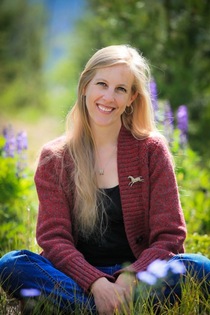
Carrie VaughnCARRIE VAUGHN, the New York Times bestselling author of the Kitty Norville books, is also the author of the stand-alone novels After the Golden Age and Discord’s Apple, and the young adult books Voice of Dragons and Steel. She holds a Masters in English Literature and collects hobbies—-fencing and sewing are currently high on the list. You can visit her online at www.carrievaughn.com.

Giveaway!

The good people over at Tor Books want to give one of my readers a Hardcover Copy of this book — and who am I to argue? We’re going to keep this simple: if you want the book, between now and 11:59PM MST on 1/30/17, leave a comment on this post. Make it amusing, if you please — it won’t help you get the book, but it’ll make things nicer for me.

Sometime next Tuesday, I’ll use some sort of random number generator to pick a winner, and notify the winner to get your address. Sound easy enough?

Not to take anything away from my upcoming review-ish post, but trust me on this folks, you want this one.

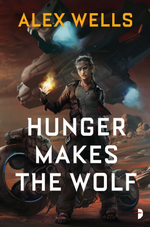
Hunger Makes the Wolf by Alex Wells

Hunger Makes the WolfHunger Makes the Wolf

by Alex Wells
Series: Hob Ravani, #2

eARC, 326 pg.
Angry Robot, 2017

Read: January 6 – 10, 2016


Let’s just get this out there — this is a very cool novel. If you dig SF that’s not beholden to space ships and lots of future tech — and can even handle a little bit of magic, you’ll want to read this one.

Tanegawa’s World is a little forgotten backwater of a planet — think Tatooine — so forgotten that none of the colonists there really have a clue that there’s an interplanetary government, or what’s going on with any other planet. The company that runs the mines (and by extension, the farming communities that support the mines) runs the whole show. There are organizations of workers in individual towns, and there’s a loose network connecting them, for mutual assistance and support. And then there are the Ghost Wolves — a band of mercenary bikers. They are a law unto themselves, but have strong ties to the miner groups. They may be supported by/sympathized with by most people in the towns, but officially they’re outlaws.

Hob Ravani is the lowest ranked member of the Wolves — she’s made some serious blunders that required her to go through the training/probationary process twice. But she’s a full-fledged member now, and the leader, Nick Ravani (no blood tie, but he gave her his name), seems to trust her, even as he’s still testing her commitment following these blunders. Making a routine run with a couple of other Wolves, Hob finds the body of Nick’s brother lying dead in the sand, shot in the back several times. This discovery — and the ensuing investigation, retaliation, and the side-effects of both — will end up changing Tanegawa’s World and the lives of many of its people in ways that no one can expect.

Which is not to say that this is a big, global story. It’s not. This is about Hob and her immediate circle. They just find themselves (and, eventually, put themselves) in some critical areas — and also don’t realize just what they’re getting themselves into. Mag, the dead man’s daughter, is Hob’s estranged best friend, and will be the favorite character of many readers. There are Geri and Freki — twins who are only slightly senior to Hob when we meet them, they’re not really friends of hers, but they are allies she can count on when she needs to — and on this world, that might be more important. There’s Coyote, who I enjoyed immensely, and a couple of other Wolves that we spend time with, but most aren’t factors in the story. There’s one more person in her circle, the Bone Collector — I’m not even going to try to sum him up in a sentence, but he’s worth getting to know.

On the flip side we have Mr. Green, who is just creepifyin’ (as Mal Reynolds would say), a Weatherman (not like Al Roker) and a couple of cut-throat corporate types who just this side of wearing black hats and twirling their mustaches They are absolutely believable and not cartoon-y, but reek of “bad guy.”

There is something that could be magic going on here — it’s definitely seen as magic by some. It might be radiation-induced mutation. It could be some sort of world-spirit/alien entity doing something to people. It’s tough to say, and it really doesn’t matter — some individuals on Tanegawa’s World possess abilities that others don’t. The ultimate cause of those abilities makes no difference to the story, it’s interesting to speculate about (and to see why various groups adopt their interpretation and how they use it) — but at the end of the day, it just means that there are a few characters walking around with extra abilities which don’t define them, but are definitely helpful.

The plotting is good, the pacing is strong, and there’s a strong voice throughout the work. This is just an impression — I can’t quote anything to verify it (were I a professional, I’d make the effort), but while the voice is consistent and strong throughout, I think Wells is a bit more aggressive about it in the opening chapters. In sort of a “come on strong and get you into the world” then dial back to “now here’s the story.” Or maybe it’s “throw you into the deep end” and then let you swim undisturbed. Or maybe I acclimatized Or maybe I should stop trying to make this point and move on. My overall point on voice — both the narrative voice, and the individual characters — it that it was strong, clear and engaging — the kind that you want to spend 300 pages with. Wells demonstrates the chops to keep and build an audience, if they’ll just give the book a shot.

I’ve seen a lot of comparisons to Dune and this world — I’ve never been able to get through much of the first book, and nor the adaptations — so I can’t comment. There’s a lot of sand, so, I guess maybe. Tanegawa’s World feels like something out of O’Keefe’s Scorched Continent or Firefly — a mining/agricultural society in what might as well be the Old West with (some) better technology than we have. Arguably, this planet is a little less hospitable to humans and The Powers That Be are a shade more corrupt.

I’ve also seen a lot of talk about the biker gang aspect of the book. It didn’t feel as prominent as I’d have liked — it was there, but it didn’t seem that vital to the nature of the mercenary crew the Ravani leads. If I had to compare it to anything, the Ghost Wolves felt more like a UF werewolf pack than anything else. That may say more about what I’ve been reading than anything that Wells wrote, still I got more of a Briggs/Vaughn/etc. vibe to the group than a Kurt Sutter-vibe. Outside of a handful of individual members, I didn’t get a clear feel for the Wolves. It’s understandable, Wells had a lot balls in the air and was doing just a good job juggling them that I didn’t notice. In retrospect, however, I’d have appreciated a little more time with this aspect.

I feel like I’ve gone on too long here, but I haven’t touched all the things I want to say. There’s just so much going on in these few hundred pages! Despite all that, you don’t get bogged down in the worldbuilding, the details, the backstories, or anything — Hunger Makes the Wolf is a fun, fast, gripping read. I trust there’s a sequel on the way. There just has to be. Not that this isn’t a complete story — there’s just a lot of threads that beg to be picked up. Either way, you’ll want to read this one.

Disclaimer: I received this eARC from Angry Robot via NetGalley in exchange for this post — thanks to both for this opportunity.

—–

4 Stars

Titanborn by Rhett C. Bruno (revised)

TitanbornTitanborn

by Rhett C. Bruno

Kindle Edition, 246 pg.
Hydra, 2016

Read: November 28 – 29, 2016

I’ve been to the rotting sewer tunnels submerged beneath the Martian domes. I’ve been to the most remote slums on Earth, and to the depths of asteroid mining colonies where being able to see the outline of your own hand in front of your face was considered bright. I’ve seen death all over and been on the end of the killing more times than I cared to count . . .

When he’s not reminiscing like an inverse-Roy Batty, Malcolm Graves is a bounty hunter of sorts — working for one of the handful of corporations that really run the solar system. He’s been at it longer than most, and has no intention of retiring anytime soon. His body, however, might have other things in mind — he’s slowing a bit, both in reflex and thought — add in a little bad luck, and Malcolm’s starting to worry about his future.

So when he’s near the site of a terrorist attack during Earth’s biggest celebration, he seizes the opportunity to get some justice and re-establish his position with the company. Sure, they’re saddling him with a partner rather than letting him work alone, but if that’s what it takes. . . . Only it’s not just a partner, it’s a young guy, fresh from an elite training program for exceptional cadets. Zhram is almost an android, it seems.

Their investigation brings them into contact with a seditious group, trying to overthrow the ruling forces on Saturn’s moon, Titan, so that the descendants of the original colonists (Titanborn). It soon becomes a race against time — can the duo find those responsible for the crime on earth and bring them in before the movement can grow and begin to make inroads against the ruling powers? Why they attempt to do so, their partnership grows and the two being to trust and learn from each other. Zhram is one of the more promising characters in the Lt. Commander Data/Odo/Sheldon Cooper-vein of people trying to learn to be more human that I’ve seen recently.

At its core, the central relationship is the classic mismatched police partners (see the Aykroyd/Hanks Dragnet, Lethal Weapon), but with a SF twist (see The Caves of Steel and Almost Human). The book is full of themes, tropes and scenarios straight from these (and similar) sources. Which isn’t to say that Titanborn is derivative — it’s part of the tradition, reflecting the best parts of its antecedents, shaping them to tell Bruno’s story.

The writing was strong (I thought a couple of times early on that he overwrote a line or two, but nothing too horrible) — the fight scenes good, the tech was believable, etc. An all-around well constructed novel.

I’ve said it before, I’ll say it again — it doesn’t matter if you tell a story that’s been told before, or using tropes commonly used — it’s how you use those tropes, how you tell the story — and Bruno did it in a very satisfactory way. I liked Malcolm from the get-go, I enjoyed watching the budding partnership between he and Zhaff, and even though I pegged (most of) the solution very early on, I really dug the reveal. I liked the characters, I appreciated the way that Bruno paced things and guided us through the shaky political landscape (and at least some of the reasons for the instability). I’d gladly read another half-dozen (at least) novels about these two racing around the solar system.

Disclaimer: This was provided to me by the author in exchange for my honest take on the book — note that I said “honest” and not “timely.” I was supposed to have this done months ago. My thanks for the book and apologies for the tardiness, Mr. Bruno.

—–

3 Stars

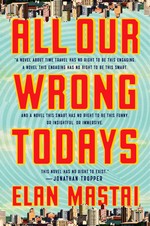
All Our Wrong Todays by Elan Mastai

All Our Wrong TodaysAll Our Wrong Todays

by Elan Mastai
eARC, 384 pg.
Dutton, 2017

Read: November 21 – 23, 2016

Avery Brooks famously asked, “Where are the flying cars? I was promised flying cars! I don’t see any flying cars! Why? Why? Why?” Elan Mastai’s book finally provides the answer. Simply put: we had it — flying cars, routine space flights, robots/other tech dressing us, feeding us, doing the everyday jobs that need to be done so that humans can focus on working in labs to make the world an even better place, to make the next technological leap forward. Essentially, everything that Science Fiction of the 1950’s told us to expect, we lived in George Jetson’s world.

Until July 11, 2016 when the first time machine was turned on and things went wrong, resulting in 40 years of history being rewritten and one man — Tom Barren — was the only one to know that we are now living in a dystopia. It’s a dystopia for everyone on Earth, but Tom, that is — his life in the 2016 that we know is much better than it was in the “original” 2016. So now Tom has to decide, does he try to restore the timeline (if he can even figure out how to do so), or does he keep things the way they are?

That’s less than you can see on Goodreads/Mastai’s site/Web retailers — and yet I think I gave away too much. But really, that’s barely scratching the surface.

There’s a great mix of detail to the science (at least the ideas and theories behind it), yet keeping it at the level where we don’t get bogged down in technicalities (and kept Mastai from having to work them out) — he gets away with it by comparing it to the way that we don’t really understand how hydroelectric dams or incandescent light bulbs work.

There’s the literary equivalent to that scene from The Wire‘s 4th episode — it’s a mixture of genius and profanity and poetry. Mostly profanity.

We’re going to be talking about Elan Mastai the way we recently talked about Ernest Cline or Andy Weir next year (assuming I can predict anything) — and he deserves it. The voice grabs you right away from the humor, the honesty — the trouble with time travel grammar. I really wish that Jonathan Tropper’s endorsement of the book wasn’t right there on the front cover, because it feels like a cheat to compare Mastai to him now, but I want to. He’s got the same mix of humor, heart, drama, inspiration as Tropper, he just blends science fiction themes in with those. 

Tom Barren’s a great character (a questionable person, but a great character) that you’ll love spending time with. There are really a lot of great characters here, but he’s the only one I feel safe discussing. There are characters with warts, strengths, weaknesses, courage, bravery, humanity in all shapes and sizes — some noble, some despicable, some pathetic. As is frequently the case, seeing multiple versions of the same characters in the various timelines tells you a lot about the people and/or worlds they live in.

Tom’s father, the one who developed the time machine — has some fantastic theories about time travel — it’s not just about time, it’s about space (between the earth’s rotation, movement through space, etc.), and for time travel to be really possible, both have to be addressed. Not only does it clear the TARDIS from every critique of time travelers/machines mentioned in the book, but it’s a really, really good point.

It’s one of those magic books that you don’t want to end, because you’ll have to leave the characters and world — but that you can’t get through fast enough because you just have to know how it turns out.
Is it flawless? No, I’m sure it’s not, but unlike ever other book I’ve read this year (including the ones I’ve loved), I can’t think of a single problem. That says a lot to me.

I have not been able to stop talking about this book for a week now — I think my wife and kids have started ignoring me when I bring it up. All Our Wrong Todays is a book that practically demands over-hyping — it’s only a huge amount of restraint that keeps me from spilling everything. I have a list of people I want to buy this for (started compiling it when I was about 10% finished), and the list is currently long enough now that I wouldn’t be able to buy any books for myself until June 2017 — so, sorry everyone, buy your own.

I don’t know if I’ll be able to watch/read more time travel again — especially time travel involving love stories — but man, it’s absolutely worth it if this was my last. Pre-order this one now so that you can dive into it as soon as possible.

—–

5 Stars

Disclaimer: I received this eARC from Dutton via NetGalley in exchange for this post — thanks to both for this.

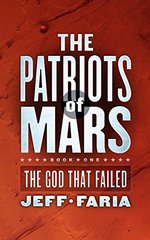
The Patriots of Mars by Jeff Faria

The Patriots of MarsThe Patriots of Mars

by Jeff Faria
Series: The God that Failed, #1

Kindle Edition, 418 pg.
Jeff Faria Communications, 2016

Read: November 16 – 18, 2016

“…All change, all worthwhile human change, comes from the common man. It is never handed down to us from our betters. My goal is to free the common man to effect that change. Sometimes that means enabling him to have a place of his own on Mars. Sometimes it means evening the odds between a nation that can afford War-bots and one that can’t. But as far as trying to figure out who the good guys are, I gave that up a long time ago. That’s a road to nowhere. Don’t go looking for heroes, Josh. You’ll never find one.”

I distinctly remember looking at the progress meter on this at 15% and groaning — it was well interesting, well-written, but I didn’t care about any of the characters or the story, and by 15% I should at least have started to get invested in something. I don’t say this to beat up on Faria, but to encourage patience in his readers. Because by somewhere in the 20-30% I was glad I stuck with it.

Basically, there’s a pretty corrupt government on Earth and a few very powerful transnational corporations (and one that’s even more so) who control a small population of miners and other laborers on Mars. Some of those on Mars start to get ideas about self-determination, self-government and whatnot. Throw in a kid who may or may not be having some religious visions that put him right in trouble’s way. Tying all of these together is a combination Internet/Simulated Intelligence enabling and supporting communications, and just about everything else in their lives. At some point the kid and some of these people on Mars get together and work toward similar ends — and that’s when everything gets weird.

Faria spends a lot of time setting his dominoes up before knocking them over — and you’ll end up not seeing exactly all the designs he had in mind. Two of the biggest are pretty apparent, but I think he wants you to see those events coming, so that you’re smarter than the characters who don’t understand their circumstances. It’s the ideas floating around these events — both leading up to them and what comes up in reaction to the various events of the novel that got and kept me interested in this book.

The science fiction part of this is well-done: the mines (why does everyone mine Mars?); the various robots; the Mad Max-ish desert areas of Mars; the political/corporate powers — even the detail about the ways they messed with the moons of mars to help land ships there — I ate all that up.

My major criticism is the female characters — there are 3 of them: Josh’s mom, Emily, and Emily’s mom (who really is just a name for most of the book until she finally shows up). Note that two of those are defined only in terms of their relation to someone (Josh’s mom has a name, I’m pretty sure, but it didn’t stick with me). You could make the case that Emily is really the only female in the cast, and that’s just not right.

I’m not going to get deeper on any of the characters, because at this point, they really don’t matter that much — I think that may change, but let’s let my lack of description of them sum up my lack of investment with them.

I’m not sure I cared that much about any of the characters in the end, really. But I want to know what happens to this world — well, worlds: Earth and Mars — and the societies represented next. It reminds me of the early Foundation novels that way, you don’t get that invested in any of the people, but man, you’ve gotta find out what happens next. This feels like the beginning of a trilogy — and I’m in for the long haul.

Disclaimer: I was given a copy of this novel by the author in exchange for this post. I really appreciate it.

—–

3 Stars

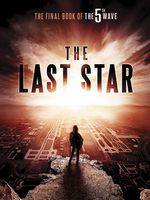
The Last Star by Rick Yancey

The Last StarThe Last Star

by Rick Yancey
Series: The 5th Wave, #3

Hardcover, 338 pg.
G.P. Putnam’s Sons Books for Young Readers, 2016

Read: November 3 – 5, 2016

Since the Arrival, I’ve been beset by more cravings than a women pregnant with triplets, and always for things I’ll never taste again. Chocolate ice cream cones. Frozen pizza. Whipped cream in a can. Those cinnamon rolls Mom made every Saturday morning. McDonald’s french fries. Bacon. No, bacon was still a possibility. I would just have to find a hog, slaughter it, butcher it, cure the meat, then fry it up. Thinking about the bacon — the potential of bacon — gives me hope. Not all is lost if bacon isn’t.

Seriously.

And there’s the best that this series can do — when there’s no reason for hope, no reason to keep going — Yancey’s characters find a reason (other than inertia) to keep struggling, to keep walking, to keep surviving, to keep hoping.

Sadly, I pretty much needed that same kind (not extent, kind) of perseverance. I thought The 5th Wave rocked, and I enjoyed The Infinite Sea, but not as much — but the wheels really came off this time. It’s not an Allegiant-level disappointment, but it was closer than anyone should want.

The writing was skillful — I liked a lot of what the book had to say about humanity, enlightenment, and teddy bears (no, really). Yancey nailed the character beats, moments, observations — but he utilized this great writing and surrounded these strong elements with a story that just wasn’t worth telling. Somehow in the end, the whole was <iLless than the sum of its parts (anyone know the German for that?).

I’m going to skip the plot summary because it’s just the next stage in the series, leading up to the final confrontation between the survivors we’re following and Humanity’s foes. That’s really all you need to know — and everyone who’s been reading the series knew that already.

This is the 10th book I’ve read by Yancey, and it’s so clearly the weakest link. I’d still recommend this book for those who’ve read the first two — but on the whole, I’d tell those who hadn’t started the series to skip it. I’m more than ready to give whatever Yancey does next a chance, if for no other reason than to get the taste of this out of my mouth.

—–

3 Stars

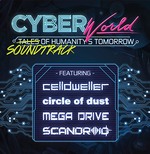
Cyber World: Soundtrack of Humanity’s Tomorrow

Cyber WorldCyber World: Soundtrack of Humanity’s Tomorrow


Hex Publishers, 2016


I enjoy music, I listen to a lot of it — but I’m no expert, so take this for what it is.

Okay, I’m not technically an expert on the other stuff I write about, but I’m closer to one when it comes to writing than I am music. But at least with books I have an idea how to talk about them, I really don’t know what to say about music — “I give him a 42 but I can’t dance to it!”

There’s a very 80’s-vibe to a lot of this music (a good thing, by and large, in my opinion . The Scandroid songs sound to me like something out of a British synth-pop band. Which may make it less than appealing for some, but it works for me (although some of the lyrics could be more interesting). I did learn what the word “Aphelion” means, though, so there’s that.

The best stuff on the album are the instrumentals — Celldweller’s “Patched in” is great background music — I’ve already been using while writing and reading. Which is not to take anything away from Mega Drive’s two songs — I alternate which of those I like best, but both are getting a lot of play time on my devices.

The three instrumental songs, in particular, do a great job of getting you into the right mood for the kind of stories the book tells — where those with vocals take you back to the era where Cyberpunk was born. So they can also put you in the right frame of mind.

A good companion piece to the anthology, and a fun listen overall. I recommend it.

Disclaimer: I was provided with a copy of this album by the publisher, which was going above and beyond. I thank them for this — it was very generous and pretty cool of them.

—–

3 Stars

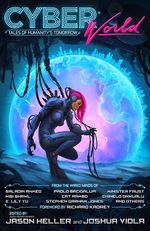
Cyber World by Jason Heller and Joshua Viola, eds.

There’s a soundtrack to this anthology, and I’ll be posting about that tonight — short version: if you like music that shares the same roots as these stories, you should check it out.

Cyber WorldCyber World: Tales of Humanity’s Tomorrow

by Jason Heller, Joshua Viola eds.


Kindle Edition, 250 pg.
Hex Publishers, 2016

Read: October 26 – 31, 2016


Heller insists in his Afterword that this is not a collection of Cyberpunk stories, and who am I to doubt him? Although it feels pretty punk to ignore the Editor/The Man. It sure feels like Cyberpunk — but I’m also pretty sure that it doesn’t matter what I call it, as long as I say that it’s good, strong, creative, mind-bending, and occasionally mind-blowing. I can’t summarize this anthology better than Hex Publishers did:

Cybernetics. Neuroscience. Nanotechnology. Genetic engineering. Hacktivism. Transhumanism. The world of tomorrow is already here, and the technological changes we all face have inspired a new wave of stories to address our fears, hopes, dreams, and desires as Homo sapiens evolve—or not—into their next incarnation.

Cyber World is a collection of this new wave of cyber-inspired tales, that should appeal to a wide audience. There’s part of me that wants to write a paragraph or two on each story — well, most of them — but I don’t have the time for that, and I can’t imagine many of you would read it. So I’ll opt for brevity. As I read through this collection, I noticed that my notes had a theme, I’d consistently remark on three aspects of the stories: 1. The Premise/Cyber-Conceit; 2. The Story/Characters; 3. The Language Used/Way of telling the story. Now, this actually sounds like a pretty decent strategy to approaching these, but I’m not clever enough to do that deliberately, apparently. Almost every story here nailed two, if not three, of these aspects.

There was a story that only scored on one front for me, but I’m not going to mention which one, because I know others will strongly disagree with me — I might even disagree in 6 months — so I’m not going to focus on it. Even those stories that didn’t do much for me, I can absolutely see where others would say that they’re a favorite. Usually, when I read a bunch of short stories I don’t see where people would have much appreciation for some of them (I mean, I know tastes vary, but sometimes you just don’t get why people like stuff). Not here — tough to ask for more than that. The writing is on point — lean, terse, quick-moving — with the occasional appropriate exception. There’s something that made me smile about all but one of the stories. The voices are strong and individual — yet pretty much clearly belong together.

I do want to talk about a few of these — sorry, no one really wants to read about how I write these things, but I think this says something. I wrote that fragment, and then took one more look at my notes, trying to find 3 or 4 stories to focus on and I came up with four in a row and stopped myself before things go out of hand. Again, this speaks to the strength of this collection. I still wasn’t able to restrict myself to 4, though:

  • Mario Acevedo’s “Reactions” is maybe too-brief, but a compelling look at remote warfare drugs and the effects of both of those on the brain/soul. Just enough zag to his pretty obvious zig to make this a keeper.
  • “The Rest Between Two Notes” by Cat Rambo contains this line:

    But this is New York City, and there can be traffic jams or terrorist threats or flash plagues to contend with…

    “flash plagues.” I love that concept. There’s just so much — probably a novel if someone wanted it, in those two words. The rest of the story was pretty weird and disturbing, and though provoking on its own, but those two words (for me) sealed it as a favorite.

  • “The Faithful Soldier, Prompted” by Saladin Ahmed reflects the international flavor of this book as well as featuring an odd mishmash of spam emails and religious revelation. Something only Ahmed could probably pull off.
  • “Staunch” by Paul Graham Raven pushed just about every stylistic button for me — mix of bio/technical/cyber/genetic fiction, plus political/economic commentary — and a whole bunch of other stuff — while telling a tight story.
  • “Will Take Care of Our Own” by Angie Hodapp is probably the most accessible, closest to mainstream story in this batch. Which doesn’t stop it from being a great story about politics, with some interesting commentary on contemporary issues — just what SF is supposed to be about — with a good fallible protagonist.
  • Minister Faust’s “The Ibex on the Day of Extinction” felt very different from most of these stories, and I don’t know how to talk about it without spoiling the whole thing, but I wanted to focus on how good it was.
  • “The Singularity Is in Your Hair” by Matthew Kessel — can I use the word “sweet” about one of these? Probably not, but this tale about VR helping a person with a debilitating disease experience more than many people is very close to it.
  • “A Song Transmuted” by Sarah Pinsker just blew me away several times.
  • “It’s Only Words” by Keith Ferrell — is almost a counter-point to the worlds the rest of these take place in — a dash of Thoreau to rebut the rest.
  • “The Bees of Kiribati” by Warren Hammond was just freaking chilling — a police interrogation to a heinous crime, becomes so much more. I want a book in this world, now. Just without the creepy killer (it can have another creepy killer, I just don’t want anything to do with this one again).

Heller (and I read his book Taft 2012 before starting this blog, so you can’t read all the nice things I thought about it at the time) and Viola did a bang up job with this collection. They might not love the label cyberpunk (but someone neglected to tell those who wrote blurbs, or the promotional material I read), and perhaps it’s not the most accurate — but if these stories aren’t Cyberpunk, they’re the result of evolution from Cyberpunk. Cyber World is a direct descendant of Mirrorshades — a couple of these stories could’ve easily been included in that collection (but some require more current cultural/technological input).

Don’t read too many of these in one sitting, it takes away some of the impact — but you’ll have a hard time stopping once you start. One of the best collection of stories I’ve read in forever.

Disclaimer: I was provided with a copy of this book by the publisher in exchange for this post and my honest opinion. I thank them for this.

—–

4 Stars

The Farthest City by Daniel P. Swenson

The Farthest CityThe Farthest City

by Daniel P. Swenson

Kindle Edition, 432 pg.
Daniel P Swenson, 2015

Read: October 21 – 22, 2016


So this takes place in some distant future Earth — the history (how accurate or not) as humanity understands it is parceled out to us in tiny bits, I could fill you in, but Swenson had some sort of plan in the way he throws crumbs. Some sort of Insectoid alien race is waging war with humans while taking over the planet. The war has been going for years and humans are slowly losing. This book traces two last-ditch efforts to get help from a Robotic race with ties to humanity in the days following World War 3 (or one of the wars after that).

Kellen is an artist (because even when the world is ending, we want graphic designers?), which turns out to be part of a Mythological Quartet to bring the robots (“Chines”) to Earth’s aid. With a Digger, Singer and Lighter, they can bring the Chines back to help. Exactly how, I don’t know — I’m not sure they do either, but they seem to have a better idea. They do meet with some sort of success — but it’s not at all how they expected, and at great cost.

Sergeant Sheemi Tanamal, is grieving her brother (killed in battle) and gets volunteered for an interstellar gamble by her father, a general. The military has a few ships capable (they hope) of interstellar flight, and they’ve got a kooky idea or two about how to find the Chines and ask for help. To say that Sheemi is unfit for this kind of mission is an understatement, but somehow she not only survives (when many others don’t), she somehow flourishes.

The main problems with this book are in execution: the way Swenson reveals information is so scattered, so like Scrooge giving to the poor, he withholds when he should explain. Mostly, I think he opts for complicated when he should aim for complex — it may seem like a fine distinction, but it’s a vital one. Yes, his dialogue is wanting, his characters are flat and unrelatable (but don’t have to be) — but it’s the writing that fails here, not his imagination.

Swenson tried, clearly tried to do something here — and he almost succeeded. But the way he failed just tarnished the good he did. This ends up being a dissatisfying mess.
Disclaimer: I received this book from the author in exchange for this post — probably not his favorite move this year.

—–

2 Stars

Page 26 of 30

Subscribe via Email

Enter your email address to subscribe to The Irresponsible Reader and receive notifications of new posts by email.

Powered by WordPress & Theme by Anders Norén