Tag: SF Page 28 of 32

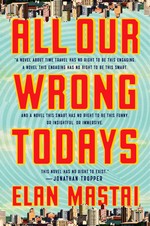
All Our Wrong Todays by Elan Mastai

All Our Wrong TodaysAll Our Wrong Todays

by Elan Mastai
eARC, 384 pg.
Dutton, 2017

Read: November 21 – 23, 2016

Avery Brooks famously asked, “Where are the flying cars? I was promised flying cars! I don’t see any flying cars! Why? Why? Why?” Elan Mastai’s book finally provides the answer. Simply put: we had it — flying cars, routine space flights, robots/other tech dressing us, feeding us, doing the everyday jobs that need to be done so that humans can focus on working in labs to make the world an even better place, to make the next technological leap forward. Essentially, everything that Science Fiction of the 1950’s told us to expect, we lived in George Jetson’s world.

Until July 11, 2016 when the first time machine was turned on and things went wrong, resulting in 40 years of history being rewritten and one man — Tom Barren — was the only one to know that we are now living in a dystopia. It’s a dystopia for everyone on Earth, but Tom, that is — his life in the 2016 that we know is much better than it was in the “original” 2016. So now Tom has to decide, does he try to restore the timeline (if he can even figure out how to do so), or does he keep things the way they are?

That’s less than you can see on Goodreads/Mastai’s site/Web retailers — and yet I think I gave away too much. But really, that’s barely scratching the surface.

There’s a great mix of detail to the science (at least the ideas and theories behind it), yet keeping it at the level where we don’t get bogged down in technicalities (and kept Mastai from having to work them out) — he gets away with it by comparing it to the way that we don’t really understand how hydroelectric dams or incandescent light bulbs work.

There’s the literary equivalent to that scene from The Wire‘s 4th episode — it’s a mixture of genius and profanity and poetry. Mostly profanity.

We’re going to be talking about Elan Mastai the way we recently talked about Ernest Cline or Andy Weir next year (assuming I can predict anything) — and he deserves it. The voice grabs you right away from the humor, the honesty — the trouble with time travel grammar. I really wish that Jonathan Tropper’s endorsement of the book wasn’t right there on the front cover, because it feels like a cheat to compare Mastai to him now, but I want to. He’s got the same mix of humor, heart, drama, inspiration as Tropper, he just blends science fiction themes in with those. 

Tom Barren’s a great character (a questionable person, but a great character) that you’ll love spending time with. There are really a lot of great characters here, but he’s the only one I feel safe discussing. There are characters with warts, strengths, weaknesses, courage, bravery, humanity in all shapes and sizes — some noble, some despicable, some pathetic. As is frequently the case, seeing multiple versions of the same characters in the various timelines tells you a lot about the people and/or worlds they live in.

Tom’s father, the one who developed the time machine — has some fantastic theories about time travel — it’s not just about time, it’s about space (between the earth’s rotation, movement through space, etc.), and for time travel to be really possible, both have to be addressed. Not only does it clear the TARDIS from every critique of time travelers/machines mentioned in the book, but it’s a really, really good point.

It’s one of those magic books that you don’t want to end, because you’ll have to leave the characters and world — but that you can’t get through fast enough because you just have to know how it turns out.
Is it flawless? No, I’m sure it’s not, but unlike ever other book I’ve read this year (including the ones I’ve loved), I can’t think of a single problem. That says a lot to me.

I have not been able to stop talking about this book for a week now — I think my wife and kids have started ignoring me when I bring it up. All Our Wrong Todays is a book that practically demands over-hyping — it’s only a huge amount of restraint that keeps me from spilling everything. I have a list of people I want to buy this for (started compiling it when I was about 10% finished), and the list is currently long enough now that I wouldn’t be able to buy any books for myself until June 2017 — so, sorry everyone, buy your own.

I don’t know if I’ll be able to watch/read more time travel again — especially time travel involving love stories — but man, it’s absolutely worth it if this was my last. Pre-order this one now so that you can dive into it as soon as possible.

—–

5 Stars

Disclaimer: I received this eARC from Dutton via NetGalley in exchange for this post — thanks to both for this.

The Patriots of Mars by Jeff Faria

The Patriots of MarsThe Patriots of Mars

by Jeff Faria
Series: The God that Failed, #1

Kindle Edition, 418 pg.
Jeff Faria Communications, 2016

Read: November 16 – 18, 2016

“…All change, all worthwhile human change, comes from the common man. It is never handed down to us from our betters. My goal is to free the common man to effect that change. Sometimes that means enabling him to have a place of his own on Mars. Sometimes it means evening the odds between a nation that can afford War-bots and one that can’t. But as far as trying to figure out who the good guys are, I gave that up a long time ago. That’s a road to nowhere. Don’t go looking for heroes, Josh. You’ll never find one.”

I distinctly remember looking at the progress meter on this at 15% and groaning — it was well interesting, well-written, but I didn’t care about any of the characters or the story, and by 15% I should at least have started to get invested in something. I don’t say this to beat up on Faria, but to encourage patience in his readers. Because by somewhere in the 20-30% I was glad I stuck with it.

Basically, there’s a pretty corrupt government on Earth and a few very powerful transnational corporations (and one that’s even more so) who control a small population of miners and other laborers on Mars. Some of those on Mars start to get ideas about self-determination, self-government and whatnot. Throw in a kid who may or may not be having some religious visions that put him right in trouble’s way. Tying all of these together is a combination Internet/Simulated Intelligence enabling and supporting communications, and just about everything else in their lives. At some point the kid and some of these people on Mars get together and work toward similar ends — and that’s when everything gets weird.

Faria spends a lot of time setting his dominoes up before knocking them over — and you’ll end up not seeing exactly all the designs he had in mind. Two of the biggest are pretty apparent, but I think he wants you to see those events coming, so that you’re smarter than the characters who don’t understand their circumstances. It’s the ideas floating around these events — both leading up to them and what comes up in reaction to the various events of the novel that got and kept me interested in this book.

The science fiction part of this is well-done: the mines (why does everyone mine Mars?); the various robots; the Mad Max-ish desert areas of Mars; the political/corporate powers — even the detail about the ways they messed with the moons of mars to help land ships there — I ate all that up.

My major criticism is the female characters — there are 3 of them: Josh’s mom, Emily, and Emily’s mom (who really is just a name for most of the book until she finally shows up). Note that two of those are defined only in terms of their relation to someone (Josh’s mom has a name, I’m pretty sure, but it didn’t stick with me). You could make the case that Emily is really the only female in the cast, and that’s just not right.

I’m not going to get deeper on any of the characters, because at this point, they really don’t matter that much — I think that may change, but let’s let my lack of description of them sum up my lack of investment with them.

I’m not sure I cared that much about any of the characters in the end, really. But I want to know what happens to this world — well, worlds: Earth and Mars — and the societies represented next. It reminds me of the early Foundation novels that way, you don’t get that invested in any of the people, but man, you’ve gotta find out what happens next. This feels like the beginning of a trilogy — and I’m in for the long haul.

Disclaimer: I was given a copy of this novel by the author in exchange for this post. I really appreciate it.

—–

3 Stars

The Last Star by Rick Yancey

The Last StarThe Last Star

by Rick Yancey
Series: The 5th Wave, #3

Hardcover, 338 pg.
G.P. Putnam’s Sons Books for Young Readers, 2016

Read: November 3 – 5, 2016

Since the Arrival, I’ve been beset by more cravings than a women pregnant with triplets, and always for things I’ll never taste again. Chocolate ice cream cones. Frozen pizza. Whipped cream in a can. Those cinnamon rolls Mom made every Saturday morning. McDonald’s french fries. Bacon. No, bacon was still a possibility. I would just have to find a hog, slaughter it, butcher it, cure the meat, then fry it up. Thinking about the bacon — the potential of bacon — gives me hope. Not all is lost if bacon isn’t.

Seriously.

And there’s the best that this series can do — when there’s no reason for hope, no reason to keep going — Yancey’s characters find a reason (other than inertia) to keep struggling, to keep walking, to keep surviving, to keep hoping.

Sadly, I pretty much needed that same kind (not extent, kind) of perseverance. I thought The 5th Wave rocked, and I enjoyed The Infinite Sea, but not as much — but the wheels really came off this time. It’s not an Allegiant-level disappointment, but it was closer than anyone should want.

The writing was skillful — I liked a lot of what the book had to say about humanity, enlightenment, and teddy bears (no, really). Yancey nailed the character beats, moments, observations — but he utilized this great writing and surrounded these strong elements with a story that just wasn’t worth telling. Somehow in the end, the whole was <iLless than the sum of its parts (anyone know the German for that?).

I’m going to skip the plot summary because it’s just the next stage in the series, leading up to the final confrontation between the survivors we’re following and Humanity’s foes. That’s really all you need to know — and everyone who’s been reading the series knew that already.

This is the 10th book I’ve read by Yancey, and it’s so clearly the weakest link. I’d still recommend this book for those who’ve read the first two — but on the whole, I’d tell those who hadn’t started the series to skip it. I’m more than ready to give whatever Yancey does next a chance, if for no other reason than to get the taste of this out of my mouth.

—–

3 Stars

Cyber World: Soundtrack of Humanity’s Tomorrow

Cyber WorldCyber World: Soundtrack of Humanity’s Tomorrow


Hex Publishers, 2016


I enjoy music, I listen to a lot of it — but I’m no expert, so take this for what it is.

Okay, I’m not technically an expert on the other stuff I write about, but I’m closer to one when it comes to writing than I am music. But at least with books I have an idea how to talk about them, I really don’t know what to say about music — “I give him a 42 but I can’t dance to it!”

There’s a very 80’s-vibe to a lot of this music (a good thing, by and large, in my opinion . The Scandroid songs sound to me like something out of a British synth-pop band. Which may make it less than appealing for some, but it works for me (although some of the lyrics could be more interesting). I did learn what the word “Aphelion” means, though, so there’s that.

The best stuff on the album are the instrumentals — Celldweller’s “Patched in” is great background music — I’ve already been using while writing and reading. Which is not to take anything away from Mega Drive’s two songs — I alternate which of those I like best, but both are getting a lot of play time on my devices.

The three instrumental songs, in particular, do a great job of getting you into the right mood for the kind of stories the book tells — where those with vocals take you back to the era where Cyberpunk was born. So they can also put you in the right frame of mind.

A good companion piece to the anthology, and a fun listen overall. I recommend it.

Disclaimer: I was provided with a copy of this album by the publisher, which was going above and beyond. I thank them for this — it was very generous and pretty cool of them.

—–

3 Stars

Cyber World by Jason Heller and Joshua Viola, eds.

There’s a soundtrack to this anthology, and I’ll be posting about that tonight — short version: if you like music that shares the same roots as these stories, you should check it out.
—

Cyber WorldCyber World: Tales of Humanity’s Tomorrow

by Jason Heller, Joshua Viola eds.


Kindle Edition, 250 pg.
Hex Publishers, 2016

Read: October 26 – 31, 2016


Heller insists in his Afterword that this is not a collection of Cyberpunk stories, and who am I to doubt him? Although it feels pretty punk to ignore the Editor/The Man. It sure feels like Cyberpunk — but I’m also pretty sure that it doesn’t matter what I call it, as long as I say that it’s good, strong, creative, mind-bending, and occasionally mind-blowing. I can’t summarize this anthology better than Hex Publishers did:

Cybernetics. Neuroscience. Nanotechnology. Genetic engineering. Hacktivism. Transhumanism. The world of tomorrow is already here, and the technological changes we all face have inspired a new wave of stories to address our fears, hopes, dreams, and desires as Homo sapiens evolve—or not—into their next incarnation.

Cyber World is a collection of this new wave of cyber-inspired tales, that should appeal to a wide audience. There’s part of me that wants to write a paragraph or two on each story — well, most of them — but I don’t have the time for that, and I can’t imagine many of you would read it. So I’ll opt for brevity. As I read through this collection, I noticed that my notes had a theme, I’d consistently remark on three aspects of the stories: 1. The Premise/Cyber-Conceit; 2. The Story/Characters; 3. The Language Used/Way of telling the story. Now, this actually sounds like a pretty decent strategy to approaching these, but I’m not clever enough to do that deliberately, apparently. Almost every story here nailed two, if not three, of these aspects.

There was a story that only scored on one front for me, but I’m not going to mention which one, because I know others will strongly disagree with me — I might even disagree in 6 months — so I’m not going to focus on it. Even those stories that didn’t do much for me, I can absolutely see where others would say that they’re a favorite. Usually, when I read a bunch of short stories I don’t see where people would have much appreciation for some of them (I mean, I know tastes vary, but sometimes you just don’t get why people like stuff). Not here — tough to ask for more than that. The writing is on point — lean, terse, quick-moving — with the occasional appropriate exception. There’s something that made me smile about all but one of the stories. The voices are strong and individual — yet pretty much clearly belong together.

I do want to talk about a few of these — sorry, no one really wants to read about how I write these things, but I think this says something. I wrote that fragment, and then took one more look at my notes, trying to find 3 or 4 stories to focus on and I came up with four in a row and stopped myself before things go out of hand. Again, this speaks to the strength of this collection. I still wasn’t able to restrict myself to 4, though:

  • Mario Acevedo’s “Reactions” is maybe too-brief, but a compelling look at remote warfare drugs and the effects of both of those on the brain/soul. Just enough zag to his pretty obvious zig to make this a keeper.
  • “The Rest Between Two Notes” by Cat Rambo contains this line:

    But this is New York City, and there can be traffic jams or terrorist threats or flash plagues to contend with…

    “flash plagues.” I love that concept. There’s just so much — probably a novel if someone wanted it, in those two words. The rest of the story was pretty weird and disturbing, and though provoking on its own, but those two words (for me) sealed it as a favorite.

  • “The Faithful Soldier, Prompted” by Saladin Ahmed reflects the international flavor of this book as well as featuring an odd mishmash of spam emails and religious revelation. Something only Ahmed could probably pull off.
  • “Staunch” by Paul Graham Raven pushed just about every stylistic button for me — mix of bio/technical/cyber/genetic fiction, plus political/economic commentary — and a whole bunch of other stuff — while telling a tight story.
  • “Will Take Care of Our Own” by Angie Hodapp is probably the most accessible, closest to mainstream story in this batch. Which doesn’t stop it from being a great story about politics, with some interesting commentary on contemporary issues — just what SF is supposed to be about — with a good fallible protagonist.
  • Minister Faust’s “The Ibex on the Day of Extinction” felt very different from most of these stories, and I don’t know how to talk about it without spoiling the whole thing, but I wanted to focus on how good it was.
  • “The Singularity Is in Your Hair” by Matthew Kessel — can I use the word “sweet” about one of these? Probably not, but this tale about VR helping a person with a debilitating disease experience more than many people is very close to it.
  • “A Song Transmuted” by Sarah Pinsker just blew me away several times.
  • “It’s Only Words” by Keith Ferrell — is almost a counter-point to the worlds the rest of these take place in — a dash of Thoreau to rebut the rest.
  • “The Bees of Kiribati” by Warren Hammond was just freaking chilling — a police interrogation to a heinous crime, becomes so much more. I want a book in this world, now. Just without the creepy killer (it can have another creepy killer, I just don’t want anything to do with this one again).

Heller (and I read his book Taft 2012 before starting this blog, so you can’t read all the nice things I thought about it at the time) and Viola did a bang up job with this collection. They might not love the label cyberpunk (but someone neglected to tell those who wrote blurbs, or the promotional material I read), and perhaps it’s not the most accurate — but if these stories aren’t Cyberpunk, they’re the result of evolution from Cyberpunk. Cyber World is a direct descendant of Mirrorshades — a couple of these stories could’ve easily been included in that collection (but some require more current cultural/technological input).

Don’t read too many of these in one sitting, it takes away some of the impact — but you’ll have a hard time stopping once you start. One of the best collection of stories I’ve read in forever.

Disclaimer: I was provided with a copy of this book by the publisher in exchange for this post and my honest opinion. I thank them for this.

—–

4 Stars

The Farthest City by Daniel P. Swenson

The Farthest CityThe Farthest City

by Daniel P. Swenson

Kindle Edition, 432 pg.
Daniel P Swenson, 2015

Read: October 21 – 22, 2016


So this takes place in some distant future Earth — the history (how accurate or not) as humanity understands it is parceled out to us in tiny bits, I could fill you in, but Swenson had some sort of plan in the way he throws crumbs. Some sort of Insectoid alien race is waging war with humans while taking over the planet. The war has been going for years and humans are slowly losing. This book traces two last-ditch efforts to get help from a Robotic race with ties to humanity in the days following World War 3 (or one of the wars after that).

Kellen is an artist (because even when the world is ending, we want graphic designers?), which turns out to be part of a Mythological Quartet to bring the robots (“Chines”) to Earth’s aid. With a Digger, Singer and Lighter, they can bring the Chines back to help. Exactly how, I don’t know — I’m not sure they do either, but they seem to have a better idea. They do meet with some sort of success — but it’s not at all how they expected, and at great cost.

Sergeant Sheemi Tanamal, is grieving her brother (killed in battle) and gets volunteered for an interstellar gamble by her father, a general. The military has a few ships capable (they hope) of interstellar flight, and they’ve got a kooky idea or two about how to find the Chines and ask for help. To say that Sheemi is unfit for this kind of mission is an understatement, but somehow she not only survives (when many others don’t), she somehow flourishes.

The main problems with this book are in execution: the way Swenson reveals information is so scattered, so like Scrooge giving to the poor, he withholds when he should explain. Mostly, I think he opts for complicated when he should aim for complex — it may seem like a fine distinction, but it’s a vital one. Yes, his dialogue is wanting, his characters are flat and unrelatable (but don’t have to be) — but it’s the writing that fails here, not his imagination.

Swenson tried, clearly tried to do something here — and he almost succeeded. But the way he failed just tarnished the good he did. This ends up being a dissatisfying mess.
Disclaimer: I received this book from the author in exchange for this post — probably not his favorite move this year.

—–

2 Stars

Time Siege by Wesley Chu

Time SiegeTime Siege

by Wesley Chu
Series: Time Salvager, #2

Hardcover, 341 pg.
Tor Books, 2016

Read: August 15 – 16, 2016


This is, in a sense, one of the most pointless posts I’ve done. If you’ve read Time Salvager, then I can’t imagine you needing to be convinced to read Time Siege, maybe you need convincing to move it up on your TBR, or just a reminder that this is out there. If you haven’t read Time Salvager, you shouldn’t read Time Siege yet because it won’t make all that much sense. But I’ll try to say a little about the book.

This book really could just be the next chapters of Salvager. It’s just taking the story to the next step — yes, there are distinct plot and character arcs, but on the whole, it’s just what should come next. Making it hard for me to know what to say. Some things that I thought were pretty well resolved in Siege are dealt with again, and hopefully resolved (or closer to it) now. Some characters come back in ways that I couldn’t have expected, some in ways that were exactly what I expected.

One thing that’s crystal clear now — and has been evident all along, really — is that Wesley Chu can write a fight scene. Whether it’s single combat or larger forces, he delivers. The scenes are suspenseful, intense, and believable. He captures what I imagine both the chaos and order of a battle would be like for those involved and those behind the lines.

Somewhere along the line, I got the impression that this was a duology, not a trilogy. So I spent most of the book thinking that this could be a dark, yet satisfying ending. Definitely not an “Everybody Lives happily every after” ending, but one that wraps things up well. Then the satisfying part became untenable (possible, but not likely) . . . and thankfully, it quickly became clear that it was going to be a trilogy. That said, everything is hanging in the balance here at the end of Time Siege, and it’s going to take a lot of heroics for there to be even a chance for an ending that doesn’t involve the doom of humanity. Even with a lot of heroics, that’s a distinct possibility — part of me wants that to happen, just to see how Chu pulls it off.

I remember liking Salvager more than I did, but whatever — the sequel did everything it needed to do to push the story forward into the third book, with heightened action, more investment in the characters and what happens to them. Chu accomplished everything he needed to here and more. I could really use a time machine now to get my hands on the concluding volume.

—–

4 Stars

The Rise of Io by Wesley Chu

The Rise of IoThe Rise of Io

by Wesley ChuA
Series: Io, #1

eARC, 352 pg.
Angry Robot, 2016

Read: September 27 – 29, 2016

“Stick with me, kid ,” he said. “We’ll introduce you to a bigger world with all sorts of new people who will want to kill you.”

Let me start by saying that while this is a sequel to the Tao Trilogy (taking place a couple of decades after The Rebirths), you don’t have to have read them to enjoy this. You’ll miss some nuances, not understand some references and will spoil events in books that you’ll end up wanting to have read. But, it’s not essential — and this would be a great jumping-on point. If you’ve read the Tao Trilogy, let me assure you that this is a worthy successor, just as fun — a part of the same series, but it feels fresh enough that you don’t feel like you’ve read this book before.

Ella Patel lives in an Indian slum — in part of the world hardest hit by the war between the Quasing factions and their human allies (while I feel bad for these fictional Indians, I’m so glad to see alien combat not centered in the U.S.). She lives on her own, orphaned by circumstance and a Gengix attack — between her small size, quick wit and almost all-consuming greed she lives life on her own terms, two steps ahead of the law and one step ahead of criminals she’s wronged. I could’ve read at least 100 pages more of her antics before we introduced a single Quasing from either side and been entirely content (not a complaint about when we got Quasings, however), Ella’s just instantly likeable in a way that no one in these series has been (with the possible exception of Cameron).

Io’s host is in India doing some off-the-books investigating into one of the Gengix’s most ambitious projects yet. That investigation doesn’t go so well and suddenly Io needs a new host — there’s the impetuous woman who tried to help her host nearby (and a much better option than anyone else), so Io makes a choice and the Queen of the streets becomes so much more. Their relationship defines rocky initially (see Tao and Roen, but worse).

It should be obvious (but isn’t) that not every Quasing will have had as illustrious existence as Tao — Io’s haven’t developed a martial art, conquered legendary kingdoms, etc. Which isn’t to say that Io didn’t leave her mark on history — for example, I trust the name “The Maginot Line” rings a bell.

As the minutes ticked by, Io clarified some of the dreams of her glorious career inhabiting humans. If anything, it comforted Ella that the Quasing weren’t all-knowing and powerful, that they were just as culpable and mistake-prone as any human.

Nevertheless, just by having existed for a few millennia on earth, Io’s got a lot of wisdom and experience to pass on to her new host. Slowly — and with several appeals to her mercenary streak — Io convinces Ella to begin training to become a Prophus agent. Eventually, Ella begins to make a sort of peace with her new life partner and something approaching friendship begins to develop.

Incidentally, Ella’s not the only one comforted by a not-all-that-perfect Quasing.

Meanwhile, a couple of Gengix Adonis agents are vying for control over India — with the citizenry of the slum (and the nation, really) acting as pawns. Shula is one of the more lethal women you’ll come across — both politically and physically. She’s not one you want to cross in almost any situation — but that doesn’t stop many.

At some point, Prophus agents come to town and everything gets turned upside down — Ella finds a desire to help the Prophus, Shula seized the opportunity for personal power, and Io has her chance at doing something that’ll leave her mark on history.

The fight scenes (training and otherwise) are up to Chu’s pretty high standards, the humor is crisp, the characters (including a couple of old friends) are just right, and the plots are among his best — I just don’t know how else to put this. The book was a solid winner and had me eager for the next installment, and then Chu hits us with one of the best Epilogues that I can remember, making me more than eager for whatever’s next (not really sure what the word for “more than eager” is, eager squared?).

Great characters, twists, suspense and grins — I dug this one so much. He keeps the magic of the Tao books, reinvigorates it and expands it. I expected Chu to deliver just what fans wanted without it being a case of “second verse, same as the first,” I just didn’t expect it’d be this good. Get on this one, folks.

Disclaimer: I received this eARC from Angry Robot via NetGalley in exchange for this post — thanks to both for this.
N.B.: As this was an ARC, any quotations above may be changed in the published work — I will endeavor to verify them as soon as possible.

—–

4 Stars

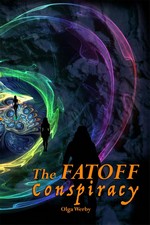
The FATOFF Conspiracy by Olga Werby

The FATOFF ConspiracyThe FATOFF Conspiracy

by Olga Werby

Kindle Edition, 317 pg.
2015

Read: August 29, 2016


This is a pretty creepy dystopian tale about a culture on the brink of disaster (self-caused, it should be stressed). Americans have lost the war on obesity and all but the elitist of the elite are dangerously obese (while tucking away a good portion of that fat into a pocket dimension), in pain, struggling, dying young and yet eating almost constantly.

Cindy Rella (and yeah, it took me until the 27% mark to figure out why that name rang a bell) comes up with a long-shot scheme to get herself government assistance to restore her to her formerly thin and healthy self). Cindy’s plan falls apart in a very dramatic (and embarrassing) fashion. Her life falls apart soon after — thankfully she has a couple of friends.

One of whom is involved in an underground movement to restore the place of actual food in the world and remove the whole food industry that is slowly killing the populace. Cindy starts exercising a bit, eating better — nothing extreme, just basic weight-loss stuff: eat less, move more — focusing on real food, not the SF foodstuff they’re all eating. The diet stuff was worked in pretty well — Werby doesn’t beat you up with it.

Most novels of this type would’ve spent a chapter or two explaining the Tech better, explaining how society got to where it was (who in their right mind starts this?) and is in. Werby just dives in to the problems, to the Tech breaking down and leaves the past in the past. Maybe in other books, I’d want more explanation, I’d want the background, but it works here. Honestly, I’m not sure that I want to know how society got to this point, because I’d like to eat sometime this month, and I might not be able to if she got into it.

The characters were okay. I liked Cindy and just about everybody else — there were a couple of villains who could’ve been better developed. Actually, this is one of the weaknesses of the book — everyone could’ve been a bit better developed. It’s like she took the cake out of the oven 5 minutes early (okay, not the best metaphor for the book, maybe I should’ve said she had us sit down when the bench’s new paint job was allllmost dry). Outside the basic plot and worldbuilding, everything needed just a bit more nuance, filled out a bit.

I enjoyed this book, but it could’ve been a little better. It was enjoyable and kept me interested — and a little horrified once all the pieces were revealed.

Disclaimer: I received a copy of this from the author in exchange for my honest — and belated thoughts. I got it in under the wire for September, but it was supposed to be in August. Ugh. Sorry!

—–

3 Stars

The Failed Fellowship by Michael R. Underwood

The Failed FellowshipThe Failed Fellowship

by Michael R. Underwood
Series: Genrenauts, #5 & 6

eARC, 181 pg.
2016

Read: September 16 – 17, 2016

Her job was to fix the story, not right every little wrong in the entire world.

But was that really enough? If you force someone to work with shoddy equipment and they get hurt every week, eventually, shouldn’t you fix the tool instead of sending them to the doctor? She’d spent the last several months playing the doctor, applying spot fixes along with the team, keeping to the shadows. Help the real hero, delay the problems until the real hero came back.

I want to come back to talk about Leah’s continuing difficulties adopting the right attitude as a Genrenaut, but we’ve got some work to get through first.

A band of intrepid warriors, in possession of a magic artifact carried by the one person capable of stopping a great evil enters a castle and fights through untold numbers of warriors through magic and feats of strength and skill. Only to have the Chosen One killed before they can challenge the leader of the forces of evil. Clearly, not the way this story is supposed to go — which creates problems on Earth Prime, and a need for Angstrom King’s team to come to Fantasy World, get the band back together, and fix the story.

The first thing the team does when they get to the world is track down Ioseph, the wizard who assembled the failed heroes. Leah describes him as:

Gandalf if Gondor had already fallen, Dumbledore facing a fascist wizard state under Voldemort.

Which is a great descriptive line, wholly genre-appropriate. This is Underwood at his best — not that he’s not great in SF or the other genres we’ve seen this season — but in Fantasy, he’s at his strength (see the Ree Reyes series for further examples).

It’s not just Underwood being comfortable, either — one of the first things we learned about Leah is that she’s a big Fantasy Fan. So her being here was is just what she’s been waiting for — and she makes the most of it. She jokes, she fights, she sings (her character is a bard), performs heroic deeds and she eats a lot of stew (while making the requisite snarky remarks about the stew). Everything you want in an epic fantasy novel or game, it’s celebrated and commented on at the same time. It’d be very easy to do a quick edit to remove all the references to other worlds/Genrenauts/etc. and come up with a decent novella-length story here — with a pretty good twist. Thankfully, we don’t have to read that hypothetical edit — we get Leah and the gang guiding us through it.

In addition to the pretty fun story — we get to see these Genrenauts function like a fully formed team — which is not to say they’re perfect, part of it is Leah’s rookie status, part of it comes from the length of time they spend in this world (as we learned last time), and part of it is the uncertainty that the tall woman they’ve been chasing brings to the story. There’s at least one other part, but you have to read the book to learn about it. Roman gets to tell Leah where he came from and what that means, which helps him a lot (the rest of the team, too). King’s and Shirin’s part of the story is the more straight-forward, if for no other reason than their temperaments and experience. Which is not to say that their parts are dull — in fact, one of the best characters from this world (with the obligatory annoying ‘ in his name) comes from their portion of the story.

The focus is, of course, on Leah — she loves being surrounded by a fantasy story and lets the setting get to her. Also, as the opening quotation shows, she’s struggling with her role as a Genrenaut in various worlds. Much like Kirk bristling under the constraints of the Prime Directive, Leah has a hard time adapting her sense of right and wrong to the world and culture she’s in — and I’m not sure she’s getting better about it, maybe she’s getting worse the more comfortable she is with the team. Frankly, I’m glad to see her struggle here, and I’m not sure what side I want her to come down on.

Leah’s now at the end of her probationary status — and if any of the Genrenauts were analyzing their own story, they’d clearly see that this was the end of a narrative arc and that something big was about to happen — enough to close this chapter and lead into a new one. It does, and it’s a doozy. Man, I hope things went well enough on the sales front for Underwood to be able to bring us a second season (if not seven) — I’m more than ready to support the next Kickstarter.

Underwood seemed more confident, a little more willing to have fun with the genre in these entries than he has with the others (not that he’s been all that restrained before). I loved this. When (for example) Leverage was on the air — there were better shows on, but few that I enjoyed as much. Similarly, I’ve read better books this year than The Failed Fellowship or any of the others in this series, but not that many and none have made me as happy reading these. There is one line towards the end of this that made me laugh out loud (and groan, too — Leah has no shame) and if I read an interview where Underwood said he wrote the previous 5 books in this series just to set up this line? It’d be justified.

Disclaimer: I received this eARC from the author in exchange for this post — I thank him for it (and for releasing the cover image in time for me to post this without my lousy placeholder).

—–

5 Stars

Page 28 of 32

Powered by WordPress & Theme by Anders Norén