

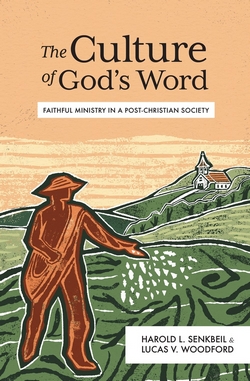
 The Culture of God’s Word:
Faithful Ministry in a Post-Christian Society
by Harold L Senkbei, read by Lucas V Woodford
DETAILS:
Publisher: Lexham Press
Publication Date: February 18, 2026
Format: Hardcover
Length: 176 pg.
Read Date: February 1, 2026


What do we mean by “culture of the word”? The culture of the word encompasses this kind of compassionate understanding, while acculturating individuals from distinctively different identities and customs into one overarching transcendent culture of the church universal and eternal. Paul’s compassionate and considerate approach to gospel proclamation shows how to best foster the culture of the word. But there’s no need to compromise Christian ethos or teaching to gain a hearing within a given subculture and grow the culture of the word.
What’s The Culture of God’s Word About?
The authors describe their starting point pretty clearly right from the start:
The book of Acts is a practical guide to mission in every generation. It shows how the first Christians were driven not by their cultural context but by the word of Christ to change the hearts and lives of people living very much in the world, yet not of it. They weren’t seeking to convert cultures but people who lived in various cultures.
Faithful mission in a chaotic world builds on this New Testament template; people in every context—every nation, tribe, and language—should be acculturated by the word of Christ. For two millennia Christians have held that the church cultivates its own transcendent culture in a rapidly shifting social context—the culture of the word.
In a culture that is safely described as post-Christendom*, their argument is simple: go back to the way that the book of Acts describes evangelism and church life. Don’t try to ape the world, adapt the Christian message to passing cultural trends, embrace the world’s values, etc. Just do what the Church and her leaders did in an equally non-Christian culture.
They spend about five chapters making the case for the reasoning behind that and what it should look like, and then wrap it up with a chapter on applying that.
* However you want to define that.
Chapters 1-5
These chapters focus on developing the above quotation. Here’s the list:
1 The Church Is Created by the Word of God
2 The Church Lives in One Transcendent Culture
3 The Church Proclaims Christ Jesus
4 The Church’s Worship Transcends Cultural Context
5 The Church Lives in the World, Not of the World
That pretty much shows you how they go about building the case—again, focusing their examples and illustrations from Acts.
Not too surprisingly, chapter 4 was the highlight of these chapters for me—I’m a sucker for a good chapter on worship. I did have some quibbles with a few things in it—but I assume that’s because I’m wrong about something they argued. Overall, it’s probably worth half the price of the book.
The Church Grows from the Culture of the Word
To faithfully grow the culture of the word there were four areas of good soil the New Testament church chose as places in which to sow the word: worship, catechesis, hospitality, and vocation. These areas remain vital to the church and must be engaged to ensure the seed is sown robustly.
That’s from the first page of Chapter 6 (that shares a title with the section heading above), and it made me instantly think of Stephen O. Presley’s Cultural Sanctification: Engaging the World like the Early Church—a book that makes the same argument (essentially) as this one, but it leans primarily on the first few centuries of the Church, rather than the inspired history of the first few decades after Pentecost.
Focusing on “worship, catechesis, hospitality, and vocation,” the authors apply the previous chapters and call ministers to work in these areas. I thought it was a wonderful and needed conclusion to the book.
So, what did I think about The Culture of God’s Word?
The task of mission and evangelization in our neo-pagan world today is exactly as it was in the pagan world of the first apostles and evangelists: to rescue and to save people by the word of the gospel accompanied by deeds of love. The culture of this word brings renewal and hope because God’s word always does what it says. The word of Christ Jesus crucified and risen heals holistically: it erases guilt, eradicates shame, and mends illnesses of both body and soul.
Now, I’m not a minister, and this book is written primarily for them—so take what I say with a larger grain of salt than you typically would. I do think that the laity can and should read books written for those who are (or are about to be) ordained to ministry—if only so we know what standards to hold them to. But still, this book wasn’t written for someone like me.
I do think I’d have gotten more out of it if I were one. But that doesn’t take away from all the things I appreciated about the book. I don’t know if it’s really all that revolutionary or unique in its outlook. This doesn’t take away from the book either—it just means that these authors find themselves in good company. If you find yourself thinking about the Presley book, or The Core of the Christian Faith by Michael W. Goheen (or other books by Goheen), or other books along those lines—don’t be surprised.
That said, it’s a short, punchy read that accomplishes what other books do in fewer pages. It could be seen as a refresher on them, or a solid introduction to this kind of thinking for those new to it.
I found myself nodding a lot, appreciating the wisdom, and making notes to talk about certain ideas with others.
I heartily encourage others to pick it up—you won’t regret it.
Disclaimer: I received this book as a participant in the Baker Publishing Group Nonfiction Reviewer Program. However, as always here, I read this book because it interested me and the opinions expressed are my own.
This post contains an affiliate link. If you purchase from it, I will get a small commission at no additional cost to you. As always, the opinions expressed are my own.
