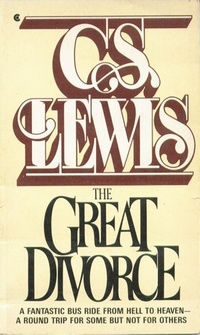
 The Great Divorce
by C. S. Lewis
DETAILS:
Publisher: Macmillan Publishing Company
Publication Date: 1946
Format: Paperback
Length: 128
Read Date: June 22, 2025


“Then those people are right who say tht Heaven and Hell are only states of mind?”
“Hush,” said he sternly. “Do not blaspheme. Hell is a state of mind—ye never said a truer word, And every state of mind, left to itself, every shutting up of the creature within the dungeon of its own mind—is, in the end, Hell. But Heaven is not a state of mind. Heaven is reality itself. All that is fully real is Heavenly. For all that can be shaken will be shaken and only the unshakable remains.”
Sixpence None the Richer’s “Soul”
Since 1994 (two or three years after I read this for the first time) I haven’t been able to think about, much less read, this book without thinking of this song. So why not let you have it run through your head as you read this?
What’s The Great Divorce About?
The conceit of this book is that C.S. Lewis is granted a vision in a dream of the afterlife. He starts out in a miserable place, full of people that could best be described as miserable (although that might be being too kind). He sees a bunch of them waiting for a bus, and since that’s pretty much the only people he can see around, he joins the queue. Before he knows it, he gets one of the last remaining seats.
After a couple of really unpleasant interactions with fellow passengers, the bus comes to a stop and everyone disembarks. They’re near some trees, but mostly there’s a large amount of grassy land near a cliff. Everyone kind of separates and walks around, while others come from a distance toward them. The best way that Lewis can come up with to describe these people is “Bright Ones” or “Solid People.”
They seem more solid and bright than anyone else—who now pretty much seem like disembodied ghosts to Lewis. Meanwhile, the grass is intensely hard and sharp; the trees and rocks are similarly “more real.” Once the Bright Ones arrive, they all head off to talk to individual ghosts—and the interactions that Lewis watches/overhears, the interactions aren’t all that pleasant.
The Bright Ones, it should be stressed, aren’t the problems. They’re patient, kind, and entirely honest. The Ghosts, on the other hand, are nasty, defensive, selfish, and seem to go out of their way to twist the words of the Bright Ones. The Bright Ones are trying to convince the Ghosts to leave these problems—and so many others behind, so they can find true happiness and forgiveness in the City.
Lewis watches some of these, and then is met by his own Bright One, who answers some questions for him about what’s going on.
Okay, that’s more of a summary than I typically give—but the meat of the book isn’t in that outline, it’s in the individual interactions between Bright Ones and the Ghosts.
“The Transmortal Conditions”
In his Preface, Lewis stresses that this book is a Fantasy, sure, it’s one with a moral—but it’s Fantasy. “The transmortal conditions are solely an imaginative supposal; they are not even a guess or a speculation of what may actually await us.”
That’s for the best because there are many problems with his vision of the realms—but at the same time, he does a wonderful job of depicting them
The loneliness of Hell/Purgatory* and how the denizens exacerbate the problem continuously to their own detriment is utterly fantastic. Even better is the hyper reality of the outskirts of the City and the Bright Ones. Lewis said he got the idea from some article he read by an American whose name he’d forgotten years before.
Between this book and Perelandra, I’m starting to come to the conclusion that Lewis’ best writing is reserved for him trying to capture Paradise and relate it to his readers. He falls short, obviously, but the way he does communicate either the area around Heaven or a Pre-Fall Venus are so fantastic that I find myself trying to describe the ineffable.
* It’s Hell for those who don’t take the opportunity to repent, Purgatory for those who do. An intriguing way to be able to placate either the Roman Catholic or Protestant in his readership.
George MacDonald
On one of the rocks sat a very tall man, almost a giant, with a flowing beard. I had not yet looked one of the Solid People in the face. Now, when I did so, I discovered that one sees them with a kind of double vision. Here was an enthroned and shining god, whose ageless spirit weighed upon mine like a burden of solid gold: and yet, at the very same moment, here was an old weather-beaten man, one who might have been a shepherd—such a man as tourists think simple because he is honest and neighbours think “deep” for the same reason. His eyes had the farseeing look of one who has lived long in open, solitary places; and somehow I divined the network of wrinkles which must have surrounded them before re-birth had washed him in immortality.
Among the many things I forgot about this book is the way that MacDonald serves as Virgil, guiding Lewis around the area, answering many of the questions he has about what he’s seeing and experiencing. Having read Surprised by Joy pretty recently, when he goes into what kind of impact MacDonald made on him really helped underline this part for me.
When so many of the other Ghosts had Bright Spirits appear to them that were someone important to them—mostly family members, Lewis (who isn’t quite a Ghost, but is largely treated as one) gets an author who was instrumental in laying the groundwork for his conversion. A great choice, and a very honest/self-revelatory one.
So, what did I think about The Great Divorce?
Never fear. There are only two kinds of people in the end: those who say to God, “Thy will be done,” and those to whom God says, in the end, “Thy will be done.” All that are in Hell, choose it. Without that self-choice there could be no Hell. No soul that seriously and constantly desires joy will ever miss it. Those who seek find. To those who knock it is opened
I absolutely loved this. I remembered liking it, but I was just blown away this read-through.
Yes, I’d quibble with some of the theology here—Lewis and I aren’t going to see eye-to-eye on many things until we both arrive in the City to be corrected (and neither of us will care about that then). But this isn’t a systematic theology, it’s a Fantasy story with apologetic aims. As such, it’s wonderful. And, I’m never going to sneeze at the chance to read Lewis describing a paradise.
And this is not an apologetic work in the way most of his are—he’s not trying to make a case for the thoughtfulness of Christianity, the reasonableness in the belief in miracles, or anything like that. He’s looking at the core of people, how they think; how they react; how in every thought, word, and deed they are selfish; it’s all about self-interest, self-importance, self-worth. They may try to dress it up somehow, but eventually—even if it’s just for a moment, it’s about them. Seeing myself in these ghosts—I assume that most readers do—is not unlike seeing yourself in the words of advice that Screwtape gives to his nephew. Neither is a pleasant experience, but the mirror that Lewis holds before his readers is pretty clear.
Of the works by Lewis that I’ve read this year, this is his best writing, his most subtle thinking, his most heart-opening thoughts. I heartily encourage this one to those who are curious—even if just for the Fantasy of it all.

This post contains an affiliate link. If you purchase from it, I will get a small commission at no additional cost to you. As always, the opinions expressed are my own.