

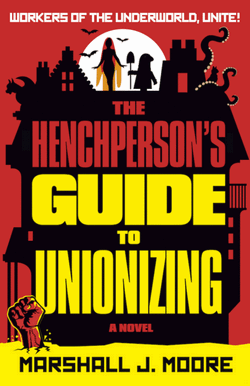
 The Henchperson’s Guide to Unionizing
DETAILS:
Publisher: Bantam
Publication Date: September 22, 2026
Format: eARC
Length: 384 pg.
Read Date: September 10-11, 2026


What’s The Henchperson’s Guide to Unionizing About?
Okay, this is going to sound familiar—using body parts and organs from several corpses and some galvanic energy generated by a lightning bolt, a Doctor and his assistant, Igor, are trying to create life. Until, of course, they’re interrupted by the locals carrying torches and pitchforks (and likely some other improvised weaponry), driving them away from their laboratory.
Igor helps the Doctor* to escape, and they head to a new town to start their work anew. This isn’t the first (or fourth) time, and Igor expects that it won’t be the last.
This time, they settle into a seemingly abandoned castle. The Doctor claims to have some family connection to it, so they’re not quite squatting as they usually do. Igor hopes that’ll keep the torches and pitchforks away a little longer than usual. The Doctor gets to his work, and Igor to his—there’s a cemetery that needs plundering.
It turns out that the castle isn’t abandoned. A relative of the Doctor’s (if you go climbing the family tree far enough) has moved back into his home. Sure, as he technically died years ago, he’d have a hard time proving ownership. He and his wife are vampires. A witch and her feline familiar also want to use the castle for their work. The Count, the Doctor, and the Witch are on the verge of tearing each other to shreds when Igor talks them into cohabiting. The castle’s big enough for all of them, after all. Maybe they could even help each other. The Count’s wife, Cordelia, the familiar, Grimalkin, and Igor are treated rather shabbily by the others in their pairings. It doesn’t take them long to recognize that in each other, to befriend one another, and to try to help each other.
It’s a short trip from people seeing your worth and appreciating you to you yourself starting to see it—and demanding it be recognized. And well…things move on from there.
* No last name given. Count it a mystery.
Why did I pick this up? Why did I keep reading?
Sadly, I don’t remember what made it click for me when I got the invitation to “Read Now” from NetGalley—but it struck the right chord in me a couple of months back, and here we are.
The first third (+/- a couple of percentage points) really didn’t do much for me. Everything was entertaining and amusing—I was ready to keep going, but I wasn’t that invested. Then something around that point clicked, and I was laughing and caring about the characters. I won’t say it swept me off my feet—but it did something close to it. I was utterly into the rest of the book—even bits I could guess or seemed paint-by-numbers, Moore’s execution was good enough that I just couldn’t care.
It’s likely that the first third would’ve landed better on another day, too. I could’ve been having an off day. I’m just saying, if you’re not sold immediately—stick around. Grim, Cordelia, and/or Igor will get to you.
What are some of the big themes of the novel?
I could toss out three as primary—which seems difficult to pull off—and at least one other as a good secondary.
The three friends don’t have a lot of practice in having friends—the one with experience has fallen out of practice for a few centuries. But they take to it easily and without noticing (at first). It’s charming, it’s sweet, and it’s entirely relatable—Igor doesn’t know how to be a friend, how to think like a friend—but he just does things that you do for friends (and then realizes it later). As the friendships grow, so do the characters—in confidence, in caring, in bravery, in willingness for self-sacrifice.
The other very prevalent theme is the idea of self-respect—and in these pages, it grows out of friendship. Igor essentially thinks, “Cordelia and Grim seem to see that I have some worth, maybe I make the Doctor show me some respect.” (and the others take similar stands). I’m not going to say how that goes for any of them, but it’s heartwarming to see. Igors and familiars are not usually treated with a whole lot of decency or respect—they’re around to do their master’s bidding, and that’s about all that anyone thinks of them. But Moore helps us to see them as people (or, in Grim’s case, a person worth paying attention to).
The possibility and tendency of anyone—regardless of appearance, profession, or background—to do good or evil (or a mix) comes from the individual, not appearance, profession, or background. This isn’t necessarily the most prominent theme—but when it crops up it sort of takes over and the rest kind of fall by the wayside. If I had to take a stand, I’d say that this is the heart of the book, though.
Despite what the title suggests, anything about the power of collective bargaining, the value of work, solidarity of the employees comes in far behind the rest—and honestly, for very few pages. It’s there—but you have to be patient. It’s a good title, though.
So, what did I think about The Henchperson’s Guide to Unionizing?
Like I said above, this novel came close to sweeping me off of my feet. I thoroughly enjoyed this ride (at least most of it). It has the feel of a cozy—but there’s some actual action and some grave robbing and corpse robbing that probably puts it out of the genre (plus other things that come up later). When trying to get this post done (it took me two more writing sessions than I expected to come up with something I liked), it occurred to me that this is a very Ted Lasso-esque novel.
It’s about a small team (of three—up to 7, depending on how you want to count it) sticking by each other, trusting each other, and using that trust to achieve something bigger than themselves. It’s about being curious (ya’ll know the rest). It’s about wearing your heart on your sleeve and going for what you want to go for.
It’s incredibly earnest and heartfelt. It’s also funny—it has a couple of laugh-out-loud moments, and some just chuckle- or grin-inducing moments. The threats of violence are real—either person-to-person, otherworldly-to-Earth, or crowd of visitors to small-group. And I’m not going to say how many of those threats get carried out, but there’s real danger and no promises of anyone making it.
There’s also another character that comes along partway through the book that is just cute. I’d love to go on about that character, but I’m afraid of what undead creature Moore would send after me for ruining things for you.
I really enjoyed this novel and think you will, t0o—it’s just the thing to set the stage for a spooky October (if that’s your kind of thing). Give it a shot.
Disclaimer: I received this eARC from Ballantine via NetGalley—my thanks to both for this. This post contains my honest opinion about a book I chose to read.
This post contains an affiliate link. If you purchase from it, I will get a small commission at no additional cost to you. As always, the opinions expressed are my own.
