

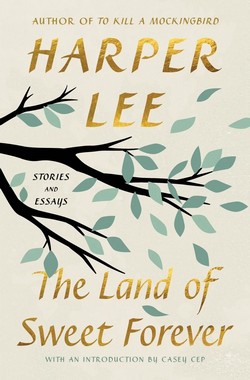
 The Land of Sweet Forever: Stories and Essays
by Harper Lee
DETAILS:
Publisher: Harper
Publication Date: October 21, 2025
Format: Hardcover
Length: 224 pg.
Read Date: January 28-30, 2026


What’s The Land of Sweet Forever?
The short version is that this is a collection of eight short stories and eight short non-fiction pieces by Harper Lee.
That seems a bit lacking, so here’s what the Publisher says:
Harper Lee remains a landmark figure in the American canon – thanks to Scout, Jem, Atticus, and the other indelible characters in her Pulitzer-winning debut, To Kill a Mockingbird; as well as for the darker, late-’50s version of small-town Alabama that emerged in Go Set a Watchman, her only other novel, published in 2015 after its rediscovery. Less remembered, until now, however, is Harper Lee the dogged young writer, who crafted stories in hopes of magazine publication; Lee the lively New Yorker, Alabamian, and friend to Truman Capote; and the Lee who peppered the pages of McCall’s and Vogue with thoughtful essays in the latter part of the twentieth century.
The Land of Sweet Forever combines Lee’s early short fiction and later nonfiction in a volume offering an unprecedented look at the development of her inimitable voice. Covering territory from the Alabama schoolyards of Lee’s youth to the luncheonettes and movie houses of midcentury Manhattan, The Land of Sweet Forever invites still-vital conversations about politics, equality, travel, love, fiction, art, the American South, and what it means to lead an engaged and creative life.
There are three pieces that I want to focus on: two short stories and one essay.
“The Cat’s Meow”
This story takes place in Maycomb—our favorite fictional community. Our narrator (a thinly disguised Harper Lee) returns home for a visit from New York City, and stays with her sister (a thinly disguised version of her sister, Alice). In this story, Alice has a “Yankee Negro” gardener with a criminal past. His actions, life, and interactions with people in the community are the focus of the story.
The narrator is clearly not comfortable with the way that the gardener is treated—but lacks the courage to follow through beyond a comment or two lest she do something to cause an irreparable rift.
It’s easy to judge the narrator (as the editor seems to in her introduction), but it’s also really easy to empathize and root for her quiet push-back and hope for something bigger around the corner. Anyone who’s been in a dicey conversation in the last few years with a relative on the other side of a political/social divide will be able to relate to this.
The characters are fully human and flawed. Everything is incredibly relatable, and you can’t help but feel for the gardener (even when he makes some huge errors in judgement)
“The Land of Sweet Forever”
This story right here is worth the purchase price of the book. It showed up in Go Set a Watchman, but don’t hold that against it.
There’s something about the characters and conversations in this story that just worked for me—the storyline itself is almost non-existent, but the scenes that make it up are so good that it doesn’t matter.
I can’t put my finger on what about this that clicked with me, and I really don’t know how to discuss it. It’s a simple little story that made my heart swell.
“Love—in Other Words”
I wasn’t sure what to expect from the non-fiction portion of the book, but when I finished it, I put in my notes, “If this is what these essays are going to be like, I’m very happy.” Sadly, this was the best of the batch—by a lot.
It’s really a basic essay about love—Lee invokes historical figures, general sentiment, literature, and the Bible, and comes up with something that just strikes you as true. Practically timeless. Yeah, it’s basic, but it doesn’t need to be more.
So, what did I think about The Land of Sweet Forever?
A lot of the stories/pieces were just fine or underwhelming—the collection as a whole isn’t that great. The high points were high (and I didn’t discuss them all), and the low points were forgettable.
But this is definitely a case of the whole being greater than the sum of its parts. We get to see a lot of different aspects of Lee here—ways she developed as a writer. The way she can lift bits of her older writing and incorporate them into her novels. Her personality. This is a great way to understand her.
I’ve heard and read the story so many times about her friends giving her a place to live for a year so she can focus on To Kill a Mockingbird. We all know how close she was to Capote, or how much she admired Gregory Peck. Reading those things in her own words just makes those things we all know resonate so much more clearly.
I don’t know how often I’ll read this entire collection again (certainly before I re-read Go Set a Watchman), but I can dip back into it here and there. But I’m so glad we have it. I think if you have more than a passing interest in Lee, you will, too.
This post contains an affiliate link. If you purchase from it, I will get a small commission at no additional cost to you. As always, the opinions expressed are my own.
