

Tag: The Pleasures of Reading in an Age of Distraction

REPOSTING: Reread Project: The Pleasures of Reading in an Age of Distraction by Alan Jacobs: A very different model of what reading can be all about.

Earlier this year, I re-read three books by Alan Jacobs in what he styles as a trilogy of sorts (my paraphrase), with the intention of writing new, longer, posts about them all–or maybe one mega-post about all three. Neither of those happened, and I’m pretty sure it’s not going to happen this year–as much as they deserve it. But I still wanted to reflect on them a bit and call your attention to them. So, I’m just going to repost what I’ve said before–which, yes, means two posts about this book.
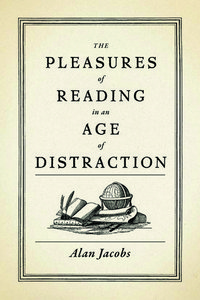

The Pleasures of Reading in an Age of Distraction

The Pleasures of Reading in an Age of Distraction

by Alan Jacobs

Hardcover, 150 pg.
Oxford University Press, 2011

Read: January 2-3, 2020
Grab a copy from your local indie bookstore!

Read what would give you delight—at least most of the time—and do so without shame. And even if you are that rare sort of person who is delighted chiefly by what some people call Great Books, don’t make them your study intellectual diet, any more than eat at the most elegant of restaurants every day. It would be too much. Great books are great in part because of what they ask of their readers: they are not readily encountered, easily accessed. The poet W. H. Auden once wrote, “When one thinks of the attention that a great poem demands, there’s something frivolous about the notion of spending every day with one. Masterpieces should be kept for High Holidays of the Spirit”—for our own personal Christmases and Easters, not for any old Wednesday.

I picked this up as my first book of the year as a way to refresh the mind, come into the year with a reminder of what kind of reader I want to be. As I write this, I’m deliberately not looking at what I wrote last time I read this, but you may find it interesting. Maybe not. I don’t know if I’ll end up repeating myself.

I remember this book being as close to a mission statement for my approach to reading as you could hope for—particularly because I came to it late in life. It’s not like this is a book I read in college and it shaped me/my thinking, but it’s something that I came to a couple of years ago and it was as if a more erudite and thoughtful version of myself had written it.

The beginning of the book is the heart of it, he sets forth his central theses, core argument:

one dominant, overarching, nearly definitive principle for reading: Read at Whim.

Reading shouldn’t be about self-improvement (primarily), it isn’t the mental equivalent of eating Brussels Sprouts. It should be for pleasure. And to maximize that, Jacobs will argue—read at whim.

Following that, Jacobs talks about many aspects of reading for pleasure—note-taking, thinking about what we read, focus (and how to expand it), the role of ereaders (he’s surprisingly pro-ereader), fighting distractions, evaluating what we read and more.

I was particularly struck this time through by his section on re-reading. For growing in appreciation for, or understanding of a work. Or because you enjoy escaping into a well-known and beloved world for a period.

Jacobs frequently quotes Auden, at one point he cites Auden’s five ratings for a book—I think we should maybe replace the standard 5-Star system with this:

For an adult reader, the possible verdicts are five: I can see this is good and I like it; I can see this is good but I don’t like it; I can see this is good, and, though at present I don’t like it, I believe with perseverance I should come to like it; I can see that this is trash but I like it; I can see that this is trash and I don’t like it.

Most of all, this is a celebration of/appreciation of reading. Jacobs is a kindred spirit to us readers as well as a humanities professor. Reading is both a passion and a profession—and both (particularly the former) are clearly seen in these pages.

Our goal as adults is not to love all books alike, or as few as possible, but rather to love as widely and as well as our limited selves will allow.

Hear, hear. That’s a good reminder.


5 Stars

This post contains an affiliate link. If you purchase from it, I will get a small commission at no additional cost to you. As always, opinions are my own.

REPOSTING: The Pleasures of Reading in an Age of Distraction by Alan Jacobs

Earlier this year, I re-read three books by Alan Jacobs in what he styles as a trilogy of sorts (my paraphrase), with the intention of writing new, longer, posts about them all–or maybe one mega-post about all three. Neither of those happened, and I’m pretty sure it’s not going to happen this year–as much as they deserve it. But I still wanted to reflect on them a bit and call your attention to them. So, I’m just going to repost what I’ve said before–which, yes, means two posts about this book. I like all of this, except the rating–what was I thinking?


The Pleasures of Reading in an Age of DistractionThe Pleasures of Reading in an Age of Distraction

by Alan Jacobs

Hardcover, 150 pg.
Oxford University Press, USA, 2011

Read: December 21 – 25, 2015

A while back my teenage son drifted into the room where I was reading, tilting his head to catch the title of the book in my hands. It was that venerable classic How to Read a Book, by Mortimer Adler and Charles van Doren. “Oh man, he said, “I had to read that in school last year. Maybe I learned something about how to read a book, but after that I never wanted to read a book again.”

Oh, I hear ya, brother! I endured Adler/van Doren for a graduate-level course and thought it was one of the most pointless books I’d ever read. Now, Jacobs finds more profit in the tome than I do, but he’s clearly not a fan.

The book starts with a call to read what you want, reading based on whim, rather than thinking of it as a self-improvement program (which it is, in a way, but it doesn’t have to be followed like one). In fact, Alden, Harold Bloom, etc. turn

reading into the intellectual equivalent of eating organic greens. . . That sort of thing is not reading at all, but what C. S. Lewis once called “social and ethical hygiene.”

Instead, Jacobs calls for people to:

Read what gives you delight–at least most of the time–and so without shame. And even if you are that rare sort of person who is delighted chiefly by what some people call Great Books, don’t make them your steady intellectual diet, any more than you would eat at the most elegant of restaurants every day.

Jacobs is a Professor of the Humanities at Baylor University, and author of many books and articles on books, reading, and authors. He’s one of those guys I’ve seen the name of everywhere, and associated with insight, but if push came to shove, I couldn’t tell you why. But now he’s the professor I wish I had (nothing against most of the early ’90s English department at the University of Idaho, most).

Reading on a whim doesn’t mean you can’t stretch yourself, read above your comfort level, or to better yourself — but you do it because it interests you, because you want to (and when you want to), rather than subjecting yourself to someone’s checklist.

After that, Jacobs moves into trying to understand how reading works, how it captures so many imaginations — and sure, he cites some studies that explain how we take black marks on paper and make them ideas in our head, at some point even the professionals have to stop and say, “it just works.” (but Jacob puts it better).

We also get discussion about the “iron-clad Law of Diminishing Returns” regarding rereading too soon (and yet, why we should reread). An interesting defense of/encouragement of fanfic. I was surprised, quite surprised, at his advocacy for e-Readers — I fully expected him to be solidly Dead Tree Edition Only, whoops — I don’t use my Kindle the way he does, but I can see where it’d work for him (or Nook, either). Why a lot of the doomsayers about the state of reading/publishing are wrong.

But mostly this is advice and guidance for the reader trying to recapture the same joy that he had before (or never had), encouragement for the active reader to keep at it, the person who still can’t get poetry, etc., etc.

I can’t resist another quotation. Towards the end of the book, he talks about the joy of finding a book by Serendipity:

serendipity is the near relation of Whim; each stands against the Plan.

Plan once appealed to me, but I have grown to be a natural worshiper of Serendipity and Whim; I can try to serve other gods, but my heart is never in it. I truly think I would rather read an indifferent book on a lark than a fine one according to schedule and plan.

Charmingly written, full of allusions (that most of us can get even without reading the works), witticisms and research — a book to entertain and edify. This one really speaks to me as a reader — it’s practically a mission statement for this blog. I expect I’ll come back to this one soon (maybe even annually). Still, for this time, I’m rating it 4-Stars, though I expect it’s a 5-Star book. I think it’s because I read it in 2-5 page spurts (one of those weeks, y’know?) after I got to page 70. Which doesn’t do the thing any favors. Towards the end of the book, Jacobs says:

All books want our attention, but not all of them want the same kind of attention.

I didn’t give this the right kind, and I’ll regret that for awhile.

If you like this blog, you’ll dig this book.

—–

Big Thanks to Aman Mittal for pointing me to this book — I haven’t read his take on it in a couple of months, so I don’t know how much we agree, but I know his post made me look for the book.

—–

4 Stars

Reread Project: The Pleasures of Reading in an Age of Distraction by Alan Jacobs: A very different model of what reading can be all about.

The Pleasures of Reading in an Age of Distraction

The Pleasures of Reading in an Age of Distraction

by Alan Jacobs

Hardcover, 150 pg.
Oxford University Press, 2011

Read: January 2-3, 2020
Grab a copy from your local indie bookstore!

Read would give you delight—at least most of the time—and do so without shame. And even if you are that rare sort of person who is delighted chiefly by what some people call Great Books, don’t make them your study intellectual diet, any more than eat at the most elegant of restaurants every day. It would be too much. Great books are great in part because of what they ask of their readers: they are not readily encountered, easily accessed. The poet W. H. Auden once wrote, “When one thinks of the attention that a great poem demands, there’s something frivolous about the notion of spending every day with one. Masterpieces should be kept for High Holidays of the Spirit”—for our own personal Christmases and Easters, not for any old Wednesday.

I picked this up as my first book of the year as a way to refresh the mind, come into the year with a reminder of what kind of reader I want to be. As I write this, I’m deliberately not looking at what I wrote last time I read this, but you may find it interesting. Maybe not. I don’t know if I’ll end up repeating myself.

I remember this book being as close to a mission statement for my approach to reading as you could hope for—particularly because I came to it late in life. It’s not like this is a book I read in college and it shaped me/my thinking, but it’s something that I came to a couple of years ago and it was as if a more erudite and thoughtful version of myself had written it.

The beginning of the book is the heart of it, he sets forth his central theses, core argument:

one dominant, overarching, nearly definitive principle for reading: Read at Whim.

Reading shouldn’t be about self-improvement (primarily), it isn’t the mental equivalent of eating Brussels Sprouts. It should be for pleasure. And to maximize that, Jacobs will argue—read at whim.

Following that, Jacobs talks about many aspects of reading for pleasure—note-taking, thinking about what we read, focus (and how to expand it), the role of ereaders (he’s surprisingly pro-ereader), fighting distractions, evaluating what we read and more.

I was particularly struck this time through by his section on re-reading. For growing in appreciation for, or understanding of a work. Or because you enjoy escaping into a well-known and beloved world for a period.

Jacobs frequently quotes Auden, at one point he cites Auden’s five ratings for a book—I think we should maybe replace the standard 5-Star system with this:

For an adult reader, the possible verdicts are five: I can see this is good and I like it; I can see this is good but I don’t like it; I can see this is good, and, though at present I don’t like it, I believe with perseverance I should come to like it; I can see that this is trash but I like it; I can see that this is trash and I don’t like it.

Most of all, this is a celebration of/appreciation of reading. Jacobs is a kindred spirit to us readers as well as a humanities professor. Reading is both a passion and a profession—and both (particularly the former) are clearly seen in these pages.

Our goal as adults is not to love all books alike, or as few as possible, but rather to love as widely and as well as our limited selves will allow.

Hear, hear. That’s a good reminder.


5 Stars

This post contains an affiliate link. If you purchase from it, I will get a small commission at no additional cost to you. As always, opinions are my own.

The Pleasures of Reading in an Age of Distraction by Alan Jacobs

The Pleasures of Reading in an Age of DistractionThe Pleasures of Reading in an Age of Distraction

by Alan Jacobs

Hardcover, 150 pg.
Oxford University Press, USA, 2011

Read: December 21 – 25, 2015

A while back my teenage son drifted into the room where I was reading, tilting his head to catch the title of the book in my hands. It was that venerable classic How to Read a Book, by Mortimer Adler and Charles van Doren. “Oh man, he said, “I had to read that in school last year. Maybe I learned something about how to read a book, but after that I never wanted to read a book again.”

Oh, I hear ya, brother! I endured Adler/van Doren for a graduate-level course and thought it was one of the most pointless books I’d ever read. Now, Jacobs finds more profit in the tome than I do, but he’s clearly not a fan.

The book starts with a call to read what you want, reading based on whim, rather than thinking of it as a self-improvement program (which it is, in a way, but it doesn’t have to be followed like one). In fact, Alden, Harold Bloom, etc. turn

reading into the intellectual equivalent of eating organic greens. . . That sort of thing is not reading at all, but what C. S. Lewis once called “social and ethical hygiene.”

Instead, Jacobs calls for people to:

Read what gives you delight–at least most of the time–and so without shame. And even if you are that rare sort of person who is delighted chiefly by what some people call Great Books, don’t make them your steady intellectual diet, any more than you would eat at the most elegant of restaurants every day.

Jacobs is a Professor of the Humanities at Baylor University, and author of many books and articles on books, reading, and authors. He’s one of those guys I’ve seen the name of everywhere, and associated with insight, but if push came to shove, I couldn’t tell you why. But now he’s the professor I wish I had (nothing against most of the early ’90s English department at the University of Idaho, most).

Reading on a whim doesn’t mean you can’t stretch yourself, read above your comfort level, or to better yourself — but you do it because it interests you, because you want to (and when you want to), rather than subjecting yourself to someone’s checklist.

After that, Jacobs moves into trying to understand how reading works, how it captures so many imaginations — and sure, he cites some studies that explain how we take black marks on paper and make them ideas in our head, at some point even the professionals have to stop and say, “it just works.” (but Jacob puts it better).

We also get discussion about the “iron-clad Law of Diminishing Returns” regarding rereading too soon (and yet, why we should reread). An interesting defense of/encouragement of fanfic. I was surprised, quite surprised, at his advocacy for e-Readers — I fully expected him to be solidly Dead Tree Edition Only, whoops — I don’t use my Kindle the way he does, but I can see where it’d work for him (or Nook, either). Why a lot of the doomsayers about the state of reading/publishing are wrong.

But mostly this is advice and guidance for the reader trying to recapture the same joy that he had before (or never had), encouragement for the active reader to keep at it, the person who still can’t get poetry, etc., etc.

I can’t resist another quotation. Towards the end of the book, he talks about the joy of finding a book by Serendipity:

serendipity is the near relation of Whim; each stands against the Plan.

Plan once appealed to me, but I have grown to be a natural worshiper of Serendipity and Whim; I can try to serve other gods, but my heart is never in it. I truly think I would rather read an indifferent book on a lark than a fine one according to schedule and plan.

Charmingly written, full of allusions (that most of us can get even without reading the works), witticisms and research — a book to entertain and edify. This one really speaks to me as a reader — it’s practically a mission statement for this blog. I expect I’ll come back to this one soon (maybe even annually). Still, for this time, I’m rating it 4-Stars, though I expect it’s a 5-Star book. I think it’s because I read it in 2-5 page spurts (one of those weeks, y’know?) after I got to page 70. Which doesn’t do the thing any favors. Towards the end of the book, Jacobs says:

All books want our attention, but not all of them want the same kind of attention.

I didn’t give this the right kind, and I’ll regret that for awhile.

If you like this blog, you’ll dig this book.

—–

Big Thanks to Aman Mittal for pointing me to this book — I haven’t read his take on it in a couple of months, so I don’t know how much we agree, but I know his post made me look for the book.

—–

4 Stars

Powered by WordPress & Theme by Anders Norén
