 Maria’s Shadow
by D.L. Cary
DETAILS:
Series: The Veil Chronicles, Book One
Publication Date: April 19, 2025
Format: Paperback
Length: 241 pg.
Read Date: September 1-2, 2025

What’s Maria’s Shadow About?
A young El Salvadoran woman takes a big risk and hires a coyote to bring her to L.A. so she can try at Hollywood (with limited, at best, English skills at this point). This coyote instead delivers her to a sex and drug trafficking organization. After some time, Maria Hernández, escapes—taking along some evidence sure to rattle the organization as insurance.
Some time later, she encounters a Sheriff’s Detective by the name of John Jefferson in Matthews, NC. Shortly after this, Maria’s past catches up to her, and Jefferson is tasked with finding out what happened to her. He has to turn to an FBI Agent he has a rocky connection to for help—and before you know it, the two of them are trying to unravel a conspiracy that goes from the poorest neighborhoods of Latin America to the heights of power in Washington D.C.
Editing?
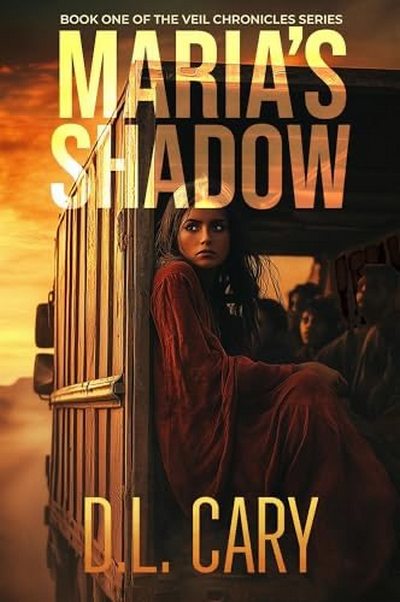
I didn’t see any information about cover art or design—but I thought the cover was really well done. I think Cary would’ve been better served to skimp a little on it and spend more money on editing.
I’m not talking about proofreading (although the double commas, repeated words, and the like would’ve been good to catch), that happens to the best books in publication. I’m talking about structural edits, developmental edits–someone to work with Cary on things like plotting, details, character development.
Why would an FBI agent in Washington, D.C. hear about the miscarriage of the wife of a Sheriff’s Deputy he didn’t have a relationship with in Mathews, NC? Why would said Deputy’s inner monologue reference something that happened to a murder victim’s body pages before he heard about it? More than once, it appeared that Cary forgot he had mentioned something, so he’d repeat it a chapter or two later. Why, when he was still collecting evidence in the early days of the investigation, did Jefferson start to wonder about a connection between this case and a murder in a completely different jurisdiction from years before (with no similarities to the present case)?
For that matter, why didn’t he ever decide how he was going to refer to Special Agent Marcus Carter or Detective John Jefferson? Why, even late in the book, did he give us their full name and title when referring to them in the narration sometimes and other times just as Carter or Jefferson?
Why does the book jacket describe Maria as being from Mexico, but the novel says El Salvador?
I could keep going, sadly—but you get the gist. Someone coming along and helping Cary to smooth this kind of thing out could’ve gone a long way into improving this thriller.
So, what did I think about Maria’s Shadow?
Cary clearly has some ambitious plans for this book and series. I hope in future volumes that he can live up to them—I don’t think he did that here.
I think it may have been wiser to focus on some small-town/small-city crimes for his first book or two. Let us see Det. John Jefferson deal with murders—or bank robbery, maybe some drug dealers—in Matthews, NC, before trying to tackle an international crime syndicate that has been around for generations.
It took Sheriff Walt Longmire a few books before he dealt with something this big, or, closer to NC, Quinn Colson’s first few cases were within the bounds of Tibbehah County, Mississippi. That allowed Craig Johnson to get some experience under his belt before he tried for something bigger—and, sure, Atkins had that experience, but he still kept things close-to-home to let Colson’s character settle.
It’s entirely possible–even likely–that if I’d encountered this series at a different time, my reaction would be different. But now? I didn’t find this terribly engaging—I don’t think my interest in the plot got higher than mild curiosity. My main interest for most of the novel was to see if Cary could pull off a convincing ending, or even get good momentum going.
The characters weren’t fleshed out, the criminals—in particular—were cardboard cutouts, the pacing seemed to have trouble taking off, the sequencing didn’t make complete sense.
Your results may vary–and I hope they do.
Cary swung for the fences here—like an MLB player going for some late-game heroics. Sadly, the best you could say about this is that it’s a single. I’m totally fine with authors (or teams) playing small-ball, and a single is getting on base. But I don’t think that’s what Cary was going for.
My thanks to The Write Reads for the invitation to participate in this tour and the materials they provided (including the book).