Tag: Theology Page 15 of 22

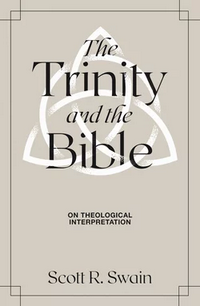
The Trinity and the Bible: On Theological Interpretation by Scott R. Swain: A Demanding and Rewarding Look at a Fundamental Doctrine

The Trinity and the Bible

The Trinity and the Bible:
On Theological Interpretation

by Scott R. Swain

Hardcover, 131 pg.
Lexham Press, 2021

Read: October 17-24, 2021
Grab a copy from your local indie bookstore!

Scriptural Trinitarianism is not unformed, inchoate Trinitarianism. As the self-revelation of the Triune God through his authorized and anointed prophets and apostles, scriptural Trinitarianism is the primary discourse of Trinitarian theology: normative, fluent, and eloquent. Ecclesiastical Trinitarianism, the Trinitarian theology of the churchs sermons, hymns, confessions, and creeds, is the secondary discourse of Trinitarian theology. Ecclesiastical Trinitarianism, at its best, is the attempt to represent the “grammar” of Scripture’s primary Trinitarian discourse in new settings and on new occasions, not to refine or develop what would otherwise be unrefined and undeveloped without it but to promote the church’s greater fluency in reading Scripture’s primary Trinitarian discourse and in responding to that discourse in its own eloquent expressions of prayer, proclamation, and praise of the Triune God.

What’s The Trinity and the Bible About?

I’m going to keep this short, because I’m sure that if I try to really get into the material, I’m only going to show how ill-equipped I am to discuss it in a meaningful fashion.

Rather than one overarching topic, this is a collection of papers that seek to show both how the Bible reveals the Trinity and how the Trinity shapes our reading of the Bible.

Swain describes the book in his introductory chapter:

Some of [the chapters] began as formal academic lectures; all of them have been published previously in various books and journals, The first and second chapters address the broader hermeneutical framework of Trinitarian biblical exegesis as well as the reception of one particular instance of such exegesis in North American Reformed and evangelical theology. The final three chapters address different aspects of Trinitarian theology by means of exegetical attention to different forms of New Testament literature, including Gospel, Epistle, and apocalyptic.

The Table of Contents, to match up with Swain’s description, is:

1. (Re)turning to the Subject: Trinity and Biblical Interpretation
2. The Bible and the Trinity in Recent Thought: Review, Analysis, and Constructive Proposal
3. B. B. Warfield and the Biblical Doctrine of the Trinity: A Historical Experiment
4. God’s Lordly Son: Mark 12:35–37 and Trinitarian Christology
5. Heirs through God: Galatians 4:4–7 and the Doctrine of the Trinity
6. To Him Who Sits on the Throne and to the Lamb: Hymning God’s Triune Name in Revelation 4–5
7. Seven Axioms: On the Trinity, the Bible, and Theological Interpretation

So, what did I think about The Trinity and the Bible?

Theological interpretation of Scripture prepares us for the vision of the Triune God by cultivating our capacities for spiritual perception and by attuning our affections to the intelligible and adorable good that the Triune God is. But theological interpretation of Scripture is more than mere preparation for this happy vision. Like the Israelite spies who tasted the grapes of Eschol before entering the Promised Land, theological interpretation of Scripture enables us to participate in this happy vision in advance by helping us perceive traces of God’s Triune glory in God’s good creation and by serving faith’s grasp of God’s Triune glory in the mediate adumbrations and attestations of that glory in the prophetic and apostolic scriptures (2 Cor 4:6).

This is not an easy read, even at 131 pages, it took several hours for me to get through it (honestly, after reading the first chapter, I wondered if I should limit myself to one chapter a week).

But it was worth the effort, every bit of it. Like a lot of the more scholarly theological books I read, I was reminded frequently while reading that I’m not an academic and this is above my weight class. But it wasn’t inaccessible, just difficult and required a little commitment.

But like the best academic theology, there were moments of the most doxological writing—or doxology-inspiring writing (or a mix). There are paragraphs and paragraphs that I wish I could commit to memory, so I could use them at the drop of my hat in conversation and in prayer.

The “Seven Axioms: On the Trinity, the Bible, and Theological Interpretation” (Chapter 7), in particular, are the kinds of things that everyone needs to learn and I think I’m going to read a few times over the next few weeks/months and really internalize.

I strongly recommend this to anyone who wants to solidify their understanding of the Trinity and wrestle with Scriptural texts, theology, and history for that.


5 Stars

This post contains an affiliate link. If you purchase from it, I will get a small commission at no additional cost to you. As always, opinions are my own.

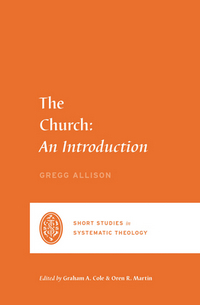
The Church: An Introduction by Gregg Allison: Tries to Do Too Much and Falters

The Church: An Introduction

The Church: An Introduction

by Gregg Allison
Series: Short Studies in Systematic Theology

Paperback, 164 pg.
Crossway, 2021

Read: October 10, 2021
Grab a copy from your local indie bookstore!

What’s The Church: An Introduction About?

Allison starts with a good Introduction, sketching the ambiguity of the current English term “church”—driving home the need for a book like this. He then spends two chapters with the foundation—outlining both the relationship between the Trinity and the Church and then with a broad overview of the Scriptural doctrine of the Church.

Then he moves into the bulk of the book:

I will present the church in terms of its local expression according to the following topics: identity, leadership, government, ordinances or sacraments, ministries, and future. For each topic, the first section—mere ecclesiology—presents the common ground shared by most churches throughout history. This aspect addresses the essence, or core, of the church’s identity, leadership, government, ordinances or sacraments, ministries, and future. The second section—more ecclesiology—describes how this essence expresses itself in the actual identity, leadership, government, ordinances of sacraments, ministries, and future of particular churches.

So, what did I think about The Church: An Introduction?

In summary, ecclesiology properly begins with a consideration of the doctrine of God. Specifically, it is grounded in Trinitarian theology, which leads to this conclusion: There is one people of God, who from eternity past has graciously elected all those who will believe in him by faith and walk with him in obedience, worship, love, and service. This one people of God consists of two aspects: the people of Israel in old covenant relationship with him and the people of the church in new covenant relationship with him. Specifically in regard to this second aspect, the church is the body of Christ and temple of the Holy Spirit. As the body, the church submits to its head, celebrates its diversity of people and gifts, lives out its siblingship in all purity, and portrays and fosters its unity by participation in the Lord’s Supper. As the temple of the Holy Spirit, the church in which he dwells is birthed, empowered, gifted, directed, sent, and sanctified by the Spirit.

The first couple of chapters got me excited for the book, and then after that, each chapter annoyed me more. He totally squandered that start—the “Mere” portions of the chapters were generally decent, but far too short. The “More” portions on the other hand…didn’t belong in a book like this (for the most part)—to get into all my problems would involve getting into the nitty-gritty of the arguments. They seemed to be what he wanted to write about more than the “Mere” bits and aren’t really introductory ecclesiology.

Also, and this is just one of those things, one chapter felt like it was written in response to my pastor’s sermon that day—each point seemed to be counter one of his (or vice versa). I was already having issues with the book, but that might have been the straw that broke the camel’s back for me. (not that I think my pastor is infallible, it was just bad timing—and a bad take on the text)

If this was the first book in the Short Studies in Systematic Theology that I’d read, I probably wouldn’t have come back for more. But, as it’s the fifth, I can keep going, trusting that this was a fluke.

In the end, I think this book tried to do too much. It tried to be all things to all people rather than embracing a confessional point of view as well as getting hung up on the structure, and ends up not accomplishing much at all. Focusing on and fleshing out the “More” portions would’ve made for a better read, a more profitable read, and a less problematic read. File this one under “don’t bother.”


2 Stars

This post contains an affiliate link. If you purchase from it, I will get a small commission at no additional cost to you. As always, opinions are my own.

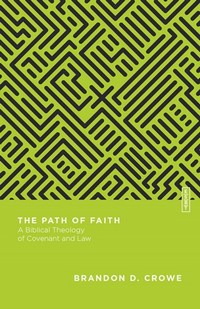
The Path of Faith by Brandon D. Crowe: Covenant and Law for Believers from Genesis to Revelation

The Path of Faith

The Path of Faith:
A Biblical Theology of
Covenant and Law

by Brandon D. Crowe
Series: Essential Studies in Biblical Theology

Paperback, 169 pg.
IVP Academic, 2021

Read: September 12-19, 2021
Grab a copy from your local indie bookstore!

What’s The Path of Faith About?

In his Introduction Crowe previews the book as a whole:

The topics of covenant and law are complex and have often been debated, but I’m not interested in getting bogged down in technical debates. Instead, in this book I make four key points.

  1. All people are obligated to obey their Creator.
  2. Though he did not have to, from the beginning God freely entered into a covenant with humanity to offer a reward upon the condition of perfect obedience.
  3. Only Jesus perfectly obeys God’s law, which is necessary for eternal life. Eternal life is granted by grace through faith on the basis of Christ’s work.
  4. Even though we can’t perfectly obey God’s law, the law continues to guide us in how we should live. Obedience to God’s law is still required. And yet obedience is not a burden but the path of blessing.

These are four landmarks to maintain your bearings in the discussion that follows, and they also serve as a handy summary of the book.

From there, the book traces the development of those concepts from Genesis to Revelation and at all points in between—as every book in this series has done/likely will do.

Relation between Old and New Covenant

Obviously, as he’s working through Redemptive History as it progresses, he begins with the Old Covenant—but always keeps the New Covenant in view, as the goal of the Old. I was particularly struck by the way he did this in Chapter 5, “The Prophets: Remind, Reprove, Renew.” I noted a few times how helpful the discussion there was at pointing at the differences between the two covenants, while stressing the continuity of the two.

I didn’t realize (but admittedly should have assumed) that that chapter was merely the foundation for a lot of the chapters to follow—particularly in Chapter 9, “The New Covenant in Practice: Hebrews Through Jude.” Which was just dynamite, and was probably my favorite chapter in the book. It wasn’t necessarily “more practical” than the rest of the book—but its focus on what what The Path of Faith looks like for believers in a post-apostolic age makes it more obviously applicable to contemporary believers.

I should add that a lot of the material in that chapter came from/was similar to Crowe’s The Message of the General Epistles in the History of Redemption: Wisdom from James, Peter, John, and Jude—and I feel compelled to recommend that book at this time (I didn’t do a post on it when I read it back in 2015, or I’d point you to that).

Revelation

Revelation fittingly concludes the biblical canon by echoing earlier Scripture, highlighting the completed work of Christ and sketching a vision for the future. Revelation wrestles with the ambiguities and difficulties of this age but doesn’t leave the plot dangling. Revelation proclaims that Christ rules, and his people will be vindicated. Revelation is an immensely practical book that provides guidance for living today.

That last sentence is going to strike more than a few readers as odd—but it shouldn’t. While the previous chapter was my favorite, this one took a lot more thought and reflection—and was more striking for me. Believers in the twentieth and twenty-first centuries are not used to reading Revelation for reasons other than “cracking the code” and figuring out the eschatological message of the book. Which isn’t to say that’s not important—but as Crowe argues, the book is more practical than that.

It’s crucial that we recognize and heed Revelation’s calls to faithfulness in life. We go astray if we think of Revelation as a fatalistic book of predictions. Revelation does not teach us to shut our eyes and sing, Que Será, Será (“whatever will be, will be”). Instead, Revelation provides motivation for faithful covenant living in the present, in light of God’s promises about the future.

This means Revelation is not only about the future; it’s about the entire age of the church, from the first coming of Christ to his second coming. It doesn’t focus only on the last few years of world history; it’s about every era of the church’s history. It’s about things that are persistently true. As one helpful book on Revelation puts the matter, “[Revelation] is a book for every age. It is always up to date.”

Given that reminder about the purpose of Revelation, Crowe’s able to point to the call for faithfulness, the motivations to perverse and the promise of the consummation of the covenants at the end.

So, what did I think about The Path of Faith?

It has been a while since I’ve read a book in this series—primarily because the outline was getting a bit repetitive, and it was causing me to glaze over a bit. It’s been long enough and (based solely on recollection without looking at a prior volume to compare) I think Crowe approaches it with a just-noticeable tweak to the standard outline that I was able to appreciate what he was saying without struggling to differentiate this work from the others.

Even without that gap for myself, I found this to be one of the (if not the) strongest volumes in the series—Crowe is able to deliver on explaining his summary from the introduction, explaining and expanding on them in each era of Redemptive History so that those of us living in the New Covenant age can profit from what was written for our benefit in the Old and seeing what our Covenant Head accomplished for us and for our salvation.

This is a great work on the ideas of Covenant and Law and I strongly encourage you to give it a read.


4 Stars

This post contains an affiliate link. If you purchase from it, I will get a small commission at no additional cost to you. As always, opinions are my own.
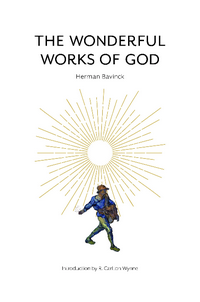
The Wonderful Works of God by Herman Bavinck: A Modern Classic Worth Its Weight in Gold

I must be insane for even trying this one…what can I possibly say about this? But it’s been over a month since I finished this, and I’ve got to pull the trigger on this now before I overthink it any more than I already have.


The Wonderful Works of God

The Wonderful Works of God

by Herman Bavinck

Hardcover, 549 pg.
Westminster Seminary Press, 2021

Read: January 3-August 8, 2021

Thus the confession of the trinity is the sum of the Christian religion. Without it neither the creation nor the redemption nor the sanctification can be purely maintained. Every departure from this confession leads to error in the other heads of doctrine…We can truly proclaim the mighty works of God only when we recognize and confess them as the one great work of Father, Son, and Spirit.

In the love of the Father, the grace of the Son, and the fellowship of the Holy Spirit is contained the whole salvation of men.

What’s The Wonderful Works of God About?

Over a century ago, Herman Bavinck gave the world a gift when he abridged his magnum opus, Reformed Dogmatics (a four-volume set) into one volume—simplified for the laity. It was translated into English in the 1950s and published under the title Our Reasonable Faith. In 2019, that same translation was re-typeset and republished as The Wonderful Works of God (a better translation of the original title) with a new translation of Bavinck’s Foreword—which was left out of the original English edition, for some reason.

And wow—what a treasure this is. Over 24 chapters—none that are terribly long—Bavick covers all the necessary topics—Revelation (General and Special), Scripture, the Nature of God, the Trinity, Creation, Sin, Redemption, Eschatology, and so on. You can read each chapter in one sitting pretty easily, but they’re deep enough that you might not want to.

Strengths and Weaknesses

It’s my habit to talk about strengths/highlights of a book along these lines, as well as things I think the author could’ve done better at. When it comes to Bavinck (or the writer of any systematic theology), I’d be punching above my weight as a reader and as a blogger to do that. Instead, I’m limiting myself to the experience of reading the work.

I’ll talk more about the strengths in the next section. As for weaknesses? One of the best parts of this book is that it’s primarily positive/constructive–here’s how the Church has understood and developed its ideas about X. He rarely spends time critiquing/criticizing a teaching or a group. When he does, he does so effectively (for example, see his comments on Chiliasm). I would’ve liked to have seen a bit more of that–I’m all for following a writer/teacher down a path, I just like a little warning when I’m about to stray off of it while I’m at it.

So, what did I think about The Wonderful Works of God?

Under the title of Magnalia Dei, the wonderful works of God, I wish to give a simple explanation of the Christian faith in a book of modest scope, as confessed by the Reformed churches (Gereformeerde Kerken) in all times and lands.

Many contemporary readers will roll their eyes at the “simple explanation” and “modest scope” that Bavinck mentions in the first paragraph of this Foreword. But really, it kind of is. Ambitious and complex would describe his Dogmatics. Contemporary readers being flummoxed has more to do with educational standards and the other ways we’ve let our minds rot.

I should stress—by “simple” I don’t mean easy, I just mean not that complex. This is readable by anyone who’s willing to put a little work into it, Bavinck’s point is being something that anyone can understand and profit from it.

The book is steeped in Scripture and you can sense it on every page—following that Bavinck will explain the catholic* understanding of the doctrine—and then narrows the focus of the chapter to a Reformed understanding. It’s a pastoral work, a compassionate work, and one that will repeatedly point to the Gospel as well as the Majesty of the Triune God.

* Catholic=universal, that is. Small “c” catholic, not capital “c.”

While I’d recommend people put the effort into Reformed Dogmatics this is a far easier place to start reading Bavinck. (I made the mistake of coming at those works in the wrong way). There’s plenty to chew on in these pages, but it’s nothing to be daunted by. I’ve read a few single-volume systematics like this—none compare to the depth, clarity, and usefulness of this one.

If you’ve yet to read this, it’s time to fix that.


5 Stars

Holier Than Thou by Jackie Hill Perry: We Can Trust God Because of His Holiness

Holier Than Thou

Holier Than Thou:
How God’s Holiness Helps
Us Trust Him

by Jackie Hill Perry

Paperback, 168 pg.
B&H Books, 2021

Read: September 5, 2021
Grab a copy from your local indie bookstore!

I don’t remember the day I thought about it and i my coffee was iced or warm. What I know is that what I thought, and what I thought of, I wanted an answer for: “If God is holy, then He can’t sin. If God can’t sin, then He can’t sin against me. If He can’t sin against me, shouldn’t that make Him the most trustworthy being there is?”

What’s Holier Than Thou About?

The impetus for this book came from that above thought—although as she notes, one of the goals of the book is to remove that “if” from the phrase “If God can’t sin.” If He, and He alone, is really worthy of that trust—how should that impact our lives? What a “blessed” assurance it is to understand and embrace God’s holiness as an intrinsic part of His nature and to then remember his promises are “Yea, and amen.”

On the one hand, that might seem kind of obvious, nothing worth writing a book about. But if you stop and think about that for a minute, what all the implications of it are, how it can (and should) shape our lives? That’s when you remember that that profundity is often hidden in simplicity.

From this jumping-off point, Perry spends the five chapters looking at the holiness of God from various perspectives—as a characteristic of God, as His moral perfection, as His transcendence—what the implications of God’s holiness mean that when it comes to sinful men, and (in a great angle) what it would mean for Creation and Humanity if God were not holy. Then she follows that up with two chapters on the sanctification of believers—how we reflect that Holiness.

The Gospel

One thing that I found reassuring and impressive throughout the book was that while the point of the book was to remind us about the holiness of God, how He should be seen as perfect in distinction to the fallen humanity we see all around us. She never uses that as a way to induce fear and despair, never tells the reader to give up—or to pull themselves up by their own bootstraps to a makeshift righteousness (a futile effort, anyway). Instead—she points to the Gospel. There is always the promise of Christ’s work for His people, His redemption in the midst of this—our only hope.

Sanctification

The other strength of this book is the way that Perry uses two chapters to address the believer’s response to God’s holiness in their own.

The first chapter is what will separate her from most books on the topic—following John Owen, she talks about sanctification as the immediate* work of the Spirit through the work of rebirth/regeneration and the changing the nature of the believer.

* that is, “acting or being without the intervention of another object, cause, or agency;” not “instant.” (definition from Merriam-Webster.com).

That established, she can then move in the next chapter to the transformation of the believer through beholding the Holy One of Israel, believing in Him, and thus becoming like Him as we follow His ways.

Keeping the horse before the cart on this topic is so essential, and so often overlooked.

The Cover

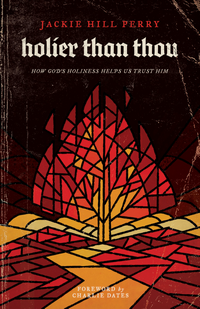
This isn’t something I usually address, but I have to take a moment to talk about the cover design—it’s just brilliant. It may be difficult to see in the thumbnail above (it probably is, but I have the paperback sitting next to me, so it’s impossible for me to not pick up the details on the .png file), but there’s this faux-distressed, bent cover, well-read/reread look to it. The book looks like I’ve read it a few dozen times—and carried it with me for a couple of moves, probably had it stacked under something for a few months.

I absolutely love it (sure, when I pulled it out of the box, I was initially annoyed when I saw the condition it seemed to be in, before I realized it was supposed to look beat up and worn).

So, what did I think about Holier Than Thou?

God’s holiness is essential to His nature and fundamental to His being. His holiness is what makes Him good, and loving, and kind, and faithful. Without holiness, God wouldn’t be beautiful, and so because of it, He is eternally attractive. Think about the opposite of it being present in Him and you may see my point. If He were sovereign, but wicked, with no inner righteousness to restrain His hand, I wouldn’t be surprised if the world was no more. If He had all power without love, our refusal to love Him back would result in cosmic abuse or maybe a million more floods with no rainbow to promise His relent. If He were an unholy God, what would salvation even mean? What is deliverance to a self-centered “savior”? Thankfully, our God is incomprehensibly holy and therefore completely beautiful in all of His ways and works. This is why we are invited to worship Him as such, and in so doing, we become just as beautiful as He is.

This is a terrific review or refresher on this vital topic. It can also serve as a wonderful introduction to it for those who need one. And for everyone, using the works Perry footnotes and alludes to would be a great way to follow up on this book.

For myself (and this is why I’m rating this low for a book I just described as “terrific”), I didn’t learn much—if anything. It felt like a retread of a lot that I’ve read before. It could’ve been a little deeper and still qualified as a retread. There’s nothing wrong with that, but it’s near-underwhelming.

However—her starting point for this book really impressed me, although I’d have preferred another chapter or two working out that idea after the rest of the book. But it’s Perry’s prose, her style, her near-lyrical* descriptions and depictions of ideas, events, and concepts—that kept me going. There are paragraphs that demand to be re-read—and occasionally to read aloud—I absolutely loved this aspect of her writing, and it’s going to be why I gladly recommend this to others, why I’d likely buy it for others, and why I’ll likely be quick to buy her next book.

* How not-at-all-surprising for a poet and hip-hop artist to have lyrical prose.


3.5 Stars

This post contains an affiliate link. If you purchase from it, I will get a small commission at no additional cost to you. As always, opinions are my own.

The Person of Christ: An Introduction by Stephen Wellum: Scriptural and Historical Perspectives on Christ

The Person of Christ:
An Introduction

The Person of Christ: An Introduction

by Stephen Wellum
Series: Short Studies in Systematic Theology

Paperwork, 180 pg.
Crossway, 2021

Read: August 29, 2021
Grab a copy from your local indie bookstore!

Thinking through all chat Scripture says about Jesus and wrestling with the church as she has sought to faithfully confess Christ is not an easy task, but it’s absolutely necessary, especially if we are going to think rightly about God, the gospel, and the entire Christian faith, The study of Christology is not reserved for academic theologians; it’s the privilege, responsibility, and the glory of every Christian.

What’s The Person of Christ: An Introduction About?

In this installment of Short Studies in Systematic Theology, Wellum examines the doctrine of the Incarnation, the Second Person of the Trinity, and the Divinity of Jesus.

He spends four chapters opening the Scriptural testimony concerning Christ and the Incarnation. Then he looks at the development of the Church’s teaching and doctrinal formulation from an historical perspective—pre-Chalcedon, post-Chalcedon, and then contemporary issues. Finally, he gives a couple of chapters of theological reflection and summary.

The Strengths of the Book

I really appreciated most of the book, but two chapters, in particular, stood out to me—Chapter 2, “The Identity of Christ from the Bible’s Storyline” and Chapter 8, “Jesus as God the Son Incarnate.”

Chapter 2 lies the foundation for the next two chapters of the consideration of Christ as presented in the New Testament by examining the storyline of the Old Testament starting with Creation, the Fall, and then seeing how the Law and Prophets point to the coming Messiah.

Chapter 8 draws the testimony of Scripture and the formulations of the creeds, confessions, and theology of The Church throughout history into ten doctrinal statements explaining the essential elements of Jesus’ identity and the doctrine of the Incarnation.

The call to action in the last chapter, “Recovering the Centrality of Christ.” is a great conclusion—something that not every entry in the series has had, but is a welcome presence, and does a good job of wrapping up the book, summing up the high points and pointing the reader to application.

As One of the Short Studies in Systematic Theology

Of the four entries in this series that I’ve read this is the least accessible overall—most of the book is just fine on that front. A large part of that less-than-accessibleness comes from the fact that this appears to be a shorter version of Wellum’s 2016 book, God the Son Incarnate: The Doctrine of Christ. Assuming I’m right about that, he should’ve edited a bit more for this. Part of the first chapter (“Approaching Scripture on Its Own Terms to Identify Christ”) and most, if not all, of the seventh (” Current Challenges to Christological Orthodoxy”) seem unnecessarily technical, and possibly beyond the Introductory nature of this series.

I’m not saying they’re completely inaccessible to laity, but they felt out of place for both the series and the rest of the book. Maybe it was just my mood or attention span as I read it, but those parts of the book in particular, bugged me.

So, what did I think about The Person of Christ: An Introduction?

Overall, I liked it—I do think it would’ve been stronger without the chapters I mentioned in the previous section (or just with them reworked). But pushing that aside—this is an important entry in the series and focuses on things that too often get ignored.

I appreciated this entry in the series, but do hope the next entry I read is a little more in line with the others. Still, get your hands on this—what it does right is very good, and the rest isn’t bad, either.


4 Stars

This post contains an affiliate link. If you purchase from it, I will get a small commission at no additional cost to you. As always, opinions are my own.
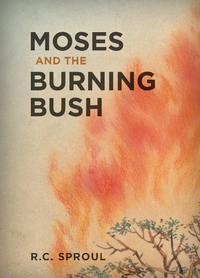
Moses and the Burning Bush by R. C. Sproul: A Brief Examination at What God Shows Moses About Himself

Moses and the Burning Bush

Moses and the Burning Bush

by R. C. Sproul

Kindle Edition, 103 pg.
Reformation Trust Publishing, 2018

Read: August 15, 2021
Grab a copy from your local indie bookstore!

What’s Moses and the Burning Bush About?

One of the church’s biggest problems is that we don’t understand who God is. But in that one revelation—the theophany in which God appeared to Moses—the transcendent majesty of God was partially unveiled. What had been invisible became visible through the theophany.

Sproul examines—briefly—just what God says about himself when he revealed himself to Moses. He shows His holiness, His glory, His Aesity, and more—here is even, as Sproul puts it, “A Shadow of Christ.”

In ten short chapters, Sproul opens up the account of Moses’s encounter with the Lord in the bush that was on fire, but was not consumed.* He doesn’t just camp out in Exodus 3, but spends time in Isaiah, Genesis, and other places, although he brings it all back to this point.

* I’ve learned to appreciate Scott Oliphant’s point that calling it a “burning bush” misses the point, it’s only supernatural to call it an “unburning bush.”

So, what did I think about Moses and the Burning Bush?

… in the burning bush we see the revelation of the person of God, of the power of God, and of the eternality of God. We see the revelation of the compassion of God, the redemption of God, and now, finally, the truth of God.

It has been ages—or at least it feels like it has been—since I’ve read an R. C. Sproul book (at least for the first time). There’s a clarity to the prose that’s almost untouchable by anyone else. He can express deep thoughts in a way that anyone can understand—not that there were a lot of tricky concepts this time out, but that voice is still there. And I’m going to miss it.

This is a nice book, as a sketch of these ideas. I think Sproul was capable of more, he could’ve got into all of these areas with more detail, could have fleshed out the concepts more—and given the reader something to chew on. I’m sure he had his reasons for not, I just wish he’d done more.

Still, if all you’ve thought of is the event itself—not what it meant beyond God calling Moses, it’s probably a good way to introduce yourself to it, but beyond that, there’s probably limited value.


3 Stars

This post contains an affiliate link. If you purchase from it, I will get a small commission at no additional cost to you. As always, opinions are my own.
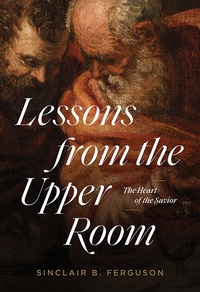
Lessons from the Upper Room: The Heart of the Savior by Sinclair B. Ferguson: A Guided Tour through The Savior’s Night before His Death

Lessons from the Upper Room

Lessons from the
Upper Room: The Heart
of the Savior

by Sinclair B. Ferguson

Kindle Edition, 241 pg.
Ligonier Ministries, 2021

Read: July 25, 2021
Grab a copy from your local indie bookstore!

What’s Lessons from the Upper Room About?

In his Gospel, John spends 4 chapters (13-17)* on the night before Jesus was betrayed. The last night He spent teaching, serving, praying with (and for), and being with the Twelve (then Eleven). In this book, Ferguson walks through those chapters, well…let him describe it in his own words:

Lessons from the Upper Room is by no means a complete exposition of John 13– 17. If that were attempted—to adapt some words of John himself—an entire bookcase could not contain the books that would be written!

Nor are these pages a commentary in any technical sense. They are, perhaps, more like the “audio description” function on my “smart” TV set. This facility provides a running commentary on the action taking place on the screen to help those who can follow the dialogue but are too visually handicapped to see it.

* Yes, I know John didn’t think of it in terms of chapters, shush, you know what I mean.

That’s basically what this is, a guided tour through these beloved passages from a trusted guide—pointing out interesting features, maybe helping the reader to think of them in a way they didn’t think of before. Maybe picking up a detail they never notice (or had forgotten they had).

Occasionally, there’s a pointed observation, a reminder that we should do more than read these words, a call to action. Nothing burdensome (see Matt. 11:30), but nevertheless, Jesus’ followers are to serve others as he did himself before supper.

So, what did I think about Lessons from the Upper Room?

I don’t have much to say about this book—that simple description is really all you need to know. Especially if you’re familiar with Ferguson, you know that what you’re getting is helpful.

Speaking of being familiar with Ferguson, I really want to get my hands on the talks that this book started out as. They have to be great—as much as I like Ferguson’s writing, his teaching and preaching are so much better.

I’m not sure I learned a whole lot from this read—a did pick up a thing or two. But this refresher on these passages is a great way to look at again at them. It’s warm, it’s reassuring, it’s stimulating. I can see this as the kind of thing I can read every couple of years as a little boost.

I commend this to you and your attention—it’ll reward your time.


3.5 Stars

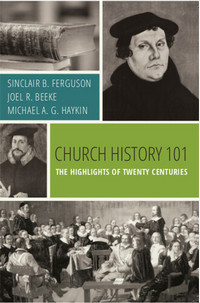
Church History 101: The Highlights of Twenty Centuries by Sinclair B. Ferguson, Joel R. Beeke, Michael A.G. Haykin: A Quick Look at 20 Centuries

Church History 101

Church History 101:
The Highlights of
Twenty Centuries

by Sinclair B. Ferguson, Joel R. Beeke, Michael A.G. Haykin

Kindle Edition, 99 pg.
Reformation Heritage Books, 2016

Read: July 25, 2021
Grab a copy from your local indie bookstore!

… the record of church history teaches us to hold fast to Christ, assured that He is with us always, even to the end of the world. He will build up His church and kingdom to all generations.

What’s Church History 101 About?

That’s the controlling idea behind this book—it’s a survey of Church History—which is the story of Christ building his church. There will be highlights and lowpoints. This, and more, is sketched out in the preface—as well as a description of the book that follows.

The chapters came from Ferguson’s time in the pulpit. Then Beeke, Haykin and their assistants revised them for use in The Reformation Heritage KJV Study Bible, and then there were published as this book.

Application

Each chapter sums up a century of Church History, talking about major movements controversies and figures incredibly briefly. It’s a ninety-nine page book, covering 20 Centuries—so to say the chapters are brief is an understatement. Most chapters include (not always as the concluding point) a “lesson” for application. Like:

Gregory’s vision produced a kind of nominal Christianity with which the church continues to struggle to this day.

The church should honor Gottschalk’s memory despite his human frailties. We should also continue to educate ourselves about missionaries such as Cyril and Methodius, and remember that the quest for power and recognition, demonstrated by Pope Nicholas, ultimately detracts from the mission and witness of the church.

Today we must see that the church exists to bring light to the world, and we must be willing to separate earthly power and gain from the mission of the church. The church accomplishes her mission by the power of the Holy Spirit, not by the might of kings or political leaders.

I get these came from a Study Bible, and those tend to be very object lesson-oriented, but I’m not sure it’s all that helpful (or necessary) in this context.

So, what did I think about Church History 101?

I think I read something wrong about the length—I knew it was a brief survey, but I didn’t expect it to be so brief that I finished it in under 90 minutes.

But, for a quick, very surface-level look at 2,000 years of History? This is good—it focuses on the essentials, it helps orients the reader to what matters—and hopefully ignites someone’s interest in diving deeper into a person, period, or movement mentioned in these pages.

I enjoyed it, I appreciate what it tried to do, I wish it had done more, but that would’ve defeated the purpose, I guess.

I do recommend this for anyone Junior High and up for a solid overview, a refresher, or a nice way to spend an hour or so. It won’t change your life, but for those who don’t need the introduction, it will serve as a reminder that Christ is building His Church and what that looks like.


3 Stars

This post contains an affiliate link. If you purchase from it, I will get a small commission at no additional cost to you. As always, opinions are my own.

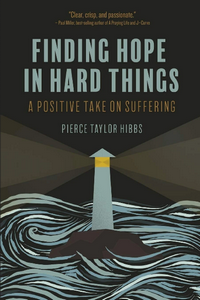
Finding Hope in Hard Things by Pierce Taylor Hibbs: How the Hard Things Shape Us

Finding Hope in Hard Things

Finding Hope in Hard Things:
A Positive Take on Suffering

by Pierce Taylor Hibbs

Paperback, 133 pg.
2020

Read: July 18, 2021
Grab a copy from your local indie bookstore!

We think we’re stone. Only chisels and hammer strikes can change our shape. But no; we’re wet clay. We’re sediment and soil. We’re waiting for hands. We’re waiting for fingertips. We’re waiting for the pressure of palms. We’re waiting to be shaped by an artist. And the artist’s tools are hard things.

Hard Things are Going to Shape Us in Ways Easy Things Can’t

That’s it, there’s the book in a nutshell—that line and the quotation, there’s the central premise of the book and the kind of way he presents it.

Hibbs focuses on three of the hard things he’s faced in his life—the death of his father, his anxiety disorder, and his struggles with self-doubt. These case studies are just that, things that his readers can relate to, sympathize with, and find similarities in their lives. After that, Hibbs points to finding Christ and His purposes in the hard things, and that’s where we find hope.

Anxiety disorders, Crohn’s disease, cancer of the spine, the death of your father—these things happen. What matters most is not what happens to you but how you perceive and respond to it. Perception and response—that’s the key.

So, what did I think about Finding Hope in Hard Things?

I’ve talked about two of Hibbs’s books here before—Finding God in the Ordinary and Struck Down but Not Destroyed: Living Faithfully with Anxiety. The former is a collection of essays about finding God in ordinary, minute things in life; the latter is a thoughtful and thorough look at how Hibbs has dealt with his Anxiety Disorder, and how the reader can apply these things to their own problems. This book combines the best of the two approaches to these books—we don’t get a systematic look at suffering. Instead, we get essays based on his studies, based on his observations and thoughts.

I loved this approach, this style. Most books on suffering that I’ve read are meditations or studies on the relevant Psalms—maybe a passage or two from the Gospels or Epistles. Hibbs doesn’t do that, he talks about where he is, where he’s been, where his readers are/have been/will be. He’s learned the lessons of those other books and now he’s internalized them. He can meditate, muse, and reflect—and that’s what these essays are.

As with his earlier book, these essays are wonderfully put together, a pleasure to read, even without the content.

On an episode of The West Wing, Leo McGarry tells a story:

“This guy’s walking down the street when he falls in a hole. The walls are so steep he can’t get out.

“A doctor passes by and the guy shouts up, ‘Hey you. Can you help me out?’ The doctor writes a prescription, throws it down in the hole and moves on.

“Then a priest comes along and the guy shouts up, ‘Father, I’m down in this hole can you help me out?’ The priest writes out a prayer, throws it down in the hole and moves on.

“Then a friend walks by, ‘Hey, Joe, it’s me can you help me out?’ And the friend jumps in the hole. Our guy says, ‘Are you stupid? Now we’re both down here.’ The friend says, ‘Yeah, but I’ve been down here before and I know the way out.'”

I thought about that story a lot while reading this. Hibbs is that friend. He knows the way out of the hole—better yet, he understands why the hole is there and how it’s used by God to make us into who He wants.

This isn’t your typical book on suffering, it’s better.

3.5 Stars

This post contains an affiliate link. If you purchase from it, I will get a small commission at no additional cost to you. As always, opinions are my own.
Page 15 of 22

Powered by WordPress & Theme by Anders Norén