Tag: Theology Page 16 of 22

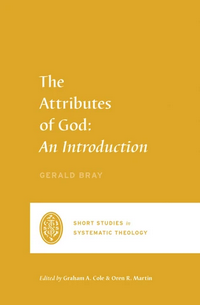
The Attributes of God: An Introduction by Gerald Bray: Sketching out The Essence of God and How He Relates to Us

The Attributes of God

The Attributes of God: An Introduction

by Gerald Bray
Series: Short Studies in Systematic Theology

Paperback, 109 pg.
Crossway, 2021

Read: July 11, 2021
Grab a copy from your local indie bookstore!

What’s The Attributes of God About?

While there are technically four chapters in this book, it’s really two–the first chapter introduces the concept of God’s attributes, where we got the idea, and so on. The last chapter endeavors to sketch out how these attributes are relevant to believers, why we should study and care about them.

The bulk of the book resides in the other two chapters–one what Bray calls God’s Essential Attributes, the second on what he calls His Relational Attributes. Typically, these are referred to as his incommunicable (omnipresence, omnipotence, omniscience) and communicable attributes (holiness, righteousness, goodness), respectively, but Bray has his reasons for changing the names and explains it (I’m not saying I’m dropping the usual labels myself, but I can appreciate his thinking).

Bray describes each attribute, what the Biblical justification is for ascribing it to God and relates it to the others. He even touches (it’s only an introduction, so he doesn’t get too far) on some of the historic discussions about the attribute.

So, what did I think about The Attributes of God?

There was a voice in the back of my head early on wondering if we needed this volume. Recent years have given us Mark Jone’s God Is…, Matthew Barret’s None Greater and Terry Johnson’s The Identity and Attributes of God, and a few others. Is there a place for Bray’s slim volume?

Of course—1. this series needs to address the topic and 2. contemporary Evangelicals have really dropped the ball on reflecting and applying that reflection on their theology and lives. We need more writing and thinking on these things which ought to characterize our thoughts not less.

Bray does a good job in introducing the notion here. Of the three I’ve read in this series, it’s the least accessible. But I’d argue that it’s still on the level with the others, you just might have to take your time with the occasional passage. These are deep waters that Bray is introducing the reader to, things that the Church has spent centuries establishing, and we need to at least see the immensity of the topic before we can say we are starting to understand it. It’s a short book and he has a lot to cover, so every word counts.

Another solid entry in this series. I’m appreciating the varied approaches and styles that the authors address their topics, while sharing similar concerns for theological method. I’m really glad that Crossway gave the green light to the Short Studies in Systematic Theology and hope it’s discovered by many. The Attributes of God: An Introduction is as good a place as any to dive in and see what it’s about.


4 Stars

This post contains an affiliate link. If you purchase from it, I will get a small commission at no additional cost to you. As always, opinions are my own.

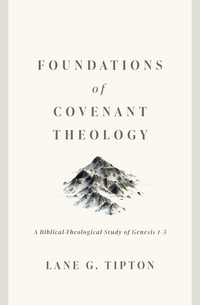
Foundations of Covenant Theology by Lane G. Tipton: A Fascinating Approach to Genesis 1-3

Foundations of Covenant Theology

Foundations of Covenant Theology:
A Biblical-Theological Study
of Genesis 1–3

by Lane G. Tipton

Paperback, 131 pg.
Reformed Forum, 2021

Read: July 4, 2021

What’s Foundations of Covenant Theology About?

In 2019, Lane Tipton gave a series of lectures for a Reformed Forum seminar on covenant theology. Tipton’s now turned these lectures into “a brief and non-technical” book, suitable for private use or as a supplement to a Sunday School class, building on the work of Geerhardus Vos and Meredith G. Kline.

I really don’t like it when I don’t provide my own summary/synopsis, but after a few attempts, I’m bailing. Primarily because my attempts ended up 2-3 times long as what’s on the back of the book/Reformed Forum’s website. So…why bother reinventing the wheel, if I’m just going to make it bloated and cumbersome?

Drawing from Genesis 1:1 and subsequent biblical revelation, Lane Tipton argues that before creating the visible world, the immutable triune God created a heavenly temple dwelling, filled that heavenly dwelling with the unchanging glory of his Spirit, and sanctified that heavenly dwelling as the realm of everlasting Sabbath rest.
Adam, as the created image of God and federal head of his posterity, could have advanced through perfect covenantal obedience beyond probation on the mountain of God in earthly Eden into the heavenly dwelling of God in Sabbath rest. This God-centered and heaven-focused theological backdrop enriches our understanding of the person and work of Jesus Christ, as the second and last Adam in the covenant of grace, who in his humiliation and exaltation has opened the gates of heavenly paradise for his church.

Vocabulary and a Glossary

This is a non-technical book as Tipton says in the preface. But at a glance, you’d be tempted to think otherwise. Tipton has a very precise and erudite vocabulary, and it’s in full view here. Where some writers will (unintentionally) obfuscate with their language, Tipton’s doesn’t do that at all. I find his style and word choice to helpful—once you get used to it (and it doesn’t take long), you don’t even notice that it’s not your run-of-the-mill non-technical language.

There are concepts and phrases he uses throughout that he wants to highlight, and they’re included in a Glossary at the end of the book. There were a few he used in the text that I’d have liked a bit more detail on, but it’s clear that he uses the Glossary to focus on the vital concepts to his argument. I wish more people would do things like that.

So, what did I think about Foundations of Covenant Theology?

I’ve lost track of the books/chapters I’ve read that serve as an introduction to Covenant Theology in the last couple of decades. Yet I keep reading them (and, largely, enjoy and profit from them). This is a different way of covering these concepts and it’s a very effective one.

It’s also a different way of looking at Genesis 1-3. Almost every time I’ve seen these chapters explained and exegeted, it had to do with the doctrine of Creation, the Fall and the Promise of the Seed in Genesis 3, and so on. But Tipton’s approach—while addressing all that—focuses on the Big Picture, looking at the purposes behind Creation, the protoevangelium, the Covenants of Work and Grace, and how those are worked out in history (particularly in the last two chapters about Christ as the Promised Seed and the Second Adam).

Would I have liked this book to be longer and these brief chapters to be expanded—making this still non-technical, just not brief. If this had taken me a few hours to read rather than just an afternoon, I’d have been happier. But…this was a fascinating book, a helpful read, and I know I’ll profit from meditating on and returning to these concepts. You really should try this one yourself, you’ll be rewarded for it.


4 Stars

Faithful Theology: An Introduction by Graham A. Cole: Basics for Building a Theological Method

Faithful Theology: An Introduction

Faithful Theology: An Introduction

by Graham A. Cole
Series: Short Studies in Systematic Theology

Paperback, 106 pg.
Crossway, 2020

Read: June 27, 2021
Grab a copy from your local indie bookstore!

…faithful theology is a human project that arises from wise reflection on the self-revelation of God. Because it is our reflection on God’s revelation, it is always to be reformed and corrected by that revelation…it is one thing to have an evangelical’s high view of Scripture. It is quite another to know how to derive teaching (doctrine or theology) from Scripture.

Cole’s purpose in this is to give his readers a method to use in “doing faithful theology.” Moving from Scripture to doctrine. Trying to balance orthodoxy, orthokardia, and orthopraxy (right opinion, right-heartedness, right practice of life), Cole organizes his approach through five elements, exploring each in a chapter. The first element is the foundation on which the others are built—God’s self-revelation in Scripture. The second is reflecting on the witness of the theology and practice of the Church through history—not on an equal footing with Scripture, but it should inform how we approach doctrine. The third element is realizing our context as we do theology—we’re in a fallen world, yet we are redeemed and are awaiting the return of Christ. Our thinking, our theologizing needs to be done fully aware of what that means. The fourth is centered on wisdom. We need to be wise in our application of the previous. The last element puts all of the above together and focuses it in a doxological direction—our theology should be a service to God.

Throughout, Cole uses examples of these principles applying to Christological and Trinitarian thought. There are some other examples, too, Which is a tremendous help—if for no other reason than they’re bedrock doctrines on which there should be no disagreement. He brings up baptismal practices at one point as an example of something where there’s an opportunity for a divergence of opinion, standing in contrast to Trinitarian dogma.

So, what did I think about Faithful Theology: An Introduction?

This is an easy read, full of solid, useful advice. I found it a little wanting, a little…uninspired? A little basic? I’m not sure precisely what word I want but it’s somewhere in that vicinity. But it’s supposed to be basic—it’s an introduction. It’s a tool to be used as someone begins working on their theology. So, what do I know?

The for Further Reading and books/articles suggested in the footnotes are helpful, but I didn’t feel inspired to track any of them down right away, but they seemed like solid and useful recommendations.

The last chapter, where he brought all the ideas together and gives a great example of how to use his elements in shaping our Trinitarian dogma is great. It makes all the rest of the book worth it.

It’s good stuff, I think it’ll be helpful to a lot of readers. I just wanted a bit more. I think Swain’s book on the Trinity left me with higher expectations. I’m looking forward to the next book I get in this series to see which of these first two are more representative of the series as a whole.


3 Stars

This post contains an affiliate link. If you purchase from it, I will get a small commission at no additional cost to you. As always, opinions are my own.

Death in Adam, Life in Christ: The Doctrine of Imputation by J. V. Fesko: Careful Words on an Important Topic

Death in Adam, Life in Christ

Death in Adam, Life in Christ:
The Doctrine of Imputation

by J. V. Fesko
Series: Reformed Exegetical and Doctrinal Studies

Paperback, 280 pg.
Mentor, 2016

Read: May 23-June 21, 2021

What’s Death in Adam, Life in Christ About?

The Back of the Book:

The doctrine of imputation is the ground in which salvation is rooted. It centers around the three great ‘assignments’ of the Bible:

  • Adam’s original sin assigned to mankind
  • The sins of God’s people assigned to Chrsit
  • And Christ’s righteousness assigned to all of His people.
    This doctrine is often seen as superfluous or splitting hairs, and yet, without it, redemption automatically becomes reliant on our own works and assurance of salvation is suddenly not so sure.J. V. Fesko eloquently and systematically works through this doctrine, looking at its long history in the church, its exegetical foundation, and its dogmatic formulation. In exploring imputed guilt from the First Adam alongside the imputed righteousness from the Second, this volume offers a helpfully well-rounded explanation of the doctrine.

Fesko starts out by sketching the doctrine and how he’s going to approach the argument. He then discusses the history of the doctrine, how the Church has discussed this from the Early Church through to the present—this takes about half the book. Then we get two carefully structured chapters looking at Imputation in the Old and New Testaments. He wraps things up with a long chapter that brings all the data together to lay out a doctrine of Imputation that reflects the exegesis and honors the best of the history.

So, what did I think about Death in Adam, Life in Christ?

I’d been wanting to try the R.E.D.S. series for a while, but hadn’t taken the leap. When Jonathan Landry Cruse cited this in The Christian’s True Identity, I figured this was the way in. This volume speaks well for the series.

If J. V. Fesko convinces you to embrace his position on something it won’t be through soaring rhetoric, emotional ploys, or charm and wit—it’ll be because he’s right. I’m not saying that Fesko drains all the life and verve out of important and interesting topics; but if you said it, I wouldn’t argue. It’s dry, it’s careful, it’s painstaking. It’s also very good.

These are important ideas, difficult topics, and they should be talked about as if they are. This is what Fesko does.

The historical overview was helpful and informative. The exegetical chapters were great. The doctrinal chapter and conclusion? Gold. It’ll take work and perseverance, but if you want to understand this vital doctrine, I can’t think of a better way.


4 Stars

What Happens When We Worship by Jonathan Landry Cruse: An Introduction To or Gentle Reminder of The Supernatural Event of Worship

What Happens When We Worship

What Happens When We Worship

by Jonathan Landry Cruse

Paperback, 186 pg.
Reformation Heritage Books, 2020

Read: February 28, 2021
Grab a copy from your local indie bookstore!

What’s What Happens When We Worship About?

…ultimately I want to recover worship from the doldrums. Let me rephrase that: I want to recover the perception of worship as being the doldrums. Worship is never dull, but we are sometimes. Churchgoing is monotonous and mundane only because our eyes are blinded to the supernatural wonder that is taking place all around us. The reality is that worship is an exhilarating experience. So we don’t need smoke machines, more lights, dramatic presentations, louder music, mystical theology, or entertaining speakers to make worship exciting. We simply need to understand what’s going on in the first place.

This is not a manual for the “how-to” aspects of worship, nor does it wade into the “style” debates and conflicts, he doesn’t look into the “why” we do certain things in worship (although he brushes against the idea). This is about the supernatural aspect to the ordinary, weekly event. This is something too few people think about when it comes to worship—we’re pretty focused on what we do for those few hours, but Cruse’s thesis is that this approach is backward.

Central Thesis

This book is written from a simple but important premise: something is happening when we worship. Something happens to us, Something happens between us and the people we worship with, and, most importantly, something happens between us and God.

Humans are not the primary actors in worship—we are primarily acted upon. We’re involved, we’re active, but only in the secondary sense. Something happens. Something happens at every stage, in every act or element of the service. This book sets out to survey this.

He does this by sketching out “A Brief Theology of Worship.” Focusing on what worship is, that the worshipper is being shaped by the event, meets with God as He renews His Covenant, the worshipper submits to God’s acts and call in this time and we do so while communing with the saints. This is about one-third of the book and it informs the rest.

The heart of the book focuses on “The Parts of the Service,” looking at what God does, what happens in each part. This has a distinctly Reformed flavoring and will include things not in typical Evangelical Protestant services, so some of these ideas may not be what the reader is used to.

The concluding chapters focus on the ordinariness of the extraordinary service (the extraordinariness of the ordinary service is probably how I should’ve put that)—how what we think of as usual, normal. ordinary is so much more and we ought to understand this. And part of that ordinary work ought to be preparing for the service, and he gives direction for that to end the book.

Highlights

I thought this was just an outstanding book, and could easily write a few paragraphs about why each chapter was so valuable and helpful. But I’m going to limit myself to a brief paragraph about two chapters that really stood out to me (on future readings, I fully expect other chapters to stand out in the same way)

In Chapter 12, “We Get a New Name,” Cruse spends a chapter on the Benediction. I’ve read and own at least a dozen books on Worship and I don’t think I’ve ever read more than a couple of paragraphs about the Benediction—much less a whole chapter. This was gold. I’d grasped and been taught about its importance before, but this kind of focus was new to me. He begins by describing it as:

God blesses His people by confirming that His name is on them for good in Christ, and thereby strengthens them to serve Him in the week ahead.

He expands that, reminding readers what having God’s name on them, ties it into Baptism and develops the idea into God sending His people into the world.

The chapter on singing was another stand-out, saying that it’s a gift of God as

a fitting way to praise Him for His work, pray to Him with our deepest needs, and proclaim to one another the sanctifigyin truths of the gospel.

It’s a measured, careful, and encouraging look at this often contentious topic. His approach ignores the controversy, focusing on weightier matters. Like so many things in the book, I found it refreshing.

Wait, Did I Miss Something?

I was thinking about this book a few days after finishing and stopped dead in my tracks when I had this thought. I don’t think that Cruse mentions the Regulative Principle of Worship by name. I could be wrong here, but if he does, he doesn’t make a big deal of it.

Typically, Confessional Presbyterians/Reformed Christian books on the subject are full of references to the RPW, many such books are defenses of, studies on, of that principle. For an entire book to be written for our camp without that is stunning.

Don’t get me wrong—this is a book about Regulated Worship. The RPW is reflected in the pages, but I don’t think it shows up by name. I find that refreshing.

So, what did I think about What Happens When We Worship?

Admittedly, we are just going to be scratching the surface here. There could easily be ten more chapters in this book, and each chapter could easily be ten times longer. But I’m not seeking to present a fully exhaustive treatment on the subject of worship. Rather, this is meant to be an important introduction to, or perhaps a gentle reminder of, the topic. My aim is to whet your appetite when it comes to worship. For indeed it is in corporate worship that we are able to “taste and see that the LORD is good” (Ps. 34:8).

Cruse writes crisply and clearly with an approachable and engaging style—there’s nothing daunting about the writing, some of the ideas might take a little work to understand if you are reading this as an introduction—but it won’t be because of the writing.

Cruse wrote my conclusion for me in his first chapter—that’s what the book sets out to be, and he accomplished that. Edifying, educational, orthodox, and even devotional—this book will introduce you to the vital topic or will gently remind you of the things you’ve been taken for granted. Either way, it’s something you should read.


5 Stars

This post contains an affiliate link. If you purchase from it, I will get a small commission at no additional cost to you. As always, opinions are my own.


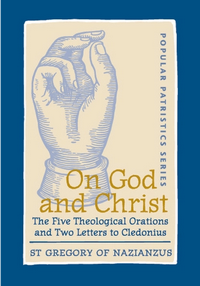
On God and Christ by Gregory of Nazianzus: Classic, Orthodox, Passionate

On God and Christ

On God and Christ,
The Five Theological
Orations and Two
Letters to Cledonius

by Gregory of Nazianzus, Translators: Frederick Williams & Lionel Wickham
Series: Popular Patristics Series, #23

Paperback, 172 pg.
St Vladimir’s Seminary Press, 2002

Read: May 2-June 6, 2021
Grab a copy from your local indie bookstore!

However, this illustration too was unacceptable to me. First, because it was quite clear what had set the sunbeam in motion, whereas nothing is prior to God to be his mover—he is cause of all and owns no prior cause. Second, because there is in this example a hint of those very things which are inconceivable in the case of God—composition, dispersion, and the lack of a fixed, natural stability. In a word, there is nothing to satisfy my mind when I try to illustrate the mental picture I have, except gratefully taking part of the image and discarding the rest. So, in the end, I resolved that it was best to say “goodbye” to images and shadows, deceptive and utterly inadequate as they are to express the reality. I resolved to keep close to the more truly religious view and rest content with some few words, taking the Spirit as my guide and, in his company and in partnership with him, safeguarding to the end the genuine illumination I had received from him, as I strike out a path through this world. To the best of my powers I will persuade all men to worship Father, Son, and Holy Spirit as the single Godhead and power, because to him belong all glory, honor, and might for ever and ever. Amen.

What’s On God and Christ About?

It’s all there in the subtitle, isn’t it? There are five theological orations/sermons and two letters in the book, focusing on the doctrine of the Trinity—with a focus on the person of the Son, and the “begotten” nature. According to the Introduction, these come in response to Anomean teaching—frequently referred to as Neo-Arian, but that’s not wholly accurate (and apparently would be offensive to Anomeans). The Church would formalize the response to the Anomeans in the modification to the Nicene Creed at the Council of Constantinople.

In other words—these sermons and letters are part of what laid the groundwork for that Creed that Christians confess throughout the world each week, and are a great way to come to a fuller understanding of some of what that Creed teaches. This is one of the recommended works from The Trinity: An Introduction by Scott R. Swain that I read earlier this year, and I can easily see why.

Readability and Tone

If there is one God, one supreme nature, where can I find an analogy to show you? Are you looking for one from your environment here in this world? It is a singularly graceless, and not just graceless but a pretty well futile, notion to get a picture of things heavenly from things of earth, of things fixed immutably from this transitory element. As Isaiah says, it is “seeking the living among the dead.”

For just about every reader (at least we non-scholars) the idea of reading Patristics is fairly daunting—even if you’ve done it before and emerged relatively unscathed (and maybe even learned something or enjoyed it). Dealing with a Church Father on something as technical as the Trinity? That’s beyond daunting, we’re talking intimidation now.

But there’s a reason that these sermons have lasted since the Fourth Century, they’re useful, educational, approachable, understandable. The translator calls them “as much high art as high theology,” in his introduction. Which isn’t a bad description, really.

There’s passion, there’s a hint of humor—not to make light of the topic, or to inject levity to entertain—but to serve as an aid to understanding (and to illustrate the foolishness of his opponents). This is a man who cares about what he’s talking about—this is important to him, important to his opponents, important to his audience, and therefore it must be dealt with carefully, with precision, and clearly. All of which translates well to us today.

Sure, because it’s technical Trinitarian language, it’s not the easiest thing in the world to read—but it’s not that bad. I think a careful high schooler could handle it.

So, what did I think about On God and Christ?

How has he been begotten?—I re-utter the question with loathing. God’s begetting ought to have the tribute of our reverent silence, The important point is for you to learn that he has been begotten. As to the way it happens, we shall not concede that even angels, much less you, know that. Shall I tell you the way? It is a way known only to the begetting Father and the begotten Son. Anything beyond this fact is hidden by a cloud and escapes your dull vision.

I am so glad I picked this up—what a treasure. It’s something I’m going to return to in years to come. Both for personal devotional reading as well as for help with tricky Trinitarian theology. I really think this is the kind of thing that everyone should read, and encourage you to give it a shot.


5 Stars

This post contains an affiliate link. If you purchase from it, I will get a small commission at no additional cost to you. As always, opinions are my own.

The Christian’s True Identity by Jonathan Landry Cruse: An Introduction to the Glory that is Being “In Him”

The Christian’s True Identity

The Christian’s True Identity:
What It Means to
Be in Christ

by Jonathan Landry Cruse

Kindle Edition, 144 pg.
Reformation Heritage, 2019

Read: March 21, 2021
Grab a copy from your local indie bookstore!

Many of us are raised believing that Jesus is simply the way to salvation. But no—He is salvation. He is the way, but He is also the life! He is both the giver and the gift. He is not a means to an end; He is the end. We are not to come to Christ looking for Him to give us something (like salvation, sanctification, a better life—or at least a better car), but instead we are to come to Christ looking for Him.

What’s The Christian’s True Identity About?

I’ve spent too much time trying to be clever or profound with this, it’s a short book, I can be brief here. The book’s point is pretty simple—despite all the noise and hubbub today about finding ourselves, choosing/shaping our identity. For the Christian, our identity comes from being rooted in Christ.

One of the—possibly the—greatest truths recovered by the Reformation was that union with Christ is at the core of all the blessings, all the amazing things that are true of the Christian, the Christian Life, and the Life of the World to Come. It’s all rooted and grounded in Him.

John calls it “abiding in” Christ. Paul repeatedly describes our blessings “in Him.” Cruse looks at ten passages from Paul’s epistles where he uses the phrase “in Him,” reviewing the passage, explaining how the passage reflects and teaches this truth about Christian identity, and applying it to the reader.

So, what did I think about The Christian’s True Identity?

Throughout this book we have considered how an identity in Christ far excels any identity the world might offer us. When we are in Christ we are chosen, forgiven, accepted as righteous, adopted into God’s family, placed in community, made new, and kept perfectly secure come what may. Our blessings in Jesus Christ are so expansive that it can truly be said that our union began in eternity with election and will forever continue in eternity with glorification.

That’s pretty much what’s covered in the book—done effectively, warmly, and clearly. Cruse has an easy-to-read, engaging style—he’ll draw you in and make you want to learn more. He skillfully uses writers from throughout Church History, contemporary scholarship, and current cultural examples to help bring these truths to life.

I think it could be deeper, I think it could be more detailed. But that’s not what the book aimed for—it’s an introduction or a refresher, that’s all. It’s supposed to drive the reader to further study, further reading. It accomplishes that goal while pointing to glorious, foundational truths. I commend it to you for that.


3.5 Stars

This post contains an affiliate link. If you purchase from it, I will get a small commission at no additional cost to you. As always, opinions are my own.
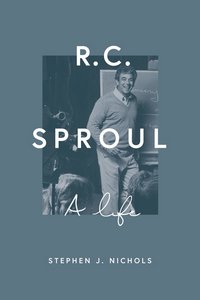
R. C. Sproul: A Life by Stephen J. Nichols: The Life and Work of Robert Charles Sproul

R. C. Sproul A Life

R. C. Sproul: A Life

by Stephen J. Nichols

Hardcover, 306 pg.
Crossway, 2021

Read: May 2-16, 2021

Grab a copy from your local indie bookstore!

Why Did I Pick Up R. C. Sproul: A Life?

If you were to go into any (confessional) Presbyterian or Reformed church in the U. S., you would have a very difficult time finding anyone there who hasn’t read a book or watched/heard a lecture by R. C. Sproul, usually several of either/each. The Holiness of God and Chosen by God were monumental in my life—and so many of his other works were huge, too. I saw him live twice, and couldn’t tell you how many videos and audio tapes/mp3s I learned from.

Basically, this guy was as close to a contemporary giant as we’ve had (whether having a giant in the church is a good or bad thing is a different discussion), so of course, I had to jump at a chance to learn more about him.

What’s R. C. Sproul: A Life About?

It’s all there in the title, really. This is a look at the life of Robert Charles Sproul, author/teacher/minister. Nichols covers it all—from his childhood to university days (and conversion), his post-graduate education, and early work. Then he moves into the founding of the Ligonier Study Center and how that led to Sproul’s books, radio show, and the rest of his work, culminating in the planting of Saint Andrews Chapel and the founding Reformation Bible College. The history of Ligonier Ministries in its various stages of development is also traced throughout. The last chapter serves as an extended eulogy for Sproul, recapping the major points of his life’s work and glancing at his legacy.

In many ways this serves as an intellectual biography and Nicholls will examine the background, main points, and impact of some of Sproul’s major projects and works in addition to the account of his life and work. These portions of the book are the highlights for me—serving both as a reminder of things I’d forgotten and a handy summary of Sproul’s major contributions.

Some Complaints

Nichols’ use of R. C. throughout, rather than Sproul, rubbed me the wrong way. I realize full well that the two had been friends for years, but I guess I expect a bit more formality from a biography.

It’s his friendship that colors this work, I think. There’s no critical eye on anything—personal choices, ecclesiastical acts, writing, public teaching, alliances with people in and out of the church—Nichols covers it all as if everything was inarguably positive and well done. While I’m sure Nichols would affirm that Sproul was fallible and capable of error, there’s no evidence of that in the book.

The discussion of Sproul’s thoughts on apologetics irked me. It’s stated that Sproul went to seminary a convinced presuppositionalist, and then Dr. Gerstner showed him the error of his ways on that issue, as well as Reformed Theology. So that his later critiques of Van Tillian apologetics come from the pen of someone who knows “both” sides and has seen the error of his ways. Well, if he didn’t become Reformed until after he shed his presuppositionalism, he wasn’t Van Tillian. Van Tillian presuppositionalism is rooted and grounded in Reformed (“Calvinistic”) theology, so Sproul was never in that camp. And frankly, I’ve listened to and read Sproul talking about Presuppositionalism, and as brilliant as he was, I just don’t think he ever really understood it. Is it that important? Not really—it just irked me, especially the way that Nichols used Sproul’s apologetic methodology in the book.

So, what did I think about R. C. Sproul: A Life?

Ultimately, this is more of an extended tribute than a biography. Nichols is no Iain H. Murray. And when I was about halfway through this book, I realized that’s what I wanted—a book roughly equivalent to Murray’s The Life of Martyn Lloyd-Jones (although I’d have been satisfied with something closer to his work on Edwards). But there’s no way anyone could have something of that scale ready less than four years after Sproul’s death, so that’s unrealistic. But I’m not going to be satisfied until we get that.

Nevertheless, I do recommend this book—it’s a good look at the man, his life, and his work. It helps understand where he came from, what led to various books and themes in his work. I do think I know Sproul better after this and that’s a good thing.

Also, if anyone deserves a 300-page tribute, it’s R. C. Sproul.


3.5 Stars

This post contains an affiliate link. If you purchase from it, I will get a small commission at no additional cost to you. As always, opinions are my own.

Reposting Just ‘Cuz: Faith & Life by Benjamin Breckinridge Warfield

I ran out of gas while trying to finish a post for today, so I thought I’d take a moment to revisit a favorite from a few years ago. I’ve been thinking of picking it up again, recently, and reading this just might have sealed the deal for me. You might want to give it a look, too.


Faith & Life:
Faith & Life: by Benjamin Breckinridge Warfield
My rating: 5 of 5 stars

Back when Princeton Seminary was the crown jewel of biblical Presbyterian training in the US, notable professors like Archibald Alexander, Samuel Miller, and Charles Hodge would have informal addresses for students on Sunday afternoons. B. B. Warfield, the lion of Princeton, continued this practice. These 41 chapters come from some of these addresses to the students.

I went skimming over the Table of Contents to pick out a few highlights — and I’m having a real problem. Almost every one is a gem. “Prayer as a Means of Grace” and “Prayer as a Practice” were very helpful — the latter was slightly better. “New Testament Puritanism” was great. Despite the reputation men like Warfield have, the chapters involving the work of the Holy Spirit were all tremendous. “God’s Holiness and Ours” was fantastic. I could keep going here, but it wouldn’t be long before I copied the Table of Contents.

For being the exemplar of “old Princeton,” with all the rigor and scholarship that entails — these addresses help us remember that even stalwarts like Warfield, who are known for strong stances on doctrinal issues — were men with vibrant faith, even a sense of humor.

I spent a few months reading 1 or 2 of these each Lord’s Day morning between breakfast and heading out for church — it was a great way to get my head (and heart) in the right frame of mind for worship. It’s everything Christian scholarship should be — warm, Christ-centered, practical, and doxological. It’s also everything that Christian devotional material should be — careful, sound, and deliberately orthodox. Highly recommended.

Sons in the Son by David B. Garner

I was talking about this book the other day, and wanted to refresh my mind about it, so I pulled up this post from 2016. It’s handy that I was able to do that (and as this is one of the reasons I started this blog, it’s great to see that it works, even if I rarely use it). I need to read this book again, soon. But also, it was such a good book and I thought I did an okay job with the post, so I thought I’d repost this.


Sons in the Son Sons in the Son: The Riches and Reach of Adoption in Christ

by David B. Garner

eARC, 400 pg.
P & R , 2017

Read: October 23 – December 11, 2016

At the heart of Pauline soteriology is the redemptive-historically charged concept of adoption (huiothesia). For Paul, the entirety of our redemption—from the mind of God before creation itself until its eschatological completion in our bodily resurrection—is expressed by filial reality, filial identity, and a filially framed union. As we will see in the following pages, this filial grace in Christ Jesus is expressly and implicitly, in Pauline theology, adoption.

I remember the first time I was really introduced to the doctrine of Adoption — sure, the idea had been mentioned throughout my Christian life, and using some material from an Ancient History class on Roman culture, I’d developed my understanding a bit, but it wasn’t until I’d been Reformed for a year or two that I heard someone seriously discuss the doctrine — the elder of the church I belonged to at the time walked us through the Westminster Confession’s teaching on it — the most robust development and explanation of the doctrine in Reformed Confessional history. I recall being struck by this teaching, how vital it was — and then hearing very little about it (on the whole) for the next couple of decades.

You see, despite being one of the three benefits the Westminster Shorter Catechism says that they who are effectually called partake of in this life (the other two being justification and sanctification, with several benefits that flow from or accompany these three), by and large, it’s been ignored in favor of the other two. Garner will describe it as a “deafening theological silence characterizing huiothesia [adoption] since the WCF.” It’s a slight exaggeration, but only slight.

Garner wants to push this doctrine to the forefront, to the limelight that it deserves, has pursued this in various forms throughout the years, and now brings it all into focus through this outstanding book.

He begins by describing various approaches to the topic — historically, linguistically, and so on — and sets out how he will proceed and build upon the best (primarily: Calvin and Westminster). This is a daunting section, but does well setting forth the landscape. It was interesting and thorough, I don’t know that it wowed me at any point, but it certainly whet my appetite for that which lay ahead.

Part 2 is where the major Biblical heavy lifting takes place — Garner goes for in-depth exegetical looks at each text that touches on the topic, building both a case for each text individually, as well as a Biblical-Theological whole. I will be honest, a lot of this went over my head — at least the details. But Garner writes in a way to ensure that even untrained laity can follow the his train of thought.

In part 3, Garner brings Adoption into Systematic Theology, primarily discussing its relation to Justification and Sanctification. He brushes up against some of the recent Justification controversies here, and demonstrates how a better understanding of Adoption, can (and should) play a significant role in resolving them. He does similar work with some Sanctification controversies — but not as much, partially because Justification has been a larger issue of late, and because historically Adoption has been (incorrectly) considered as forensically as Justification. This section probably takes more work to understand than the Exegetical section, but that could be just because I don’t try to get too much of a handle on the Greek, and I don’t have that hang up with English. Takes more work, sure, but doable.

Garner isn’t writing for laity explicitly, but he doesn’t write in a way that’s only accessible by theologians and scholars. Yeah, you sometimes there’s a lot of technical jargon to wade through, but it can be done (if nothing else, you feel smarter — and probably learn a couple of things). It was a bit weightier than most of what I’ve been reading lately, and I took my time with it to make sure it didn’t overwhelm me (it easily could have).

It’s absolutely worth the effort — this book is full of pastoral application, it will help you understand and appreciate the Pauline texts — and will deepen your assurance. This is quite possibly the best book I’ve read this year. Read this one. I will re-read it — I’m even going to buy a hard copy when this is released, you should, too.

Disclaimer: I received this eARC from P & R Publishing via NetGalley in exchange for this post — thanks to both for this. I meant it, I’m buying a hard copy as soon as I can.
N.B.: As this was an ARC, any quotations above may be changed in the published work — I will endeavor to verify them as soon as possible.

—–

5 Stars

Page 16 of 22

Powered by WordPress & Theme by Anders Norén