Tag: Urban Fantasy Page 27 of 44

Book Spotlight: Dark Queen by Faith Hunter

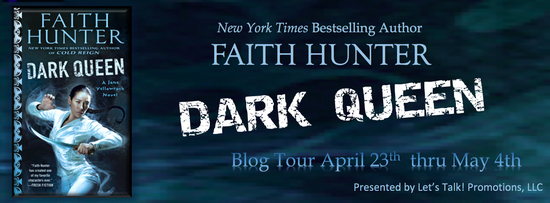
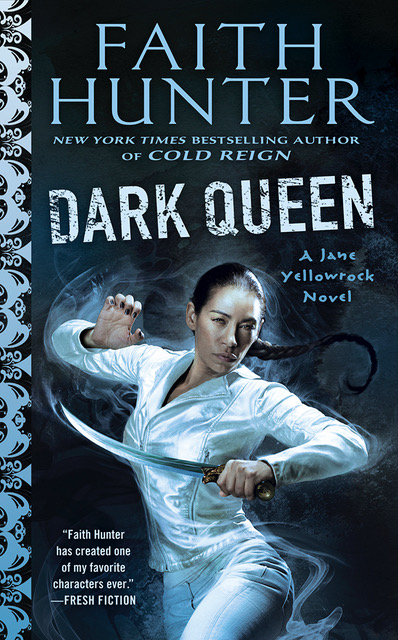
Welcome to our Book Tour stop for Faith Hunter’s Dark Queen, the twelfth (and best — so far, anyway) Jane Yellowrock novel. Along with this blurb about the book and author I’ll be posting my 2¢ about the book in a little bit, although I guess I just spoiled it, eh? The book is released today, you should head out and buy it (or, I guess, surf to the e-retailer of your choice and order it).

Be sure to scroll down to the bottom of this post for a chance to win a complete set of Jane Yellowrock books!

Book Details:

Book Title:  Dark Queen by Faith Hunter
Publisher:  Ace
Release date:  May 1, 2018
Format: Mass Market Paperback/ebook
Length: 432 pages

Book Description:

Jane Yellowrock used to hunt vampires, but now she must fight–and win–beside them.

As Enforcer to the vampire Master of the City of New Orleans, Jane Yellowrock stakes her reputation and her life on keeping her territory safe. But Leo has been issued a blood challenge by the emperor of the European vampires, who seeks to usurp all of his power and possessions. If Leo loses the match to the death, the city will be forfeit, and the people of New Orleans will suffer the consequences. Jane can’t let that happen.

Preparing for the duel requires all of Jane’s focus, but with so much supernatural power in play, nothing goes according to plan. She has to rely on herself and the very few people she knows she can trust to stand and fight. Only two things are guaranteed: nothing is sacred, and no one is safe.

ISBN: 1101991429
ISBN-13: 978-1101991428

Purchase at:

Author Bio:

Faith HunterFaith Hunter is a New York Times and USAToday bestselling author. She writes dark urban fantasy and paranormal urban thrillers.

Her long-running, bestselling, Skinwalker series features Jane Yellowrock, a hunter of rogue-vampires. The Soulwood series features Nell Nicholson Ingram in paranormal crime solving novels. Her Rogue Mage novels, a dark, urban fantasy series, features Thorn St. Croix, a stone mage in a post-apocalyptic, alternate reality. Two of her fantasy series have been nominated for Audie Awards.

Under the pen name Gwen Hunter, she has written action adventure, mysteries, thrillers, women’s fiction, a medical thriller series, and even historical religious fiction. As Gwen, she is a winner of the WH Smith Literary Award for Fresh Talent in 1995 in the UK, and won a Romantic Times Reviewers Choice Award in 2008. Under all her pen names, she has over 40 books in print in 30 countries.

In real life, Faith once broke a stove by refusing to turn it on for so long that its parts froze and the unused stove had to be replaced. Her recent hankering for homemade bread and soup resulted in fresh loaves each week and she claims that the newish stove feels loved and well used—because Faith talks to her appliances as well as to her plants and dog. She collects orchids and animal skulls, loves to sit on the back porch in lightning storms, and is a workaholic with a passion for jewelry making, white-water kayaking, and RV travel. She likes the shooting range, prefers Class III whitewater rivers with no gorge to climb out of, edits the occasional anthology, and drinks a lot of tea. Some days she’s a lady. Some days she ain’t. Occasionally, she remembers to sleep. The jewelry she makes and wears is often given as promo items and is used as prizes in contests.

For more, including a list of her books, see www.faithhunter.net , www.gwenhunter.com  To keep up with her, like her fan page at Facebook: https://www.facebook.com/official.faith.hunter

GIVEAWAY!

Win one of two complete sets of Faith Hunter’s Jane Yellowrock novels! Contest runs April 23rd until May 11th.

a Rafflecopter giveaway
https://widget-prime.rafflecopter.com/launch.js

Rafflecopter link: http://www.rafflecopter.com/rafl/display/9751c0429/?

My thanks to Let’s Talk! Promotions for the invitation to participate in this tour and the materials they provided.

Have you met . . . D. I. Jolly?

The first book I read in 2017 was Mostly Human by D. I. Jolly — and it was one of my favorites (but man, I’d have sworn it was 2016, man…I’ve read a lot in the last 15 months). We did a little other business via his then-day job at a publisher, and a Q&A. And I’ve really, really intended on coming back for more of his work (as much as I’ve read, there’s more I want to ). Anyway, he’s got himself a snazzy new website and is trying to get some eyeballs on it (and, hopefully, the books he talks about there).

So, click the link above — or this one — and, if you have the inclination, check out my thoughts about Mostly Human and the Few Quick Questions with him.

Scourged by Kevin Hearne: The Iron Druid Chronicles conclude with a bang.

This took me longer to write than I intended. Maybe I should’ve talked about it right after finishing it after all.

ScourgedScourged

by Kevin Hearne
Series: The Iron Druid Chronicles, #9

Hardcover, 265 pg.
Del Rey, 2018
Read: April 4, 2018

So, in a fast 265 pages Kevin Hearne gives us: Ragnarok; a lot of dead vampires; environmental crises; a friendly sloth; puppies; send-offs to many, many characters; shocking deaths; less-than-shocking deaths; surprise non-deaths; and more discussion of poots (elven and jaguar) than one’d expect in this kind of book. The amount that he accomplishes here is really staggering. Some of it, alas, could’ve been deeper — explored more thoroughly — if he hadn’t set out to do so much or if he’d taken more time with some things (and less time with others). Still, this was a heckuva way to end the series.

This is not the book to start this series with, go back and read Hounded if you’re curious (one of the best series kick-offs around), and I’m not going to get into the plot much. It’s Ragnarok. We’ve all known it was coming and now it’s here — ’nuff said. Along those lines, however, Hearne also gets bonus points for including a “where we are in the series” introduction, summarizing the first 8 novels and the short stories/novellas that got us to this point. Again, this should be a requirement for long-running series.

There’s no easy way to say it: there was just too much of Granuaile and Owen. Yes, it’s the best use of Owen since his introduction, don’t get me wrong. But it’s the Iron Druid Chronicles — fine, use the others if you want, but they shouldn’t get equal time to the Iron Druid here in the last book. Especially given the number of things — and scope of action — that had to be accomplished in Atticus’ story, it really should’ve had more room to breathe. That said — for End-of-the-World Showdowns featuring deities from multiple pantheons? This rocked. He wrapped up the story he kicked off in Hammered and Two Ravens and One Crow in a fantastic fashion, full of death, blood and tension. At the same time, he maintained the very idiosyncratic characterizations he’d created for the various gods and goddesses.

Speaking of Two Ravens and One Crow, a small, but fun, point from that comes back in these pages in a way that no one could have expected and added just the right level of fun to the battle.

Hearne did a great job integrating the short stories from Besieged into this book — I didn’t expect to see so much from them carry over to this. It all worked well and set the stage for Hearne to get in to the action of Scourged right away and he took full advantage of that.

There were more than a few things that seemed like they needed better explanations — doesn’t the convenient dog sitter find the way that Atticus spoils his dogs more than a little strange? Given that they’ve known the clock was ticking on Ragnarok, why did Atticus wait until the last second to give Granuaile and Owen their assignments? I mean, it works out well for dramatic purposes, and allows certain plot points to be triggered, but that’s not a good reason for the characters to work that way. At the very least, why weren’t his former apprentice and his former teacher pestering Atticus to lay out his plans long before this? While I eventually saw what Atticus and Hearne were up to, in the moment, a lot of the plan just didn’t make sense. When the world is falling apart, why set someone up for an extended training session (for one example)?

I’m not giving away anything about anyone dying — or living — but we know this is the finale, so we’re seeing the end of stories for these characters. Some good, some shocking, some disappointing, some sad. In no particular order: Laksha got a nice send-off, I really didn’t expect to see her here — and I really appreciated what Hearne did with her. It’s not honestly the ending I’ve had wanted for Atticus — but it’s the kind of ending that Hearne’s been building to for a while now, so it’s fitting. I can appreciate the way that Hearne accomplished his goals, even if I think Atticus deserved better. Owen’s ending was everything you could’ve hoped for. Granuaile’s story was fitting for her — and a good reminder that I stopped liking her a few books ago (seriously, why couldn’t she adopt an attitude similar to Owen or Flidias when it comes to their assignments during the battle?). I would’ve liked to have seen Perun one more time, but he got a good send off in Besieged.

Oberon was sidelined for most of the book — I understand why: Atticus wanted to keep his buddy safe, and Hearne needed to keep things ominous, dramatic and threatening, which is hard to do with everyone’s favorite Irish Wolfhound putting his two cents in (it’s hard enough with Coyote around). Still, we got some good Oberonisms, and he elicited more than one smile from me — and you could argue he saved the day ultimately. If I didn’t know that Hearne was writing one more of Oberon’s Meaty Mysteries, I’d be despondent over not seeing him again.

Scourged wasn’t perfect, but it was very satisfying. If I have to say good-bye to these characters, this is a pretty good way to do it. There was enough excitement, drama, and happenings to fill a couple of books and Hearne got it all into one — no mean feat — and it was a great read. It’s not easy letting go of most of these characters and this world (I mean, apart from re-reads), but I’m glad Hearne got out when he did and the way he wanted to. I’m looking forward to his future projects.

—–

4 1/2 Stars

I’m not going to talk about Scourged by Kevin Hearne today…

ScourgedScourged

by Kevin Hearne
Series: The Iron Druid Chronicles, #9

Hardcover, 265 pg.
Del Rey, 2018

Read: April 4, 2018


I was able to take the evening last night (when this posts, anyway — was just a few minutes ago really) to read the last two-thirds of Scourged while sipping some Tullamore Dew (see yesterday’s rambling). And it was a very satisfying way to spend an evening, no doubt.

My intention was to turn immediately to writing a blog post/review/rave about it, but I think I want to spend some time thinking about it before I start to write. A couple of spoilers about what I’ll end up saying: I really, really, really liked it. It wasn’t as triumphal as a part of me had hoped (“Everybody lives, Rose! Just this once, everybody lives!”), but it wasn’t as grim as I feared (Angel “Not Fade Away”‘s ending). It wasn’t perfect, but it was very satisfying. If I have to say good-bye to these characters, this is the way to do it.

And I’d better shut up before I end up writing a whole post after all.

Good Guys by Steven Brust

Good GuysGood Guys

by Steven Brust

Hardcover, 316 pg.
Tor Books, 2018
Read: March 30 – 31, 2018

Kind of odd, isn’t it? I’m waiting for my chance to kill a complete stranger, and to kill him in an ugly and gruesome way, so I fill in the time by checking out local architecture and museums. How did I become this person? Well, put that way, it was simple: Some son of a bitch had destroyed my life, and he just didn’t give a shit. To him, I’d been another chance to climb a ladder, add zeroes to his bank account, have more people calling him sir. To him, that’s what mattered. Maybe there really is no satisfaction in revenge, but I can tell you one thing for sure: There’s no satisfaction in letting someone get away with ruining your life, either.

And the Museum of Science and Industry is as good as the hype, so there’s that.

In almost every Urban Fantasy series there’s some sort of explanation for how magic/magic beings/magic users/etc. is/are kept under wraps so that we muggles can keep living our lives unaware of what’s going on all around us. Some of it is a by-product of magic/the supernatural that just clouds our minds, some of it is the result of efforts of the supernatural community (or at least part of it) keeping it under wraps. In Steven Brust’s Good Guys, The Foundation is tasked (among other things) with keeping magic off of the radar of mundane people.

Now when you have someone like our above narrator, killing complete strangers in ugly and gruesome ways enabled by magic, that particular task gets more difficult than usual. Here enter our protagonists — a Foundation Investigation and Enforcement team consisting of a very skilled investigator, a young sorcerer, and someone who provides security for them — they might also pick up a little extra help along the way. The team works through a combination of old school detective work, magic, high-tech wizardry and gumption to find the connections between these victims and use that to uncover just who might be behind the killings.

The investigation is well-constructed and keeps the reader guessing and invested. Brust’s jumping between various perspectives is well-done — the touch of only the killer being in the first person is an interesting touch (most authors would have one or more of the Foundation team as first person, with the killer in third) — not just with the team, but with various other individuals within the Foundation, giving a real sense of the scope of this group. The characters are interestingly conceived and executed — the killer’s motivation is easy to understand (not saying it’s easy to sympathize with, but you have a hard time wanting him stopped at all costs). When the pieces finally fall into place, it’s very satisfying.

One of the nicest touches Brust gave this world is a tiny budget for the Foundation — for a global security and research enterprise, they seem to be operating on a shoestring budget — they certainly don’t pay their employees very well. I’m not sure why this tickles me the way it does, but unlike the Men in Black, S.H.I.E.L.D., or any of the other clandestine groups that fill our imaginations — these guys can’t just whisk around the world at the drop of the hat. They have to fly coach at one point, rather than use the teleportation ability of the Foundation.

The members of the team make very little, and live pretty solitary lives (it’s not like they can tell anyone what they do) — there was a humanizing moment for each of them at various points through the story considering a pet to help them fight the solitude (all different potential pets, too).

This was a solid thriller with some great Urban Fantasy touches, a very satisfying solution that rings true. Well-paced, well conceived, and well-executed — in short just what you want out of this novel. A very pleasant way to spend a couple of hours. I don’t think this is the first of a series — but if I’m wrong, I’ll gladly jump on the sequel.

—–

3 Stars

2018 Library Love Challenge

Tricks for Free by Seanan McGuire

Tricks for FreeTricks for Free

by Seanan McGuire
Series: InCryptid, #7

Mass Market Paperback, 346 pg.
DAW Books, 2018

Read: March 13 – 17, 2018

           There are people who say you never really escape from high school, you just keep finding it in different forms, over and over again, until it finally kills you. Those people are assholes, and should not be allowed in polite company. That doesn’t mean they’re wrong.
           The room seemed even larger without the safety of the elevator behind me. I took a few hesitant steps forward, wishing I had a knife, or better yet, twenty knives, or better yet, twenty knives and a brick of C-4. Plastic explosives are a strange and dangerous security blanket, but they tend to make whatever’s scaring me go away quickly, so I’m in favor.

Whenever possible, frequent/regular readers know, I like to start off these posts with a quotation from the book that sums up the feel, the character, or just makes me smile. I couldn’t decide this time what to go with, so I used both — one from a flashback to high school which is just perfect for everyone who views it as something they survived, and the other that captures Annie’s voice oh-so-well.

Because of [Spoilers Redacted] at the end of Magic for Nothing, Annie’s on the run and on her own. Her family doesn’t know where she is (and hasn’t heard directly from her to keep it that way), her friends know nothing — she doesn’t even have a single Aeslin mouse with her. She could not possibly be more alone in the world. She lucks into a job at Lowryland — an amusement park near DisneyWorld — thanks to running into a teammate from high school who is an executive there. It’s not a glamorous job — she works in knick-knack shops, does clean up, works in food kiosks, etc. for far too little money. But there’s enough people around that she can hide in and almost no spell or anything the Covenant (or anyone else) tries to use to find her will work in that setting.

She’s living in the employee apartments near the park with a couple of cryptids. One is from her old Roller Derby team, who, as luck would have it, started working for Lowryland around the same time. The other roommate is a Pliny’s Gorgon, working as a resident at the Lowryland hospital. Tying this book back to Half-Off Ragnorack is a nice touch (and works out well for other reasons). It’s not the best life, but she’s content enough, she’s safe enough, and there are good people in her life.

Until things start to go wrong at the park, some magic users discover that she’s hiding there (they’re also hiding from the Covenant, so that works out), and people are getting hurt. Making this a question of can Annie stop whatever’s going on at the park without revealing herself to the Covenant and putting her friends in danger?

So there’s the setup — does McGuire pull it off? Yeah, stupid question. She does and she does it well.

First, she nails Annie’s emotional state — probably better than she does Verity’s often. Annie’s in a very vulnerable place — emotionally, psychologically, physically — and you can feel that.

           I went very still as it struck me that, tight now,l was living like a cryptid. l was hiding from people who wanted to do me harm as much because of who 1 was as because of anything I’d done. That was normal — being a Price meant I‘d had a bounty on my head horn the day l was born — but the isolation that came with it was new. The need to view everyone around me as a potential danger, to hide, it was all new, and it burned. There were dragons working all over Lowryland, and while none of them were part of my personal clique of Mean Girls, none of them knew my name either. It wasn’t safe. It might never be safe again, not until we’d found a way to end the danger posed by the Covenant — and that was something we’d been trying to accomplish for generations.

That vulnerability runs throughout this book — even when Annie’s at her most “rah-rah, we can do this, team” she’s very aware that everything is seconds away from disaster. This brings a richness of character to Annie that Alex and Verity don’t have (at least not to the same extent), if you ask me, this brings Annie into Toby Daye territory and elevates this series as a whole because of it.

You may have noticed a repeated use of the word luck above — that’s purposeful. Luck, as a concept, permeates these pages. It’s not a very clear concept to most of the characters, but it gets clarified by [Spoilers Redacted]. As one more magical system in this world that has a variety of them — that overlap, run parallel, and make a general mish-mash of things, it’s great. I think it’s a clever addition and I enjoyed watching it play out here, and anticipate continuing to affect things down the road.

The major flaw comes in how Annie pulls things off — in humble opinion. Throughout the book, there’s a warning given Annie — don’t do X. Beauty isn’t supposed to go in that part of the castle, Egon warns Ray and Venkman against crossing the streams, Annie needs to not do X. You know that all of those things will end up happening before the story’s done. Here’s my problem: it’s too easy for her to do it she makes the choice too quickly — and I’m not sure it was necessary when she did it (it may have been, this may have been a rare-stumble for McGuire where she didn’t make it clear that things were just that dire). I do know that if it’s something Annie felt the need for here, Verity sure should’ve done it back Chaos Choreography. But whatever, I’m over it — I just want to see how it plays out in the future.

One highlight for that I really can’t get into without ruining the first twelve chapters — but there’s a conversation in Chapter 13 catching up every character in Annie’s little circle with who’s who, what’s going on right now and since the last time they talked (hours or months ago), etc. This conversation just might be my favorite thing of March — reading or in Real Life™ — and it’s been a very good month. It’s just a pure joy to read.

By the way, the lack of Aeslin mice absolutely is felt throughout the book — the absence is supposed to make things feel strange, and it does. But never fear — there’s a novella starring the mice from Magic for Nothing at the back of this book. I hope when I have time to read it that it makes up for their absence.

Oh, and there’s a Priscilla Spencer map of Lowryland. Because what isn’t made better by a Priscilla Spencer map?

This is a great addition to a very fun series that adds some good depth to things, sets up our characters for a lot of trouble, and moves the series’ story as a whole down an interesting path. The next book also features Annie, but I’m sure we get back to Alex or Verity soon, and I can’t wait to see how these books without them affect their lives.

—–

4 Stars

Magic For Nothing by Seanan McGuire

Something — time constraints, distractions, deadlines, big shiny things in the corner — kept me from finishing this post last year. I tried every now and then to finish it, but at a certain point my copious notes weren’t enough. Thankfully, reading the next book in the series helped me remember enough that I thought I could finish this post. It’s not everything I wanted it to be, but short of a re-read, nothing was going make it that.

Magic For NothingMagic For Nothing

by Seanan McGuire
Series: InCryptid, #6


Mass Market Paperback, 358 pg.
Daw Books, 2017
Read: Mach 18 – 21, 2017

And you shouldn’t believe all the press about Ouija boards. They can’t be used in an exorcism. Trivial Pursuit can, but that’s another story.

This has nothing to do with the story, I just really liked that line. It comes from one of the best (probably the best, I don’t keep notes on that) openings to an InCryptid novel that McGuire’s done yet.

So after Verity declared war on the Covenant in the closing pages of Chaos Choreography, the Price family has to follow suit and step things up. Their first step? Having Antimony go undercover with the Covenant as a new recruit. This could be a suicide mission but she knows it’s the best shot to understand what’s going on with the Covenant and their plans for the United States.

You could make the claim that Annie’s infiltration of the Covenant is a little too easy — but why? It’s far more interesting for her to have infiltrated the Covenant and get assigned for a probationary task quickly than it would be for there to be a realistic screening and training process — I’m sure McGuire could have pulled it off, because what can’t she write? But this was better. Very quickly the Covenant comes up with an assignment that’ll test her loyalty and maybe score them some dead American monsters. Part of Annie’s cover is that her circus family was wiped out by a bunch of somethings and she wants revenge, the Covenant has wind of a monster or two at a circus in the midwest killing people in the towns it visits. Her assignment: infiltrate the circus, find the responsible creatures (and any others) and call in her handlers to wipe them all out.

So she’s going undercover as part of her undercover assignment. Thankfully, she’s had multiple aliases since she was a wee girl, so she’ll probably be able to keep her names straight.

Once she gets there, she finds more than one person that the Covenant will want killed just for being — so Annie has to figure out how to keep that from happening and keep her cover intact long enough that she can learn something for her family.

I loved the circus atmosphere, I pretty much always do, come to think of it. As is her norm, McGuire’s cast of characters for the Price adventures, is a whole lot of fun. But I think she stepped her game up with this one — even her Covenant characters have a bit more going for them than her normal baddies. But the key to this novel being so entertaining is Annie. We’ve seen her a little bit here and there throughout the series, but never for very long. She’s just great. Her attitude, gumption, grit and talents make for a fun character. The complicated hero-worship/jealousy thing she has going on regarding Verity (not so much with Alex, but a little bit) is a nice realistic and humanizing touch. I’m not going to blather on about her too much, but of the siblings, I think she’s my favorite.

The big climatic battle and the aftermath from that setting up at least the next novel? Thick, rich icing on an already tasty cake.

Oh, the mice. How did I get this far without mentioning the mice? The Aeslin mice are a great source of laughs as well as heart throughout this series — but man, this time Mindy (Annie’s Aeslin companion) really got me. I was moved. I . . . well, yeah,let’s just leave it there. Mindy’s just great.

If there’s one thing in this world that I know I can rely on, it’s the joyous cheering of the Aeslin mice.

Ditto, Annie, ditto. Joyous cheering of Aeslin mice and Seanan McGuire’s writing — wholly reliable. If you haven’t gotten around to picking up this volume of the InCryptid series yet, you need to. It’d make an okay jumping on point, too — but a lot of the little things won’t mean as much to you as they should. Still, I think it’d convince you to go read the earlier books.

—–

4 1/2 Stars

Burn Bright by Patricia Briggs

I had this pretty much ready to go yesterday and the day before that, but I didn’t like what I’d written — it’s not like I disagreed with myself (I’m funny that way), but I just had gone off on a tangent and ended up writing about things I didn’t care that much about, and ignored the things I’d been thinking about since I read the book. This isn’t exactly what I meant to talk about, nor is it as clear as I wanted things to be — but it’s close enough. Hope someone gets something out of it.

Burn BrightBurn Bright

by Patricia Briggs

Series: Alpha and Omega, #5

Hardcover, 308 pg.
Ace, 2018

Read: March 7 – 8, 2018

Anna was her father’s daughter, and her father believed in science and rational thinking. She’d been a werewolf for years now, and she still tended to think about it from a scientific viewpoint, as though lycanthropy were a virus.

Faced with a wall of briar-thorned vines straight out of a Grimms’ fairy tale, she’d never had it brought home so clearly that what she was and what she did was magic. Not Arthur C. Clarke magic, where sufficient understanding could turn it into a new science that could be labeled and understood. But a “there’s another form of power in the universe” magic. Something alien, almost sentient, that ran by its own rules-or none. Real magic, something that could be studied, maybe, but would never rest in neatly explainable categories.

I appreciated this look into Anna’s thinking. It matches up with what we’ve seen of Mercy’s take on magic, but not completely, underscoring the differences in t heir personalities and way of looking at the world.

Burn Bright takes place on the heels of Silence Fallen — Bran’s not back yet and Charles is handling things. At least as much as Leah will let him. We’ve known for quite some time that Bran’s pack is full of misfits, wolves that need extra care and attention that they probably couldn’t get elsewhere — particularly older werewolves, the type who are nearing the point where they can’t keep control. Asil is a prime example of this — but now we learn that Asil actually is an example of an older wolf who’s doing just fine and that there are a half-dozen or so living near the Marrock, but that don’t come into town or have much at all to do with anyone not Bran, Charles or a small number of specific individuals.

Now, while the Marrock is gone, someone is targeting these wolves — and all signs point to someone within the pack. Can Charles, Anna and others protect these pack members from this new threat? Can they identify the traitor in their midst, and will Charles have to kill someone he trusted to preserve the safety of all the wolves?

One thing I noticed last year doing my re-read of the Mercy and Alpha & Omega books was just how comfortable I felt in these books — that holds true here, too. It doesn’t matter about the peril being faced by Charles and Anna (or any of the rest of the pack), reading this book was a nice, relaxing time with old friends. Agatha Christie or Dorothy Sayers, she’s not, but Briggs sure writes a cozy novel. I cannot put my finger on why — if it’s something in Briggs’ style, her voice, the stories, a combination of the three — but it doesn’t matter. As long as she does that, she’ll have loyal readers.

This was a very talk-y story (and maybe all the Charles and Anna stories skew this way, but this seemed a bit more pronounced). More than once I asked “Do we need to tell this story now? Can’t we come back and chat about this later, you know, after everyone is safe?” Of course, the answer is now, and we need all the talk-y bits to get the understanding and information necessary to defeat the bad guys. Still, the author and readers know this, but Charles, Anna and the rest don’t know that and I wish they displayed a greater sense of urgency.

Most of the talk-y portions were discussing the wildlings being targeted by the mysterious (and well-armed) forces at work here. Which at least pays off in the readers getting to know them — which I greatly appreciate. The other person we get to know better is Leah, Bran’s wife and his wolf’s mate. Between these books and the Mercy novels we’ve gotten to know here a bit, but this novel fills that knowledge out. Between Leah and Chrissy (Adam’s ex- in the Mercy books) Briggs displays a real talent in writing women that you cannot stand or trust, but have enough sympathy for that you can’t just hate. They’re manipulative, conniving, and self-promoting in ways that are clearly meant to set your teeth on edge — but there’s something very vulnerable about them, too.

There’s a reveal or two later in the book that seem inevitable — only because that’s how stories work, even when (especially when?) everything is pointing in one direction, but there’s no way an author of any experience would go with something so obvious. It’s hard to get more specific while not giving away the details — but those reveals ended up leaving me dissatisfied only because I called them so early. It feels like when you’re watching a police procedural and identify the killer when the guest star makes their appearance in the first 10 minutes — sure Castle might be charming, Bones’ intern might be delightfully quirky, or Rizzoli might have some sort of compelling side-story, but the mystery part of the story is a disappointment because how is Morgan Fairchild not going to be the killer?

But the focus of the book is on the relationship between Charles and Anna, their mutual trust, the way they help each other in ways no one else can. That part of the novel is rock solid, and as long as Briggs delivers that, who’s going to complain?

I thoroughly enjoyed this one, don’t misunderstand me. And the more I learn about Bran’s pack in Montana, the more I like it and the more I want to know. Asil, as always, was a joy. But . . . the more I think about Burn Bright the less satisfying it seems, the slighter it feels. I’m glad I read it, I’ll likely gladly read it again — and I look forward to the next adventure with these two. But I think Briggs could’ve — and should’ve — done better.

—–

3.5 Stars

PubDay Repost: Smoke Eaters by Sean Grigsby

yeah, yeah I told you that I’d get this up last week, but writing while hacking isn’t that easy. Yes, I’m a hack writer, but that means something totally different.

Smoke EatersSmoke Eaters

by Sean Grigsby

eARC, 384 pg.
Angry Robot, 2018

Read: February 2 – 3, 2018

Really, the case for you (or anyone) reading this book is simply and convincingly made in 13 words:

Firefighters vs. Dragons in an Urban Fantasy novel set in a futuristic dystopia.

I’ll just wait here while you open another tab to put in your order. There’s really nothing more that I need to say, is there? What if I throw in robot dogs?

Since you’re here anyway, I’ll talk a little more about the book. In the early 22nd century, dragons show up (technically, come back) and everything changes over night — cities burn, non-urban areas burn, geography changes, societies change, political/governmental realities change. And so on. Where there are dragons, there’s fire; and where there’s fire, there are firefighters. A special division of firefighters soon develops — Smoke Eaters — who specialize in dragon fighting, while the rest take care of fires, saving lives and property, etc. You know, the basic everyday hero stuff.

One such hero is Captain Cole Brannigan. After decades of fighting fires, he’s a week away from retirement when disaster strikes and he finds himself without his air supply in a dragon smoke-filled room, which it turns out that he can breathe. Which means he’s one of a select few people naturally immune to the stuff and is basically pressed into service as a Smoke Eater. Instead of commanding a squad and their respect, he’s a trainee — worse, a trainee who used to be a fire fighter. I’m not really sure I get the level of antagonism that exists between the two groups, but it’s pretty intense. No one respects his expertise, his experience, his perspective. He’s tolerated at best — and that’s really only because of the whole smoke immunity thing.

I cannot stress how much I enjoyed this dynamic — stories about someone learning their way through a new reality, or new abilities, etc. are a staple of the genre. But a fully-realized adult, in a long-term, stable marriage (as stable as they can realistically come), successful already and sure of his place in the world being thrown into a new situation like this is unique. Cole spends as much time fighting his instincts about assuming leadership roles (and assuming people will follow) as he does trying to understand his new teammates and duties. Naturally, his perspective and experience will prove important to understanding a new challenge facing the Smoke Eaters.

I’m not going to get into everyone else, because this is Cole’s story, but that doesn’t necessarily mean he’s the most interesting character (he probably is, though, your mileage may vary). The rest of the characters aren’t quite as well drawn — mostly because we see everyone through Cole’s eyes — but most are close enough that you don’t notice.

I should probably mention that when he’s not writing about fire-breathing lizards, Grigsby’s an actual firefighter. So he knows his stuff — when he says fire behaves a certain way, it’s not because he’s read a lot about that or watched Backdraft a few dozen times (well, both of those may be true, but neither is the primary reason he can say that fire behaves a certain way). The authenticity about this kind of thing shines forth and adds a layer of reality to this novel. He knows guys just like Cole — and probably most of the other firefighters and Smoke Eaters — he knows the devastation that fire leaves behind (both to structures and people), and what it takes to keep pressing on in the face of that.

There is a lot more that I want to try and cover, but this is one if those books that if I said everything I wanted to, it’d take a week to write and an hour to read – so let me wrap this up (man, I didn’t even talk about Grigsby’s Canada…the book is worth a look just for that). This is full of action, and some of the ways a gentleman of Cole’s age keeps up with the action are pretty smartly conceived, but there’s some thinking involved, too. Still, you’ll be kept leaning forward in your seat. It’s a good story; with great, developed characters; a wonderful concept; all executed like a seasoned pro was behind it all. There are some little details that will make you chuckle as you read them (the misunderstandings of barely remembered 20th century culture, for example). Smoke Eaters is going to be one of the best UF reads you find this year.

Disclaimer: I received this eARC from the good folks over at Angry Robot via NetGalley in exchange for this post and my honest take on the book — thanks to both for their generosity and this rockin’ read.

—–

4 1/2 Stars

Smoke Eaters by Sean Grigsby

yeah, yeah I told you that I’d get this up last week, but writing while hacking isn’t that easy. Yes, I’m a hack writer, but that means something totally different.

Smoke EatersSmoke Eaters

by Sean Grigsby

eARC, 384 pg.
Angry Robot, 2018

Read: February 2 – 3, 2018

Really, the case for you (or anyone) reading this book is simply and convincingly made in 13 words:

Firefighters vs. Dragons in an Urban Fantasy novel set in a futuristic dystopia.

I’ll just wait here while you open another browser tab to put in your order. There’s really nothing more that I need to say, is there? What if I throw in robot dogs?

Since you’re here anyway, I’ll talk a little more about the book. In the early 22nd century, dragons show up (technically, come back) and everything changes over night — cities burn, non-urban areas burn, geography changes, societies change, political/governmental realities change. And so on. Where there are dragons, there’s fire; and where there’s fire, there are firefighters. A special division of firefighters soon develops — Smoke Eaters — who specialize in dragon fighting, while the rest take care of fires, saving lives and property, etc. You know, the basic everyday hero stuff.

One such hero is Captain Cole Brannigan. After decades of fighting fires, he’s a week away from retirement when disaster strikes and he finds himself without his air supply in a dragon smoke-filled room, which it turns out that he can breathe. Which means he’s one of a select few people naturally immune to the stuff and is basically pressed into service as a Smoke Eater. Instead of commanding a squad and their respect, he’s a trainee — worse, a trainee who used to be a fire fighter. I’m not really sure I get the level of antagonism that exists between the two groups, but it’s pretty intense. No one respects his expertise, his experience, his perspective. He’s tolerated at best — and that’s really only because of the whole smoke immunity thing.

I cannot stress how much I enjoyed this dynamic — stories about someone learning their way through a new reality, or new abilities, etc. are a staple of the genre. But a fully-realized adult, in a long-term, stable marriage (as stable as they can realistically come), successful already and sure of his place in the world being thrown into a new situation like this is unique. Cole spends as much time fighting his instincts about assuming leadership roles (and assuming people will follow) as he does trying to understand his new teammates and duties. Naturally, his perspective and experience will prove important to understanding a new challenge facing the Smoke Eaters.

I’m not going to get into everyone else, because this is Cole’s story, but that doesn’t necessarily mean he’s the most interesting character (he probably is, though, your mileage may vary). The rest of the characters aren’t quite as well drawn — mostly because we see everyone through Cole’s eyes — but most are close enough that you don’t notice.

I should probably mention that when he’s not writing about fire-breathing lizards, Grigsby’s an actual firefighter. So he knows his stuff — when he says fire behaves a certain way, it’s not because he’s read a lot about that or watched Backdraft a few dozen times (well, both of those may be true, but neither is the primary reason he can say that fire behaves a certain way). The authenticity about this kind of thing shines forth and adds a layer of reality to this novel. He knows guys just like Cole — and probably most of the other firefighters and Smoke Eaters — he knows the devastation that fire leaves behind (both to structures and people), and what it takes to keep pressing on in the face of that.

There is a lot more that I want to try and cover, but this is one if those books that if I said everything I wanted to, it’d take a week to write and an hour to read – so let me wrap this up (man, I didn’t even talk about Grigsby’s Canada…the book is worth a look just for that). This is full of action, and some of the ways a gentleman of Cole’s age keeps up with the action are pretty smartly conceived, but there’s some thinking involved, too. Still, you’ll be kept leaning forward in your seat. It’s a good story; with great, developed characters; a wonderful concept; all executed like a seasoned pro was behind it all. There are some little details that will make you chuckle as you read them (the misunderstandings of barely remembered 20th century culture, for example). Smoke Eaters is going to be one of the best UF reads you find this year.

Disclaimer: I received this eARC from the good folks over at Angry Robot via NetGalley in exchange for this post and my honest take on the book — thanks to both for their generosity and this rockin’ read.

—–

4 1/2 Stars

Page 27 of 44

Powered by WordPress & Theme by Anders Norén