Tag: Urban Fantasy Page 41 of 44

Dusted Off: Greywalker by Kat Richardson

Greywalker (Greywalker, #1)Greywalker

by Kat Richardson
Series Greywalker, #1


Mass Market Paperback, 341 pg.
Roc Trade, 2006
Read: August 18 – 20, 2012

Wow. Great, great first chapter. Had me hooked on the book within the first few paragraphs and really didn’t let go.

Solid, solid read. Action, little humor, dash of romance, and a really good crew of likeable characters.

I had a couple of quibbles: There was one transition between chapters that involved a time jump, which (eventually) got enough explanation that I didn’t feel shorted, but it didn’t fit with the rest of the narrative style of the book. Too much of the book was Harper learning about the Grey–the world of magic/paranormal/etc., so it’s hard to see what future installments would be like.

Obviously, the series is pretty successful at this point, and this book makes it easy to see why, don’t think I’ve felt this way about a debut UF book since Rosemary and Rue.

—–

4 Stars

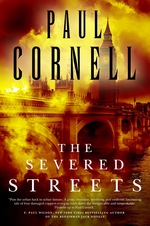
The Severed Streets by Paul Cornell (Updated)

Update: A representative of Audible.com, emailed me to ask if I’d like to post a clip from the audio book with this review. Sounded like a good idea to me (no pun intended). The sample’s at the bottom of this post, give it a listen.

The Severed StreetsThe Severed Streets

by Paul Cornell

Hardcover, 416 pg.
Tor Books, 2014
Read: June 11 – 14, 2014

This Cornell guy can write.

I’m tempted to let that be all I say about this book. Won’t be (because I can’t help myself), but it’s tempting. The other thing I’m tempted to do is copy and paste the first three paragraphs of my London Falling review to start this one — I am a little annoyed to see that I spoke so much about the Bryant & May Peculiar Crimes Unit series last time, because the comparison really hit me repeatedly as I read this book. I hope neither Cornell or Fowler mind that comparison.

Straightaway, Cornell creates a world rich with atmosphere — the his depiction of the tension on the streets of London is visceral, and then when the first murder occurs, you start to wish for something a little less visceral. And that’s in the first handful of pages. Once the focus turns to the team of detectives, it takes almost no time at all to immerse yourself again in this world (one that I honestly was a little fuzzy on when I picked up the book, remembering everything about these characters took a page or two back with them). There’s a bit more esprit de corps amongst them now then when we left them in London Falling, they’ve spent more time together, are more familiar with each other — and, if nothing else, realize that they share something that no one else in the London Police does.

Now they’ve got their hands full, seeking a vicious killer that only they can see. One that seems to have connections to a popular protest movement (think the Occupy movement, but with masks) and maybe to Jack the Ripper. Add all those things together, and you’ve got yourself a real mess. To that, add multiple conflicting goals on the part of Quill and his team, a looming police strike, an overly-inquisitive media mogul, a meddling Security Service, and a city on the verge of riot — and you’ve got, well, I don’t know exactly what it is, but the word “mess” no longer can describe it.

This early in a series, I don’t have any strong emotional connection to characters — particularly in this series, which (to me) seems to lend itself to a distancing between reader and character. But when one of the team makes an unthinkable sacrifice, I realized that distance didn’t exist anymore for me, and I had to put the book down for a brief moment to think about what I’d just read. But I couldn’t keep it down for long and had to pick it up quickly — only to be hit with something worse not that long after.

Which is not to say that this whole novel is an emotional wringer, there’s more humor, more hope intrinsic to this book than its predecessor, while it doesn’t lose any of it’s edge. The celebrity cameo was hilarious in a book not typified by hilarity of any kind. And then it became more than a cameo, which was pretty cool — and then it became, brilliant. I mean, truly brilliant. And I really can’t say more about it than that without violating all sorts of my spoiler policies.

I want to say more about this book, and maybe I’ll come back and revise this later, but for now I’d better leave it at this or it’ll never get done. The Severed Streets is one of those books that will make you want to cancel plans, so you can spend more time with it. From the unnervingly impossible assassination at the beginning to the truly disturbing final sentence, and almost every point in between, this is a killer book — gripping, suspenseful, with no punches pulled on any level. Please let there be more of these soon.

—–

4 1/2 Stars

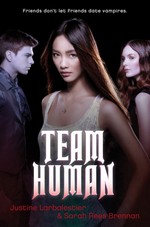
Dusted Off: Team Human by Justine Larbalestier, Sarah Rees Brennan

Team HumanTeam Human

by Justine Larbalestier, Sarah Rees Brennan

Hardcover, 352 pg.
HarperTeen, 2012
Read: Jul. 19-21, 2012

Much more than a Twilight spoof (although, that’s there) this is a heckuva read. Mel’s a spunky high schooler with a lot on the ball, her friends see her as a fixer, the one who can help them deal with whatever crisis they’re dealing with. It’s a role she relishes, it’s her way of identifying herself. Particularly this time, when she’s trying to stop one friend from falling for a vampire, while another is coping with her dad abandoning the family for a vampire lover. Vampires are pretty low on Mel’s list.

Mel’s a flawed hero, in an endearing way. She’s bullheaded, fierce, dives into things without looking, she makes mistakes, but picks herself up and charges back into the fray with a minimum of self-doubt.

The rest of the cast are almost as well-rounded, were I in high school, I’d love to hang out with them (they’d probably be a bit too wild for me, honestly).

A fun, emotionally-satisfying novel for teens and adults who don’t mind reading below their grade level.

—–

4 Stars

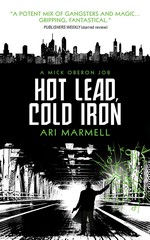
Hot Lead, Cold Iron by Ari Marmell

Hot Lead, Cold IronHot Lead, Cold Iron

by Ari Marmell

Trade Paperback, 311 pg.
Titan Books, 2014
Read: May 19 – 27, 2014

This is the way to start a series, I mean, wow. Mick Oberon is a P.I. in the rough and tumble days of late-Prohibition-era Chicago. He mixes with the mob, political figures,and other assorted low-lifes, while eking out a living — just enough to afford milk, rent and the cheap suits he wears. He can take a beating like nobody’s business, and packs a wand rather than rather than a gun. Oh yeah, and he’s fae.

I’ve got a mental checklist that I use to evaluate a new (to me) Urban Fantasy: 1. Is there a strong voice? 2. Do I like the characters/world? 3. Is the magic system interesting? (you can replace vampire/werewolf/etc. system where applicable)

Hot Lead, Cold Iron passes this test easily. Oberon’s smart, snarky — a little disdainful of humanity (but it’s not like you can really disagree with him). This Chicago is right out of The Untouchables, and when you add in the supernatural to the world (plus the Seelie/Unseelie Courts) — this world is a riot. There is so much raw material here that Marmell is set for several books. The magic system? I don’t have it all worked out after just one book, but what I’ve seen, I’ve liked. Oberson plays with luck — he takes good luck from people and uses it to power his own, he magnifies people’s bad luck to cause mishaps/mayhem, and so on. No big fireballs, or dramatic spells, just little bits of luck here and there going his way. I think that’s pretty nifty — especially the way it’s working out so far.

I’ve enjoyed Marmell’s prose in the past, and this is no different, even as it doesn’t feel like his other books. The novel is filled with great lines that are the epitome of hard-boiled P.I.s like Phillip Marlowe or Dixon Hill such as, “clad in shirt and trousers creased sharp enough to trim hedges.” Or this description of the fae world:

The colors. . . They’re intense, impossible, almost painful; entities unto themselves, rather’n mere traits of other objects. They’re stark, standing out against each other, the richest greens, the sharpest reds, the deepest browns, the brightest yellows. you could try to capture ’em in a painting, but nobody’d buy it: too fake-looking. There’s no gradation, nothing muted; the dark and light emeralds of a leaf don’t blend into each other, but sit side-by-side with clear demarcation — as if no one color here would ever lower itself to blend with another.

I hope future books spend more time in the fae world (and there’s every indication that they will), it’s slightly bent/twisted hyper-reality was truly imaginative, and unlike anyone else’s take on it. The fae camera, for example, was sort of a mix of something you’d find in a store on Diagon Alley and in Bedrock. I realize that analogy probably makes no sense — read the book and it will.

Good action, good plot, strong protagonist, strange world and intriguing magic system — everything a series’ first novel needs. Bring on the next!

—–

4 1/2 Stars

Night Broken by Patricia Briggs

Night Broken (Mercy Thompson, #8)Night Broken

by Patricia Briggs
Series: Mercy Thompson, #8


Hardcover, 341 pg.
Ace Hardcover, 2014
Read: March 19 – 20, 2014

Yay! Mercy’s back! She’s back and she’s facing off with her most potentially destructive foe . . . Adam’s ex. Oh, sure, there’s some sort of Gray Lord threatening her, a supernatural super-baddie that Mercy and her pals have never heard of, and an escaped felon who has powers a lot like Mercy . But the big danger comes from Christy.

This wasn’t a “big” novel in any real sense — seeds were planted/characters were introduced tha will be important, and I wouldn’t want to say that nothing significant happens. But, no epochal shifts, no game changers here — just straightforward case of bad guy comes to town, and Mercy et al. stop it. And along the way the final confrontation with the bad guy, we get to spend sometime with the Tri-Cities pack, as well as see some of the fallout from the last couple of books in this or the Alpha-Omega series. And that’s fine. Not every book needs to be an even, some just need to have a fun story, and maybe even move the chess pieces around a bit.

Initially, the villain of the piece looks fairly disappointing, just some stalker jerk making life difficult of Christy. But it soon becomes clear that there’s more to this guy, and it doesn’t take long to see that he’s one bad customer — creepy, dangerous, and powerful in a way I don’t think I’ve seen before. All in all, a worthy competitor for Mercy and the pack.

As always, the interplay between Mercy and the various members of the pack — or just between the pack without regard to Mercy — is fascinating. At once familial, yet competitive, not necessarily all that affectionate, yet more loyal than a troop of Marines.
The more the Jesse/Mercy relationship develops, the more I like to see it — particularly here, where much of the book can be seen as mother v. step-mother, watching Jesse maturely navigating those treacherous waters was quite satisfying.

My main (only?) quibble with the book was the way that Adam was depicted. He was continually utterly clueless about the way that Christy’s actions would/did affect Mercy. A lot of that, to be fair to the guy, can be attributed to how much he’s moved on from Christy and how devoted he is to Mercy — he doesn’t even see his ex as a potential threat. But, 1. Adam’s smarter than that and 2. given how territorial werewolves are in Briggs’ universe (and as seen in this book), it’s almost impossible to believe that he wouldn’t pick up on the territorial incursions Christy’s making.

Not the best thing that Briggs has written in this series, but not the worst. It had a good story, it was good to spend time with these characters, and I enjoyed the introduction of the new forces at play. A fun way to spend a few hours. Just about everything you could ask for.

—–

4 1/2 Stars

Dusted Off: Blue Diablo

Blue Diablo (Corine Solomon, #1)Blue Diablo

by Ann Aguirre
Mass-Market Paperback, 336 pg.
Roc, 2009
Read: June 3-5, 2012

Ann Aguirre starts the 4th (or so) chapter by quoting the show, Coupling, which I’m pretty sure means I have to buy every book she’s written/will write. Doesn’t hurt that her heroine, Corine Solomon, has the same power as Anton Strout‘s Simon Canderous–psychometry (just a grittier version than Simon’s).

The book starts off in a nice, homey setting–but it’s clear that Corine has a dark backstory. It’s not too long before we meet a shadowy guy from her past and we’re off and running through a murky mix of various types of magic/magic-users, human trafficking, drugs, and other types of depravity. The plot takes some darker turns than I’d expected (and one or two pretty sillier ones). Corine meets plenty of new people along the way–most of whom are the kind of characters you grow to like and/or are interesting enough that you want to spend more time with.

Overall, a strong start to what should prove to be a very satisfying series.

I really could live without the Guy A or Guy B or Guy Neither storyline (but if push comes to shove, consider me Team Jesse), I did appreciate what Aguirre did with it this time–just not looking forward to more of it).

—–

3 Stars

Dirty Magic by Jaye Wells

Dirty Magic (The Prospero's War, #1)Dirty Magic by Jaye Wells
Series: Prospero’s War, #2

Paperback, 381 pg.
Orbit, 2014
Read: February 15-17, 2014

Kate Prospero is a tough cop, scraping by, raising her kid brother with the help of her best bud and a kindly senior citizen neighbor. Her troubled past has so far blocked her from progressing out of uniform and the detective ranks — but she’s got grit, determination, and hope — not to mention an unreliable automobile and a healthy tuition bill for her brother’s private high school.

I know I’ve read and/or seen this a couple dozen times. So does Jaye Wells do something to freshen this up? And does her take on this work? Yes, and pretty much.

Wells’ twist on this is introducing magic into the mix. It’s our world, but instead of Big Tobacco and the Pharmaceutical Industry exploding in the last few decades, while their less than legal counterparts were finding similar success — “clean” (read: legal) and “dirty” (read: illegal) magic came into economic ascendancy. There’s a Magic Enforcement Agency running the war on dirty drugs on the federal level, while Prospero and her brethren in blue take the battle to the streets.

That pretty much tells you all you need to know. The book plays out pretty much how you’d imagine it would. Well-told and decently-paced, there’s nothing to object to here (well, some of Prospero’s emotional reactions seem a bit over-wrought, though your results may vary) — but there’s nothing to get terribly excited about either.

It’s an entertaining enough read, and I’m curious about where Wells will take things. But I don’t know that I’ll run for the bookstore come August when the sequel, Cursed Moon comes out.

—–

3 Stars

Blackbirds by Chuck Wendig

Blackbirds (Miriam Black, #1)Blackbirds

by Chuck Wendig
ebook, 264 pg.
Angry Robot, 2012
Read: Jan. 4-6, 2014

Over the last couple of years, I’ve really enjoyed — and learned a few things — from Chuck Wendig’s blog posts about writing, and have seen nothing but raves for this series from people and writers whose taste I respect and frequently agree with. But, when reading descriptions for Mockingbird it seem all that interesting to me. When the publisher was giving away e-copies last month, I figured I’d roll the dice and hope to be pleasantly surprised.

I should’ve stuck with my gut. This was not a book for me.

There are a lot of positives to Mockingbird. It’s told with imagination, humor, style, verve, panache and skill. Everything that Wendig’s blog tells you to do, he does. I don’t think there was a single dud sentence in the 264 pages, and there were several spectacular ones.

However…

Miriam Black’s power is fairly lame. Like Deanna Troi’s — it’s a neat parlor trick, but there’s not much use to be made of it.

As is the case 99% of the time a book doesn’t work for me, it ultimately comes down to the characters. I’ll put up with a lot for characters I like — and I don’t think I’m alone. I never cared about Miriam, Louis, or anyone. The villains were a little too villain-y for my taste — which, oddly, made them less threatening or interesting. If I don’t care about the characters, how can I care about what happens to them?

Lastly, there were some formatting troubles with the ePub. This isn’t damning or anything (or all that novel a problem) but when you’re not particularly enjoying a book, minor annoyances are less minor — almost feeling like a deliberate attempt to lessen the experience.

I do want to read more by Wendig, just not in this particular world.

—–

1 Star

Twenty Palaces by Harry Connolly

Twenty Palaces
Twenty Palaces

by Harry Connolly
Series: Twenty Palaces, #.5


E-book, 250 pages
Radar Avenue Press, 2011

I’m not usually one for prequels — if the author/filmmakers have done their job, we know what we need to know already. Sure, it allows the creator to fill in some blanks, make the in-joke — but on the whole, they just seem to serve as red meat for fans*, while offering little new.

But a well-done prequel can be a lot of fun — and in the end, if you’re not reading genre fiction for fun — what’s the point?

Between the rest of the books in this criminally-underselling series, we’re given a decent idea what happened between Ray and Annalise before Child of Fire, how Ray got his Knife (one of the coolest tools I can remember reading about), and about Wally getting Ray into this mess. So, I put off reading this one longer than I’d intended to. Glad I finally got around to it — this was a blast.

Ray Lilly is a messed up, broken, not-so-good guy trying to live straight — to become a “seat belt person,” as he puts it. He’s fresh from prison, but he knows he hasn’t finished paying his debt to society (his policeman uncle helps drive this home) and really wants to get on with his new life.

Naturally, his old life — particularly his old friends, are there to drag him off his new path. But this isn’t your garden-variety recidivism at work. There’s some otherworldly magic using his friends — and almost everyone around him — for ends that even a guy of Ray’s questionable morality can’t abide.

The new reality that Ray steps into here is unlike anything you’ve seen before — dark, scary, amoral, and uncaring — a lot like our world seems too often. The magic system that Connolly has created in this series is something special — I so, so wish we’d gotten to see more of it following Circle of Enemies.

This was fun, very satisfying — and most of all, it made me want to re-read the rest of the books, I’d forgotten just how addicting these books were.

If you’ve read the Twenty Palaces series, this is a nice little cherry on top — if you haven’t? Skip this for now, and run to your indie bookstore (or internet retailer, I guess) and grab them.

—–

* Not that I’m against red meat for fans — as a fan of many things, including red meat, I like when creators entertain me.

—–

4 Stars

Autumn Bones by Jacqueline Carey

Autumn Bones
Autumn Bones

by Jacqueline Carey
Hardcover, 424 pg
Roc Hardcover, 2013

I quite enjoyed Carey’s UF debut, the first Agent of Hel book last year, Dark Currents, and was glad to see the sequel pop on my radar this fall. I’m not sure I enjoyed this as much as Dark Currents, but it was close enough, to not spend much time comparing the two.

Half-human/half-incubus, Daisy Johanssen has grown a bit more comfortable in her role as Hel’s Agent on earth — a liaison between human and eldritch communities most of the time, occasional supernatural cop. She’s also grown more comfortable with herself i general, even dating someone regularly — a normal human being, Sinclair Palmer — the Jamaican immigrant we met last time, when he was busy getting various fairies to assist in his tourist bus business.

Except he’s not all that normal. His family, Obeah practitioners, have decided it’s time for him to come home — without taking a millisecond to consult him. He resists this summons — with the assistance of Daisy and most of the local magic practitioners. Mom and sister don’t take this too kindly and proceed to let a restless spirit loose in the town to wreak whatever havoc it can until Sinclair decides to come home.

And havoc is wreaked — so Daisy has to work on both tracking down and trapping this spirit, preventing much more of the town being destroyed, saving Sinclair, and how yeah — figuring out who the guys buying up more and more of the city is.

Meanwhile, Daisy’s working with the Outcast (ghouls) to better understand and use whatever supernatural abilities she has. Not only was it good to see Daisy grow to do more than just wave that magic dagger around, this provided a good opportunity to better understand the Outcast has a group and as individuals. This may have been my favorite part of the book.

There’s a subplot involving the vampire group in town and Daisy’s best friend’s family, carried over from the last book. I liked this a lot more than I expected to when it was reintroduced, and look forward to the exploration of this a bit more in the next novel.

I really could’ve lived without quite as much detail about the sex lives of Daisy (and others), but given this is the author of the Kushiel books* — this is pretty decent. Also, one reference to her friends becoming her Scoobies à la Buffy the Vampire Slayer is enough — I think we got 3 or more here. C’mon, Carey — if we’re reading this, there’s a better than average chance we know the show and have already noticed what’s going on with Daisy’s friends. When you beat the horse like this, it’s just not that sporting.

A well-told story, good characters, actual character development and lots of potential for the series as a while — better than more than a few UF novels I’ve read this year.

—–

* This observation is based solely on impressions I have of the various books by that name, no first hand knoweldge — I could be totally out to lunch.

—–

3 Stars

Page 41 of 44

Powered by WordPress & Theme by Anders Norén