Tag: YA/Children’s Books Page 6 of 14

Grandpappy’s Corner: Farmhouse by Sophie Blackall: The Story of a House That Was Also a Home

Grandpappy's Corner Logo

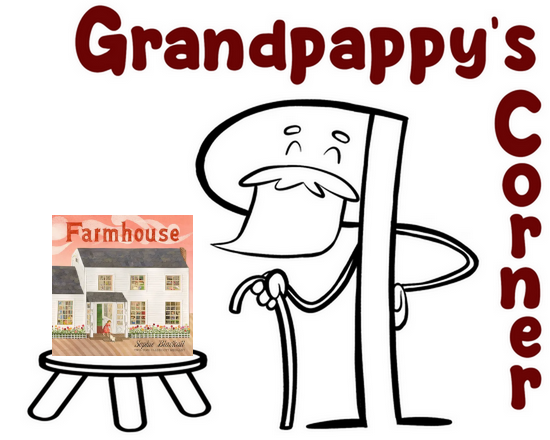
Farmhouse

by Sophie Blackall

DETAILS:
Publisher: Little, Brown Books for Young Readers
Publication Date: September 13, 2022
Format: Hardcover
Length: 40 pgs.
Read Date: April 21, 2022


What’s Farmhouse About?

It’s about a Farmhouse (no, really!) and its residents. It tells the story of a large family (from an indeterminate time, but not recent) growing up, growing older, and departing their home and leaving it as a house.

As the years pass, the house falls into disrepair and a new type of resident moves in—animals of various species and sizes. Eventually, the house is about to fall apart and is found by someone fairly contemporary to us—and its story gets told.

Let’s Talk about the Art for a Minute

This is a pretty, pretty book. I’ll be honest with you, I don’t know how a child is going to react to this art. But I can’t imagine any adult reading this and not being captivated. Maybe you can talk about the drawings and layers (more about that in a moment) with the child as you read it.

The last few pages of the book describe how the author (as a character in the story) created the art and the book. This is just great idea and fits the overall arc here—and (at least the first time) is a nice twist to the family story.

There’s also an Author’s note at the end for the adult to read that’s a lot more detailed about the way the art was created. This is a very nice bonus and will equip the adult to go back later and explain all the craft involved. For me, this is not the way I think at all—I can’t imagine taking all the bits and pieces that Blackall did and turning them into something like this. But I’m so glad someone did.

How is it to Read Aloud?

Well, the book is really one reallllllly long sentence, so if you’re going to be pedantic and uptight about that kind of thing, you’re going to run out of breath and pass out. Don’t do that.

Thankfully, it works pretty well to just read a page at a time.

This is not one of those books that’s fun to read—there’s no fun rhyme, no goofy wordplay, or that kind of thing. That’s also a blessing—you can just relax and bask in the warmth of this book. As such, it’s really pleasant to read aloud.

So, what did I think about Farmhouse?

In the beginning, I was pretty “meh” about this book—not that I disliked it, but I didn’t really care about it. But by the midpoint, it had worked its charm on me—and then when the author came along? I was totally won over.

This is a simple book, about a simpler time, told (in words and pictures) in an attractive way that will make fans of older readers, and likely younger readers (I’m assuming a Caldecott winner is a better gauge of what her audience will find appealing than me). It’s one I can’t wait to share.


3.5 Stars

This post contains an affiliate link. If you purchase from it, I will get a small commission at no additional cost to you. As always, the opinions expressed are my own.

Grandpappy Icon

Grandpappy’s Corner: God Never Changes by Carine MacKenzie, Derek Matthews (Illustrator) ★ ★ ★ Small Words About a Big Idea

Grandpappy's Corner Logo

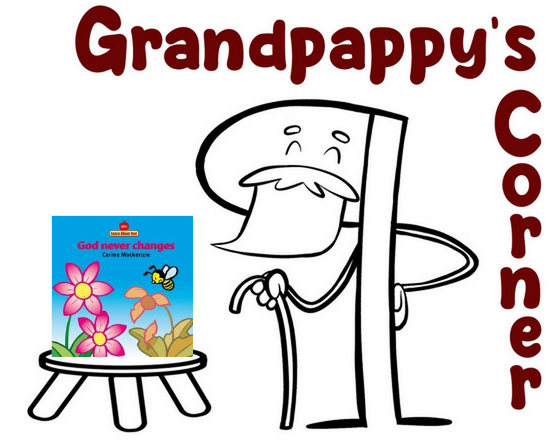
God Never Changes

by Carine MacKenzie, Derek Matthews (Illustrator)

DETAILS:
Series: Learn About God 
Publisher: CF4Kids
Publication Date: September 2015
Format: Board Book
Length: 12 pg.
Read Date: April 22, 2023

What’s God Never Changes About?

This is a quick and yet thorough (at least for the Board Book audience) look at the Immutability of God. Each page starts off by saying, “God Never Changes,” and then comparing Him to various aspects of life and nature that a child can understand and appreciate. And learn from.

Let’s Talk about the Art for a Minute

It’s simple, it’s cute, it’s bright, and attractive. It does the job. I liked it—and can see kids liking it, too.

How is it to Read Aloud?

Very simple. There’s no rhyming or anything (which is good, I think it’d be annoying for this subject matter). It works well for reading aloud and then stopping to talk about the ideas, too.

So, what did I think about God Never Changes?

I picked this one out of the handful from this series sitting on our shelves because I’m in the middle of the discourse on The Immutability of God in Charnock’s The Existence and Attributes of God, and I figured I’d stay on theme. It works remarkably well in conjunction—in fact, Mackenzie uses some of the same argumentation and explanations as Charnock does when it comes to this topic. Just much simpler. My inner geek loved that bit.

I don’t know that this is the kind of thing a child will clamor to have read to them again and again—but you never know. I do think it’s good for teaching at a young age, and that’s the whole point of this series. I do recommend it and look forward to using it with my grandcritter soon.


3 Stars
Grandpappy Icon

Grandpappy’s Corner: Red Stripes VS Miles the Mutant Mouse by Amy Rice and Kyson Rice: Not Your Typical Cat and Mouse Story

Grandpappy's Corner Logo

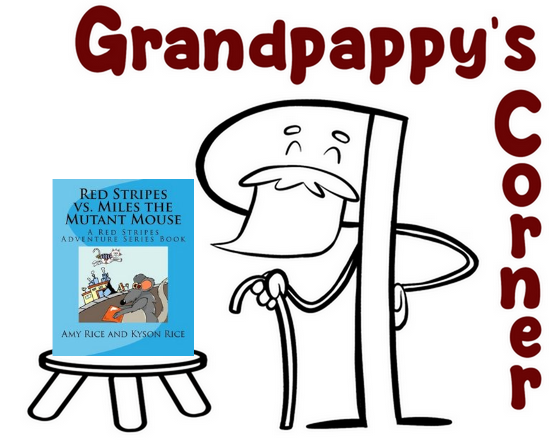
Red Stripes VS Miles the Mutant Mouse

by Amy Rice and Kyson Rice

DETAILS:
Publication Date: August 28, 2017
Format: Paperback
Length: 60 pgs.
Read Date: March 27, 2023

What’s Red Stripes VS Miles the Mutant Mouse About?

Red Stripes is your typical pet cat who spends his time playing with his human, Kyson. Unless disaster strikes—then he has to disappear (not unlike a certain Agent P) to help out, he’s secretly the superhero, Red Stripes the Super Wonder Cat!

In this particular adventure, a perfectly nice mouse was exposed to some toxic chemicals and mutated into a large and very hungry hulk of a mouse. Seeking food, he inadvertently creates a path of destruction, wreaking havoc on businesses, homes, and the city. Can Red Stripes stop him in time?

Let’s Talk about the Art for a Minute

As Amy Rice described it to me, while she did the art—Kyson directed it—changing colors and providing input on the overall look. A good team approach that is probably reflected in the text, too.

The designs and looks for Red Stripes and Mutant Mouse are great—I particularly like the mouse. Some of the objects—and (I’m sorry to say) all of the people are a little on the iffy side. But overall, it’s an attractive, vibrant, and playful book with a lot of energy to the art. It fits the story and the writing—and probably only older readers like me will nitpick the art (and really, I’m only nitpicking, not complaining).

So, what did I think about Red Stripes VS Miles the Mutant Mouse?

This is a cute little story, really. What I really admire about this is that the Rices worked on this together and accomplished something at Kyson’s pretty young age (I believe 5 at the time of writing).

I think younger readers will respond to the idea that a kid wrote this—it reads like the kind of thing a kid would make up, too—so it’ll probably hit the reader right in the sweet spot. Who knows, it might inspire a reader to try something like it themselves.

I don’t know that older readers will respond too well to the writing or the story—but that’s okay. We can get wrapped up in the story behind the book, that’s enough for us—we’re not the audience. And while I might not have loved this book on an aesthetic level, I did get a kick out of it and found myself smiling a good deal while reading it.

I admire Kyson’s mom for seeing this through—and the patience that both of them must’ve had to exercise along the way—and recommend a parent pick it up just to show a child what’s possible when they stick to a goal. The fact that they’ll be entertained by the art and story is a great bonus.


3 Stars

Grandpappy IconLiterary Locals logo

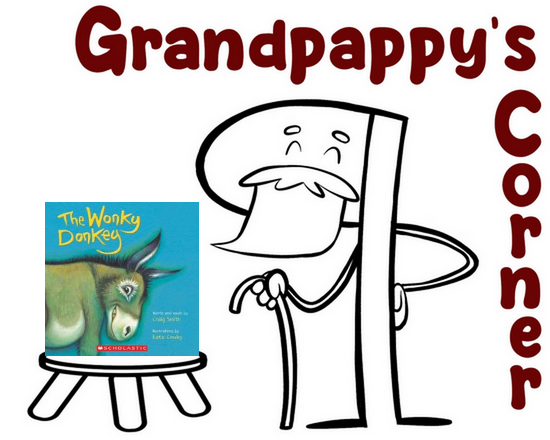
Grandpappy’s Corner: The Wonky Donkey by Craig Smith, Katz Cowley (Illustrator): Tongue-Tying Magic

Grandpappy's Corner Logo

The Wonky Donkey

by Craig Smith, Katz Cowley (Illustrations)

DETAILS:
Publisher: Cartwheel Books
Publication Date: December 29, 2020
Format: Board Book
Length: 21 pgs.
Read Date: March 8, 2023


What’s Wonky Donkey About?

Lifted from the lyrics of a children’s song, the book starts:

I was walking down the road and I saw…
a donkey,
Hee Haw!

And goes on from there to describe this unfortunate equine in more and more detailed (and ridiculous) ways–starting with its three legs, going on to describe its taste in music, coffee consumption, attitude, attractiveness, and so on.

Let’s Talk about the Art for a Minute

Katz Cowley is fantastic. The natural world and physical objects are presented in a great realistic fashion–heightened just a bit. The titular donkey and a bird that shows up in every scene, however, are a goofy cartoonish exaggeration of that fashion

I don’t know who decided to give this donkey a prosthetic leg–but it only comes up in the illustrations, so I’m going to give Cowley credit for it. It’s a great detail on many levels.

The expressions on the bird and donkey are the stars of the show–better than the words (by a crooked hair). I don’t know how a child can look at them and not want to stare. Or not wanting to pick up the book for another reading session.

Especially when a child is the age of the target audience, the adult reading the book is going to see themselves in the coffee-less expression of the donkey on the page talking about the caffeine deprivation. So everyone wins?

You can see some of the art, and learn more about the book, on Cowley’s website.

How is it to Read Aloud?

Ohhh boy. This is going to be hard to convey. First, it was only after I’d read this that I took the time to track down the song, but I couldn’t help but get a sing-songy cadence and voice as I read it. I also found myself talking faster and faster as I went through the book–like there was this unconscious effort on my part to spend the same amount of time reading each pair of pages–like a snowball rolling downhill, growing bigger and getting faster. This is great and all, but it’s also kind of a workout of both stamina and verbal dexterity.

You can’t help having fun with these lines–even as they build up and repeat like the 12 Days of Christmas. Really, try being expressionless or frowny while saying “He was a hanky-panky crank stink-dinky lanky honky-tonky wink wonky donkey.” You can’t, can you?

You might need to start using a spirometer before cracking this thing open though. As fun as it is, you’re going to end up getting requests for encores, and after 2-3 readings in a row, it’s going to lose a little bit of its charm. So keep something else around so you can switch to it for a minute or two before having to come back.

(between you and me, the song isn’t my style. I really hope the Grandcritter doesn’t discover it, because it feels like the kind of thing that’d you’d have to listen to 30 times a day–like that ditty about an infant scaleless predatory fish)

So, what did I think about Wonky Donkey?

A couple of weeks ago, my wife was telling a friend about our prep work for grandkids, including all the books we’re starting to stockpile. Once she got over being aghast that we’d never heard of The Wonky Donkey, she insisted that we fix this. We dutifully complied and it’s either one of the best moves we’ve made or one of the worst (see what I said above about reading it).

Joking aside, this is a great book for the intended age group. I’m going to have to do a deep dive into both the work of Smith and Cowley.

The other thing my wife’s friend told us was to get the board book–and she was right again. Parents/Grandparents/Etc. Do NOT get the paperback or hardcover. If the child(ren) doesn’t/don’t like the book, you’ll have spent too much money. If they do like the book (the more likely outcome), they will destroy it. It’s going to demand the number of re-re-re-re-reads that anything else won’t hold up to it. It’s also going to end up being one of those books a kid is going to carry around with them and flip through themselves–a lot. Paperbacks/hardcovers will not survive the gumming, accidental ripping, deliberate ripping, and overall expressions of toddler love that are so destructive.

I can’t see where this doesn’t become a tongue-tying obsession. The book you know the kid will love, you enjoy (the first few times a day you read it), you end up memorizing without trying to and just hope your lung capacity holds out during. It’s fun, it’s goofy, and it’s the kind of thing you’ll look back on in fondness.


4 Stars

This post contains an affiliate link. If you purchase from it, I will get a small commission at no additional cost to you. As always, the opinions expressed are my own.
Grandpappy Icon

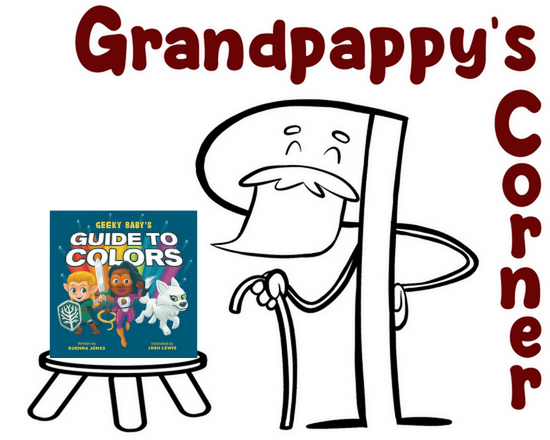
Grandpappy’s Corner: Geeky Baby’s Guide to Colors by Ruenna Jones, Josh Lewis (Illustrator): Starting a Geek Off Right

Grandpappy's Corner Logo

Geeky Baby’s Guide to Colors

by Ruenna Jones, Josh Lewis (Illustrator)

DETAILS:
Publisher: Running Press Kids
Publication Date: September 21, 2023
Format: Board Book
Length: 26 pg.
Read Date: January 16, 2023
Support Independent Bookstores - Visit IndieBound.org

What’s Geeky Baby’s Guide to Colors About?

This is a book about colors illustrated with Geeky/Pop Culture illustrations (or inspired by pop culture things—for example, I don’t think some of the orange-masked faces are real superheroes).

There are pages about a White Wolf, a Gray Wizard, a Black Car (a ’67 Impala with a couple of men in the front seats), a Yellow (not golden) Lasso, and so on.

Let’s Talk about the Art for a Minute

This art is cute—in case you ever wondered if Legolas or T-Rex could look dangerous and “awww” worthy at the same time, Josh Lewis can answer that for you. All the colors pop—not just the color focused on in the drawing. All the illustrations are eye-catching and will bring a smile to the adult reading with a kid (or likely will entertain a kid flipping through the book solo).

There are a few images from the book on the Illustrator’s website.

How is it to Read Aloud?

So the reading part isn’t that engaging. It’s two words per page—color + item. But this isn’t a book about reading, it’s a book about exposing a child to colors, and helping them identify them. So the words are more prompts about what to talk about rather than reading.

So, I guess this question should be re-rephrased as “what’s this like to go through with a child?” And that answer would be it’s a lot of fun for a geeky adult who will enjoy the pictures for what they represent in Pop Culture.

Timing Is Important

If you ask me, this is a book to go through before a child is at the asking questions stage of life. As I was preparing to write this post, I started thinking about some of the conversations that could go really wrong with an inquisitive child.

Child: What happened to the White Wolf and its brothers, Grandpappy?
Me: Well, um...er, it went to live on a farm where there was a lot of room for it to run around and play.
Child: But they live near a forest already, why couldn't they stay with all the Stark children?
Me: It's time for a nap.

or

Child: What do those men do in the Black Car, Grandpappy?
Me: (forgetting to think about phrasing) They travel around and fighting angels and ganking demons, and...
Child: Are you s'posed to be fighting angels?
Me: No, that's not a good thing.
Child: What's "ganking demons" mean?
Me: Er, want some cookies? Let's not tell Mommy we had this chat, okay?

And so on. When they start getting inquisitive, it’s time for this book to be shelved out of sight.

So, what did I think about Geeky Baby’s Guide to Colors?

When my wife and I saw this, we only had to look at one or two pages to know we had to have this around for the Grandchild-to-be. I think it’ll be great to sit and look at with them while they learn colors or just to look at the pictures.

For the adult, there’s the nice feeling about introducing a child to some of these images, even if it’s only to get them embedded in a child’s subconscious. You’re never too young to learn about a sonic screwdriver or role-playing dice, anyway, right?

This is fun (in different ways) for young and old. I’m really looking forward to sharing this one with the Grandcritter.


3 Stars

This post contains an affiliate link. If you purchase from it, I will get a small commission at no additional cost to you. As always, the opinions expressed are my own.
Grandpappy Icon

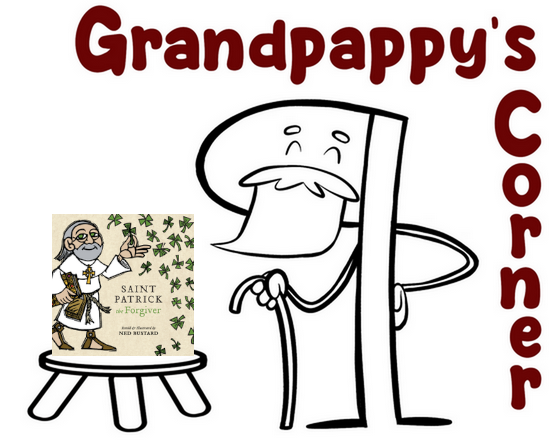
Grandpappy’s Corner: Saint Patrick the Forgiver by Ned Bustard: Patrick’s Story Told for Wee Ones

Grandpappy's Corner Logo

Saint Patrick the Forgiver:
The History and Legends of Ireland’s Bishop

Written and Illustrated by Ned Bustard

DETAILS:
Publisher: IVP Kids
Publication Date: February 21, 2023
Format: eARC
Length: 32 pg.
Read Date: February 17, 2023
Support Independent Bookstores - Visit IndieBound.org

What’s Saint Patrick the Forgiver About?

Drawing on both legends about him and Patrick’s Confessions, this book tells the life story of Patrick of Ireland for the youngest set.

It starts off with his childhood and touches briefly on his period of slavery before moving into his return home and the call to Ireland. It doesn’t gloss over the hard parts of his life, but it doesn’t dwell on them, either. The focus is on Patrick forgiving those who wronged him, spreading the gospel—and even teaching the Trinity via the shamrock.

The book even covers some of the myths that arose around Patrick—baptizing a giant, driving out the snakes, etc.—working that in seamlessly with the book and not distracting from the main point.

Let’s Talk about the Art for a Minute

This art is great—it’s friendly and cartoonish, with great colors and details. Bustard also weaves in traditional Celtic knots and Christian art (like elements seen in The Book of Kells, etc.). So we’ve got a pretty modern feel with a lot of Irish elements thrown in to ground it in Patrick’s history.

Are kids going to get that? Nope. Will the adults reading it with/to the kids? Quite likely. And if not, I think they’ll still appreciate it the art, even if they’re not familiar with the influences Bustard is drawing from.

Click here for a two page sample (picture and text) on the Publisher’s site. I’m not sure it’s the image I’d have used, but it’s representative.

How is it to Read Aloud?

It’s pretty fun—the rhythm is easy and the rhymes are nice (and only one or two of them seemed like stretching things to make the rhyme).

The Grandcritter isn’t around yet to listen to me read this, but I still read most of it aloud just to see how it went—I think it went pretty smoothly and I could have some fun with it.

So, what did I think about Saint Patrick the Forgiver?

This was a great way to give an age-appropriate lesson in forgiveness while telling the story of one of the heroes of the faith. I was entertained, and even chuckled a couple of times.

It’s a great combination of story, art, rhyme, and lesson. I can see this winning over little audiences as much as it did me. Hopefully, it’ll lodge in their minds enough that they’ll want to learn more about Patrick as they grow older and through him the Three-in-One that Patrick spent his life teaching about.

I strongly recommend this quick little read.

Disclaimer: I received this eARC from InterVarsity Press via NetGalley in exchange for this post—thanks to both for this.


5 Stars

This post contains an affiliate link. If you purchase from it, I will get a small commission at no additional cost to you. As always, the opinions expressed are my own.
Grandpappy Icon

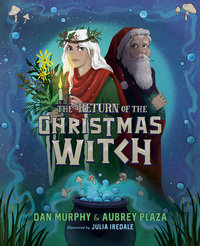
The Return of the Christmas Witch by Dan Murphy and Aubrey Plaza, Julia Iredale (Illustrator): The Witch Returns to Battle a Dystopian Holiday

The Return of the Christmas WitchThe Return of the Christmas Witch

by Dan Murphy & Aubrey Plaza, Julia Iredale (Illustrator)

DETAILS:
Series: The Christmas Witch, #2
Publisher: Viking Books for Young Readers
Publication Date: October 10, 2022
Format: Hardcover
Length: 56 pg.
Read Date: December 17, 2022
Support Independent Bookstores - Visit IndieBound.org

What’s The Return of the Christmas Witch About?

Kristtörn wakes from her frozen slumber to find a world she cannot recognize—it’s a dystopian world where the joy of Christmas is gone and everyone is left with an automated, sanitized, homogenized, corporation-run day of market-driven consumption. Santa is nowhere to be found—and many doubt he ever existed—in his place, we have the Kringle Corporation.

We get to spend time with one family—grandmother remembers Santa and longs for his return, but her grandchildren don’t (but aren’t fans of Kringle, either). Kristtörn watches the girl and the two strike up a relationship at a distance, and ultimately team up to take down the corporation and bring back Kristtörn’s brother.

That’s a sloppy job on my part, but it’ll do for these purposes. Murphy and Plaza tell it so much better.

The Artwork

On the whole, I’d just want to repeat what I said about the first book, so I will.

Iredale’s work struck me like a classic storybook, the kind of art that was in the books I read as a kid—especially the books that were old by the time I read them. It was fitting for the kind of story. It wasn’t knock-out gorgeous, and I think it would’ve hurt the book overall had it been. There’s some sharpness to the art—almost the kind of thing that would’ve been carved into wood.

It’s vibrant and I can’t imagine a kid who won’t want to pour over the pictures as much as the story.

So much for repeating—I did think this work wasn’t as well done as the previous book. There are a couple of illustrations that…sloppy isn’t the right word, but they don’t seem as finished. It felt like Iredale ran out of time and rushed one or two drawings/characters. That’s likely not right—and probably not that fair of me to say. But that was my impression. I doubt that any of the target audience will pick up on it (or care if they do), but it surprised me that I wasn’t as impressed with the art.

So, what did I think about The Return of the Christmas Witch?

This takes a darker turn than I expected from this story—the first book had a hint of this, and it’s not out of place, but I raised an eyebrow at the dystopia. That said—I thought it was a great choice, and offered a new take on the usual “over-commercialization of Christmas” and “we need to get back to the essence of the holiday” stories. But that’s what it is at its core—and I’m all for that kind of story.

I did think the ending felt a little rushed—like the authors ran into a hard page limit/word count. It wouldn’t have taken much more, but after the well-established set-up, I thought we needed a little more development to the magical ending.

The door is left open to one more book in the series—it’s maybe even suggested. If so, I’m totally on board for it. I can see the authors leaving it here, too—and I’d be okay with that.

The words-to-image ratio for this kind of book leans toward the words side, so that will limit some younger fans—but as long as there’s a willing adult around, I think this will satisfy fans of the first book.


3 Stars

This post contains an affiliate link. If you purchase from it, I will get a small commission at no additional cost to you. As always, the opinions expressed are my own.

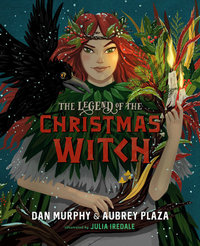
The Legend of the Christmas Witch by Dan Murphy and Aubrey Plaza, Julia Iredale (Illustrator): The Story of Santa’s Misunderstood Sister

The Legend of the Christmas WitchThe Legend of the Christmas Witch

by Dan Murphy & Aubrey Plaza, Julia Iredale (Illustrator)

DETAILS:
Series: The Christmas Witch, #1
Publisher: Viking Books for Young Readers
Publication Date: November 15, 2021
Format: Hardcover
Length: 56 pg.
Read Date: December 3, 2022
Support Independent Bookstores - Visit IndieBound.org

Santa and Me

Let’s start with a personal note, I’m apprehensive (at best) about man-made religious holidays. I don’t do Christmas posts here—and almost without exception, if you see a book on here having to do with any Winter holiday, it’ll be because it’s part of a longer series that I already read.

But having been indoctrinated in American mass culture, I was on the receiving end of more stories, shows, and movies about Santa Claus (both growing up and since) than anyone else. And I’ve probably seen variations on his origin than Batman and Spider-Man combined (and if I never have to see Ben Parker or Thomas and Martha Wayne killed again, it will be too soon). They’re not my favorite things, but I tend to enjoy them and am always ready for a new one.

Which brings us to:

What’s The Legend of the Christmas Witch About?

We open with a couple of twin children, Kristoffer and Kristtörn, both of them have some magic which they mostly use in the games they play with each other. They have no parents when we meet them, and don’t appear to remember them.

They’re separated at one point, and Kristoffer is taken in by a couple from a nearby village and grows up among people—eventually delivering baked goods from his adoptive mother’s bakery. Kristtörn is heartbroken by their separation, and a witch from the woods comes along to raise her.

Time passes and Kristoffer becomes Santa Claus. Kristtörn tries to make contact with him but is unable to. So she starts visiting places just before Christmas Eve, hoping their paths cross. A legend around her (mostly misunderstanding her) grows at the same pace as her brother’s does.

This all leads somewhere, but I’m not going to go further than that.

The Artwork

Iredale’s work struck me like a classic storybook, the kind of art that was in the books I read as a kid—especially the books that were old by the time I read them. It was fitting for the kind of story. It wasn’t knock-out gorgeous, and I think it would’ve hurt the book overall had it been. There’s some sharpness to the art—almost the kind of thing that would’ve been carved into wood.

It’s vibrant and I can’t imagine a kid who won’t want to pour over the pictures as much as the story.

So, what did I think about The Legend of the Christmas Witch?

The best way to describe this book is—imagine that the Grimm Brothers wrote a story about where Santa came from as well as telling us about his sister. Now imagine that someone took that Grimm’s Fairy Tale and sanitized it for contemporary kids. That result would be a lot like this. A little dark, a little light…

Because of that tone, I do think that parents/caregivers/etc. should exercise some judgment in who gets to read this one—some of it is going to go over the heads of young ones of a certain age, and some of it could be considered too dark for some little ones. But for the right reader, this take on Santa’s origin is going to be a lot of fun.

I’m glad that I indulged my curiosity, I’m not going to suggest that this filled me with the Christmas spirit or anything, I’m not off to buy the biggest goose for anyone and my heart is the same size as it was before. But when it comes to a reworking of the Santa Myth, this was a very satisfying one.


3 Stars

This post contains an affiliate link. If you purchase from it, I will get a small commission at no additional cost to you. As always, the opinions expressed are my own.

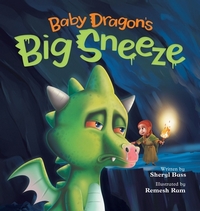
Baby Dragon’s Big Sneeze by Sheryl Bass, Remesh Ram (Illustrator): A Sick Dragon in Need

Come back in an hour or so for a Q&A with the author!


Baby Dragon's Big SneezeBaby Dragon’s Big Sneeze

by Sheryl Bass, Remesh Ram (Illustrator)

DETAILS:
Publisher: Be-Kind Publishing
Publication Date: October 18, 2022
Format: eBook
Length: 36 pg.
Read Date: December 2, 2022
Support Independent Bookstores - Visit IndieBound.org

Before We Get to the Story

I’m going to take things in a slightly different order than I usually do: I’m going to start with two important things you need to know from the outset.

The first is that Remesh Ram has given readers one of the cutest dragons ever. Really adorable.

The second thing that Ram demonstrates in almost one-half of the pages, is that a runny—nay, drippy—nose can be cute (also, this is going to really grab the attention of some kids).

The rest of the art is just as good. In a lot of books like this, all the adults/non-main characters tend to look identical—just different clothes and hair colors. Ram’s characters are clearly individuals. I really appreciated that.

Overall, bright colors, some very imaginative illustrations, and great character design. I’m really impressed with the art.

What’s Baby Dragon’s Big Sneeze About?

Right, now it’s time to get to the story part.

We start out with our cute baby dragon suffering from a cold, and as he’s flying around one day he sneezes (as one does when you have a cold). Being a dragon, stuff shooting out of your nose tends to be on fire—and this sneeze did a good job of setting part of a village on fire.

Our parent-less dragon doesn’t know what to do…he’s distraught and makes plans to leave and find a new cave away from the village (while leaving an apology note behind). A determined little girl comes upon him as he’s preparing to leave and confronts him. Then she decides to find him some help.

Discussion Points

The publisher notes that this book would serve to get conversations going about:

– Found Family
– Building Trust
– Love and Kindness
– Helping Others / Sharing
– Reserving Judgement
– Accountability / Making Amends

And, yeah, I can see it functioning that way well. I do think it can come across as too heavy-handed on some of these points. But I have to remind myself that this is a book intended for a very young audience—and subtlety isn’t called for there. Heavy-handed is a selling-point.

So, what did I think about Baby Dragon’s Big Sneeze?

I thought it was a cute little story. I think some of the rhymes would be fun to read aloud (I haven’t tried it yet, my dogs aren’t good audiences), and things like that are what draws a picture book to me as a potential reader-to-others. Will I have a good time reading this, or is it more of a thing you endure while hoping someone gets drowsy? (I’ve got plenty of experience with both)

I do think it’d work well for age-appropriate chats along the lines mentioned above—which is another nice bonus.

This is a great combination of attention-grabbing and attention-keeping art, a heartwarming story, some fun rhymes, and some potential life lessons. And—it’s about a dragon. Who doesn’t like to read about dragons? It’s been a while since I looked, but books for this audience about dragons aren’t super-easy to find. What better way to raise a Fantasy reader?

DISCLAIMER: I recieved a copy of this book from the author in exchange for this post and my honest opinion.


3.5 Stars

This post contains an affiliate link. If you purchase from it, I will get a small commission at no additional cost to you. As always, the opinions expressed are my own.
A Few Quick Questions with…Danielle Higley

Earlier today, I gave my take on Danielle Higley’s great book, The Stories Behind the Stories, and now I’m very excited and pleased to share this Q&A with her. I hope you enjoy


What was the genesis of this project? How did you select the authors to feature?
This book came about in a somewhat unconventional way. In my spare time, I proofread and copy-edit for publishers and independent writers. I was referred to Bushel & Peck via another publisher and began proofreading for them in late 2020. I guess they liked my work, because shortly thereafter, they came to me with an idea for a nonfiction children’s book: The Stories Behind the Stories.

They gave me free rein to come up with what titles would be included and how those stories would be told. We did go back and forth on a few of the chapters—Peter Pan or Peter and Wendy was particularly challenging to write—but they gave me a lot of creative freedom. I chose the stories inside, initially, based on the books I’d consider the most famous or influential children’s classics. I then filled out the list by looking at other lists. I did consider diversity in my selection process, but looking back, I wish I would have included more books by authors of color.

I compare my publishing journey to that of The Magic School Bus creators, where Craig Walker, an editor for Scholastic, recruited Joanna Cole and Bruce Degen for the project. Walker believed that if someone could find a way to combine curriculum science with fun fiction, kids would be more engaged with the subject matter. He was challenged to find an author who could do all the research and writing, and an illustrator who could meld creativity with scientific sketches, but of course we know that the end result was a huge success. As a Magic School Bus enthusiast, I’m secretly very pleased to be in the same camp as Joanna Cole and all the other writers out there who’ve been gifted with this sort of incredible publishing opportunity.

I loved the design of this book—both the cover and interior—did you have a hand in that? If so, what can you tell us about that process?
Thank you! I’ve received so many kind comments about the art in this book! Alas, I don’t have that sort of talent. The art in The Stories Behind the Stories was all created by David Miles. He and his wife are also the founders of Bushel & Peck—an incredibly talented and busy power couple. David used a collage of images in the public domain, I believe, to create the artwork for each story.

Undoubtedly, there were facts/stories that you couldn’t work in—any spring to mind? How about authors that you’d wanted to cover, but because of time/space you had to cut? Any chance of a volume 2 to get those?
Oh man, it’s absolutely impossible to tell someone’s whole story in such a brief number of words. And also, in many cases, the story behind a book. The challenge, for me, was trying to keep all the stories fun. I knew children would be reading them—not just their parents. And that meant I had to leave out the gruesome details of Peter Pan’s history, and the somewhat boring (but really fascinating to English majors like myself) connection between The Golden Compass and Paradise Lost.

I did write a piece for The Hunger Games, but the quotes I used from Suzanne Collins were a bit dark. She talked about seeing Iraq war updates on the nightly news, interspersed with reality TV shows, and how unsettling it was when those two things fused together as entertainment. I thought that was really interesting, as well as her perspectives on “just-war theory,” but I have to say that after doing in-person readings with small children and seeing my book in elementary school libraries, I’m glad that story didn’t make the final cut.

I don’t know if there will be a volume 2 in the future, but I hope so!

What was the biggest surprise about the writing itself? Either, “I believe X is so easy” or “If I had known Y was going to be so hard, I’d have skipped this and watched more TV.”
I think the biggest surprise, for me, was finding that I could do it—on multiple levels. From the beginning, I knew this was a topic I wanted to write about, but I was also nervous. My baby was weeks old when Bushel & Peck sent the proposal. I didn’t know how I was going to write a book and take care of a newborn. I felt very much like I only had half a [mom] brain, and I was getting like two hours of consecutive sleep a night. Not exactly ideal conditions for being smart and creative.

But I also knew that if I didn’t say yes, I might be missing out on the biggest opportunity of my life. Book deals don’t just drop into people’s laps—believe me, I’ve been rejected by editors and agents many times. I’m so glad I said yes, though. I learned that I can write a lot of words in just a few months (provided they’re split into bite-sized chunks). I also learned that I can write, even under the most challenging circumstances. I feel like I’m stronger for that experience.

Given your subject, I have to ask: What’re your personal Desert Island Top 5 Children’s Books?

  • The Watsons Go to Birmingham – 1963 for sure; that book makes me laugh and cry every time, and the characters would make great company on a desert island!
  • The Mysteries of Harris Burdick because each page is so intriguing; I could spend the rest of my life coming up with stories for every illustration.
  • Harry Potter and the Goblet of Fire because it’s Harry Potter and the Goblet of Fire.
  • The Adventures of Mrs. Pepperpot because it’s perfectly nostalgic for me.
  • Some kind of nonfiction survival book, because the thought of being on a desert island gives me anxiety haha!

What’s next for Danielle Higley, author?
I’ve recently been asked to be on the jury for the Lee Bennett Hopkins Poetry Award for Children. Because of that, I’ll be doing a ton of reading between now and the end of the year. Still, I’m hoping to write more when I can. I’m working on some children’s picture books right now, and also an adult novel that needs some serious love and attention.

Thanks for your time—and thanks for The Stories Behind the Stories!


Page 6 of 14

Powered by WordPress & Theme by Anders Norén