Tag: YA/MG Page 18 of 23

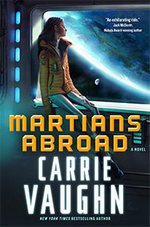
Martians Abroad by Carrie Vaughn

Welcome to Part II of the Book Tour for Martians Abroad by Carrie Vaughn — if you missed the first part, go check it out and enter the giveaway for a free copy.

Martians AbroadMartians Abroad

by Carrie Vaughn

eARC, 288 pg.
Tor Books, 2017

Read: January 11 – 12, 2016


There are so many things that I want to say about this book, I don’t know if I’ll be able to get to them all — seriously, I have a checklist that’s daunting — but let’s give it a shot.

I remember while growing up back in the 20th century that SF was fun. Maybe fun isn’t the right word, but stick with me — sure, the stories were serious, there were real stakes (usually), not every ending was happy, and so on — but there was an overall sense that the future would be okay, that space travel and aliens (at least the ones not trying to kill us/take over the world) were positives, and that there as something in humanity that made it all worthwhile. But more and more that went away, and the future became (when not downright dystopian) a grim place with people struggling to survive. By and large, who wants to live in the future depicted in SF now? Sure, there are exceptions, but most of those are in the Douglas Adams’ tradition (Scalzi and Clines would be good exceptions to this) — “light” or humorous SF. I’m not saying that I want an end to those stories, or that I don’t enjoy the darker SF. But I wouldn’t mind more SF that makes me feel okay about the future, rather than wanting to return to the carefree days of the end of the Hoover administration instead of getting to 2040 and beyond.

Enter Carrie Vaughn and Martians Abroad — an update of Heinlein’s Podkayne of Mars (not unlike Scalzi’s take on Little Fuzzy in Fuzzy Nation). Now, I’ve not read Podkayne, but I assume that it could use a little update and some tweaking. Not necessarily to improve it, but to make it “fit” the readers of today. Like a good cover song, such an update can revitalize an older work, showing different aspects of it, without having to replace it (see Parton and Houston’s “I Will Always Love You”). Since I didn’t read the original, I have no real idea how much of the plot of this book came from Heinlein and how much is straight from Vaughn herself — and I really don’t care outside of some vague curiosity. What I do know, is that Vaughn took some classic ideas and did something that only she could do with them. She gives us a vision of the future that’s not perfect, but seems like an okay place to be. This doesn’t make it better (or worse) than other SF works — just a refreshing change of pace.

From Lowood Institution to Trinity High School to Welton Academy to Hogwarts (and many others), there’s something about boarding school stories that just works. You get a little bit of a fish out of water story, usually an oppressive administration, some unofficial traditions shaping actions (frequently at least brushing up on bullying), and a heckuva story ensues. Sure, as a kid (and even now) I always wondered why anyone would attend/send their kids to one, but apparently it’s a thing. Add the Galileo Academy to the list — it’s a school for the children of Earth’s elites, as well as those of a few select space stations and colonies. Charles and Polly Newton are the first students from Mars to matriculate there — by “from Mars” I mean that they’re from the human colony on Mars, not some sort of fully alien life.

But really, in so many ways, they might as well be wholly alien — ditto for the students form various space stations or the Moon, etc. Due to differences in gravity, having to breathe pumped-in air, etc., their muscle structure bone density — and even digestive systems — have adapted to their environments to the extent that it’s easy to tell an offworlder by sight. How serious are these changes? Let’s put it this way — the non-Earth born kids can’t eat bacon. I know, I said this wasn’t a grim or dystopian view of the future, but that one fact makes me rethink that whole idea.

Now, the last thing Polly wants to do is come to Earth — she has a plan for her future, and this isn’t anywhere near it. It fits right in with her mother’s plans (Polly just doesn’t know how), Charles convinces his sister to go along with his mother’s plan without much fuss — it’s not like they could stop things, anyway. The trip from Mars to Earth isn’t as bad as she expects and she begins to have a little bit of hope – only to have that crushed as soon as she starts to meet students and administrators from the Academy. Basically offworlders are seen as lower-class/working-class, not as sophisticated or healthy as those born and raised on Earth. Polly, Charles and the other offworlders find themselves grouping together, and the target of harassment of varying degrees of seriousness and intensity from the rest. It’s tough to tell how much of this is in their minds and how much this is real — at times it feels like Polly’s exaggerating how bad things are, but typically, her perceptions are substantiated.

Before long, some accidents or other dangerous situations start occurring that put Polly and her classmates in jeopardy –and it’s not long before the students begin to wonder if there’s something other than chance at work here. While Polly seeks to integrate herself better into her new community — and she makes some pretty good strides at it (and some stumbles) — she, Charles and her friends try to figure out just who is targeting their class and why.

Polly is a great character — strong-willed, fallible, smart, impulsive, brave, socially awkward — very real. Incidentally, you may have noticed that we share a last name — I’m claiming Polly Newton as my great-great-ellipses-great-granddaughter right now, and welcome her to the family. The rest of her classmates are just as well-drawn. I could’ve used a little more on the adult front — the teachers and administrators are largely absent, and are vaguely drawn. I do think that’s a function of Vaughn’s focus being on the students, not necessarily a flaw with the book — I just would’ve liked a bit more of adult presence.

There is some real honest humor here — some of it comes from the situations, some of it is from Polly’s snark. But better than her attitude is the sheer awe she feels at Earth — the colors, the life, the non-greenhouse plants, the sky, the air. Her initial impressions of Earth were great — and they only got better from there — each time she left the confines of school, she discovered something new about this planet and the way it was described was better than the last. Polly’s a human, but from her perspective she’s an alien to this planet, she’s seeing it with fresh eyes.

There are some villains (of a sort), some real opponents to be faced, but really, there’s no one evil. There’s some misguided people, some . . . unthinking/wrong-thinking characters. But there’s no Voldemort figure, no true evil. Just conflicting agendas, different priorities, unrepentant snobbery — it feels real. Again, a refreshing change of pace.

Yes, this book is about teenagers, but it’s not a YA book. It is, like the SF I talked about at the beginning, YA-friendly, though. A book that I can recommend to friends as well as my kids and their friends — and, of course, you, whoever you are. The book was exciting, entertaining, filled with real situations in an appealing future. Vaughn’s to be thanked for such a pleasant change of pace, a breath of fresh air — and I hope we get to revisit this world (but if we don’t, that’s okay, this is a complete story as is).

Disclaimer: I received this eARC from Tor Books via NetGalley in exchange for this post — thanks to both for this. Also, thanks to Tor for the opportunity to take part in the Book Tour.

—–

4 1/2 Stars

Korian and Lucy, Part II by Zoe Kalo

Korian and Lucy, Part IIKorian and Lucy, Part II

by Zoe Kalo
Series: The Cult of the Cat, #.06

Kindle Edition, 35 pg.
2016

Read: November 29, 2016


I’m not sure how to go about this — this makes no sense if you haven’t read Part 1 of this tale — and neither would really make that much sense without the novel, Daughter of the Sun. So if you haven’t read either — skip this, really. Go read Kalo’s novel (or at least my take on it) instead of this post.

Still, I want to say something — and not just because I said I would. I liked this a whole lot better than Part I , which is just about the fainted praise possible. And, like with the novel, Kalo is starting to win me over — she has a certain charm, no doubt about it. I liked Lucy more after this book — her mother. too — and I’m a tad more interested in the story. All good — and well done, Kalo.

Here’s the problem: I’m less convinced than I was after Part I that Kalo’s readers need this story. We haven’t gotten anything we couldn’t and wouldn’t have assumed from what we learned in the novel about this period. I don’t need to know anything about Trinity’s mother, or her romance with Trinity’s father, to be invested in Trinity. Also, I’m not sure that Part II actually accomplishes anything other than letting us know that time passed and that the pregnancy progressed — oh, and it charms curmudgeonly readers like myself. But the story needs to do more than that to justify itself, doesn’t it?

Now, will Part III be able to change my mind about this entire story? Sure. I truly hope it does. But at the present, I don’t see why she bothered with this installment.

Still, I enjoy this world — I like Kalo’s writing (which was better here than in Part I, but not as good as in Daughter of the Sun, Kalo’s one of those writers that needs space), so I’m glad I read this, as will most of her readers be. I’m looking forward to Part III (and truly hope that it wraps things up) — but even more, I’m looking forward to the sequel to Daughter of the Sun.

Disclaimer: I received a copy of this from the author in exchange for this post and my honest opinion.

—–

3 Stars

The Last Star by Rick Yancey

The Last StarThe Last Star

by Rick Yancey
Series: The 5th Wave, #3

Hardcover, 338 pg.
G.P. Putnam’s Sons Books for Young Readers, 2016

Read: November 3 – 5, 2016

Since the Arrival, I’ve been beset by more cravings than a women pregnant with triplets, and always for things I’ll never taste again. Chocolate ice cream cones. Frozen pizza. Whipped cream in a can. Those cinnamon rolls Mom made every Saturday morning. McDonald’s french fries. Bacon. No, bacon was still a possibility. I would just have to find a hog, slaughter it, butcher it, cure the meat, then fry it up. Thinking about the bacon — the potential of bacon — gives me hope. Not all is lost if bacon isn’t.

Seriously.

And there’s the best that this series can do — when there’s no reason for hope, no reason to keep going — Yancey’s characters find a reason (other than inertia) to keep struggling, to keep walking, to keep surviving, to keep hoping.

Sadly, I pretty much needed that same kind (not extent, kind) of perseverance. I thought The 5th Wave rocked, and I enjoyed The Infinite Sea, but not as much — but the wheels really came off this time. It’s not an Allegiant-level disappointment, but it was closer than anyone should want.

The writing was skillful — I liked a lot of what the book had to say about humanity, enlightenment, and teddy bears (no, really). Yancey nailed the character beats, moments, observations — but he utilized this great writing and surrounded these strong elements with a story that just wasn’t worth telling. Somehow in the end, the whole was <iLless than the sum of its parts (anyone know the German for that?).

I’m going to skip the plot summary because it’s just the next stage in the series, leading up to the final confrontation between the survivors we’re following and Humanity’s foes. That’s really all you need to know — and everyone who’s been reading the series knew that already.

This is the 10th book I’ve read by Yancey, and it’s so clearly the weakest link. I’d still recommend this book for those who’ve read the first two — but on the whole, I’d tell those who hadn’t started the series to skip it. I’m more than ready to give whatever Yancey does next a chance, if for no other reason than to get the taste of this out of my mouth.

—–

3 Stars

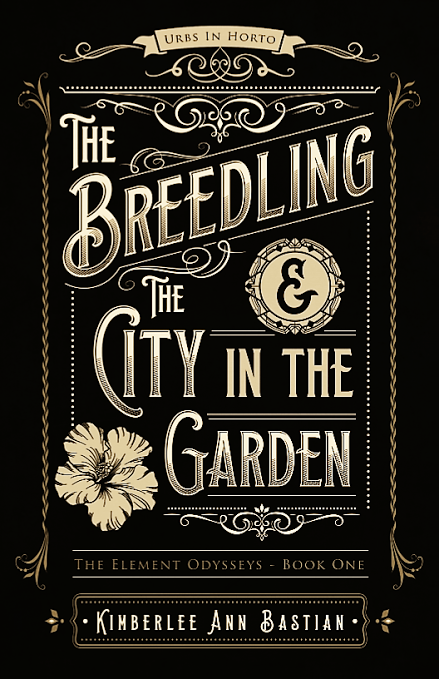
The Breedling and The City in the Garden by Kimberlee Ann Bastian

Now for the last post on The Breedling and The City in the Garden book tour.

The Breedling and The City in the GardenThe Breedling and The City in the Garden

by Kimberlee Ann Bastian
Series: The Element Odysseys, Book 1

Kindle Edition, 280 pg.
Wise Ink Creative Publishing , 2016

Read: October 24 – 25, 2016

The immortal soulcatcher Bartholomew (soon to be known as Buck) comes to 1930’s Chicago to track down someone and repay a debt. He comes looking like a young teen and is taken under the wing of a homeless orphan who seems to be a year or two older. The two have to deal with challenges and obstacles both mundane and other-worldly to survive, much less complete.

I’m not really sure how to describe the book beyond that, quite honestly. Maybe go back and check the main Book Tour post for a better description.

This book is all about what you think about Buck — and Charlie, to a lesser extent. Buck/Bartholomew has an eccentricity, a naivety that can make him endearing, ditto for Charlie’s street-smarts coated with his tough (yet tender) exterior. Better yet, if you find yourself invested in their friendship’s ups and downs. If you like these two, are interested in what happens to them, pretty much every problem with the book can be ignored. I wanted more from both of those characters, and I’m not sure I can ignore the problems with the book just because to them. Still, I can see where many people would love these two and find my issues shallow.

There are some real problems with this — for example, it’s hard to tell just how much of Bastian’s world is “our” world and how much is her mythology. Which might not make much sense, so let me try to explain: there are priests (I assume, Roman Catholic), but it’s hard to tell if that worldview is true/a true world here; Eden means one thing to Roman Catholics, but pretty much it seems to indicate the mortal world in this book. Also, too often I think Bastian goes for mysterious or suspenseful and ends up being vague, opaque or ambiguous. She’s done some great world-building here, I’m just not convinced that she’s great at explaining that world to the reader.

Technically there was a narrative arc to this novel, with an actual ending and a place to jump off to the next novel. But only technically, this is part of a story at best, the first installment in a series that really just serves to propel the reader for the forthcoming book. There’s some odd vocabulary sprinkled through the narrative occasionally — its one thing for Bucks/Bartholomew to have antique words and phraseology due to his origin, but for the narrative to throw those in every now and then it just doesn’t work it’s jarring, drawing attention to it self

There’s an earnestness to the writing, a clear effort on Bastian’s part, and you want to root for her and her creation — I’m not entirely certain she succeeds with this book, but man, you want her to. Those who like steampunk, but aren’t tied to the tech; those who don’t mind mixing fantasy with history; and/or those who like seeing children/child-sized characters in life-or=death situations, this could work for you.

—–

3 Stars

A Few Quick Questions With…Kimberlee Ann Bastian

So, for the second post on The Breedling and The City in the Garden book tour, we got a few questions with the author, Kimberlee Ann Bastian. As usual, I kept it short and sweet, because I’d rather she work on her next book than take too much time with me.

I see that this is being billed as a “reboot” of the novel — what does that mean for you and the book?
All it really means is that my first attempt was a dress rehearsal. I learned a great deal of what not to do when self-publishing and really it boils down to not cutting corners where your book is concerned. Not that I meant to cut corners. I just didn’t have the proper funds. You’re either all in or you’re not and though my first intentions were good and I had the drive, it wasn’t quite what I imaged it would be. Now, with the brilliant team at Wise Ink Creative Publishing, I have an extraordinary team to work with and all the tools an indie author needs to realize his or her vision. The Breedling and the City in the Garden is now, after eight years of trial and error, the way it was always meant to be with all the professional bells and whistles included.
Most authors have dozens of ideas bouncing around their craniums at once — what was it about this idea that made you say, “Yup — this is the one for me.”?
The idea for the Element Odysseys came to me at a time when I actually had no other ideas running through my head. I put all my energies into the concept and it really helped me write my way out of a trialing situation and once I started, I couldn’t stop.
What kind of research — if any — did you have to do for this? Uncover any nuggets that were so great that you had to rework the story just to fit some of your research into things?
The research journey for this book and for the series in its entirety has been fascinating. I have tapped into every vital online database, read countless books and articles. Watched a few documentaries and I went above and beyond the scope of what has made it into the final version of the story. I have even visited the sites of Chicago where the story takes place, or what’s left of them. For The Breedling and the City in the Garden, the greatest historical nugget I found came during my second round of editing when I was working on changing the title. I came across the Great Seal of Chicago, which on the seal the Latin phrase Urbs In Horto is present. Upon learning the translation Garden City or City in the Garden, I knew I had to reference it in the story and ultimately it became the second half of the title.

Who are some of your major influences? (whether or not you think those influences can be seen in your work — you know they’re there)
I think for this first book I pulled a great deal of inspiration from Charles Dickens’ Oliver Twist, Irene Hunt’s No Promises in the Wind and Mark Twain when creating the historic feel of the story. For the mythology elements of the story, I did draw a little from HBO’s Carnivale in how to blend the historical with the fantastical. Although for those familiar with the series, I’m not nearly as abstract. Subconsciously, I probably took some inspiration from Harry Potter as well, for I have already been told the opening chapter is reminiscent of Dumbledore and McGonagall in the beginning of The Sorcerer’s Stone (The Philosopher’s Stone).
What’s the one (or two) book/movie/show in the last 5 years that made you say, “I wish I’d written that.”?
This is the hardest question by far—haha. (pauses to contemplate) In the book category, I’d have to say Erin Morgenstern’s The Night Circus. I’m also going to go a little rogue and choose a musical, Lin Manuel-Miranda’s Hamilton: An American Musical, it is my current obsession.

Thank you kindly for letting me swing by The Irresponsible Reader, H. C. It has been a blast chatting with you! Happy Reading.

Thanks for your time, Ms. Bastian, I wish you and the release the best.

The Breedling and The City in the Garden by Kimberlee Ann Bastian Book Tour

Welcome to our Book Tour stop for The Breedling and The City in the Garden. Along with this blurb about the book I’ve got a Q & A with the author, Kimberlee Ann Bastian and my 2¢ about the book coming up (the links will work when the posts go live).

Book Details:

Book Title:  The Breedling and The City in the Garden (The Element Odysseys Book 1) by Kimberlee Ann Bastian
Category: YA fiction, is also intended for Adult (18+) readers
Length: 280 pages
Genre: Historical Fantasy
Publisher: Wise Ink Creative Publishing
Release date: September 20, 2016

Content Rating: PG-13 This book is rated PG-13 for time period slag (no F*words), violence and mature themes associated with the historic time period such as smoking, drinking, gambling, and death (no sexual scenes).

Book Description:

Absolute obedience, servitude, neutrality.

These were the laws that once governed Bartholomew, an immortal soulcatcher, until one ill-fated night when he was forced to make a choice: rebel against his masters or reveal an ancient, dangerous secret.

He chose defiance.

Imprisoned for centuries as punishment for his decision, Bartholomew wastes away—until he creates an opportunity to escape. By a stroke of chance, Bartholomew finds himself in the human world and soon learns that breaking his bonds does not come without a price. Cut off from the grace that once ruled him, he must discover a new magic in 1930s Chicago.

Armed with only a cryptic message to give him direction, Bartholomew desperately tries to resume the mission he had started so long ago. Relying on the unlikely guidance of the streetwise orphan Charlie Reese, Bartholomew must navigate the depressed streets of the City in the Garden. But in order to solve this riddle, he must first discover if choice and fate are one in the same.

Buy the Book

Amazon ~ Barnes & Noble ~ Author’s Website

Meet the Author:

Kimberlee Ann Bastian has a unique love affair with American nostalgia, mythology, and endless possibilities. This melting pot of elements is what prompted the creation of her epic ELEMENT ODYSSEYS series, starting with the reboot of her debut novel now titled THE BREEDLING AND THE CITY IN THE GARDEN.

When she is not in her writer’s room, working her current “day job”, or consuming other literary worlds, she enjoys hiking and cycling around the bluffs of your Southeastern MN home and catching up on her favorite pop culture. ​
Website

Twitter

Facebook

Pinterest

Instagram

Max Hamby and the Blood Diamond by Kathy Cyr

Max Hamby and the Blood DiamondMax Hamby and the Blood Diamond

by Kathy Cyr
Series: Max Hamby, #1

Kindle Edition, 211 pg.
Gaslight Press, 2014

Read: October 29, 2016


Max is, I’m assuming, somewhere between 9-12 — like the target audience of the book — (it’s entirely possible that the book said his age and it didn’t stick with me — I’m not sure it matters that much), school doesn’t really seem like his thing, he’s a target of bullies, doesn’t seem that fond of his teacher. While on a field trip, more than a couple of things go wrong, inexplicably so (shades of a certain someone’s visit to the Zoo for his cousin’s birthday). Before he has a chance to get in trouble, he learns that his mother has disappeared, and he’s going to be cared for by a neighbor.

Soon, he learns that his neighbor, his mother — and everyone in his subdivision — has some sort of tie to magic. His mother hasn’t just disappeared, she’s been taken. Max is thrust into a world of guitar playing giants, always hungry trolls, dwarves, pixies and more family than he knew he had.

He also, it turns out, has more enemies than he knew he had — and most of them are far worse than any school bully. Max’s family are guardians of an ancient artifact that holds back great evil. Now, with his mother’s life hanging in the balance, Max has to learn magic, and stand in opposition to forces he thought were fiction just days ago.

This would be a fun series to pick up for those who want something in the vein of Harry Potter, Fablehaven, or Percy Jackson. In many ways, this isn’t anything those readers haven’t seen before. But Cyr’s take on it is about as strong as you could ask. She does some things that no one’s seen before, too — don’t misunderstand — but it’s familiar enough that it’s easy for a reader to feel comfortable in. Cyr writes with a good combination of lightness and tension, with enough twists and chuckles to grab her audience just right — with an ending that almost demands a prompt reading of the sequel.

Disclaimer: This was provided to me in exchange for my honest take on the book, which I really appreciate.

—–

3 Stars

Calvin by Martine Leavitt

CalvinCalvin: A Novel

by Martine Leavitt

Hardcover, 181 pg.
Farrar, Straus and Giroux (BYR), 2015

Read: August 1 – 2, 2016

I realized the doctor was leaving the room, and I was talking out loud to nobody. And that’s why they want to put people on medication.

Calvin is a high school senior on the verge of graduation and a bright future. If only he had the ability to focus. He reaches a breaking point and has a schizophrenic episode, resulting in his hospitalization. His family and doctors seem supportive and caring, and at least one classmate stops by to visit, too, his life-long friend Susie.

Me: . . .You’re you’re part of it.

Susie: Part of what?

Me: Part of what’s happening to me. Didn’t you ever think about, you know, that you’re named Susie, and you’re friends with a
guy named Calvin?

Susie: I always thought my parents didn’t put much imagination into my name–

Me: I was born on the same day that Bill Watterson published his very last comic strip?

Susie: You’ve mentioned that.

Me: My gramps gave me a stuffed tiger called Hobbes I’m hyperactive and pathologically imaginative? And then, even more amazing, a girl lives two doors down and her name is Susie! Maybe once you create an idea and millions of people are loving that idea, when you get brilliance and love all mixed up like that, it makes something that has to go somewhere. It impacts reality, like a meteorite hitting Earth. Bang! I think the universe just couldn’t let Calvin go.

Okay, that’s not necessarily the conclusion that most people would arrive at given the evidence (Suzie, for example, doesn’t buy it) — but there’s something to his logic.

Calvin decides that if Watterson’s creation is what led to his problems, Watterson can fix him. To prove his devotion, he sets out on a pilgrimage that could be fatal, and Susie tags along to try to keep him safe. Hobbes tags along to . . . well, do Hobbes-like things.

This is a story about friendship, young love, the hazards of high school for the psychologically fragile, and about how a psychological diagnosis doesn’t have to determine your life and future. Leavitt writes with a lean, crisp prose that keeps things moving — even while treading emotionally rich territory.

A frequently very funny book, but I felt guilty laughing at this poor, sick kid. It was largely predictable, but satisfying nonetheless. I liked Calvin, Susie and their relationship. A sweet and imaginative tribute to Watterson and his creation.

—–

3.5 Stars

Harry Potter and the Cursed Child by J.K. Rowling, John Tiffany & Jack Thorne

Harry Potter and the Cursed ChildHarry Potter and the Cursed Child – Parts One and Two (Special Rehearsal Edition)

by J.K. Rowling, John Tiffany & Jack Thorne
Series: Harry Potter, #8

Hardcover, 308 pg.
Scholastic, Inc., 2016
Read: September 2, 2016

I went into this with low expectations for a few reasons (negative buzz being one of many), and sadly had them all met — I don’t think anything were exceeded.

This is fan-fiction, pure and simple. Sure, it’s official fan-fiction written in conjunction with Rowling — but it’s not the same series, it doesn’t feel the same. It feels like someone’s trying to recapture what they had, in just a slightly different form. I’m fine with that — if people want to throw money at Rowling, Tiffany and Thorne for doing this? Let them. Let’s just not pretend it’s more than what it is.

The story primarily focuses on Harry and Ginny’s middle child, Albus. Albus is pretty uncomfortable living in the shadow of the Boy Who Lived — he doesn’t like the notoriety or pressure that comes with that territory. Which is absolutely understandable — especially now that he’s at Hogwarts, where Harry’s legend is strongest. Between that, and typical teenager strife with Dad leads Albus to take some really big risks with banned magical technology.

These risks center on time travel — and this is where it lost me. I just can’t stand the kind of stories where someone goes back in time with perfectly good intentions and messes things up, changing the future so much that it’s not recognizable. So then they (or someone else) have to go back in time again to prevent/minimize the damage. And magically, this second (or third) intervention restores everything back to the way it was before the time travelers left. Sure, this is a series in which magical things like that are clearly possible. But there’s possible and too-incredible. It almost doesn’t matter how good this story/execution was, I wouldn’t be crazy about it.

The writing was . . . okay. Nothing spectacular, nothing that had the same …”magic” as the other books in the series. It’s not as bad as many claim — but it’s not as good as others claim either. How some of this can be staged, I just can’t imagine. I’m not saying it can’t be — but wow, that’s a real technical challenge, I’d think.

There were some nice moments, some great fan-service stuff — and I’m very glad I got to meet Scorpius Malfoy. I’d rather spend time with him than any of the rest of the descendants of the original series, there’s something very cool about this kid. I should also mention that there’s some nice father-son moments with Harry and Albus.

On the whole, I’m glad I read this, but I really can’t get crazy about it.

—–

3 Stars

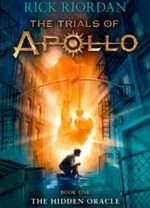
The Hidden Oracle by Rick Riordan

The Hidden OracleThe Hidden Oracle

by Rick Riordan
Series: Trials of Apollo, #1

Hardcover, 361 pg.
Disney-Hyperion, 2016

Read: August 31, 2016


Only 361 pages? Riordan is taking it easy on his readers. And maybe himself.

Anyway, following the events of The Heroes of Olympus, Zeus is a little displeased with Apollo and demonstrates this by turning him into a human teen (read: YA/MG novel star) and casting him to earth. He appears to be fully human — not even a demigod like Percy and the rest. Speaking of Percy, as soon as Apollo figures out what happened to him and where he is, he makes a beeline for Percy’s apartment to get help. Smart move. Percy gets him to Camp Halfblood and disappears back to NYC to do homework.

Once there, Apollo begins trying to figure out what quest he’ll have to do to return his status to quo. Along the way, he’ll make some friends, get a better perspective on himself and his offspring (yeah, that’s not weird), and maybe go through some of that personal growth. Note that I said, “some” personal growth and “better” perspective — that’s not saying much, basically Apollo comes across as a teenaged-Gilderoy Lockheart with a conscience. Instead of the large number of missions that we’ve become accustomed to in these books, there’s really just one (plus the series-arc mission) — such a nice change.

A lot of people from the Percy Jackson and The Heroes series are name-dropped and discussed, not to mention the few that we see — there’s even a nod to the Magnus Chase series — thankfully, my favorite is one of those who shows up in the flesh. There’s also a good amount of in-jokes to please the long-time fans. But readers new to this universe shouldn’t be put off by any of this — it’s absolutely approachable, maybe even moreso than anything since The Lightning Thief.

This is told in the typical breezy style that characterized non-adult mystery Riordan novels, but given the different protagonist, feels a little fresher. A little briefer, a little change of pace — still full of that Riordan magic. The Hidden Oracle is a sold first-entry in yet another adventure in this world. Give it a shot.

—–

3.5 Stars

Page 18 of 23

Powered by WordPress & Theme by Anders Norén