Tag: YA/MG Page 20 of 24

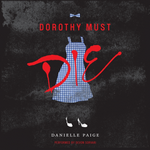
Dorothy Must Die (Audiobook) by Danielle Paige, Devon Sorvari

Dorothy Must DieDorothy Must Die

by Danielle Paige, Devon Sorvari (Narrator)
Series: Dorothy Must Die, #1

Unabridged Audiobook, 14 hours and 12 minutes
HarperAudio, 2016

Read: May 25 – 27, 2016


So, imagine a world where Baum’s books (and that movie) are present and beloved — but also, are non-fiction (not that anyone who isn’t from our world gets that). I think that made sense. Anyway…in modern-day Kansas, there’s a girl, Amy Gumm, who isn’t having the best time. Her mother lives (well, exists) in a drug and alcohol-induced stupor. She has a pet rat (who she hates), and not much else in her life, other than a dream of getting out.

This being a story about Oz that starts in Kansas, a tornado hits. And, lo and behold, it transports Amy, her trailer house and the rat to Oz. But it’s not the Oz Dorothy landed in anymore.

There’s a new ruler — Ozma and the Wizard are out (well, Ozma’s technically in charge, but she’s not). Magic is being changed — corrupted, stolen. The realm is in ruins — Oz is a dystopia, and the Tin Man, Cowardly Lion and Scarecrow are mutated, monstrous versions of themselves and Dorothy is behind it all. Amy is recruited — as an otherworlder, it has to be her — by a group of rebels to kill Dorothy.

It’s got all the makings of something interesting, and just isn’t. It’s not bad, it’s just dull. The excesses that Dorothy and her friends indulge in are predictable and unimpressive. The last chapter or so really only existed to push things into a sequel.

Actually, I’m just going to stop at this point — I don’t care enough to carry on. And if I did, I’m afraid this would come across as a critique or a tearing-down of the book. And I don’t want it to be, because I wasn’t provoked enough to do that. I was generally (not wholly) unmoved.

As far as the audio performance goes — I just didn’t appreciate whatever Sorvari was doing. The narration seemed angry, clipped. And yes, that matches Amy (especially early on) — fine. But I don’t need to hear 14 hours of ticked off descriptions of scenery, character appearances, etc.

I may, if the Library has a copy, get around to the next volume — but I’m not going to worry too much about it. It wasn’t a waste of time, I liked bits of it, but on the whole — it just didn’t do anything for me. The story was okay; the narrator was frequently annoying, but otherwise was okay. With such a promising premise, it’s disappointing that nothing much was done with it.

—–

2 1/2 Stars

The Quest for Merlin: Magimakía by Rafael Lovato

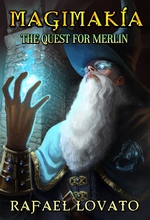
The Quest for MerlinThe Quest for Merlin

by Rafael Lovato
Series: Magimakía, Book 1

Kindle Edition, 286 pg.
Howling Wolf, 2016

Read: June 20 – 22, 2016

I guess this is life. Maybe, strange things happen without much meaning.

The number of strange things happening around Oliver is pretty large.

So, hundreds of years ago, Merlin put himself in a suspended animation of sorts, and hid his body behind some clever little puzzle — like a video game. Wizards have made a few attempts to find him, but they haven’t worked out (obviously). The last attempt ended in death, destruction and betrayal.

More than a decade later, it’s time for another shot — one last shot. Merlin’s last male descendant, Oliver (although I’m not really sure about the math on that — sure, he’s a dork and awkward with females, but there’s no reason to think that Oliver couldn’t have kids). Oliver has no clue that he’s a Wizard (I guess the owl from Hogwarts got lost), his mother’s memory has been magically wiped, so she has no clue, either.

Oliver’s kidnapped (for his own good) and whisked away to begin to learn about his heritage while being introduced to a world of elves, witches, trolls, goblins, demons, seraphs and more. Most of whom are on the verge of war with each other, and only Merlin can stop it.

Oliver, a mind-reading goblin, a couple of attractive adolescent witches (he’s a 15-year-old nerd, of course that’s how he categorizes them), and an old friend of his father are the key to bringing back Merlin and saving the world. This isn’t your typical Merlin — or your typical anything — beyond the very typical socially awkward teenage male protagonist.

The plot, on the whole, was so-so. It got the job done, but never really grabbed me. The characters were . . . all right. Nothing special, nothing we haven’t seen before, but nothing eye-roll inducing or annoying. The world-building was very detailed, intriguing, and impressive — although sometime it wasn’t explained clearly. Still, if anything would bring me back for a second novel, it’d be the world-building. I don’t think the chapters of Goblins speaking to Goblins were anywhere near as funny as Lovato seemed to think they were, but I admire the fact that he stuck with them for as long as he did.

There were a few quirks that caught my eye — each race’s magic is characterized by a color, and Lovato spends a lot of time talking about them — so much so that I wondered if Hal Jordan and the Guardians of Oa were going to show up. I’m not sure I remember reading anything where the hero gets knocked out so often — it’s worse than Daredevil, Season 1. It’s not a huge thing, but there’s a difference between someone being a novice/rookie and someone being pathetically helpless. Reduce the knock-outs by 20% and I probably wouldn’t say anything.

My main complaint was the language — a few idiomatic phrases were off, the dialogue was frequently stilted, a lot of the word choices were not wrong, but certainly not right. About halfway through the book, I skipped ahead and read about the author — the fact that he’s a non-native English speaker explained just about every problem I had with the mechanics of the writing and I was able to ignore them. That’s precisely how it reads, and if I’d known that going in, I’d probably have enjoyed the whole experience a little more. Still, far too often Lovato uses three words when one would do.

Not a great book, but an entertaining read — and at the end of the day, that’s enough. For a little atypical YA fantasy, this would be well worth a look.

Disclaimer: I received this book from the author in exchange for this post, the honest thoughts contained above, and participation in the Book Tour.

—–

3 Stars


GUEST POST: Behind the Scenes – Rafael Lovato


Rafael LovatoMagimakía – the quest for Merlin is the first book of a contemporary fantasy series for Young Adults that explores the universe of RPG and MMORPG. In it, Oliver, a naive young virgin bullied 15 year old boy, without any knowledge of magic, trying to find the mage Merlin and save the Order of Mages and Witches of undoubted extinction, ends his journey victim of a magnificent and at the same time terrible event.

From a young age I always wanted to write a fantasy novel, because of my experience with (MMO)RPG games like Diablo and World of Warcraft. The magical universe, the battles and the powerful characters fascinated me. But writing a fantasy book is not something simple. So, after five books published and feeling capable of a foray into this universe, I finally wrote Magimakía – The search for Merlin.

The first step was to choose about what would be the story, and what kind of races and powers I would use in it. Since I always liked fantasy movies, and there was no way for me to escape this influence, I took Tolkien’s idea of introducing demons as non-religious entities (from ​​Lord of the Rings, the battle between Gandalf and the Balrog). Alongside the demons, I brought angels, who resemble paladins, also not religious, and mages, witches, elves, trolls and goblins.

Regarding the writing itself, to construct the history I used the Hollywood structure, with the characteristics turning points structure (10%, 25%, 50%, 75% and 95%). Also, took great care to develop the “arc of the characters”, and build well-marked voices for the three book narratives: Benjamin, goblins and Oliver. The scenes and sequels respect the international structure (Scene: objective, obstacle and disaster; sequel: reaction dilemma and decision), and wrote the entire text within the MRU’s technique (motivation and reaction units).

The story itself respects the dynamics of the RPG universe, with close attention to powers mathematics. This means that all races powers are balanced, as well as the most powerful entities. To a careful analysis, you can identify that in the mechanics of battles there are warriors, generals, mini-bosses, bosses, and world bosses. This engine respects the dynamics of RPG games, to appeal to the book’s target audience, who are young adult video-gamers aged 12 to 25 (and adults too, of course).

The book was originally written in Portuguese and published in Brazil by Editora Zap Book (eBook and print) and in Portugal by Editora Chiado (print and eBook), both in June/15. Availing the fact that I speak English fluently, I wrote the English version of the book, and introduced it to a US editor, for editing. I was fortunate to present the manuscript to Ravenswood, who did not hesitate to offer me a publishing contract.

About myself, I am a well-established Brazilian author with six books commercially published, being Magimakía – the quest for Merlin the latest. Recently the Oxford University Press bought a short story of my to use in their courseware as writing model for fiction short stories, already published in the book Portuguese language for 6th grade, by Oxford. Magimakía already is the best-selling book of my Brazilian Publisher, which is starting a national advertising campaign of the book.


The Quest for Merlin: Magimakía by Rafael Lovato Book Tour

Welcome to our Book Tour stop for The Quest for Merlin: Magimakía. In addition to this blurb about the book and author, I’ve got a a Guest Post from Rafael Lovato about the life of this book up to this point and my 2¢ about the book.

Book Details:

Title: The Quest for Merlin: Magimakía (Book 1)
Author: Rafael Lovato
Release Date: June 30, 2016
Page Count: 286
ISBN: 978-1530797950 & 1530797950
Imprint: Howling Wolf

Keywords: young adult fantasy, goblin hero, angels and demons, witchcraft, RPG games, elves fairies trolls, merlin series
Genre(s): Young Adult/Fantasy/ Action Adventure

Synopsis:

The Quest for Merlin is the first book of the Young Adult fantasy series Magimakía, goblin word meaning “The Great Battle of Mages and Witches.”

Follow Oliver’s journey, a skinny, naive 15 year old boy who knows nothing about magic, let alone how to survive high school as a bullied and outcast teen, as he attempts to help save the Order of Mages from destined extinction.

Kidnapped by a midget goblin and his troll cohorts, Oliver’s only hope is to learn the whereabouts of the all powerful Merlin who has been missing for over 500 years.

With the help of two witches, Avery and Violet, Oliver begins his journey in a world full of potions, spells, and bubbling cauldrons, learning a lot about witchcraft and magic.

You will be spellbound as you are transported into this amazing landscape where anything could happen, as tragic events unfold that could keep Oliver from saving Merlin and the entire world of Mages and Witches!

One Liner: Magimakía – the Quest for Merlin is the first book of a contemporary fantasy series for young adults that explores the universe of RPG and MMORPG where a naive, bullied 15 year old boy, without any knowledge of magic, tries to find the mage Merlin and save the Order of Mages and Witches from destined extinction.

Author Bio:

Rafael Lovato is a Brazilian author with six books published commercially in Brazil, and one in Portugal, Magimakía, a busca por Merlin. This is his first book published in the US. In 2014, the prestigious Oxford University Press bought one of his award-winning short story to use in their courseware as writing model to teach students, already published in the book Portuguese language for 6th Grade, by Oxford.

For More Info:

Book Page: http://ravenswoodpublishing.com/bookpages/magimakiabookone.html

Author Links: http://www.rlovato.com.br
https://www.facebook.com/operegrinojoshua
https://twitter.com/rlovatoescritor

Amazon US: http://www.amazon.com/The-Quest-Merlin-Magimakía-Book-ebook/dp/B01EI2R4V8
Amazon UK: http://www.amazon.co.uk/Quest-Merlin-Magimakía-Book-ebook/dp/B01EI2R4V8
Amazon CA: https://www.amazon.ca/dp/B01EI2R4V8
Barnes & Noble: http://www.barnesandnoble.com/w/the-quest-for-merlin-rafael-lovato/1123675514;jsessionid=3E933572BB6A6699C9EB512693D80A46.prodny_store01-atgap05?ean=2940153226026
Kobo: https://store.kobobooks.com/en-us/ebook/the-quest-for-merlin
Google Play: https://play.google.com/store/books/details/Rafael_Lovato_The_Quest_for_Merlin_Magimak%C3%ADa?id=S7b-CwAAQBAJ&hl=en
iBooks: https://itunes.apple.com/us/book/id1105254907
Createspace: https://www.createspace.com/6173524


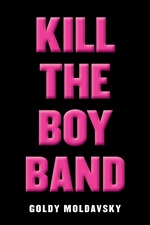
Kill the Boy Band by Goldy Moldavsky

Kill the Boy BandKill the Boy Band

by Goldy Moldavsky

Hardcover, 312 pg.
Point, 2016

Read: May 3 – 4, 2016

It’s not every day you get to be alone with a member of the most popular boy band ever.

Wait. Let me rephrase that.

It’s not every day you get to be alone with the biggest flop in the most popular boy band ever while he is blindfolded and bound to a hotel armchair.

The Ruperts were formed by the producers of the TV show, So You Think the British Don’t Have Talent? because they were about the same age and had the same first name. I should add, I can absolutely see this happening. They go on to become the biggest music stars on the planet. Again, I can absolutely see this happening. A group of four friends get a suite in the same hotel the band is staying at while filming a Thanksgiving special, and inadvertently kidnaps one of them. You know what? I can see it happening, too — at least the way Moldavsky writes it.

I hate books like this when it comes to writing about them — it is next to impossible to talk about them without ruining everything. Half the fun in this is seeing how Moldavsky reveals tidbit after tidbit during the story. How they accidentally kidnapped the Rupert, what ulterior motives might be at work here, why do we need to know the size of Apple’s bag? Seriously, I don’t want to say anything about the book beyond the hook.

What I can say is that it’s funny, it’s smart, it’s strangely heartfelt, satirical without being mean, celebratory without turning off the brain and its critical faculties. In the midst of telling a clever dark comedic story, Moldavsky blends in a commentary on fangirl culture, a critique of them, as well as a celebration of them. It’s very thoughtful when the book isn’t wickedly fun.

The characters were well-drawn, you can see them all very clearly in your mind. The dialogue rings true (even if I think some of the 80’s references will go over the heads of the target audience — I don’t care, I caught them — and enjoyed them). Moldavsky has a great ear, and I hope to see it displayed again.

Somehow I knew we were going to meet The Ruperts. I didn’t know yet if I would cry or scream or faint. And I know that sounds like the reaction you’d have while getting mugged or something, but getting mugged and meeting your idols was basically the same thing: a moment of pure hysteria where you lose our mind and all control. The Ruperts could do that to a person. They could do it to me. And I couldn’t care less.

For fathers of teenaged girls this will help you understand your daughters’ obsession(s) with bands, both the whys and the hows. It may also scare you (and even provide a little relief knowing that your Not-So-Little Princess is a lot like other Not-So-Little Princesses out there). I know it did all of the above for me.

Give this one a read, you’ll probably enjoy it.

—–

3 Stars

Guardians by Josi Russell

Be sure to watch the blog over the next day or two for more about this book as Release Day approaches — giveaways, sales, etc.!

—

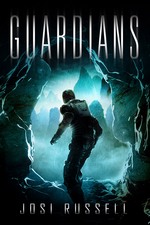
GuardiansGuardians

by Josi Russell
Series: Caretaker Chronicles Book 2

Kindle Edition, 394 pg.
Future House Publishing, 2015

Read: February 4 – 9, 2016

Note: I threw MG/YA in as a category here, because while the book isn’t marketed for them — and the main characters are adults — there is absolutely nothing here that a 5th grader on up couldn’t enjoy. I’d have read this when I was that age.

I did one of those wild and crazy things with this book — throwing caution to the wind in a daredevil-like fashion — I read the second book in a series without reading the first book. Gasp!

Recklessness, no? It’s the kind of nutty thing I used to do all the time in my youth, but haven’t really done lately, so I figured I’d give it a try. Yes, there’s some history (between the characters, and actual history) that I didn’t really understand and some jargon that I didn’t get right off the bat because I hadn’t read Caretaker but with context, I got the jargon (pretty much, anyway), could piece together the history just enough to get by, so I didn’t feel like I was at a disadvantage for not having experience with the series. I can say with a degree of certainty now, though, that I’m going to get to it pretty soon.

The action takes place on the planet Minea, which on paper, is run by the United Earth Government, but really is run by four Corporations and most of the populace lives in their company towns — which, not surprisingly, act like company towns pretty much always have. What do the people who live on Minea do? Well, mostly, they mine (get it? Minea? What do you want, they’re miners, not cartographers), and then there are shopkeepers, mechanics, doctors, etc. that support the miners. What they mine is this ore called Yyinum, which is this universe’s equivalent of a Dilithium crystal — it’s what enables their fastest ships to travel the galaxy — unlike Dilithium, it seems to run out and the ships need to refuel. There’s only one place it can be found — Minea.

But things aren’t going so well, for the residents of Minea. Yyinum is getting harder and harder to find; there’s a blight on the crops they’re growing; some sort of plant is growing everywhere (like a mutant Space Kudzu or something); and a new, fatal disease is cropping up. Oh, yeah, and an unidentified alien space ship is orbiting the planet and no one knows why or what it’s intentions are.

That’s the overview, but if we zoom in for a closeup, we have a great cast to look at. We’ve got Ethan (who must’ve had a wild time in the last book), a government official (which means almost nothing in the company towns) who’s sent on a survey mission and goes missing in uncharted — and very dangerous — area, with a crew of surveyors that don’t like him. This is the heart of the book — but not the most important part. There’s Marcos Saras, the on-planet head of his father’s mining company, trying to win daddy’s approval and make a profit at all costs (the two are probably the same thing). There’s Kaia — the biggest reason I want to read Caretaker is so I can better understand her — a brilliant engineer in a losing battle with her body. Her father, the Admiral in charge of defending the planet — which is typically easier than it is once the aliens show up (natch) — we don’t spend as much time with him as you’d expect. And then there’s Aria — Ethan’s wife, who is spurred to action after his disappearance (and after Saras’ company gives up the search quickly) — she continues the search, studies the Taim (the Space Kudzu), and tries to do something about the blight and disease (and a whole bunch of other things. If any one person understands what’s going on on Minea, it’s her. I’d say pay attention to her, but it’s impossible not to. Mix in a whole lot of secondary characters (some of which could carry more than they’re given) that add color, flavor, and a dash of romance.

The ending — especially the denouement — felt a little rushed, like the author was up against a deadline and just needed to finish things — but they got the job done, and didn’t seem incomplete. To be fair, if she spent a little more time with both of them, I might be sitting her accusing her of stretching things out to make a word count.

The world-building was solid. The storylines? I’m in, because even the predictable bits are done in a way to keep them interesting. You’ve read most of these storylines before — maybe even all of them. But there are two elements that make this one stand out from others. The first is the way that Russell combines these storylines, weaves them together, and her weaving various characters through multiple storylines.

The second reason is what really makes me want to read the other book — and whatever Russell puts out next — the characters. I like these people, and even the one’s I’m not crazy about are one recognizable as people, not stock characters or anything (with an exception or two). About halfway through reading this my family and I finally got the chance to watch Ridley Scott’s adaptation of The Martian, *THE MARTIAN NOVEL SPOILERS TO FOLLOW* now the junior high school science nerd in me is ashamed of this, but there’s a lot of what Mark Watney said that I didn’t completely understand in Weir’s book. But it didn’t matter, because for a few days there, Mark Watney was one of my best friends. If things had gone a certain way in the book, I can tell you, I’d have been a wreck. *THE MARTIAN NOVEL SPOILERS OVER* Now, I followed 97% of this novel better than Weir’s book, but at the same time, it almost didn’t matter what was going on, I was into this because of the characters. The humanity with which she imbues the people, the aliens, and…well…some other things. That’s the difference between this book and any number of SF novels out there.

I knew I was hooked, not just enjoying the book but was hooked, when the thing that happened about halfway through Chapter 31 made me excited and got me smiling (even if it was a pretty obvious thing that the reader was waiting for Ethan and the rest of the humans to learn). Read the book and that’ll make sense. Probably.

I’m not sure when I realized this, far later than I should’ve — there was almost no violence (except when the aliens and human military got going — and even then it was pretty PG), there was no sex or “adult” language to speak of. Thanks for that, Josi Russell, what a pleasant change. On the other hand, I’m sure I ever needed the image of Minean cockroaches — the size of an adult hand, mind you — at all, and especially not crawling over the bodies of those killed in an accident. Shudder

A good SF tale with a lot of heart, and some characters you’ll care about. That’s a great way to spend a few hours.

Disclaimer: I received my copy of Guardians from the friendly people over at Future House Publishing in exchange for an honest review.

—–

3.5 Stars

Winter by Marissa Meyer

WinterWinter

by Marissa Meyer
Series: The Lunar Chronicles, #4

Hardcover, 824 pg.
Feiwel and Friends, 2015

Read: January 19 – 22, 2016

So, the first book I really blog about is the conclusion to the tetralogy — not the best way to go about it, but it’ll have to do.

Primarily because I started this blog after I’d read the first two books in this series, and only slightly due to laziness, I’ve only blogged about one other of The Lunar Chronicles — the “.5” preceding this one, Fairest. Which makes this a little hard to do, but not that much. Basically, what Meyer has done is combining and intertwining the stories about Cinderella, Little Red Riding Hood, Rapunzel and Snow White; removing the magic, inserting computers, cybernetics, and space ships; and setting the entire thing in a future where Earth and the Moon are on verge of war. Couple that with Meyer’s voice and skill? This series is a crowd pleaser.

During Part I, I felt like The Grandson in The Princess Bride, “Is this a kissing book?” There was just so much smooching, significant looks, and avowals of affection that it got close to annoying. That said, it was so nice reading a YA book where (almost) everyone was open and honest about their attractions and (almost) everyone had their feelings reciprocated. Those that weren’t that open might as well have been, they were all pretty horrible at keeping things secret. Over all, it was sweet, it was cute, it was like a fairy tale.

What are the odds, right?

But after that? A great mix of character moments and action. On the one hand, Meyer takes her time setting things up — but on the other hand — she doesn’t have to take time and introduce anyone knew this time. All the players are known quantities, the relationships are set up between all of them, and there are two major goals at work — Stop Levana, or Stop Cinder. Everything else is frosting.

Clear directions, clear motives, it’s a crisp, well-paced adventure story at this point — yeah, there’s a little politics, there’s a little subterfuge — but basically, it’s “Let’s raise an army and storm the castle.” Which doesn’t mean everything’s a cake walk, of course. There’s some tension, real hardships and peril — am I allowed to say that there were a couple of times when thing seemed pretty Grimm?

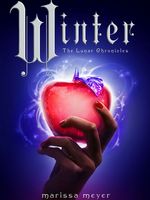
This is based on a fairy tale, and that needs to be borne in mind as you read it. That being said, Meyer makes it very easy to forget that and by the time that the part of Winter that was the most-Snow White-y, I’d forgotten that’s what this novel was about. You’d have thought between a. the cover, and b. the time I’ve spent in the world of Indexing lately, I’d have seen it coming. But I didn’t until I was right in the middle of the scene — which made it much more effective for me.

Meyer is great with her characters, and you can get attached to even those we meet for the first time in these pages — for those who’ve been around since the beginning? Hate to say good-bye to them, especially Iko the android. In the end, I think this is one of the more emotionally satisfying series conclusions I’ve read recently.

—–

4 1/2 Stars

Top Ten (and a bonus) Books from My Childhood

I was bemoaning how long my current read was the other day and how it was going to leave me without a post for today, and my ever-so-clever daughter suggested, “Why don’t you list the Top 10 Books from your childhood?” That sounded pretty fun, so I figured that I might as well. It turned out to have been better than I thought, so kudos to her.

Ranking them really would be impossible, but then 11 came to mind really without any effort, and I couldn’t axe one of them, so there’s a bonus entry to the list. All of these I read more than I can count — if they’re part of a series, these were the ones that I came back to most often. The links are to Goodreads pages because I can’t find good official pages for all the books/authors (a true sign of my age, I guess).

Enough of that, on with the trip down Amnesia Lane:

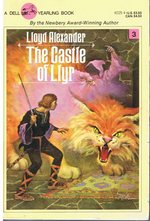
The Castle of LlyrThe Castle of Llyr

by Lloyd Alexander

The Chronicles of Prydain taught me most of what I needed to know about Fantasy (augmenting The Chronicles of Narnia‘s lessons). Fflewddur Fflam here is at his best, I think it’s here that I fell in love with Eilonwy, Taran’s more of a real hero than before, and you get plenty of Gurgi (who I just have to mention because thinking of him makes me smile). There’s peril, the characters grow more than they have before, a hint of romance . . . it’s not the most important book in the series, but I think it’s pivotal.

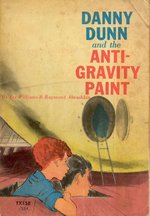
Danny Dunn and the Anti-Gravity PaintDanny Dunn and the Anti-Gravity Paint

by Raymond Abrashkin and Jay Williams

I didn’t know until today that this was the first in the series, I always figured it was mid-series. It’s the only one of the series that I owned — thankfully, the library had a few more — so it’s the one I read most. It was also my favorite — I just loved the stuff at the edge of our solar system and Prof. Bullfinch and Doctor Grimes making musical instruments from their hair — stupid as all get out, but it worked for me.

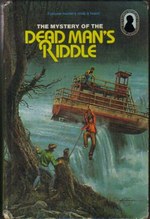
The Mystery of the Dead Man's RiddleThe Mystery of the Dead Man’s Riddle

by William Arden

While Encyclopedia Brown (see below) got me reading mysteries, it was The Three Investigators — Jupiter Jones, Bob Andrews and Pete Crenshaw (btw, the only thing there I had to look up was Pete’s last name — not bad for a series I haven’t touched since the late 80’s) got me hooked on reading detective series. The Dead Man’s Riddle was one of my favorites — and I think the first or second I read — something about the Cockney slang kept bringing me back to it. I read what I do today because of this series, really.

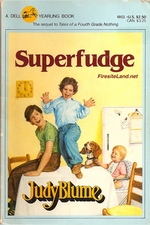
SuperfudgeSuperfudge

by Judy Blume

I remember Tales of a Fourth-Grade Nothing being funnier, but this was a better story — the Fletchers leaving NYC, Peter maturing, Fudge being a real pain, not just a cute nuisance. Blume taught me a lot about how to read non-genre stuff, probably paving the way for Hornby, Tropper, Weiner, etc.

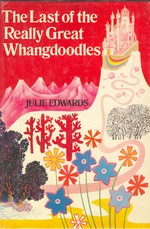
The Last of the Really Great WhangdoodlesThe Last of the Really Great Whangdoodles

by Julie Edwards

What a great world, what a great magic system . . . I’m not sure I can express what this book meant to me as a kid, and the copious warm-fuzzies the memory brings up. I remember that it was in the pages of this book about a magic kingdom that I first learned about DNA and RNA (and what those letters meant) — thanks, elementary school science classes. The creatures’ names in this are great (and, as an adult, I can “hear” Andrews saying them in my mind for an added layer of fun). There’s a great deal of whimsy here, a sense of play that permeates this — even when it gets silly. The kingdom’s motto, “peace, love and a sense of fun” really sums up the spirit of the book.

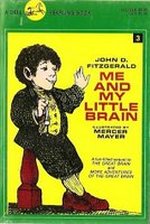
Me and My Little BrainMe and My Little Brain

by John D. Fitzgerald, Mercer Mayer (illus.)

Sure, the series was supposedly about Tom, but J. D.’s the real hero of the books. He has a conscience, a better moral compass than his brother — and is probably just as smart. This is the book that lets him shine as he ought to have all along. All the books had their strong points, and were fun, but this ruled them all.

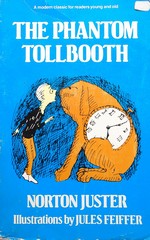
The Phantom TollboothThe Phantom Tollbooth

by Norton Juster, Jules Feiffer (illus.)

Such wordplay! What a great, twisted way to teach how important words and ideas are. Seriously, just a wonderful book. The humor is so off-kilter, any appreciation I have for puns came from this book (and it set the standard that a pun must achieve for me not to groan). If you haven’t seen the documentary about it, The Phantom Tollbooth: Beyond Expectations, get on it. (I contributed to the Kickstarter for it, I should add).

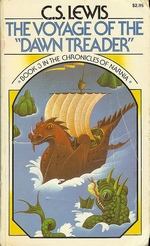
The Voyage of the Dawn TreaderThe Voyage of the Dawn Treader

by C. S. Lewis

I remember the bookstore where I bought this, the date and month that I bought it, and reading a good chunk of it before I got home. I read this one more than the rest of the series (Prince Caspian a close second). I just love this one — you get Reep at his bravest and funniest, some really odd creatures, an epic story, and Eustace’s redemption (back when I did crazy things like this, I almost got a tattoo of Eustace as Dragon). Who could ask for more?

Alan Mendelsohn the Boy from MarsAlan Mendelsohn, the Boy from Mars

by Daniel M. Pinkwater

Pinkwater has funnier and stranger books (both before and after this one), but there was heart, there was depth — there was length! — to this story about a kid who didn’t really fit in until he made a friend who didn’t want to fit in. This is another one where I can peg the place and time I bought it. Science Fiction-y in a real world (didn’t know you could do that!), comic book geeks as heroes, and real non-sanitized-for-kids emotions. There’s no way this wouldn’t be a favorite. More than the rest on this list, I’m thinking of finding my old copy and taking it out for another spin (because I just read the next one a couple of years ago).

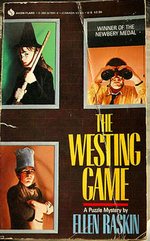
The Westing GameThe Westing Game

by Ellen Raskin

If I had to pick one off this list (and I don’t), this would probably be my favorite. I re-read it two years ago, and it was one of my favorite experiences that year with a book. The characters are great, the story was so clever, the writing so crisp. There’s nothing wrong with this book at all.

I saw a hardcover reprinting of this on Monday, and had to fight to resist buying a new copy. Kind of regretting that now.

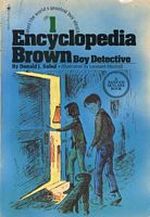
Encyclopedia Brown Boy DetectiveEncyclopedia Brown, Boy Detective

by Donald J. Sobol

Summer after second grade, we were on a forever-long road trip and I was bored, so I demanded my parents buy me something to read. I must’ve been a real snot about it, because at the next town, they did. I got two books, this one and Sugar Creek Gang Screams in the Night (not the best in the series, but it was good enough to read several times). It blew me away — I loved the puzzles, the characters, the idea. I wanted to be a P. I. This was my first mystery book, and it clearly set the stage for most of what I’ve read since (about a third of what I read).
Were you a fan of any of these as a kid? What were some of your faves? Have you read them lately?

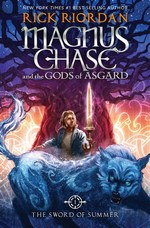
The Sword of Summer by Rick Riordan

The Sword of SummerThe Sword of Summer

by Rick Riordan
Series: Magnus Chase and the Gods of Asgard, #1

Hardcover, 491 pg.
Disney – Hyperion Books, 2015
Read: November 6 – 7, 2015

Maybe you’re thinking, Oh, Magnus, you didn’t really die. Otherwise you couldn’t be narrating this story. You just came close. Then you were miraculously rescued, blah, blah, blah.

Nope. I actually died. One hundred percent: guts impaled, vital organs burned, head smacked into a frozen river from forty feet up, every bone in my body broken, lungs filled with ice water.

The medical term for that is dead.

Gee, Magnus, what did it feel like?

It hurt. A lot. Thanks for asking.

Welcome to Rick Riordan’s latest tale of the offspring of mythological deities and the humans silly enough to fall for them. We’ve done the Greek pantheon, spent some time with the Egyptians, and came back for another round with the Greeks — this time with their Roman counterparts, but now we’re in for something new: Norse mythology. A whole new kettle of fish. This involves a new type of central character, a new kind of setting, new challenges. Which gives us the best thing from Riordan since the Percy Jackson & the Olympians series.

Magnus Chase is a homeless teen, orphaned a couple of years back when his mother was killed. Since then, he’s lived on the streets of Boston, spending his days in museums and libraries, learning as much as he can about whatever, and establishing relationships with generous restaurant employees and fellow homeless people. Two of whom track him down one day to let him know that there are people looking for him. It turns out that this is his sixteenth birthday and life just got a lot more dangerous for him. The people seeking him are family and they’re sure that he’s about to be hunted by beings he doesn’t believe exist.

The quotation above shows how well that being hunted works out for Magnus.

But he goes down fighting — to save himself, bystanders, and a couple of friends. So a Valkyrie (who happens to be Muslim, a combination that fascinates me) takes him to Valhalla — where he makes some more interesting friends, and enjoys a quality of (after-)life that’s far better than the streets. But then, someone casts doubt on the worthiness of his selection, which puts that Valkyrie in hot water.

So now Magnus has to take things into his own hands, prove that he’s worthy, defend the Valkyrie, and prevent Ragnarok from starting — or, if things go wrong, kick it off. It could go either way, really. One of the best pieces of advice he gets — the thing that inspires him is:

The thing about fate, Magnus: even if we can’t change the big picture, our choices can alter the details. That’s how we rebel against destiny, how we make our mark.

Now it’s just a question of what kind of mark he leaves.

Love, love the voice/attitude, I’ve seen some criticisms of it from parents, but I think it’s fun, and it’s just the kind of thing to feed into his audience (both the target and those who’ve grown up reading Riordan and still read him despite no longer being age-appropriate). It’s the clearest, crispest, funniest narrative voice since the Percy books — and might end up surpassing them by the end of this series.

I really don’t know that much about Norse mythology — world tree, Ratatoskr, Asgard, Valhalla, Odin, ravens, Hel, etc. I’ve got, but the details are really fuzzy. Most of what I know about Norse myth comes from Kevin Hearne’s Iron Druid Chronicles and Jacqueline Carey’s Daisy Johanssen/Agent of Hel Urban Fantasy books. So I’m learning a lot — and I assume younger readers will, too. The few pages of supplemental materials in back of the book are such a nice help! I really enjoy Riordan’s take on these mythological figures — both those I know and those I’m new to. I think the Thor you meet in these pages is fantastic. Yeah, Hearne’s Thor is a better character, but Riordan’s Thor induced more chuckles.

There are some great chapter titles here — I tend to ignore them (anything beyond a number is a distraction), which is short-sighted, I realize, but that’s what I do. In this book? It’d be really dumb to skip them. Every now and then I’d stop to go back and read the last few that I’d missed. If they’re not the funniest (and most creative) lines in the book — they’re in the top 2%.

The tie-in to the Percy Jackson books is obvious (and I felt really stupid having to have it spelled out for me in the opening chapters rather than sussing it out much earlier) and unexpected, but I can’t wait to see how that develops. But even more entertaining are the jokes about aspects of the Percy-verse — flat-out funny, and nice bit of fan service, too. Oh, and they won’t make a lick of difference to the Riordan-novice.

I just realized that I haven’t even addressed the titular sword. I don’t know what to say about it without ruining anything, but if I was eleven years old? It’d be my favorite sword ever — better than Excalibur or anything that Tolkien could offer (as someone much older than 11, I don’t think that, but I wouldn’t argue with my younger self).

One other thing — I read a review from one review site that I respect that dampened by enthusiasm for getting this — but I decided that Riordan had earned my trust (and I was curious), so I gave this a shot. That review complained about the sarcasm — I don’t get that, but apparently that’s a thing for some parents. And they complained about the addition of cussing — now maybe I missed it, but outside of the taking the names of Norse gods in vain (and that could be argued), the only cussing I saw was in dialogue tags. As in “…,’ he cussed.” Seriously? If we have to shield our middle graders from the concept of cussing, they’re not going to survive the middle grades. There were a few other complains that were about as baseless as these — I kept waiting to see these problems as I read and missed every single one.

Which isn’t to say this is a perfect book — but man, it’s the best he’s done in quite a while. The problems I have are really not worth getting into, they don’t ruin the experience, and if you’ve read Riordan before, you’ll be expecting them (they’re less problematic in this book than the last 2-3). The Sword of Summer is funny, exciting, with real heart — just the thing for middle grade readers (or those who don’t mind reading below their fighting weight).

—–

4 Stars

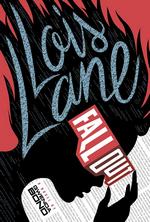
Lois Lane: Fallout by Gwenda Bond

Lois Lane FalloutLois Lane: Fallout

by Gwenda Bond
Series: Lois Lane, #1

Hardcover, 303 pg.

Switch Press, 2015

Read: June 27, 2015I’d love to be able to talk about this book as a YA adventure tale on its own. But I can’t. It’s Lois Lane, fer cryin’ out loud. Lois the intrepid, fiery, determined journalist. Not the ditz, not the comic relief, not the damsel in distress (except for the distress she finds herself in because she plunged into danger, not as a victim). Sure, she’s sixteen and a rookie when it comes to reporting things — but she’s gotta start somewhere.

Not only is this Lois Lane, but it’s teenaged Lois. So you have to think about this in terms of Smallville, well I have to, anyway. Bond’s Lois isn’t Smallville‘s — she’s closer to Chloe Sullivan (just with less tech savvy). Actually, if we’re talking WB shows, Bond’s Lois is Veronica Mars without the cool dad. But she’s not just smart and tenacious. She also gets people — she may have no social skills (or not enough of them), but she can read a person. Early on, Lois sees what’s going on with the other girl in the news staff pining after one of the guys. There were other examples, but putting that one where it was — and the way Lois saw it — makes you believe her “reads” of other people.

After spending her life bouncing around the world, from base to base, and seeing the negative effect it’s having on his daughter. General Lane gets himself a permanent assignment to Metropolis (the exact nature of which isn’t clear — but what teenager cares that much about what their parent does?). Lois is going to put down roots here, too, and not get in trouble at school — a resolution that doesn’t last through first period. But, this draws Perry White’s attention as he visits the school, and he invites her to join a new student news project. From there, Lois and her new colleagues uncover a story that involves a strange mix of cyberbullying, VR gaming, and group psychology.

Sure, the story she uncovers is about outlandish, a little hopefully) hard for us to believe. But, hey, this is a book based on comics. So yeah, outlandish works. It also allows Bond to make some subtle (maybe overly subtle) remarks about group-think, the dangers of our online society, and so on.

The use of Gen. Lane, Lucy, Perry White and the Daily Planet were inventive, but were consistent with the source material. Which was both a relief, and a key for the book working as well as it did.

Her friends aren’t that developed — but there’s enough of them to be more than cardboard cutouts of high school stereotypes. I look forward to learning more about them all — I think Maddie’s the most entertaining and interesting, but I’d gladly see more of the others as well. Which goes for East Metropolis High as a whole, really. I hope in future installments that Lois can find someone other than the school secretary to dupe to accomplish her ends.

She doesn’t do much with him, but I enjoyed Bond’s treatment of Lois’ online friend, SmallvilleGuy. Someone she met online after posting about seeing something inexplicable in the middle of Kansas. Bond doesn’t try to hide from the reader who this guy is, or play games with us — the nickname is a dead giveaway. Still, it would’ve been easy for Bond to pretend for a couple of books that this stranger was someone new to the canon. Instead, she plays it straight — sure, she has some fun because we all know a whole lot more than Lois does about this guy, and what their future will hold. But she doesn’t do it at the expense of either character.

Fallout was engaging, fun, and an inventive contemporary take on a timeless character. Recommended for comic book types who don’t mind a different look at canon and/or people who like CW dramas.

—–

3.5 Stars

Page 20 of 24

Powered by WordPress & Theme by Anders Norén