Tag: YA/MG Page 22 of 23

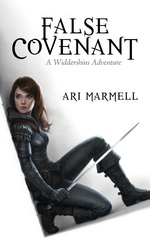
Dusted Off: False Covenant by Ari Marmell

False Covenant (Widdershins Adventures, #2)False Covenant

by Ari Marmell
Series: Widdershins Adventures, #2

Hardcover, 281 pg.
Pyr, 2012

It doesn’t matter what Ari Marmell writes — whether the fantasy is YA or not — it’s gripping and intense. The only difference is the swearing and amount of blood.

Still reeling from the events of the first volume — the death of a close friend, a showdown with a demon, a burgeoning friendship with an up and coming star in the Guard (not a good move for a professional thief)– this adventure will push Widdershins even further and harder and will keep the pages turning ’til the jaw-dropping end.

Marmell has created a rich and elaborate world for Widdershins — the magic/mythology system, the thieves’ guild, it’s a soil that many volumes could be grown in, I certainly hope they do.

—–

4 Stars

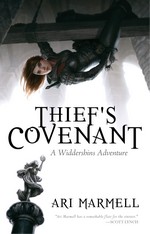
Dusted Off: Thief’s Covenant by Ari Marmell

Thief's Covenant (Widdershins Adventures, #1)Thief’s Covenant

by Ari Marmell
Series: Widdershins Adventures, #1

Hardcover, 273 pg.
Pyr, 2012

Marmell’s first foray into YA is exactly what it should be–his kind of story, without the adult-y material, which he managed to do without feeling like he watered anything down. There’s some light moments–and some flat-out clever writing–but on a dime, Marmell can turn things dark and gruesome

Adrienne/Widdershins/insert-alias-here is a heckuva character — tough, but vulnerable; wise, yet naive; reckless, yet skilled–a good YA character. She’s good at what she does–maybe even great–but not perfect, which I really appreciated.

A good, solid fantasy in a package that’s smaller than a doorstop. I’ll be back for more.

—–

3.5 Stars

Rock On by Denise Vega

Rock On
Rock On

by Denise Vega
Hardcover, 296 pg.
Little, Brown Books for Young Readers, 2012

I can’t remember what it was that made goodreads suggest this book to me, but I put it on my To Read list over a year and a half ago, and really only picked it up because it was front-faced on a library shelf I walked by last week, and my stack was pretty light. Glad I did pick it up though.

I’ve got a soft-spot for rock band novels — ever since The Buffalo Nickel Blues Band, which I read about 400 times in junior high. The Commitments (one of my all-time favorites), Eddie and the Cruisers, Juliet, Naked and a handful of others I can’t recall at the moment. There’s something about the raw emotion that the music taps into that just grabs you, makes a solid connection between the characters and the reader.

This is more than that (as the subtitle informs). Primarily, we’ve got the story of a high school band on their way to the High School Battle of the Bands. But that’s not the emotional core of the novel, it’s just the framework to hang the rest of the stories on.

Sure, Ori’s a great guitarist — practically too good to believe (but hey, it’s fiction, relax). But when it comes to girls? Fuhgeddaboudit‎. Nervous, anxious, trembling, not-at-all-confident — pick your synonym, and that’s him. As he and his band start gaining a little notoriety in the area, he’s finding himself receiving a bit more female attention (which is both great and mortifying for him). There’s one girl in particular . . . well, read it yourself. It’s a sweet story, well told. Nothing that’ll rock your world, but it’s nice.

But even that’s not the core of the novel — the fractured relationship between Ori and his older brother/former idol Del is where this book lives (or at least wants to). It takes time to get the full story, but Del goes from being the Top Dog in high school to a former jock/college drop-out during his first semester, he moves home and things between the brothers deteriorate quickly. Without this the rest of the book would barely be worth reading (as much as I liked it), watching Ori struggle to find the brother he worshiped in this current version, Del struggle with his current reality, and the brothers struggle to be civil — that’s the ultimate story being told here. And as well-done as it is — the emotions are right (on both sides), it’s utterly believable and relatable — but there’s something missing. I wish I knew what it was, but it’s just not as good as it wants to be.

I don’t want to overlook some of the other supporting characters — Ori’s little sister, his next-door neighbor/friend/band webmistress, and the eventual bass player are well-drawn, and I’ve been glad to spend more time with one/all of them — the bassist in particular.

A nice touch to this is in between some chapters, Vega provides logs from the band’s blog on a local music site — the blog posts themselves, mostly reiterate what we already know, but the comment threads? A lot of fun to read — and nice way to get a different perspective on events than Vega’s characters or the readers have.

A fun, quick read, emotionally satisfying, and almost as good as it tries to be — a pleasant way to while away a couple of hours.

—–

3 Stars

Steelheart by Brandon Sanderson

Steelheart
Steelheart

by Brandon Sanderson
Hardcover, 386 pg.
Delacorte Press, 2013
Series: The Reckoners, #1

This blurb was enough to get me excited about this book:

Ten years ago, Calamity came. It was a burst in the sky that gave ordinary men and women extraordinary powers. The awed public started calling them Epics.

But Epics are no friend of man. With incredible gifts came the desire to rule. And to rule man you must crush his will.

Nobody fights the Epics . . . nobody but the Reckoners. A shadowy group of ordinary humans, they spend their lives studying Epics, finding their weaknesses, and then assassinating them.

If the book description doesn’t sell this book, I can’t imagine anything I say will. But the story of young David Charleston, orphaned during the takeover of this world by the Epics, fueled by a thirst for vengeance and justice, is one you’d do well to read.*

I wish I could remember what podcast I was listening to recently where they started discussing the difference between DC and Marvel heroes — but I thought of it when I was reading Steelheart. DC heroes, they claimed, jumped at the chance to use their powers to fight evil. Marvel heroes, on the other hand, were reluctant heroes — they have no other choice to do what they do with their powers. In Sanderson’s world, on the other hand, no one with powers wants to do anything for anyone but themselves. Basically, Steelheart is the embodiment of Lord Acton’s maxim, “Power tends to corrupt and absolute power corrupts absolutely.”

This is the YA thriller done right — a lot of action, a hint of romance (no triangle, for which we all owe you thanks, Mr. Sanderson), a solid group of characters, a very bleak looking world, and a central character that doesn’t really fit in — but is driven, more capable than anyone thinks, and in the right place at the right time.

This band of rebels David finds himself working with isn’t as rag-tag as you’d expect — which is an interesting way to approach it. But the Reckoners are rag-tag enough, that even if they weren’t going up against nigh-invulnerable people, you’d still see them as the underdogs. Which you have to see them as, or you won’t be able to root for them. It also helps that we don’t get a good look at the Epics as anything but “The Other” or “The Enemy.” We don’t get the chance to sympathize, to understand, to care about them.

One quibble — some of David’s humor, his references, don’t feel quite right — they don’t seem like the kind of thing a kid who’s been living the kind of life he’s been living for ten years. Actually, most of the humor in the book feels out of place coming from the Reckoners.

That said — David’s wit (as bumbling as it is), Cody’s self-aware eccentricity, the voice this story is told in is what moves this book from “engaging super-hero distopia” to “zowie!” It doesn’t ring true, but it doesn’t matter — Sanderson sells it while you’re reading.

I’m eager to see what Sanderson has for us in this series — where did these powers come from? What are the other groups of Reckoners like? Are we going to see [redacted] again? Is David ever going to figure out how to use figurative language?

—–

*Unless you don’t like super-hero stories, YA adventure, distopian novels, or books that rock, if that’s the case, I can’t help you.

—–

5 Stars

Dusted Off: Beauty Queens by Libba Bray

Beauty QueensBeauty Queens

by Libba Bray
Hardcover, 396 pg.
Scholastic Press, 2011

This book is just fun. Are the characters over the top? Yup. Is it too preachy at times? Oh yeah. Does Bray hit the same target over and over and over again? Yup. But usually those targets have it coming.

There are plenty of flaws in this book, but Bray’s style, tone and message(s) work so well that you ignore them easily and forgive them all even more easily. A great, fun read–even for a guy like me who is nowhere near the target audience.

—–

4 Stars

In Medias Res: The House of Hades by Rick Riordan

as the title implies, I’m in the middle of this book, so this is not a review, just some thoughts mid-way through

—–

House of Hades
The House of Hades

by Rick Riordan

Okay, we’re in the home stretch of the third mythology-based series from Riordan, and by this time it’s pretty easy to what he’s up to, it’s like clockwork, the way he builds these things.

But just because his books have become formulaic doesn’t mean they’re bad. It’s not the formula, it’s the execution. There’s a reason that NCIS and Law & Order reruns are almost constantly on the air somewhere, they do it right. As does Rick Riordan. Fun, engaging, educational — bah, enough of this, I’m getting back to Percy, Jason, Annabeth, Leo and the rest.

Dusted Off: In Zanesville by Jo Ann Beard

In ZanesvilleIn Zanesville by Jo Ann Beard

The 1970’s weren’t the easiest time for a couple of 14 year old girls to grow up–just ask In Zanesville’s unnamed narrator and her best friend. In this coming of age novel, we see the two of them deal with odd babysitting gigs, clothes, strange teachers, annoying/horrible family situations, self-awareness, friends, brushes with popularity, and (of course) boys at that awkward and vital time of life. Jo Ann Beard depicts their struggles, failures (and even a success or two) in a well-written (sometimes wonderfully so), moving way.

My problem with this book is that the narrative doesn’t go anywhere, the narrator’s story doesn’t end, there’s no conclusion, it just stops. I’m not sure the narrator comes of age, she rather comes right up to the border of it and looks across. That’s more than dissatisfying, it ends up cheapening the whole experience.

Even so, Beard’s writing makes In Zanesville worth the time.

—–

3 Stars

Review: North! or Be Eaten by Andrew Peterson

North! or Be Eaten
North! or Be Eaten by Andrew Peterson
My rating: 3.5 of 5 stars

It is true the Shining Isle is smoke and ashes and that darkness is wide over the land. But your long memories have failed you. Of all creatures, you should know that the darkness is seldom complete, and even when it is, the pinprick of light is not long in coming — and finer for the great shroud that surrounds it.

This quotation is from the closing pages of this volume, and sums things up pretty well. This is the second book in a fantasy series — and certain things have to happen in a second book — namely, things get dark and bleak, almost completely so as stated above. Peterson makes sure that North! or Be Eaten fulfills that role just fine. It got a little darker than I expected, more than many contemporary children’s authors would be willing to go. But Peterson doesn’t go too far, he’s actually honest with his readers — no matter their age — things look dark, but there’s the pinprick of light. That’s always present.

To match the tone and events of this book, the sense of whimsy and play that was so prevalent in the first book is almost gone. There are hints and traces, but it doesn’t go as far as it did before — which is good, it wouldn’t have fit this time. It was appropriate in On the Edge of the Dark Sea of Darkness, and it will be again, but it’s not now.

The Igibly family — Wingfeather, actually — has had to leave their home and strike out trying to survive the Fangs. So the world of the novel has to expand — as does the cast of characters. More villains, more Fang-victims, more monsters, more betrayal, more close calls and trouble in general for the family. More friends and allies, too — more wonders of a fantastic world, more chances for heroics (obvious and not so much), more opportunities for kindness.

The characters are forced by circumstance to grow up quickly, and they do so — but not to the extent it feels forced or unnatural. These are diamonds being formed by intense pressure, and on the whole, they do so well.

I know most readers of this won’t pick up on it, but I caught some echoes of the Song of Ice and Fire in this book — for example, Janner and his new friend, Maraly, remind me a lot of Jon Snow and the wildling, Ygritte — so much so that I kept waiting for her to turn around and say, “You know nothing, Janner.” The geography and climate of the North here also struck me as very Westerosian. I can’t imagine that Peterson was tipping his hat in that direction, but you never know.

Not as fun as the first book, but still a well-told story, consider me ready for more.

Dusted Off: Mockingjay by Suzanne Collins

Mockingjay (The Hunger Games, #3)Mockingjay by Suzanne Collins
My rating: 4 of 5 stars

I honestly don’t know what to put here. I think that’s a compliment, hope it is anyway. I spent most of this novel leaning forward, as if that would get me to the end quicker. I don’t know how many times I said, “She’s [Collins] isn’t really doing that…” when it was very clear she was.

Yet the book as a whole (even most of the time I was reading it) I felt a mixture of pleasure and disappointment. I really don’t think that Collins could’ve done better, I don’t think there was any way to stick the landing. The setup over the first two novels created expectations that were too high — a plot that couldn’t be wrapped up in just one book (but I don’t think 2 would’ve done it either, then she would’ve had to resort to filler, I think).

So let me put it this way…did we get honest character growth/development? Yup.
Did we get to spend more time with people we’ve grown to like? Yup.
Did we see man’s cruelty to man clearly displayed? Yup.
Did we get a conclusion (however unsatisfying or sad) to every storyline? Yup.

Pretty much what we would want to see from a conclusion. Was it the ending that I wanted? No. Was it the ending that I feared we’d get? Thankfully, no. Can’t complain about that.

The most redeeming thing about this series (which, please don’t get me wrong, I loved) is the commentary on the relations between media, government actions (military and otherwise) and entertainment/distraction of the masses. I don’t think Collins said anything new, but she said it pretty darn effectively. And no one needs to think about these things more than the series’ target demographic.

Dusted Off: Catching Fire by Suzanne Collins

Catching Fire (The Hunger Games, #2)Catching Fire by Suzanne Collins
My rating: 4 of 5 stars

Freeyow! (not a word, I know, but…) Took The Hunger Games and kicked it up a notch. Compelling just doesn’t cover it.

On the whole, I enjoyed The Hunger Games more, but this was a very worthy sequel, and definitely left me wanting to/needing to move on to Mockingjay

Page 22 of 23

Powered by WordPress & Theme by Anders Norén