Month: August 2014 Page 1 of 3

Saturday Miscellany — 8/30/2014

Odds ‘n ends over the week about books and reading that caught my eye. You’ve probably seen some/most/all of them, but just in case:

    This Week’s New Releases I’m Excited About and/or You’ll Probably See Here Soon:

  • Lock In by John Scalzi — this really doesn’t seem like my kind of book from the descriptions, but something tells me I’m really going to dig this when I get around to reading it.
  • The Revenge of Seven by Pittacus Lore — The fifth in the Lorien Legacies, and I know, I know it’s built on cynicism and questionable motives, but there’s something about this that just works.
  • The Bullet-Catcher’s Daughter: The Fall of the Gas-Lit Empire, Book 1 by Rod Duncan — Steampunk with a twist, so I understand. Looks pretty interesting.
  • Once Upon a Rhyme: Volume I of the Charming Tales by Jack Heckel — this looks like fun. Nothing inventive (at least from the description), but still a fun read.

Hounded by David Rosenfelt

HoundedHounded

by David Rosenfelt
Series: Andy Carpenter, #12

Hardcover, 320 pages
Published July 22nd 2014 by Minotaur Books
Read: August 22 – 23, 2014

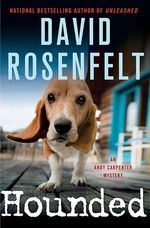
First things first: is this not the cutest cover image ever?

Secondly, I’m not a Today watcher, but my wife is when she’s home sick from work. This mini-rant from Andy was exactly what I’ve been thinking.

I am a creature of habit, and by this time I am always in the den, watching the CBS Morning News. I used to watch the Today Show, until they came up with something called “The Orange Room.” Basically, they go there to tell us what people are tweeting to the Today Show Orange Room. People who would take the time to tweet to the Today Show Orange Room are among the people in the world whose opinions interest me least, so I stopped watching it.*

On to the book itself, which is what I’m supposed to be talking about —

By this time it’s pretty much assumed that Andy will be taking in a dog for the duration of whatever case he takes up (after being forced/tricked into it by this point), and he does so this time — a six year-old Basset Hound named Sebastian. However, this one comes with an accessory Andy’s not used to — an eight year old boy named Ricky.

You see, Andy’s friend Pete Collins was pretty good friends with Ricky’s dad, Danny Diza, and an Uncle-figure to Ricky. And Ricky’s was just murdered, so until the system is able to place Ricky in a permanent home, Pete asks Laurie and Andy to take him in. Why doesn’t Pete do that? Well, he’s going to be arrested for Danny’s murder. Never mind that Pete Collins is about the best that the local Police Department has. Thankfully, he does have super-defense attorney as his best friend.

The number of people in Andy’s social circle who haven’t charged with murder is getting pretty slim at this point. He’s either going to have to make other friends, or do some marketing. Hate to have to see Andy defend Marcus.

Ricky’s presence brings out a side in Laurie we had heretofore not seen, but should’ve known were there. Similar sides in Edna (of all people) and Marcus (!) are brought out as well. Very fun to see the latter two, and heartwarming to see the former. The Ricky-factor alone elevates this particular Carpenter novel.

This case involves a conspiracy, as is almost always the case lately. But this time, it’s on a smaller scale — no worldwide terrorist networks or anything. Just one murder leading to a few others that are trying to be kept quiet by some mysterious and nefarious people. It’s definitely in Andy Carpenter’s wheelhouse, and just the thing his readers are looking for.

Here’s the thing that bugs me, and is a minor spoiler — very minor since I’m describing something that didn’t happen: At no point in time did Andy or Laurie — or some psychologist/counselor they hire — talk to Ricky about the events of the night his father was killed. He was upstairs when it happened. I’m not saying it wouldn’t have been tough, it likely wouldn’t have given Andy much to work with in the defense (I know that because I read Rosenfelt’s narration, Andy didn’t), but still, you’ve got to do it to save Pete’s neck, right?

Other than that, the only beef I have is that I talked myself out of the solution at one point. I was pretty annoyed with myself when Andy figured it out.

Despite the ongoing drought of song-talking between Andy and Sam, this is one of the better entries in the series, and was a lot of fun to read. It featured the typical courtroom antics, banter between Andy and the gang, adoration of Tara, and so on. Not to mention the laugh-out-loudest Marcus joke ever, some welcome character arcs developments, and the most “awww”-inducing closing paragraph that I’ve read in ages.

—–

* To be fair, my wife thinks about as much of The Orange Room as Andy and I do, she just likes the rest of the show’s format.

—–

4 Stars

Robert B. Parker’s Blind Spot by Reed Farrel Coleman

This should’ve been done at the beginning of the month, but I wanted to do this book justice, and if I couldn’t hit this out of the park, I didn’t want to swing. Also, (this is partially justification for the delay) I wanted to think about it some before putting pen to paper, so to speak. But it’s now at the point that if I didn’t get something written, I wasn’t going to — so I just did my best, and hopefully have a base hit here. As for thinking about this? Pretty sure I haven’t had a new thought about the book since I put it down — and I’ve thought about it a good deal — I’m just less prone to hyperbole about how great it is now.

Robert B. Parker's Blind SpotRobert B. Parker’s Blind Spot

by Reed Farrel Coleman
Series: Jesse Stone, #13

Advance Review Copy, 339 pg.
Putnam Adult, 2014
Read: August 1 – 5, 2014

One of the major drags (I’d imagine) for the writer in Coleman’s position is all the comparisons — to Parker himself, and to Michael Brandman. But, I don’t really have a choice, how else to you talk about the merits of the 13th book in a series without comparing it to the previous? I guess you could act like this was the first in a series, but that just disrespects what’s gone before (however much one might want to forget some of that).

I know I’ve said a lot of this before — this will (probably) be the last time: When Night Passage was released, I was hooked immediately. Spenser’s series was in the midst of the really rocky post-Taming a Sea Horse period, and it was so refreshing to see Parker really on his game, and with something so fresh, so different. He kept that up for three additional books, and then the series started slipping in quality. I kept buying and reading them — there’d always be a few lines or a couple of chapters that had that ol’ Parker magic, and I liked the characters, but a couple of these were the worst things that Parker ever published. Then following his death, Michael Brandman tried to carry on in three books, none of which were good, and were generally worse than anything Parker had done on a bad day. So, I was pretty hopeful and enthusiastic when it was announced that Reed Farrel Coleman was going to take over the series — at this point, all I’d read by him was his essay about Jesse in Penzler’s In Pursuit of Spenser, but that was enough to get me hopeful.

Unlike what Atkins is doing (pretty well) with Spenser — trying to retain Parker’s voice; and what Brandman did (disastrously) with Jesse — trying to keep the feel of the CBS/Selleck movies; Coleman is keeping the characters and the world, but writing them in his own voice (or maybe not his natural voice, but in a voice unique to him). This, coupled with Coleman’s own strengths as a writer, gives Jesse Stone a freshness, a richness, and a quality that’s been missing since the end of 2003’s Stone Cold. Just in word count alone, Coleman shines above the sparseness of Parker’s writing — it doesn’t feel bloated, it’s well-paced, but Coleman takes a lot more time and words to tell his story — this is a strength, everyone gets fleshed out. Ideas are followed up on, shades of gray are introduced to events — this is a more complex novel than others in the series.

There are, of course, several references to events and people in earlier books — far more than is typical for a Jesse Stone novel. Some of them come across as natural, others are more like nods to the reader, some feel like Coleman trying to establish his bona fides — “Trust me, I know the series.” At this point, I welcome them all — I like to be reassured, I like being reminded of books I liked — but if he keeps it up at this pace, it could get old really quick.

One of thing that gets mentioned in every Jesse Stone novel is that he was in the Minor Leagues and probably would’ve made it to the Major League, if he hadn’t suffered a career- ending injury. He keeps a large picture of Ozzie Smith on prominent display in his sparsely furnished and decorated home. He tosses a ball into an old glove while he thinks. It is the great unknown in Jesse’s life — and probably what really got him drinking seriously. He knows that he and Jen couldn’t ever make it work (as much as he still wants it to), he knows what kind of cop, employee, and leader he is — he even knows just how much his drinking is messing up his life. What he doesn’t know? Could he have made the Big Leagues? Could he have been a great — or even just good — player. But we’ve never seen Jesse spend much time on that — a little here and there. An occasional toast in the general direction of Smith’s picture. But that’s it, until now. Now Coleman gives us a Jesse brooding over how things turned out — a few times, beyond brooding and moved right into nasty and bitter. It never occurred to me before how little Jesse thinks about this chapter in his life — maybe it’s because Parker (apparently) lived without a good deal of self-reflection that he didn’t know how to write Jesse doing just that. I don’t know, but it was a mistake — and I’m glad that Coleman has addressed it. It doesn’t need to become an obsession or anything, but something that he thinks about from time to time is good. It might even be healthy.

Jesse’s ruminations on his thwarted career are prompted by a reunion of his Minor League team, hosted by the only member of that group to make it to the Major League, Vic Prado. During the festivities, both Vic and his wife approach Jesse individually, saying they want to talk to him about something. Neither tells him what they want to talk about, but it’s serious, and has nothing to do with a reunion. Meanwhile, in Paradise, a rich college kid and his girlfriend are crashing his parents’ vacation home for some undisturbed time together. One will be killed and the other kidnapped. Add in a vicious mob boss and his Irish enforcer, a wealthy man and his criminal defense lawyer. a federal agent obsessed with a target, and one of the scariest hit-men I can remember. The result is a novel with a lot of moving pieces, shifting targets and high stakes. That said, it didn’t take long to figure out what’s going on with the various and sundry criminal interests and enterprises involved here — but it’s still very intriguing to watch the pieces be put in place until there’s a very clear picture of everything that’s going on .

Coleman took better advantage of what a third-person omniscient narrator could do than Parker ever did. Not only are we told Jesse’s story, we see a lot more of the stories of the other characters — particularly the various criminals running around here. In the end, I felt like I understood why each character did something, and who they were in general — not just Jesse’s interpretation of their motivations.

There were a lot of little moments in this book that worked so well, that moved this out of the range of Brandman — and out of the range of a lot of books in the genre. Two examples were the chapter where the “woman the folks in Scottsdale knew as Dee Harrington” evaluated her last (and lost) opportunities, and came to some big decisions — and the chapter where the parents of the murder victim arrive with Molly to identify the body. The way that Coleman is able to reveal and establish character, or to underline what we knew about other characters while showing us new sides or aspects to them, is such a pleasure to watch. Character and plot development aside, just some of what he’s able to say about the human experience is impressive.

Of course, at one point, Jesse comes across a woman being harassed by tough guy of some sort. Rather than mind his own business, arrest the guy (he has an excuse this time — he’s out of his jurisdiction), or involve some other authority; Jesse proceeds to beat the guy up. It’s borderline gratuitous, and it’s fairly typical of the series. We get a little flash of the mean, brutal side of Jesse that he normally keeps under wraps, but that really informs most of his life; this is also a bit of Jesse letting off steam from the frustrations of his murder case, there’s also a bit of chivalry. This is really Jesse Stone in a nutshell. This does nothing to the overall search of the killer and for answers for what’s behind the kidnapping. But it reminds us about the person that Jesse Stone is — he’s hard, he’s not that emotional, and he has a very strong sense of what’s legitimate and what’s just wrong when it comes to public behavior.

Seeing echoes of Harry Bosch’s creed of “Everyone matters or no one matters” in John Ceepak last year started me looking for things that revealed other detective’s guiding philosophies, or drives, and doing so has helped me understand a lot of these characters better (whether it’s a new character to me or one that I’ve been reading for years). When Jesse arrives at the initial crime scene, we’re given insight into what makes Jesse the cop he is:

Jesse understood that his demeanor at crime scenes sometimes led his cops to believe he thought hat one corpse was like the next, that one murder victim was like any other. He supposed that it was okay for them to believe that. He also supposed it was true, if not completely. Every murder victim deserved justice, needed an advocate. Just as every living citizen was entitled to equal protection under the law, so too were the murdered entitled. Yet some victims were more equal than others. Maybe that wasn’t fair or right, but it was human, and cops were owed that much leeway.

There’s a semi-redemption for one of the criminals involved in this mess that struck me. It’s not one that I think Parker would’ve given that particular guy — I’m not altogether sure that Parker would’ve paid as much attention to him as Coleman did. However, both the character and his semi-redemption are consistent with Parker’s world. Jesse, Spenser, Virgil and maybe even Hawk, would approve of this guy’s change, his reasons for doing so and how he attempted it.

There’s one other character I’d like to talk about, but I can’t quite figure out how to do so without spoiling far too much. But if you read the book, you’ll understand the one sentence I’m allowing myself, “I found myself really liking __________, and hope we see a lot more of her in future novels.”

I do have a few minor gripes and I’m going to list all of them to provide a little balance (I feel like I’m gushing more than is becoming). Some word choices repeated too often (at least often enough that one noticed). The way that the Joe Breen talked seemed off somehow — and not in a purposeful way. I either got used to it, or eventually Breen’s dialogue improved, I got too involved in everything else about him that I forgot to track that.

I’m not loving the fact that Jen comes back into the picture, while he was never really going to get over her, Jesse seemed to have moved on in Parker’s last books. But, Coleman did brought her back in just the right way, so I’m only complaining about it as a formality.

My real problems are about the way that Suit and Molly were treated. Coleman says that he loves Suit (“How can you not?” he correctly asks in some of the promotional material). But he doesn’t use him as much in this book as he should. Coleman nails every line involving Officer Simpson, which is encouraging, but there aren’t enough of them.

I have three distinct problems with the way he used and depicted Molly. There’s a set banter between Jesse and Molly — she’ll say something disparaging or critical (in jest or not) about him, he’ll echo her jab adding “Chief” to the end — and she’ll eventually do the same. It’s cute enough, and Parker over-used it, too. But not as much as Coleman did — wow, dude. You’re on the verge of parody here. Honestly, Coleman might use the catchphrase as frequently as Parker did, but since Coleman has more Molly/Jesse conversations in this book than in a typical Parker, it seems worse.

Secondly, yes, Molly had one brief dalliance with Crow back in Trouble in Paradise, and yes, Jesse has brought it up on occasion. But Coleman has the Chief doing so several times in this book — almost brow-beating her with it. I don’t have a count, but I’d be willing to believe Jesse brings it up as often here as he has in the last ten books. Hyperbole aside, it seems out of character.

Lastly, in various points in the past, we’ve read, “Molly Crane had a pretty good body, Jesse thought, for a cop with three kids.” Parker’s Jesse keeps using that qualifier “for a cop with three kids.” But in this book we get a different kind of reaction — at least from the other males that see her (I don’t remember Jesse reflecting on her body in general or on specifics of it like others do). Maybe Molly’s been spending time with Tony Horton DVDs, I don’t know, it just didn’t feel right to read the comments made about her. Part of Molly’s appeal is that she’s — for lack of a better term — “real.” She’s not the glamorous type from Los Angeles. She’s a small-town cop and a Roman Catholic mom of three. Keep her that way.

None of this is a deal killer for me, but I hope that Coleman makes some adjustments to the way he uses Molly in the future, and that he just uses Luther “Suitcase” Simpson more.

All in all — a great read. Coleman has made Jesse Stone his own, while maintaining the universe that Parker created. Lee Goldberg said that Coleman “has saved Jesse Stone.” Indeed he has, and I’m so happy to be able to say that.

One more comparison to Parker before I’m done — not in his almost 70 novels did Parker end one like Coleman did here. Bravo. It was a gutsy move and it worked just the way you want an ending like this to. Jesse Stone #14 can’t hit the shelves fast enough.

Note:I received this book as an uncorrected proof from the publisher. Which was generous and cool of them, but didn’t impact what I said about the book, I care too much about Jesse to be swayed by that (which isn’t to say I couldn’t be bought if someone wanted to try). I’ll endeavor to verify my quotations with the printed book as soon as I can.

—–

5 Stars

Reread Project: Lullaby Town by Robert Crais

Lullaby Town (Elvis Cole, #3)Lullaby Town

by Robert Crais
Series: Elvis Cole, #3

Mass Market Paperback, 352 pg.
Bantam, 1993
Read: August 21, 2014


The third book in the Elvis Cole series is about sixty pages longer than the previous — and it was about sixty pages longer than the first. This isn’t a trend that will continue, I say with some relief (in fact, I believe the next will be shorter). But the growth isn’t just in page count; it’s in depth of story, depth of character, and the way Crais deals with making sure neither plot nor character get short-shrifted in this.

There’s an obvious effort here to establish a series continuity here with The Monkey’s Raincoat. We get the return of Pat Kyle and her laugh — and that would be enough to help establish this book’s place in the Cole-verse, but we get more. As he spends time sticking out like a sore thumb in a small town, he reminisces about the first time he visited Watts with Cleon Tyner and felt the same way. We also see (and get a reference to) Ellen Lang, briefly. She’s doing much better than she was when we saw her last. In Stalking the Angel, Elvis makes reference to keeping in touch with a couple of former clients, and with Ellen’s appearance we see him doing that again. Unlike with the clients in Stalking, she wasn’t there as a plot device, she was just there to let series readers know that she was still around. I really appreciate little touches like that.

If one’s an incident, two’s a coincidence, and three’s a pattern, we have ourselves a legitimate pattern established. For the third book in a row, Elvis is approached by a potential client/representative of a potential client who is difficult or obnoxious. Elvis will say that he’s not taking the case for the difficult client/client representative, but he will for the likable/put-upon representative/client. I can see why Crais uses this — Elvis gets to show some independence, some graciousness to the non-obnoxious person, and even a little wit in the way he phrases it. But, it’s getting to be lazy returning to this so often. Then again, if I wasn’t reading these so close to each other, I probably wouldn’t have noticed this pattern. So who am I to say?

So here’s the setup: Peter Alan Nelson, the 3rd biggest director in the world (mostly action flicks, apparently — a proto-Michael Bay, but one who’s not as Bay-ish, let’s hope) dumped his wife and kid just before he made it big. It’s been ten years and he’s feeling bad about that now, and wants to get to know his son. So the studio hires Elvis to find them. He does so, she’s living on the other side of the country, appears to have actually done okay for herself, the boy seems good — really, the last thing they need is a brash, self-obsessed, Hollywood type to interrupt their lives. But that’s what Elvis was paid to help with — but first he wants to check into something odd about Nelson’s ex. Turns out, she’s under the thumb of the capo di tutti capi. So before Elvis unleashes Hurricane Peter into their lives, he and Joe Pike will have to see about removing that thumb.

The tension is high, the solution isn’t obvious — and isn’t easy to achieve, either. Elvis does a pretty neat job investigating things to find Heather Lloyd in the first place and he has to do plenty more to figure out how to extricate her from this situation. There’s a good deal of sleuthing in this book, which really makes up for last time. Teach me to be snarky about that. Sure, they’ve got the ex-cop with all the connections and some power, Rollie George, to act as a font of all knowledge and help them navigate a city they aren’t familiar with. But that really doesn’t come across as a cheat — Elvis still has to act on the info given and turn it into something. Rollie cuts out a lot of time, but he doesn’t hand him anything wrapped in a bow. Having someone be a source of local information can really help keep things moving plot-wise.

This time out, the Peter Pan quest, protection of innocence — whatever you want to call it — is very brief and understated. If anything we see the dangers of that kind of life — Peter Alan Nelson could arguably be considered an eternal youth, with expensive toys to play with — but his demeanor, self-centeredness and lack of ethical code make him a very different kind of child than Elvis. If you’re going to hold on yo your childhood, do it the right way, or you end up as a petulant slob. There’s a child-like way of approaching things, and a childish manner. Cole’s not interested in the latter one bit. It’s interesting to watch Elvis draw the distinctions, or at least act on distinctions that he’s drawn, so that we can see what they are. You also have to wonder, seeing Peter Alan Nelson throw a fit, if Cole seeks to shed a bit of his version of Peter Pan so that he won’t act like “that guy.”

Lullaby Town has moments of humor throughout, but like Stalking, it’s not as jokey as Monkey’s was. The wit is there, he just doesn’t feel the need to break it out as often. Or when he does (and he’s not just provoking annoying clients or self-important mafia persons), there’s a purpose, to illustrate something, to reveal something — or to break monotony. Either way, Crais is learning how to let situations drive this kind of thing.

Portrait of the Big City Detective sitting on a small-town bench, ferreting. In the cold. People passed on the sidewalk, and when they did they nodded and smiled and said hello. I said hello back to them. They didn’t look as cold as me, but perhaps that was my imagination. You get used to the weather where you live. When I was in Ranger School in the Army, they sent us to northern Canada to learn to ski and to climb ice and to live in the snow with very few clothes. We got used to it. Then they sent us to Vietnam. That’s the Army.

Our knowledge of Elvis isn’t enhanced a lot by this novel, but what we do get is important. On the not-so-important side, we get a definitive note from him about giggling – he doesn’t like it (which maybe was hinted at before, but his displeasure wasn’t as explicit). We do get confirmation of a good deal here, his character, his willingness to help those who need it, but can’t afford him — that sort of thing. He gives Karen a concise explanation for why he decided to help her rather than turn things over to the police.

“And you haven’t told the police?”
“No.”
“But those men beat you up.”
I said, “I knew something was wrong and I wanted to find out what it was. Cops deal with the law. The law isn’t usually concerned with right and wrong. Ofttimes, there are very large differences.”
She shook her head as if I’d spoken Esperanto.

Elvis is solidified here as your hard-boiled hero. It’s not about legal/illegal, it’s about right and wrong — an objective morality. This is the core of Elvis Cole, and even Joe Pike — why do they do what they do? From tearing up Ellen Lang’s check, to carrying on the search for Mimi Warren after being fired, to putting themselves out on the limb for a client they were only hired to find (and who can’t pay them anything). This is it.

As the action in this one takes place no where near the LAPD, we don’t get to see the antagonism they have for Joe Pike, but we learn a little bit about him. Bit by bit, we’re getting a picture of Pike so that when we do eventually learn a good deal, there’s an impact. As tensions are at their highest between Elvis and the mafia, we get this exchange:

I asked Pike, “Are you afraid?”
He shook his head.
“Would you be afraid at midnight if we were alone?”
He walked a moment. “I have the capacity for great violence.”
I nodded. So did I. But I thought that I might still be afraid.

“Elvis?”
“Yeah?”
“I remember being afraid. I was very young.”

and that’s all we get about that. For now. But it hints at something serious — that we will explore in the future. As serious a moment as that was, I have to chuckle at Pike’s “I have the capacity for great violence.” Yeah, no kidding, buddy — never would’ve guessed.

I don’t know if I can successfully describe why I like this one so much — not that I had real problems with the first two books, but this one seems to have everything clicking and only the minor-est of problems. Funny, snappy writing, solid action, a complex solution, and growth and development in multiple secondary characters. There will be higher points in the series, but for awhile, this will be the standard by which Cole novels are measured by me.

Coming up next: Free Fall which is definitely a departure for Crais, Cole and Pike in many ways.

—–

4 1/2 Stars

—–

Drawing by Kirsty Stewart, chameleonkirsty on deviantART, used with permission.

Saturday Miscellany — 8/23/2014

For the last day or so, one of the top “Trending” stories on Facebook has to do with George R. R. Martin, the headline reads: George R. R. Martin Teases Lots of Death in the next ‘Game of Thrones’ Books. Yeah? No kidding. Death, never would’ve suspected lots of that. Need to prepare for the next headline “George R. R. Martin Warns that Next ‘Game of Thrones’ Books Will Be Very Long.”

Anyway, here are the odds ‘n ends over the week about books and reading that caught my eye. You’ve probably seen some/most/all of them, but just in case:

  • The Princess Bride You Didn’t Meet In The Movie — I’m not sure I’d agree with everything Leslie Kendall Dye says about the book in her little essay, but — it’s thought-provoking, and anything that gets people to read this book works for me. Love the movie, love the book more.
  • 23 Contemporary Writers You Should Have Read by Now — Reader’s Digest lists 23 critically acclaimed writers that supposedly deserve more attention. Now, I admit I don’t read as much “serious” fiction as I ought, but I figured I’d have read a couple off this list. Nope. Had only even heard of one of these. Humbling.
  • Speaking of “serious” fiction: Jennifer Weiner: why I’m waging war on literary snobbery — Another piece about Weiner’s quest to get “chick lit” (and herself) taken more seriously
  • Adult Fiction? — huh, whaddyaknow? Adults reading books about teens — you know, what’s marketed as YA today, and which so many look down on adult’s reading — has quite the long and impressive pedigree. Teresa Michals’ essay is well worth the read, no matter what you think of YA books.
  • In what’s becoming a regular feature on this list, Patrick Rothfuss’ review of The Girl Who Circumnavigated Fairyland in a Ship of Her Own Making — This has been sitting on my TBR pile since 2011, and on my daughter’s bookshelf since then, too. I need to buckle down and just read the thing, don’t I?
  • The Wisdom of Hounds — Mark Mason’s musical tribute to Oberon, the true star of the Iron Druid Chronicles. Also worth checking out if you’ve never read IDC, but appreciate things from a dog’s point-of-view.
    This Week’s New Releases I’m Excited About and/or You’ll Probably See Here Soon:

  • One Kick by Chelsea Cain — am hearing good things about this, assuming those are right, with this premise? Should be a good read.
  • Percy Jackson’s Greek Gods by Rick Riordan — it looks pretty funny and informative — what D’Aulaires’ was for me, but with Percy’s snark. And, apparently, huge. Huge as in abnormally tall, not thick.
  • What Might Have Been by Matt Dunn — whoops! — should’ve listed this one last week, this looks like a fun read.

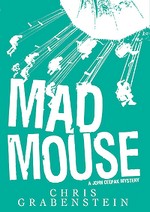
Dusted Off: Mad Mouse by Chris Grabenstein

Mad Mouse (John Ceepak Mystery, #2)Mad Mouse

by Chris Grabenstein

Hardcover, 320 pg.
Carroll & Graf, 2006
Read: November 27 – 28, 2012

Man, this is just such a fun series. Ceepak’s a great superhero cop (though I hope he becomes a bit more rounded in the books to come), and Danny’s one of the best sidekicks around. Watching him grow up is a blast.

I thought it was great that this book didn’t focus on a murder (my wife took a different stance), a serious crime, yes, but not a murder. The sense of urgency was still real, it was a serious crime, but a crime more likely that a small town would face–rather than a Jessica Fletcher-like situation where 3 centuries worth of murders happen to a tiny city in a matter of months.

—–

4 Stars

Dusted Off: Loser’s Town by Daniel Depp

Loser's Town: A David Spandau NovelLoser’s Town: A David Spandau Novel

by Daniel Depp

Hardcover, 290 pg.
Simon AND Schuster, 2009
Read: November 8 – 12, 2012

Um, ugh. This is a really well-written, occasionally clever, disappointment.

See here’s the thing…in a detective novel, the protagonist, or if you will, the detective, should detect things. Spandau did nada. His violent associate (not really a Hawk, Joe Pike or Bubba Rogowski, but close enough) investigated; his boss did; his boss’ secretary did. Spandau? He sat around and mooned over his ex-wife, bullied his client, bullied his associate, bullied the bad guy, was a jerk to just about everyone. And then sorta cleaned up the mess at the end. But even in that, he was pretty passive.

Blech.

A passive hero — no matter how nice of a guy, how thoughtful, whatever — is not something you want to read.

—–

2 Stars

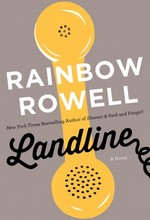
Landline by Rainbow Rowell

LandlineLandline

by Rainbow Rowell

Hardcover, 310 pg.
St. Martin’s Press, 2014
Read: August 13, 2014

If the last few years have taught us readers anything, it’s that if you want quirky, honest, heart-felt romance with real (and usually moderately overweight) people and solid laughs, Rainbow Rowell will consistently deliver for you. And if you don’t think you want that, after you read her, you’ll realize that’s just what you wanted after all. She has two YA books and now two Adult books to her credit. Her latest, Landline delivers the typical Rowell magic in her story, but this time she included something else: actual magic. Sort of.

Georgie McCool is half of a pretty successful TV writing team who are thiiiiis close to being much more successful, all they have to do is crank out a handful of scripts in the next couple of weeks and they’re in a great position to sell their first series. The catch is, this involves working over Christmas — despite Georgie’s plans to go to her mother-in-law’s in Omaha with her husband, Neal and their two daughters. Georgie says that she can’t pass up this opportunity, so Neal and the girls go off without her.

Georgie sees this as a regrettable occurrence, but one of the sacrifices she has to make to get her dream show made. Her mother, step-father and sister see it as her husband leaving her, and Georgie ends up staying with them. Which gets Georgie to worrying — especially when she can never seem to reach Neal on the phone during the day. At night, however, when her iPhone battery is dead, she has to resort to the landline in her old room and she ends up talking to Neal back before they got engaged.

Don’t ask. It makes no sense. She never bothers to explain. And it doesn’t matter. Georgie eventually figures out that’s what’s going on and she rolls with it, and the reader does, too.

These conversations, as well as the absence of her family, lead Georgie on a path down memory lane, reflecting on the beginning of their relationship and how it changed as they did. Maybe Neal had made a mistake choosing her. Maybe she’d ruined her life (and his) by choosing him. Would they have both been better off going their separate ways? Or was there something worth fighting for now? Would that matter? The clock is ticking — for Georgie’s marriage (both now and then) and her career. Is she up for it?

The tension is real, the apprehension, fear, and self-doubt (for starters) that Georgie is wrestling with is very obvious and palpable. Yet while focusing on this, Rowell’s able to create a believable world filled with a lot of interesting people. There’s Georgie’s partner/best friend, Seth and another writer on their current (and hopefully future) show — and Georgie failing to hold up her end of things there, as much as she tries.

Then there’s her sister, mother and step-father. They’re much better developed (probably only because we spend more time with them). Her mother’s a pretty implausible character, yet not a cartoon, she’s a pug fanatic, married someone much younger than her, and generally seems really happy. Her sister’s about done with high school and is figuring herself out (and mostly has) — she’s a hoot, and my biggest problem with the book is that we don’t get more of Heather. Not that there wasn’t plenty of her — and it’d require the book to take a far different shape. We get whole storylines about all the non-Neal people in her life, little vignettes showing us their character, giving us smiles in the midst of Georgie’s crisis, like:

“Kids are perceptive, Georgie. They’re like dogs”–she offered a meatball from her own fork to the pug heaped in her lap–“they know when their people are unhappy.”
“I think you may have just reverse-anthropomorphized your own grandchildren.”
Her mom waved her empty fork dismissively. “You know what I mean.”
Heather leaned into Georgie and sighed. “Sometimes I feel like her daughter. And sometimes I feel like the dog with the least ribbons.”

Not only do the supporting stories, or even the little moments like this fill out Georgie’s world and make it more interesting, they provide a breather for the reader from having to deal with the disintegrating marriage.

I know some people think we spend too much time in flashbacks, where Georgie’s remembering how she and Neal met, got to know each other, and started seeing each other, etc. But we need that. If all we get is Neal in the present, or past-Neal on the phone, we’re not going to care enough. Especially in the first couple of scenes we get with Neal, it’d be real easy to see him as unsympathetic — the guy holding Georgie and her career back. We need these flashbacks so the reader can sync their feelings about Neal with Georgie’s, so that when we read something like:

Georgie hadn’t known back then how much she was going to come to need Neal, how he was going to become like air to her.
Was that codependence? Or was it just marriage?”

or

She needed him.
Neal was home. Neal was base.
Neal was where Georgie plugged in, and synced up, and started fresh every day. He was the only one who knew her exactly as she was.

find ourselves agreeing with her, or at least seeing why she says it.

At the end of the book, there’s a lot of plot lines dangling — some very important ones, actually. Enough so, that normally, I’d devote a paragraph to complaining about it. But I won’t this time — it works for Landline. There’s a lot for Georgie to work out herself, she’s really only settled on the one most important thing, leaving the rest to be resolved another day. And that’s got to be good enough for the reader.

Not her best, but Rowell on an off day is still really, really good.

—–

4 1/2 Stars

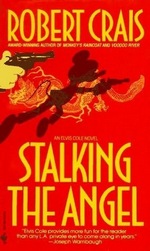
Reread Project: Stalking the Angel by Robert Crais

Stalking The Angel (Elvis Cole, #2)Stalking The Angel by Robert Crais
Series: Elvis Cole, #2

Mass Market Paperback, 260 pg.
Crimeline, 1992
Read: August 13 – 14, 2014


Okay, here we go with the second Elvis Cole adventure — I hesitate to call this a mystery, the amount of investigating that Elvis performs before finding what he’s been hired to is pretty minimal. What can I say, the guy’s got himself some great instincts.

The book opens with a great visual — Elvis is doing a headstand in the middle of his office when in walks the man who will go on to hire him, and his lawyer — “the best looking woman [Elvis has] seen in three weeks.”

I said, “You should try this. Invigorates the scalp. Retards the aging process. Makes for embarrassing moments when prospective clients walk in.”

Bradley Warren is not amused, but is in a hurry and needs an investigator so he sticks around to hire Elvis.

Crais packs a lot into the description of Warren’s lawyer — giving us his initial impressions of her, as well as revealing a little about himself to (re-)familiarize readers to his character, in addition to the obvious physical description:

Jullian Becker was in her early thirties, slender in gray pants and a white ruffled shirt with a fluffy bow at the neck and a gray jacket. She held a cordovan Gucci briefcase that complemented the gray nicely, and had very blond hair and eyes that I would call amber but she would call green. Good eyes. There was an intelligent humor in them that the Serious Businesswoman look didn’t diminish.

They explain, Warren does a lot of business (he’s a very influential and wealthy man, they make sure Elvis realizes) with Japanese investors — and in a promotional stunt, he’d arranged a loan of one of the few original copies of The Hagakure from the thirteenth-century, and it was stolen from his home safe. He needs it back in a couple of days, and as distasteful as he fins Elvis, he needs his help. He and Elvis spend a little time annoying each other, before Elvis relents — for Jullian’s sake — and agrees to help find the manuscript. While Warren and Becker jet off to Japan, he starts investigating at the scene of the crime, where he runs into Warren’s very drunk wife who makes several passes at Elvis. Tiny spoiler: Elvis keeps it in his pants for the whole book. Maybe having established his noir cred in Monkey, Crais didn’t have to keep that going (not that Elvis doesn’t notice attractive women, flirt, etc).

Elvis taps a source for someone who dabbles in stolen art and leans on him to get an idea who’d have motive and means to steal The Hagakure, he gets a name. Elvis pushes the dabbler to the edge of despair — he know that his world could come crashing down around him and ruin the lives of his family. Elvis is disturbed by that, musing to his cat later,

“You ever notice . . . that sometimes the bad guys are better people than the good guys?”

It’s a small moment, but reveals a lot about Elvis that the reader needs to know without just telling us the information. The bad guy as a better person (and vice versa) is something we’ll see again in this book — and frequently from here out.

Elvis takes that lead he bullied out of that man and finds someone with ties to the yakuza — and the LAPD task force watching him. Things don’t go well with either group and he has to bring Joe into the picture. Oddly, things escalate with Warren and he starts receiving threats. But he goes ahead with business as usual. After failing to convince him to cancel a public event despite these threats against him and his family, Elvis and Joe help out with security in a location almost impossible to secure.

Pike drifted up to me. “This sucks.”
That Joe.
“I could off anybody in this place five times over.”
“Could you off someone and get away with you here?”
Head shake. “I’m too good even for me.”

Technically, Joe didn’t joke there — but he came close.

Things get worse from there, spiraling out of control and pushing Elvis to the brink. Which allows Crais to explore the friendship between the two — Pike spends a lot of time reassuring Elvis, trying to keep him from going over the edge. With more sensitivity than he showed Ellen Lang in Monkey, Pike’s there, keeping Elvis on track.

“You were doing your best for her, something that no one in her life has ever done.”
“Sure.” Mr. Convinced.
“Ever since the Nam, you’ve worked to hang on to the childhood part of yourself. Only here’s a kid who never had a childhood and you wanted to get some for her before it was too late.”

I know I noticed that theme of protecting childhood — Elvis’ own, and others’ — as I read the series before, but I don’t think I saw how prominent it is, this will be interesting to track.

Speaking of Joe, we get more of the Pike myth — at some point the FBI gets involved in the case. The agent talking to Elvis knows Pike’s name, and understands something of his reputation. He doesn’t want to meet Joe, but he does want to take a look at him. The Agent’s attitude is different than the LAPD’s, Pike’s not despised by him, it’s more like an urban legend that he gets to verify exists. Later, Elvis and Joe have to do a little skulking around a home that the police have staked out, and Pike stays back in case he’s recognized by them. By this point, Crais is making sure you’re wondering what’s going on here.

Elvis — both in dialogue and in narration — is still funny, but I think there are fewer jokes per inch in this book, but I think they’re funnier. Elvis cracks me up, and I appreciate that. He also drops the jokes toward the conclusion, when things get violent and deadly. I noticed that some readers were critical of Elvis’ joking at the similar point in the last book, and Crais must’ve seen something similar twenty years ago — or it’s just him being more disciplined as an author. Hopefully the latter, but I’d assume the former is possible.

Crais seems more confident, more sure of his characters and story this time out — as he should be, this is a stronger book. In addition to a strong hard-boiled detective story, we see themes of friendship, honor; the protection of childhood; criminals acting nobly, “good guys” who need someone like Elvis to threaten to kill them.

A very successful sequel to The Monkey’s Raincoat, Stalking the Angel secures Crais’ place at the top of the field. That’s about all I have to say about it, so I’ll see you next week for one of my favorites, Lullaby Town.

—–

4 Stars

—–

Drawing by Kirsty Stewart, chameleonkirsty on deviantART, used with permission.

Saturday Miscellany — 8/16/2014

A quick personal note: As we have for 7 or so years, my kids took part in our local library’s Summer Reading Program — for my family, it’s never actually increased our reading, but it’s a fun little thing for the kids to do (and it gets them a free book). The last few years, they’ve added a program for adults — also, doesn’t do anything to increase my reading, still I like to participate. Turns out that I won one of the drawings from the program this year — a Kindle Fire — and a free book (Fannie Flag’s The All-Girl Filling Station’s Last Reunion). I’d like to give a shout out to the Nampa Public Library as well as a hearty thanks for my new tablet. Remember to support your local library.

Just a couple of odds ‘n ends over the week about books and reading that caught my eye. You’ve probably seen some/most/all of them, but just in case:

    This Week’s New Releases I’m Excited About and/or You’ll Probably See Here Soon:

  • Cursed Moon by Jaye Wells — the sequel to the promising, but not as good as I’d hoped, Dirty Magic
  • We Are All Completely Fine by Daryl Gregory — this could be a fun and trippy read

Page 1 of 3

Powered by WordPress & Theme by Anders Norén