Month: August 2014 Page 2 of 3

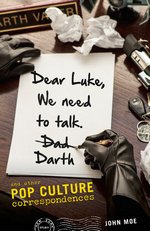
Dear Luke, We Need to Talk, Darth by John Moe

Dear Luke, We Need to Talk, Darth: And Other Pop Culture CorrespondencesDear Luke, We Need to Talk, Darth: And Other Pop Culture Correspondences

by John Moe

ebook, 288 pages
Published June 10th 2014 by Three Rivers Press
Read: August 14, 2014

This is an incredibly amusing collection of pop culture-based humor pieces — I’m tempted to call them columns, but that’s not exactly it.

So these are correspondence (in various forms) associated with gems from Pop Culture — the titular notes from Darth Vader to his son; the entire list of Jay Z’s 99 problems (4. Don’t really enjoy rap music; 55. Shamrock Shake only available once a year.; 84. Worry someone will discover that I’m secretly a member of Bon Iver.); internal e-mails when E.T.’s shipmates discover he was left behind; and so on. I cracked up a lot. I made my wife read bits and pieces, but I resisted reading portions/the entire book aloud. Some of the pieces I wanted to read aloud included: The editorial notes on Guns ‘n Roses “Sweet Child of Mine” (“Redundant. You either have a memory or you’re reminded of something. You’re not reminded of a memory. Your heavy-metal supporters won’t stand for such writing”); a note from the bar manager to Billy “The Piano Man” Joel; the development of the lyrics to the “Batman” show theme; Dora the Explorer’s mother’s letter to CPS (“I know that imaginary friends are a perfectly normal part of childhood, but this was different. Dora would speak to an entire group of people, almost like an audience. And she would demand things of them: “Say map! Say map!’ It was like super-bossy, group-oriented schizophrenia”); a list of changes the Hotel California instituted after being visited by Don Henley (“Acquire steelier knives and/or less resolute beast”).

It probably doesn’t need to be said, but your appreciation of a piece will be directly correlated to your appreciation of the pop culture basis. For example, I don’t like The Walking Dead (yeah, I’m the one guy in the U.S.), so Message Board posts by the Walkers didn’t do anything for me, ditto for the Engineer’s Notes from Fleetwood Mac’s “Rumours” sessions. But I’m willing to bet that fans of either would get a few chuckles.

There are several pieces (perhaps the majority?) that go on too long — maybe two that aren’t long enough. But even with those that do wear out the joke, carry on, More makes persistence worth it.

My only warning is — do not try to read this cover to cover. Read a piece or two. Put the book down. Come back in a day or so. More than that and you’ll stop chuckling, maybe even build up an intolerance. Just sip at this one, no chugging.

I enjoyed it — I laughed, I chuckled, I grinned, I wished I’d thought of that joke first — this is a great coffee table kind of book. I’d buy another volume or three of this just to have around. Give it a shot.

Note:I received this book for free from Blogging for Books for this review. Which was generous and cool of them, but didn’t impact what I said about the book.

—–

3 Stars

Treasure Coast by Tom Kakonis

Treasure CoastTreasure Coast

by Tom Kakonis

Kindle Edition, 304 pg.
Brash Books, 2014
Read: August 7 – 12, 2014

I really don’t like writing these kind of reviews. So let’s get this out of the way straight off: this was not a book written for me. Which doesn’t mean I couldn’t appreciate its strengths — and it certainly could’ve won me over (others I didn’t think were for me have), but it really didn’t. I certainly disliked it less by the end then I did at the beginning.

This is a book that’s very much a tale of two halves. In the first half we get introduced to several characters, all of whom (with one possible exception) are very unsympathetic, and there’s really only one of which I had any hope of becoming a tolerable character by the end of the book. It was a slog to get through, and I really had to force myself. It was a large number of ugly people doing ugly things to other ugly people. But aside from one excessive beating, the ugly things were pretty small — and all just to establish character (and lack thereof). It’s just about 150 pages of setup.

The second half contained most of these characters, though three of them vanished for all intents and purposes; but it moved faster — there was a point to the action, for that matter, there was action. Where the first half could be seen as potential energy, the second half was all kinetic. Sometimes that kind of book can work well — but you run a risk in putting all your eggs in the second half. It’s too easy to just walk away unless that hook is set well at the beginning. And Kakonis didn’t really accomplish that. The characters start interacting, the storylines overlap and intertwine. And all the “best-laid schemes o’ mice an’ men” get busy fulfilling “Gang aft agley / An’ lea’e us nought but grief an’ pain, / For promis’d joy!”

While the first half was all set up — it set up a handful of characters and associated storylines that are just abandoned in the second. I didn’t understand that. Why spend extra time putting up dominoes that you don’t intend to knock over?

Ignoring the story problems, the language the novel was told in was deplorable. Orwell said, “Never use a foreign phrase, a scientific word, or a jargon word if you can think of an everyday English equivalent,” Twain put it more succinctly, “Don’t use a five-dollar word when a fifty-cent word will do.” If they’d read Kakonis, Orwell would’ve included “obscure slang” — thankfully, with maybe one or two minor exceptions were decipherable with context clues, but I had a hard time believing that most of these characters would have so large and varied a vocabulary. But beyond the general slang, was the vulgarity and ugly racism — I learned at least one new derogatory epithet for the police, a couple for females/female genitalia, and was reminded of a couple for Hispanics. Sure, I understand, that these characters were by and large uneducated, lower class, and criminals — not the type that you’re supposed to want to emulate in word choice. But this was just horrible, wretched. A real block to my enjoying — even tolerating — huge passages from the book. It seems to me that Kakonis was inspired by Elmore Leonard in the structure, tone and subject for this book. And Leonard wasn’t afraid to have racial/sexual epithets come out of his characters. But for him, it worked, they never came across as vile, just human.

So, yeah. Not for me — but I can see where some people might enjoy it. If the product description appeals to you, give it a shot. Hopefully it works better for you than it did for me.

—–

2 Stars

In Medias Res: Landline by Rainbow Rowell

as the title implies, I’m in the middle of this book, so this is not a review, just some thoughts mid-way through

—–

Landline
Landline

by Rainbow Rowell

I’m on page 153 of 308 — as close as you can get to half-way (at least if you stop at the end of a chapter), and I’m all in on this book. It’s told with Rowell’s trademark warmth and charm. It’s funny, but not hilariously so; tragic, but not heartbreaking (yet); romantic, without being sappy; and real, without being . . . non-fiction?

Yeah, okay, that sentence got away from me.

This is a story about a marriage on the rocks, about the beginning of this romance, maybe about its end, friendship, priorities, and a magic telephone. Most of these are themes not new to Rowell, but that are in constant demand as fodder for stories. Rowell’s doing a bang-up job so far, I’m really pulling for this couple (in both the beginning and at the later part of the relationship). As always, Rowell gives us real people — people we could know, people we would befriend, people we could be.

At this point, I can see a few ways this could end — all of which are entirely justified by what’s come so far, and the vast majority of them end with me risking alcohol poisoning. I’m really liking Georgie McCool that much (and yes, that is her real name).

Review Catch Up: Broken Homes; Black Arts; The Player; Speaking from Among the Bones

I’ve got a backlog of 50 or so reviews I’ve been meaning to write — some of them, I just have to admit aren’t going to get done. But I’m going to try my level best. The four books I’ve decided to tackle in one fell swoop are books I enjoyed, from series I enjoy, and yet I’ve had trouble reviewing them. In the end, I decided that was because by and large, I don’t have anything to say about these books that I haven’t said about others in the series.

But I do want 1. clear these off my to-do list and 2. more importantly, encourage readers to give these a look. So, without further ado:

Broken Homes (Peter Grant, #4)Broken Homes

by Ben Aaronovitch
Series: The Rivers of London, #4

Mass Market Paperback, 324 pg.
DAW, 2014
Read: February 15, 2014

The plot took its own sweet time getting where it was going, with a lot of strange little turns here and there — which works because it’s probably what actual policemen go through investigating a crime. But almost doesn’t work because it makes it feel like Aaronovitch didn’t pace this correctly (which is silly, because he did).

I really, really liked the undercover stuff. The conclusion is probably the best that this series has been. It’d be great if Peter learned a bit more though, his stumbling efforts are amusing, but it’s time for more proficiency.

I’m eager for the next one of these (and would be even without the big twist) — such a great world he’s created here, and I want to learn more about it and the characters that inhabit it.
4 Stars

—–

Black Arts (Jane Yellowrock, #7)Black Arts

by Faith Hunter
Series: Jane Yellowrock, #7
Mass Market Paperback, 325 pg.
Roc, 2014
Read: March 25 – 29, 2014

What’s to say about this one, that I haven’t said about other books in the series already?

The action’s tight, the vamp politics and Jane’s interaction with it are pretty interesting, Faith’s coming to grips with more of her background was really compelling, and her growing relationship with the brothers is fun.

Obviously, this is the most personal case that Jane’s had yet — for someone to be messing around with Molly, that’s just beyond the pale. Those raised stakes (pun fully intended), and the ongoing drama with Leo’s grip on the New Orleans vampires made this the best of the series.
4 Stars

—–

The Player: A Mystery (Carter Ross, #5)The Player

by Brad Parks
Series: Carter Ross, #5

Hardcover, 336 pg.
Minotaur Books, 2014
Read: April 1 – 4, 2014

What’s to say about this one, that I haven’t said about other books in the series already?

A lot of fun — great characters, love Carter’s voice, everything that you want to see in a Carter Ross novel was here — twisty conspiracy, some good laughs, Carter’s personal life in shambles. It was nice to meet his family.

Sadly, I’m at a loss for words here (something that never seems to be Carter’s problem), this was a lot of fun. I want a lot more of these.
4 Stars

—–

Speaking from Among the Bones (Flavia de Luce, #5 )Speaking from Among the Bones

by Alan Bradley

Hardcover, 372 pg.
Delacorte Press, 2013
May 16 – 14, 2014

Flavia’s her typical charming, precocious, incorrigible self. Perhaps a bit more clever than we’ve seen her before, definitely with less a sense of self-preservation than we’ve seen previously. Her sisters are a bit, more human? Or maybe Flavia’s portraying them more honestly/more sympathetically. The financial pressures her father’s under are more and more pressing, causing everyone to be a bit more realistic, it seems.

Still, that doesn’t deter Flavia from doing her thing when a body is discovered. It’s everything you want in a Flavia de Luce novel — very, very smart conclusion to this mystery.
3 Stars

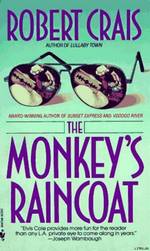
Reread Project: The Monkey’s Raincoat by Robert Crais

The Monkey's Raincoat (Elvis Cole, #1)The Monkey’s Raincoat

by Robert Crais
Series: Elvis Cole, #1

Mass Market Paperback, 201 pg.
Crimeline, 1992 (originally 1987)
Read: August 6, 2014


We start the Reread Project with The Monkey’s Raincoat, which should be read as the pilot for the Elvis Cole series. It establishes the characters, the world, the tone — the story is secondary to that. It’s also the foundation — everything after this will be building on this, and will be an improvement (if for no other reason than Crais gets better). It does all the establishment work pretty well — and some points of the non-establishment work is standard, some of it is quite well done. In the end, its a successful pilot, showing the promise to be delivered in ensuing novels.

“Peter Pan. You told Ellen you wanted to be Peter Pan.”
“Unh-hunh.”
“That’s crap. Stay a little boy forever.”
“It’s not age. Childhood, maybe. All the good things are in childhood. Innocence. Loyalty. Truth. You’re eighteen years old. You’re sitting in a rice paddy. Most guys give it up. I decided eighteen was too young to be old. I work at maintaining my self.”
“So at thirty-five, you’re still eighteen.”
“Fourteen. Fourteen’s my ideal age.”
The left corner of her mouth ticked.

Now, I contend that something happens in a few books to get Elvis to decide to grow up (I’m not convinced he realizes it though) — but for at least a handful/handful-and-a-half novels, this is a great summary of Elvis’ core.

A lot of people will compare Elvis Cole to Spenser and while it’s frequently over-stated, it is a legitimate comparison. And Raincoat Elvis compares pretty strongly with The Godwulf Manuscript Spenser, but Elvis is a lot closer to the character he’ll be from now on, than Godwulf Spenser is to the character he will be following it. Which says something about the thought that Crais put into Elvis before writing, and his experience working with character — Parker really ever had this until he had a few novels under his belt.

Before we get to the Peter Pan self-disclosure, we see that in action — in the decorations of his office, his dress style, the way he talks to prospective clients — all in the first few paragraphs. Which also contain a nice info dump disguised as dialogue, as way to introduce himself to the reader as well as the client who asked him about his qualifications. It gets the job done and it doesn’t feel all clunky and Dan Brown-like. Crais doesn’t do anything ground-breaking here, but so often (especially in first books of a series) this is done in a clumsy way, so it’s nice to see it done smoothly.

There’s a lot to Elvis Cole here that seems straight from the hard-boiled detective starter-kit: he’s got the relationship with a police detective that’s based on mutual respect, but the police detective can’t color outside the lines like Elvis can. He’s got the friend who’s a newspaper reporter — far too busy to have a real conversation with him, but will give him just the right quick answers (while being a real smart aleck) to move the investigation along (in return for tickets to a sporting event). He’s got quite the way with the ladies. He’s a lone wolf type, will drink a lot, he’ll constantly have a wise-crack at the ready, he had a few odd jobs related to law enforcement prior to this, but he can’t work within the system — and so on. It’s what Crais does with these elements — and the rest of Elvis’ characteristics that elevate the character.

So much of the what will separate Elvis from Spenser/Patrick Kenzie/Lincoln Perry/Cormoran Strike/etc. are the quirks and the little details: The nameless, beer drinking cat; the morning yoga; his Elmore Leonard fixation; his Hawaiian shirts and Disney stuff. I liked the fact that Elvis keeps a roll of nickels in his car to use in case of a fist fight. Even more, I like that he had to dig around under the seat to find the roll (and if the interior matches the exterior, it’s not easy to find anything under the seat).

Now, you can’t talk about Elvis Cole without talking about Joe Pike — his business partner with the empty office. Yes, in many ways Joe’s the Hawk to Elvis’ Spenser. But he’s more. By the time we meet him, Elvis has had a couple of very brief phone chats with him, but even the terseness of those won’t prepare us for actually meeting him. Our first introduction to Pike is striking:

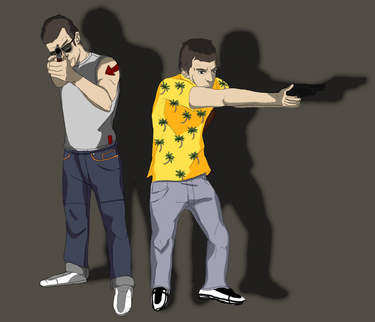
The next morning I woke with brilliant white sunlight in my face, smelling coffee. The sliding glass doors were open and Joe Pike was out on the deck. He was wearing faded jeans and a great sweat shirt with the sleeves cut off and blue Nikes and government issue pilot’s sunglasses. He rare takes the glasses off. He never smiles. He never laughs. I’d known Joe Pike since 1973 and he has never violated those statements. He’s six feet one with short brown hair and muscled the way a fast cornerback is muscled, weighing in somewhere between one eighty-five and one-ninety. He had a red arrow tattooed on the outside of each shoulder when he was in The Nam. They pointed forward.

The description today would be a little different. A little. But on the whole, Joe’s consistent, he’s grown a little bit as a character (because of Elvis, he’d assure us), but even with growth, the Joe you get in Monkey’s is the Joe you get in Taken.

Every time Joe’s name is mentioned around someone from LAPD, it’s answered with scorn (at best). Elvis will shed a little light on this eventually when Ellen asks (again, info dump — however small — and dialogue that doesn’t feel forced). But on the whole, all Crais is doing is a bunch of seeds that he’ll harvest later in a way that probably no one reading this can guess. Since this is Elvis’ narration, and Elvis is his friend, we trust that the LAPD is out to lunch on this, and this is reinforced by the clueless way they handle the disappearance of Perry Lang. Time will tell if our trust in Elvis is well-placed.

There’s a clear affection between Elvis and Joe. They trust each other, they tease each other — they depend on each other (without ever coming out and saying it). They’ve known each other more than 15 years at this point, as partners for most of that, and a lot doesn’t need to be communicated anymore

The thing that truly separates Pike from your typical mercenary/bonebreaker-as-sidekick is the way he deals with Ellen Lang. He tells her things about his past, he helps her learn to shoot, he goes out of his way to empower her — and through that, comfort her. Elvis will give her pep talks, he’ll encourage her — even force her to see reality. But Joe (unintentionally) inspires her, and then will (intentionally) show her the inner strength, the character she has and needs to meet the future. Hawk would never do that.

I’m sure I should say something about the story, too. So, Ellen Lang comes (with a lot of prompting from her friend Janet Simon) to Elvis needing help finding her estranged husband, who seems to have taken off with their son (but not their daughters). Elvis isn’t crazy about the idea, but he has rent to pay — so he takes the case and starts poking around looking for the missing talent agent. He finds Mort’s girlfriend, but that doesn’t help but it sheds some interesting light on Mort’s lifestyle. Before long, there’s a body, a couple of kidnappings, a lot of missing cocaine, and a crime boss’ Eskimo enforcer roughly the size of a small bull.

As Elvis goes through the investigation, it’s good, solid stuff carried along by his narration. But there’s nothing other than his narration and the character work he’s started to make it distinctive over any other of a dozen PI’s. But then you get to the conclusion — a big, guns-blazing, bullets-flying, implausible-but-not-really, story climax — and you really start to see the potential for this Crais guy and his pair of Vietnam Vets.

I’m not sure I’d give this 4-stars if I this was my first read of the series, or even of this book (rather than the 6th or 7th). But it’s not, I know what seeds Crais planted (whether he intended to or not), I know where’s he’s going with this and how well this sets up the books to follow. As such, it deserves no less than 4-stars.

—–

4 Stars

—–

Drawing by Kirsty Stewart, chameleonkirsty on deviantART, used with permission.

Coming soon: The Reread Project

Joe Pike and Elvis ColeOne of the things I’ve been thinking about lately is that I don’t re-read as much as I used to, so I’m making a greater effort to do that, starting in January of this year. Think I’ve managed to reread 1 book before this week. Whoops.

Anyway, I got to talking about Robert Crais with a buddy last week who was wanting to dip his toe in the water, and wanted to know if he needed to read the Cole/Pike books in order or if he could just read which ever he could get his hands on. I’m sure he regretted asking because rather than the 1 sentence answer that he was probably looking for, he got most of a page of text. And if I’d had more time before needing to get to sleep, I’d have probably written pages. And that was just off the top of my head.

I honestly couldn’t stop thinking about Elvis and Joe after that email — I’d read everything up to book nine, The Last Detective, at least twice. But had only managed to reread the first two Joe Pike books since. So the series is ripe for this kind of thing. If I manage myself correctly, I’ve got enough time to read the series before the next novel hits my doorstep in November. Which makes it a bit more appealing — I love a good deadline.

My reviews will be a bit longer (I think) than usual, if the first one is any indication, anyway (1400 words or so) — looking both at the novel and their place in the series, the changes, developments, ties between novels, themes, etc. I don’t think I’ll have time for the two stand-alone novels that introduced characters now part of the series, so we’ll have to rely on my memory for that. These should go up on Mondays — leaving the few “Dusted Off” posts that I have for those weekdays I just can’t get anything else finished.

Once I’m done with Elvis/Joe, I’ll move on to something else. I like the discipline of one reread a week. I did it with the Nero Wolfe series a couple of years ago, and really enjoyed that.

Hope you enjoy this — and if you’ve read the series, please, please contribute to the comments.

—–

Drawing by Kirsty Stewart, chameleonkirsty on deviantART, used with permission.

Saturday Miscellany — 8/9/2014

Hey, it’s National Book Lovers Day! Yay!

Odds ‘n ends over the week about books and reading that caught my eye. You’ve probably seen some/most/all of them, but just in case:

    This Week’s New Releases I’m Excited About and/or You’ll Probably See Here Soon:

  • The Magician’s Land by Lev Grossman — did I mention that I was excited about it?
  • Paw and Order by Spencer Quinn — I had one complaint about the last one in this series, I fully expect that this one will do better on that point.
  • Revenant by Kat Richardson — The release of the ninth (and final) Greywalker book is great reminder that I need to read #3.
  • Whiskey Tango Foxtrot by David Shafer — this one looks pretty darn good.

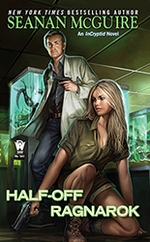
Half-Off Ragnarok by Seanan McGuire

Half-Off Ragnarok (InCryptid, #3)Half-Off Ragnarok

by Seanan McGuire
Series: InCryptid, #3


Mass-Market Paperback, 356 pg.
DAW, 2014
Read: March 21 – 22, 2014

I — like a number of people, I expect — approached this one with a sense of trepidation and a laundry list of questions: No Verity? We’ve got to start over with some other guy? Why? What did we do wrong? Why is Seanan punishing us like this? How are we supposed to get along without the Aeslin mice? (good news and minor spoiler: Alex has his own colony of them — Seanan doesn’t hate us). After about 50-60 pages, I’d admitted that McGuire knew what she was doing (how could I doubt that?) and that Half-Off Ragnarok served as a good jumping-on point for the series, or good next entry for those who’d been following it already. Alex has a similar voice to Verity, but it is different — close enough that they could be siblings, though.

The story, particularly its central mystery, was just okay. But the setting and the characters elevated the whole thing. They sold me on what was going on, and once the narrative got flowing, I didn’t notice how not-stellar the story was (I’m not saying it was bad, it just didn’t knock me out). Having a cryptozoologist working in a zoo — and doing field research nearby, gave this a different feel from Verity’s nightclubs and sewers — like maybe there was something less haphazard about it this endeavor.

But more than anything else, the characters are what sell this story. There’s Alex’s Gorgon assistant, Dee; a little girl I won’t describe for your sakes here (you want to discover her eccentricity on your own); there’s Alex’s grandparents; his pet griffin, Crow; the aforementioned Aeslin mice; and the knock-out blonde Australian who works at the same zoo that he does. Best of all, his and Verity’s cousin, Sarah. She’s staying at their grandparent’s home for awhile to recover from what happened to her at the end of Midnight Blue-Light Special — well, hopefully recover, anyway. Sarah’s presence helps link the installments of the series together, helps us trust Alex more right away for the way her treats her.

A couple of notes about this world McGuire’s building here. Without getting into details, it was very nice to see that there are options other than the Prices and the Covenant for humans who are aware of the cryptozoological populations, it makes it all a little less David and Goliath. The other thing that’s highlighted here is just how different groups/species view the Prices. Which isn’t exactly all positive — there’s suspicion, distrust, antagonism, begrudging respect — along with more positive views. I got that impression during the Verity books, but it’s underlined here. This is a fun world, and it’s nice to see it fleshed out.

I like Alex, and would gladly read more of his adventures–at home or abroad. I would also like to check in on Verity again — and soon — as she was our entry point into this world, but it’s possible I like Alex more at the end of the day. Unlike Verity, he’s all in when it comes to this work, and doesn’t spend so much time wanting to do something else. Although, Verity’s conflict between her duty/interest in cryptozoology and love for dance is one of the things that makes her interesting. Never mind, my guess is that my favorite Price sibling is whichever one I’m reading/just finished reading. Just give me more of both of them.

—–

4 Stars

He Drank, and Saw the Spider by Alex Bledsoe

He Drank, and Saw the Spider (Eddie LaCrosse, #5)He Drank, and Saw the Spider

by Alex Bledsoe

Hardcover, 320 pg.
Tor Books, 2014
Read: August 6, 2014

After a couple of adventures which aren’t quite typical in their nature, Eddie La Crosse gets back to basics with a fairly straightforward case. Well, that’s not exactly true — it ‘s just that the last two were more outlandish, more grand-adventure-y, less LaCrosse-as-sword-jokey. This is Eddie doing what he does best. Yes, there’s magic, and monsters, and all the other trappings that keep this from being something that Sue Grafton or Dennis Lehane would’ve written.

Sixteen years ago, Eddie promised a dying man on the run that he’d take care of the baby that the other man was running to protect. He found a seemingly-trustworthy family willing to take the infant in, and went on his merry way, and actually forgot all about the incidents surrounding that. Until years later, when Eddie and his girlfriend, Liz, are on vacation in that area, when suddenly it all comes back to him and he decides to try and track down the (now) young woman and see how she’s doing.

Naturally, things start to go poorly about there. He does find her — pretty easily, too — it is a small community, with an economy largely-based on sheep-herding and farming, so it’s not really a bustling metropolis where no one knows anyone else. But there’s a whole lot of interesting things happening around the young woman — royalty in disguise, a meddling sorceress, an untrustworthy mercenary-type, an over-protective mother, a dose of sibling rivalry, and some sort of articulate and super-strong inhuman creature with a healthy interest in the girl.

Even though he was just supposed to check on her and not interfere with her life — he had no intention of even introducing himself to her. Eddie can’t help himself, and before you know it, he’s neck-deep in intrigue, and danger.

On the whole, this is a fun, brisk novel — a lot of humor, some good action, nice banter and interaction between the characters (especially Eddie and Liz). A good change of pace over Dark Jenny and Wake of the Bloody Angel, which tended to be more on the serious, emotionally-charged side. Yet, even as the answers to the questions surrounding the girl’s mysterious origins become obvious, and some of the characters get to the point where they seemed a irredeemable, Bledsoe (as he can every so well) keeps you completely drawn in and even tugs the heart strings a bit as the truth is revealed to the characters. Just really, really well done.

There’s a lot of nice little touches along the way. For example, towards the end of the book, Eddie and those he’s traveling with encounter a preteen who joins their little band for a while. She’s pretty new to swearing and tries to get in as much practice as she can while with them. At first, I thought she was an odd (but entertaining) and pointless distraction. It didn’t take too long to see she was a perfect tension-breaker, just what that part of the novel needed to keep from being too tense and so much more serious than what had come before.

Eddie’s narration has never been better — humor-tinged and hard-boiled, a medieval Philip Marlowe or Elvis Cole. I liked all of these characters, and really wanted to spend more time with each of them — I don’t know how Bledsoe could’ve pulled that off without getting the whole thing to slow and ponderous (which would’ve sucked the fun out of 60-70% of these characters). This is really such a well-done and fully realized series. I can’t wait to see what happens next.

—–

4 Stars

Reading Day

Sorry, no new post today — outside of this notification. The review I’m working on is taking more time/energy than usual — and I need to do a little more reading today, too.

There are things afoot here, readers, that I’m pretty enthused about, and I hate to take a day off. But ya gotta do what you gotta do, right?

Page 2 of 3

Powered by WordPress & Theme by Anders Norén