Month: February 2016 Page 1 of 4

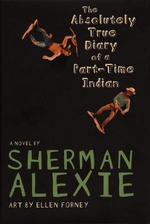
United States of Books – The Absolutely True Diary of a Part-Time Indian by Sherman Alexie

The Absolutely True Diary of a Part-Time IndianThe Absolutely True Diary of a Part-Time Indian

by Sherman Alexie, Ellen Forney (Illustrator)

Author: Elisha at Rainy Day Reviews

Entertainment Weekly says about their Washington state pick– “Alexie grapples with serious issues through the not-always-serious voice of a 14-year-old caught between his life on the reservation and his entry into an all-white high school.”

Synopsis:

Bestselling author Sherman Alexie tells the story of Junior, a budding cartoonist growing up on the Spokane Indian Reservation. Determined to take his future into his own hands, Junior leaves his troubled school on the rez to attend an all-white farm town high school where the only other Indian is the school mascot.

Heartbreaking, funny, and beautifully written, The Absolutely True Diary of a Part-Time Indian, which is based on the author’s own experiences, coupled with poignant drawings by Ellen Forney that reflect the character’s art, chronicles the contemporary adolescence of one Native American boy as he attempts to break away from the life he was destined to live.

Review:

I was intrigued with this book once I learned that this story was based on the author’s own experience. I was not aware of the coarse language in the book until I began reading it; which in my opinion makes this read inappropriate for younger readers. However, that said, I did appreciate that even though this teenager saw a lot of heartache and injustice, including racism and death, there is a lot of laughs throughout the story.

I like the narration of the book, hence the title. That was different than the typical read. Gave it a different feel from a story being told. Even with the racial divide in the story that the boy dealt with, I think this story is very relatable to other young adults out there (tragedy in life, being bullied, and the instability that life can bring with its ever-changing twists that life tends to do to all of us. All in all, a good book and a quick read that I would definitely recommend to everyone to read.

* Disclaimer: language may be coarse for some readers*

Saturday Miscellany – 2/27/16

If you haven’t had time to weigh-in on Wednesday’s post about books that left you a wreck , take a second and do so, would you? I’m enjoying what you all have come up with.

I was on the road last week when I got the news about Harper Lee’s death, so I couldn’t add anything to the scheduled post for Saturday. But it’s no secret that I loved her stuff, and the news saddened me. Sure, we all knew that we weren’t going to get anything new from her, and that she was in declining health. But, to hear that she’s gone, just seems wrong. I tried to come up with something on my own, but my words were inadequate. Here’s a small sample of the tributes that were worth reading and resonated most with me:

Now for the odds ‘n ends over the week about books and reading that caught my eye. You’ve probably seen some/most/all of them, but just in case:

    This Week’s New Releases I’m Excited About and/or You’ll Probably See Here Soon:

  • The Absconded Ambassador by Michael R. Underwood — the 2nd Genrenauts novel. I dug it and I think you will, too.
  • Out of the Blues by Trudy Nan Boyce — An Atlanta Police Dept. vet turns mystery author. This will bleed authenticity. Looks like a good novel, too.
  • The Drowned Detective by Neil Jordan — this detective novel looks as thoughtful and moving as one of one of his movies.
  • The Forbidden Wish by Jessica Khoury — an intriguing looking YA-take on Aladdin.
  • Kill the Boy Band by Goldy Moldavsky — The title’s enough, right? When being a Super-fan goes awry.

Lastly, I’d like to say hi and welcome to Bibliophage and greenlanddiary for following the blog this week.

A Few Quick Questions With…Vanya Ferreira

This morning I blogged about Vanya Ferreira’s story, “The Story of Lucius Cane: Book One,” a promising start to a series of stories about an atypical Vampire. Vanya was kind enough to take part in a little Q&A with me about his writing in general and his upcoming projects. I kept it short and sweet, because I’d rather he work on those project than take too much time with me, y’know?

What got you into writing? Who are some of your major influences? (whether or not you think those influences can be seen in your work — you know they’re there)
That’s actually a very interesting question. I remember my parents reading to me as a child and as I got older, my friends would be out and about, while I roamed in the library. I always found the library to be my sanctuary; a place where different worlds, knowledge and realities all overlay. I guess that it was all the reading that got me into writing but this only came much later; I did, in fact, actually despise English as a subject at school. Some of my major influences would have to be Stephen King, Paulo Coehlo, Oscar Wilde, Aldous Huxley, George Orwell, Christopher Paolini and many more.
About Lucius Cane: how many stories do you have in mind for this? Or are you going to expand this into a novel?.
I’m actually thinking about having 3 to 4 books for this series which would include a complete background of who Lucius is. However, to keep something of the mystery and why he is who he is, I plan to release the background as the final book in the series. I don’t think that I’ll expand it into a novel but I’ll rather just keep it as a short story collection that flows into each other. I have noticed with today’s society that our attention spans have gotten rather short and I think that this makes the story easier to read and keeps the excitement for what’s to come next.
Your Amazon bio says that you’ll have Crime Thriller out this year — what can you tell us about that?
Yes, indeed, I am. At the moment it is still very much a work in progress and doesn’t have a title yet. I believe that it will be quite different than most crime thrillers out there since it closely follows the life of the killer himself as the main character. I wanted to create something that would take the reader through the emotional depths and the crevices of madness that I imagine many killers must feel. For example, the serial killer William Heirens (a.k.a The Lipstick Killer) actually wrote a call for help in lipstick at one of his crime scenes, which just goes to show how difficult it must have been for him to be, well, who he was. So my aim for the novel is to try and transform that mental disparity and transport the reader into the world, and hopefully mind, of a killer.
In the writing of “The Story of Lucius Cane”, what was the biggest surprise about the writing itself? Either, “I can’t believe X is so easy!” or “If I had known Y was going to be so hard, I’d have skipped this and watched more TV”.
About the writing itself? Hmm… I think that I was quite surprised at how easily the story unfolded. I remember that I had the vague idea of someone watching a girl from the bushes, as seen in the prologue, and the rest just seemed to flow. I admit, however, that there were days in between where my inspiration just flat-lined but it seems that to just continue writing would spark it back up. Apart from the writing, I would have to say that the biggest surprise, by far, was the amount of work it takes to actually publish and promote a work. Looking back, it’s quite clear that writing was merely the first, and easiest, stage; it’s the promoting and getting it out there where the real work is at.

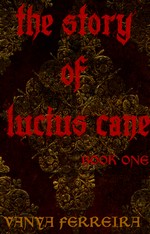
The Story of Lucius Cane: Book One by Vanya Ferreira

The Story of Lucius CaneThe Story of Lucius Cane: Book One

by Vanya Ferreira

Kindle Edition, 27 pg.
Vanya Ferreira, 2016

Read: February 23, 2016

This first installment is a tale of a couple of atypical takes on supernatural staples.

It’s London in 1794 and we meet a different kind of vampire (for reasons that are sort of explained), but except for one little quirk of personality, he seems like your typical pre-Victorian Vampire. The quirk does seem to save lives, so it’s endearing.

Jack ‘The Hound’ Estenborough is lycanthrope-ish. A former pirate, now loanshark (and his own leg-breaker). A man as synonymous with violence as he is with body hair.

The two are manipulated into a showdown, and face-off in a knock-down, drag out fight which is the kind of thing everyone who watched a Lon Chaney flick as a kid wanted to see.

This was a quick story, so there’s not a lot to say, not much time for character development or anything like that. It wasn’t the most skillfully told story, but it got the job done and kept you reading.

There was a good chunk of info dumping with one character, where he only hinted at things for the other. Obviously, the treatment of the other primary character was better — but I didn’t mind the info dump too much, the title tells you the story’s not about The Hound, so no need for gradual reveal — also, it was a fun, quick info dump.

Ferreira made some odd vocab choices — some words (especially in idiomatic phrases) that are almost, but not quite right. But when someone living in Serbia writes in English, I figure that’s a risk you run — and it’s never too distracting.

There were a few questions left by the story, but you can tell that Ferreira has an answer ready for them, he just needs the space to relay them. That, and the cliff-hanger ending, demand a series of these stories (as does, the title, I guess) — or a novel. I don’t care which, as long as I get to read it.

Disclaimer: I was provided a copy of this story by the author in exchange for an honest review.

—–

3 Stars

Opening Lines – Morning Star

We all know we’re not supposed to judge a book by its cover (yet, publishing companies spend big bucks on cover design/art). But, the opening sentence(s)/paragraph(s) are fair game. So, when I stumble on a good opening (or remember one and pull it off the shelves), I’ll throw it up here. Dare you not to read the rest of the book.

Deep in darkness, far from warmth and sun and moons, I lie, quiet as the stone that surrounds me, imprisoning my hunched body in a dreadful womb. I cannot stand. Cannot stretch. I can only curl in a ball, a withered fossil of the man that was. Hands cuffed behind my back. Naked on cold rock.

All alone with the dark.

It seems months, years, millennia since my knees have unbent, since my spine has straightened from its crooked pose. The ache is madness. My joints fuse like rusted iron. How much time has passed since I saw my Golden friends bleeding out into the grass? Since I felt gentle Roque kiss my cheek as he broke my heart?

Time is no river.

Not here.

In this tomb, time is the stone. It is the darkness, permanent and unyielding, its only measure the twin pendulums of life — breath and the beating of my heart.

In. Buh . . . bump. Buh . . . bump.

Out. Buh . . . bump. Buh . . . bump.

In. Buh . . . bump. Buh . . . bump.

And forever it repeats.

from Morning Star by Pierce Brown

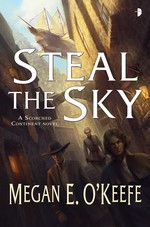
Steal the Sky by Megan E. O’Keefe

Steal the SkySteal the Sky

by Megan E. O’Keefe
Series: The Scorched Continent, #1

Mass Market Paperback, 439 pg.
Angry Robot, 2016

Read: February 20 – 23, 2016
It’s both overly-simplistic and inaccurate to describe Steal the Sky as The Gentlemen Bastards in the Firefly ‘Verse. But it’s not completely wrong.

I’m not sure I can defend that, but I tell you this: read the book and you’ll probably agree. I’m going to try to reference those other works as little as I can, because the book is more than just a combination of their DNA, but I’m going to have to a couple of times. There’s also a smattering of Steampunk-ish elements, some Epic Fantasy-like things, and a dash of The Stainless Steel Rat. You know how Data downplayed his violin playing as a combination of all those various artists, and Picard and Crusher (I think it was her, anyway) telling him that he’s the one who took all those various characteristics and made it his own? That’s what O’Keefe did here, and I hate to minimize what she did by just referencing these other works — but in the interest of brevity, you pretty much have to. I, frankly can’t wait to see in future books what other ingredients she puts in her secret sauce.

But before then, we have to step onto the Scorch, an unforgiving continent, to be sure.

What is it with SF novels and mining? Everywhere I turn lately, there are people slaving away (literally) in mines — Pierce Brown’s Darrow (and the rest of the Reds); almost everyone on Josi Russel’s Minea; and countless people in Aransa and the rest of the Scorched Continent. Really, it wouldn’t surprise me to see Raylan Givens and Boyd Crowder’s descendants digging for spaceship fuel next year on FX. One reason that you see them everywhere is that it’s really effective — you read “miner” and you see poor workers, toiling in unsafe conditions, who are very likely being taken advantage of. If that’s not grounds for compelling drama, well — did you not get where Katniss Everdeen was from?

Like on Minea, there’s a special kind of person who can find the precious resource, called Sel. Sel-sensitives — no matter what their social class, family, or other abilities — go work in the mines (well, a very few become pilots). They can find Sel, they can manipulate Sel, they are the key to getting it out of the planet and into their ships (as an aside, Sel seems to be somewhat renewable, which is nice). The last things the government wants is turmoil — and the thing they want most are Sel-sensitives who can do more than get Sel out of the ground.

The Scorched Continent looks and acts like something from the Old West (at least as we know it from movies, TV, etc.) small communities, mostly poor, with some nobility with a lot of on the “have” side of the equation. Which is where Detan Honding comes in — he’s the black sheep of the oldest of the noble houses, a small-time con man staying one step above starvation and another step ahead of the law (I’m about to break into “Street Rat” from Aladdin, so I’m going to stop). Along for the ride is his long-suffering ship’s pilot, friend, and resident voice of reason (probably the only one who keeps him from getting carried away), Tibs.

The two find themselves in Aransa, a larger city with a big mine. Detan and Tibs are known in some quarters of the city, most notably by the Captain of the Watch, Ripke Leshe, who wants them out of town. But has a unique business proposal first . . .

This is getting too long — let’s leave things there, with some people left for you to meet. And you want to, trust me. Including the villains — both petty and Big Bads (especially the Bigger Bads that you don’t think of that way at first).

O’Keefe has created a great world, with a robust culture, a specialized vocabulary, its own technology, politics and whatnot. There’s a whole invaders taking exploiting indigenous/traditional cultures thing that’s also going on — but O’Keefe doesn’t spend too much time on it, just gives us a quick glance of that — but it looks like future books will explore this more. So I’ll just leave it there, but I’m pretty curious about the whole thing. Speaking of local customs — anytime people talk about Walking the Black — put aside anything you may be snacking on.

Now, since I (and many others) have invoked The Gentlemen Bastards and Firefly, I should say that both of those have a sense of fun — a sense of play — that’s really not that present in Steal the Sky. You get the impression that maybe (probably) whatever happened before this did, though. This book is mostly like the part of Lynch’s work where play time is over and Locke is going for vengeance, not just a payday. Which is not to say that isn’t fun — there are plenty of laughs, jokes, witty rejoinders and whatnot — I’d love to quote some, but the amount of context it’d take for the you to get the joke would kill this. This novel doesn’t have the joie de vivre that the other works do, but it could.

One more Firefly reference and I’m done — towards the end, when things look pretty dire for some of our characters — you get the impression that O’Keefe spent a lot of time wondering just what happened to River while at The Academy, and a few people here would probably find themselves capable of swapping notes with Ms. Tam.

There’s excitement, piracy, politics, thievery, general mischief, subterfuge, revenge, friendship, loyalty in this story — told in a great world, with hints of more worlds to come (as well as more to learn about this one). People are going to be talking about this one for a while, I think. I am, at least.

—–

4 Stars

I’m Curious: What Was the First Book That . . .

I hate these kind of days — I try to get something up at least 6 days a week. But some days a combination of my job, parenting, husbanding and need for sleep — IOW, the stuff that happens when I’m not reading or blogging — has to take precedence. Today’s such a day.

I did accomplish some things today for the blog, but it’s all behind the scenes stuff and/or things I can’t post quite yet.

Anyway. . .

This was asked a couple of weeks ago on some Facebook group I belong to and I thought the answers were interesting enough, I’d ask you:

If you can remember, what was the first book that destroyed you?

For me, it was either: Where the Red Fern Grows (which I read most of several times, and all of a couple of times); The High King by Lloyd Alexander between the deaths and goodbyes, I still can’t do it dry-eyed; or Bridge to Terabithia — I can’t tell you anything about the plot (there were 2 kids, 1 girl and 1 boy, right?), the characters or anything, and I read it 2-4 times — all I can remember is emotional devastation.

Looking forward to hearing from you. Share the emotional scars we all know you have. 🙂

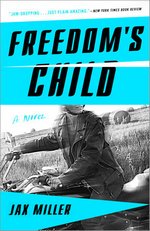
Freedom’s Child by Jax Miller

Freedom's Child Freedom’s Child

by Jax Miller

Trade Paperback, 308 pg.
Broadway Books, 2015

Read: February 19 – 20, 2016

The open road gives you ample opportunity to think; in fact, the road forces reflection on a man . . . or woman, in my case. And it’s a terrifying thing, my thoughts. With each thought, each idea, each regret that makes my blood curdle, I accelerate, I race fast enough on the motorcycle so my demons can’t catch me, but they always seem just a step ahead of the game, always there to entertain my sin.

Ugh. This book set my teeth on edge from the get-go. Yet another story with a Prologue that puts our narrator in a life-or-death situation, so you can turn the page to get “X period if time earlier” (two weeks ago, in this case) to create suspense, or a sense of anticipation, or whatever. I hate those beginnings, books, movies, TV – – hate ’em all. They’re almost never worth it. This is one of those times, Chapter 1 is a much better starting point.

Once we get past that nonsense, we meet Freedom. She’s a tough-as-nails bartender outside of Portland, OR, working in a bar that’s been adopted by a biker gang. The first thing we see Freedom do, is save a girl from being raped by a large biker in a way that will keep you nervous around McIlhenny Co.’s signature product for awhile. So you know it’s not just bluster, it’s not just attitude and language — Freedom is not someone to mess around with. It turns out that Freedom’s in the Witness Protection Program, and the same Marshals that come by to tell her to stay out of trouble, are also here to let her know that the man she put away just got out on a technicality after 18 years.

It’s almost like they know that someone had gained access to their records and that her new identity is known by all the people she doesn’t want to know. Namely, her murdered husband’s family, including his newly released brother and his non-incarcerated brothers. The destruction and violence that come to Oregon are a clear sign to Freedom that the Delaney brothers are here for her and the Feds can’t help her. So she takes matters into her own hands, because it’s not just her that they’re after. She had two children with her husband, and had been forced to give them up. If her new identity is known, their identities would be, too. So she’s off to the other side of the country to try to keep them safe, although there’s enough drama in their lives without their uncles coming for them.

That’s enough of the plot to whet your appetite. It gets better from there — more twists and turns than the Publisher’s Description suggests. I can’t imagine that Miller could’ve fit in one more twist without needing to add a couple of chapters. But before you get to all that, you have to endure a lot of Miller setting up her dominoes. It was hard to slog through it all without enough context and many perspective changes (I think we could’ve just used a smidgen more context with each perspective). But you watched her set them all up, because you could tell all along that when they started to fall, things were going to be wild.

I don’t want to talk about the characters — seeing them revealed was a lot of the fun. There’s one exception to that: Freedom’s Mother-in-Law, Lynn. I felt like I needed a shower after reading the first 2 pages of with Lynn — one of the nastiest characters you’ll come across in 2016. I hoped right away that Lynn would get what’s coming to her (and that feeling only intensified). But you could tell straight-away that this was the kind of book where just desserts weren’t on the menu for everyone (oh man, when did I become Horatio Caine?), and I had to deal with this sense of dread that she’d make it. There’s a certain amount of pleasure you get from Hannibal surviving The Silence of the Lambs (but not Hannibal — while waiting Lynn’s fate, you feel the exact opposite.

This next paragraph, I’m a little apprehensive about, but I’m going to go ahead and write it: There’s a cult involved, and I have a little trouble with it (as I write it, I’m sure with some research every one of my objections can be brushed aside by someone, and I’m hoping Jax Miller is one such person). The cult reminded me of a phenomena I ran into with Flannery O’Connor in college — her Southern Protestants may have sounded like typical Baptists/Methodists/etc., but their thinking was awfully Roman Catholic. These cultists looked, sounded, and acted like Pentecostal Christians, but they were infused with an odd amount of Roman Catholic practices. So much so that it was hard to swallow. It almost felt like someone took a bunch of noticeably religious practices and terms and mixed together, assuming the reader would just accept the blend, whether or not it was consistent. I’d absolutely believe it if someone could point to a Group Z and said that Miller just ripped them off, but absent that these guys were too much to believe.

This was a well-constructed and satisfying read with characters that leapt off the pages (except for the minor Delaney brothers and a couple of other miscellaneous people). It didn’t end anything like I expected it would, but superior. I spent the whole time thinking it was a book about X, when it was about Y all along (although, it was kind of about X). The novel makes you think it’s about revenge (or the escaping from it), but at the end of the day, that’s just not what it’s concerned with. This was an entertaining read, maybe not as good as it could’ve been, but enough to make me to keep my eyes peeled for Jax Miller’s future work.

Disclaimer: I received this book from the good people at Blogging for Books for this review.

—–

3 Stars

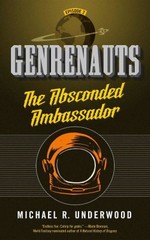
Reposting: The Absconded Ambassador by Michael R. Underwood

It’s Publication Day for The Absconded Ambassador, so I thought I’d better throw this up again. Go get your hands on it.

The Absconded AmbassadorThe Absconded Ambassador

by Michael R. Underwood
Series: Genrenauts, Episode 2ARC, 159 pg.
Tor.com, 2016
Read: December 31, 2015

Working as a Genrenaut was like being a member of a theater troupe run by a burnt-out hippie who melded Devising with MBA management: the ideas were outlandish and random, but the execution was 100% corporate.

Now this was a way to close out 2015 — the second episode in Michael R. Underwood’s Genrenauts delivers on the promise of Episode 1, and demonstrates that his special alchemy of Leverage + The Librarians + Quantum Leap + Thursday Next (just my current guess at his secret recipe) has legs — and will hopefully go a long time.

Leah has had about a week to get used to this new reality since her adventure in Western World — a week filled with meetings, reading assignments and trying to wrap her head around things. In the meanwhile, everyone at Genrenauts HQ is trying to prepare for the next breach (in the midst of a spike of 15% over the norm, for your corporate types), probably in Romance World. Which obviously means it’ll be pretty much anywhere else, like say Science Fiction World.

The station of Ahura-3, in the space opera region, to be specific. I’m sure the similarity between the name of the station and a certain Communications Officer is a huge coincidence. Ahura-3 is everything you want in a space station — it’s a melting pot of very-alien-looking/acting aliens, it’s a culture to itself, with strategic location, and very delicate intergalactic politics.

Leah’s excitement about being in “honest-to-goodness, Sally Ride is my homegirl zero-g” space was infectious. But even more fun was the amount of SF references Underwood fit into half of chapter 1 — truly astounding, and didn’t feel forced or overcrowded. He deserves a tip of the cap right there. I made it all the way to page 42 without having to Google one of them (I think there was only one other time I had to grab my smart phone). But the fun’s not limited to the references and allusions — it’s in the alien cultural practices (and appearances), the various factions (human and otherwise), businesses, and just watching the whole Science Fiction World thing at work.

One thing that’s been niggling at the back of my mind with these Episodes is what’s to keep Leah from being Ree Reyes 2.0? Underwood seems to be going with keeping Leah from the more Parker/Eliot Spencer-type roles and moving her into the Sophie Devereau/Alec Hardison-type roles. She and Shirin scramble all over the station trying to keep treaty negotiations moving forward. They’re thinking on their feet, using their wits, charm and SF knowledge to keep things under control — Leah’s on-the-job training under Shirin helps the readers acclimate to this world, too. The action-hero needs are served by the rest of the team, Roman and King — whose banter while throwing punches, engaging in dogfights, and so on, kept the fun going (honestly, maybe was a little more fun than the rest).

In Episode 1, I wondered if the pilot nature of the novella kept it from being everything I wanted it to be. The Absconded Ambassador built on that ground work and gave us a solid, fully-formed adventure — everything I hoped it would be. And that’s just in the main story, there’s all this other stuff going on: not only do we have a sense of impending doom — or at least very big crisis — coming to the Multi-Genre-Verse. But now we’ve got some sort of secret within the team (not one that’s going to cause much trouble, I don’t think — but you never know), and (according to the preview for Episode 3) maybe some intra-team conflict. Underwood just nailed here, and Genrenauts is about half-a-novella away from being his most consistently entertaining work.

I won a copy of this in a drawing on the author’s website — which means I got to read it two months early — and I got a very nice autograph on the title page. The downside is, I have to wait longer than I’d have had to wait otherwise between Episodes 2 and 3. I still came out ahead, but not by much.

—–

4 Stars

United States of Books – My Antonia by Willa Cather

My AntoniaMy Antonia

by Willa Cather

Author: Teri at Sportochick’s Musings

Blurb

Through Jim Burden’s endearing, smitten voice, we revisit the remarkable vicissitudes of immigrant life in the Nebraska heartland, with all its insistent bonds. Guiding the way are some of literature’s most beguiling characters: the Russian brothers plagued by memories of a fateful sleigh ride, Antonia’s desperately homesick father and self-indulgent mother, and the coy Lena Lingard. Holding the pastoral society’s heart, of course, is the bewitching, free-spirited Antonia.

Review 2 1/2 Stars

This story is narrated in first person by Jim Burden in what I think is a very plain unemotional manner. I honestly had a hard time reading this book and at points kept putting it down. It was puzzling to me that for all of the unusual dramatic events in this book it was for me unemotional. I am not sure if listening to it on Audible and switching off and on with the book impacted my feelings. Though these dramatic events in the book were described in fine detail my mind felt a distance from the writing.

Two characters did stand out. Antonia who was very expressive and Jim’s grandfather for the ways that he dealt with crisis’s, personality issues and his deep integrity. Antonia throughout the book was very emotional and it was obvious to see why quiet Jim liked to be around her and had grown to love her.

I finally connected with the book in the last chapter and a half where it became to me a book worth reading. This part of the book make me feel great sadness for Jim and Antonia and where they were 20 years later. The ending was poignant and still brings tears to my eyes.

This book leaves the readers pondering the what if. What if Jim didn’t go away to college? What if Antonia made a different decision when her first love deceived her? What if Jim had told her he loved her? But the largest question that I had was how did Jim love Antonia? A sister, friend, lover? This book left me feeling sad because if Jim had more gumption his life would of been so different than it was. It also left me pondering on how many people lost out on the best thing of their lives because they were afraid.

Page 1 of 4

Powered by WordPress & Theme by Anders Norén