Category: Quotations Page 1 of 31

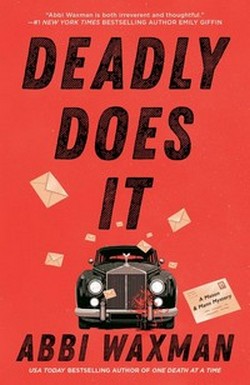
Opening Lines: Deadly Does It by Abbi Waxman

Head & Shoulders used to tell us that, “You never get a second chance to make a first impression.” That’s true for wearing dark shirts, and it’s especially true for books. Sometimes the characters will hook the reader, sometimes the premise, sometimes it’s just knowing the author—but nothing beats a great opening for getting a reader to commit.

It wasn’t that Mason was vain. It was just that if anyone was going to mess up her face, she wanted it to be her. She already had two piercings in one eyebrow, two in her nose and multiple holes in her ears, but the guy approaching her with a slender but very pointy ice pick seemed to think something more central was going to really pull her look together.

Not that aesthetics were his primary concern.

“I’m going to hurt you,” he said, his breath a little ragged. Mason had just punched him in the gut, and he’d taken it badly.

from Deadly Does It by Abbi Waxman

Opening Lines Logo

Opening Lines: The Daughters’ War by Christopher Buehlman

We all know we’re not supposed to judge a book by its cover (yet, publishing companies spend big bucks on cover design/art, and we all do judge them that way). But, the opening sentence(s)/paragraph(s) are fair game. So, when I stumble on a good opening (or remember one and pull it off the shelves), I like to throw it up here (especially if I’m out of time to come up with a post that involves writing on my part).

from The Daughters’ War by Christopher Buehlman:

I saw my first goblin the same day I saw my first shipwreck.

I was under sail, on my way to war.

On my way to fall in love with death, and with a queen.

On my way to lose all of my friends, and two of my brothers.

I would see a great city fall in blood and fire, betrayed by a false god.

Later, I would be commanded to die on a high stone bridge, but I would fail in this.

The rest of the First Lanza of His Majesty’s Corvid Knights would not fail.

This is not a happy story, but it is a true one.

I have no time for lies, or for liars.

Opening Lines Logo

Opening Lines: First Mage on the Moon by Cameron Johnston

Head & Shoulders used to tell us that, “You never get a second chance to make a first impression.” That’s true for wearing dark shirts, and it’s especially true for books. Sometimes the characters will hook the reader, sometimes the premise, sometimes it’s just knowing the author—but nothing beats a great opening for getting a reader to commit.

“You must meet the most interesting people on the gallows,” Whitlaw Goddard said to the black-hooded man readying his noose. The wooden stool creaked beneath his bare feet as he shifted, earning him a cuff that left his ear throbbing. The large audience chattered among themselves, making jokes and mocking, waiting for the day’s entertainment to begin.

The silent executioner didn’t dare talk with the heretic the corrupt hierarchs held responsible for conniving to land a mage on the holy moon, home of the gods. He ignored the condemned mage and pulled a length of rough rope taut, checking that it would hold the weight of his portly criminal. The man grunted in satisfaction and tied the end into a looping knot just large enough to accommodate Whitlaw’s head.

The mage shuddered and swallowed back down the sudden burn of bile. He’d never been one for pointless small talk, but with his hands bound and his magic sealed, a rising panic lent desperate energy to his tongue — as if by some miracle he might charm the dour executioner into sparing his life.

from First Mage on the Moon by Cameron Johnston

Opening Lines Logo

Highlights from May: Lines Worth Repeating

Under a picture of someone highlighting lines in a book, the words: 'Highlights of the Month: Lines Worth Repeating'
This is a few weeks late–but I think these lines are worth it.

Personally, this was one of the more enjoyable lists to compile in this series. Hope I’m not alone.

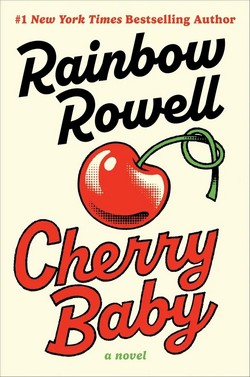
Cover of Cherry Baby by Rainbow Rowell

Cherry Baby by Rainbow Rowell

The tears on Cherry’s cheeks were fat.

In the months after Tom left—and the months after it became clear that he wasn’t coming home—Cherry’s tears had changed.

There were days when her eyes felt so full, the tears ran in rivulets. She’d swear that crying had never felt that way before—that before, she’d cried drops, and now, she cried streams. There must be some science to it, one sort of crying for transient pains and another sort for crippling grief.

Cherry should mind her own business… But the point of holidays—the point of family—was to mind everyone’s business.

A fat girl can’t wait for boys to pluck her like a flower or find her on the beach like a seashell.

Cherry had never been Cinderella. She’d always been the prince chasing down what she wanted. (She’d been a witch, enchanting apples.) She’d had to reach for things. For love. For attention.

Cherry had trusted Tom. She’d taken him for granted—she’d thought that she was supposed to. She’d believed they were a settled question.


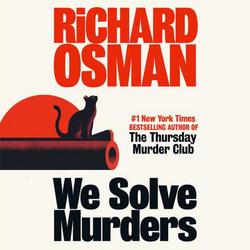
Cover of We Solve Murders by Richard Osman

We Solve Murders by Richard Osman

“If someone does try to shoot me this week, do you have to dive in front of the bullet?”

“That’s the idea,” says Amy, without conviction. “Though that’s mainly in films.”

It’s hard to dive in front of a bullet, in Amy’s experience. They go very fast indeed.


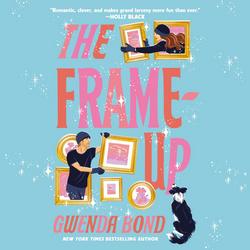
Cover of The Frame-Up by Gwenda Bond

The Frame Up by Gwenda Bond

Memory was a House that always seemed to win, rewriting history for either maximum escape or maximum pain.

When she took the dog to the local shelter, they’d said, “Her owner died. We can’t keep her from escaping, she’s a Houdini.”

“Is it a kill shelter?” she’d asked, a last-ditch. It had been.

So then she had a dog.

Yet, in the lowest, quietest moments of life, a dog made you feel redeemable. If a dog loved you, you must not be all bad.


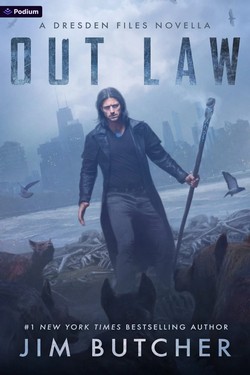
Cover of Out Law by Jim Butcher

Out Law by Jim Butcher

…relax, kid,” Bear said quietly. “I’ve been doing this a long, long time. I’m better at avoiding trouble than most. And if I can’t, I can at least promise you a glorious death.”

Fitz grimaced at her and said, “I know you mean that to be reassuring.”

Bear grinned. “Like the wizard said—this is the job, kid. Make peace with it.”

I’ve been through a lot. Some of the scars show. I do not look like a pleasant person. I have resting wizard face, which is to say I often look like I have had it up to here with everyone’s nonsense.


Cover of Book of Spores

Book of Spores edited by Frasier Armitage, Eleni Argyró, Adrian M. Gibson & Ed Crocker

“On the Magic of Mushrooms: An Introduction” by Eleni Argyró

Stories are psychedelics in narrative form, and writers the shamans, healers, diviners, mediators, priests. With each word, the folds of readers’ brains expand, the doors of their perceptions open, and the fabric of reality shifts to encompass new ways of thinking, seeing, and believing.

“Farlen and The Tower of Decay” by Ryan Kirk

“You’ve got the look about you. I’ve seen it before, and it tells me you aren’t likely to see the sunrise.”

“But if I do, they’ll sing songs about me long after death eventually claims my soul.”

The stranger stared a moment longer, then shrugged and turned away, as though he’d just been in conversation with a ghost.

“The Fungitive” by Tom Bookbeard

So, make no mistake, starting my day with a guy grinding a bowie knife into my palm before I’ve flicked on my espresso machine isn’t high up on my list of morning routines.

“A Serious Track” by Krystle Matar

He was especially watchful over Eddie, because he saw— like most adults around us saw— that Eddie desperately needed someone to be especially watchful over her. From the time we were kids, she had a distance in her, a kind of distance that gave the impression that she’d just as soon disappear into the aether if you took your eyes off her for too long. A distance that drew people in, made them want to lean close and catch ahold of her before she vanished.

“A Serious Track” by Krystle Matar

I was too young to know that Uncle Victor’s supper club was at least thirty years out of fashion— too young to understand that it was mostly gold leaf and overly wrought, a pretender’s attempt at approximating wealth. It was a child’s understanding of luxury, built on the assumption that if it glittered, it must be glamorous. In that way, I was the perfect audience for Uncle Victor’s display. With my child’s covetous perspective, I wanted to touch every gilded chair, every sparkling lamp, every crystal cut candle holder on every gleaming wooden table. I wanted to sink into that place, to become a feature of it, wanted to be the sort of person who commanded so many beautiful things, empty though they were.

I remember wondering what living in Washaw must have been like, with all those nice lawns and clean alleyways and freshly painted front doors, what it must have been like to live a life where being busy was optional, where you could just hide from the world and the weather when a storm was brewing. Back in the Flats, our streets were always busy, rain or shine, because no one had the luxury of waiting for the clouds to clear in the interest of staying dry.

A gun has a habit of betraying the slightest tremor as the metal pieces clunk together, but my hands were always steady when I was doing dangerous things, no matter how much my heart raced or my breath rattled or stomach twisted itself into knots.

“The Road to Fungaddicticon” by DB Rook

Simeon was lost to the shrooms. Had he been straight- headed, he would argue he was found, but his drooling, slackened face and his ebbing pulse would have you believe otherwise.

Near-death experiences, hallucinogenics, mile after mile of hard travel, not to mention radiation and bacterial infections, had somewhat disheveled them.

“The Toadstool Witch” by Greta Kelly

Juliote didn’t cry the words, for a woman only wept for a hope that had been betrayed. And it had been many years since Juliote had felt the taste of hope on her tongue. She didn’t scream the words either, for all that her voice was hoarse it had no fight left in it. No, Juliote’s was the voice of a person utterly devoid of anything but jagged-edged desperation. The kind that drove people to crossroads at midnight to treat with nameless devils.

“A Dangerous Donation” by Emma L. Adams

…she of all people knew that deeming a situation ‘impossible’ was usually an admission of a failure of imagination rather than a statement of fact.

“The Book of Hries” by M. J. Kuhn

The rest of the work was done without my hand. Instead of leaning on the piousness of priests, I leaned on man’s hubris. Honestly, of the two, it’s always been the much sturdier cane.


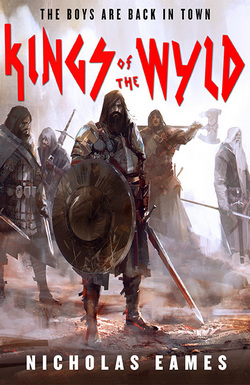
Cover of Kings of the Wyld by Nicholas Eames

Kings of the Wyld by Nicholas Eames

“They used to call us the Kings of the Wyld, remember?”

“Yeah, they did. When we were twenty years younger. When our backs didn’t ache every morning and we didn’t wake up five times a night to piss. But time did what it does best, didn’t it? It beat us up. It broke us down. We got old, Gabriel. Too old to do the things we used to, no matter how good we were at doin’ ‘em.”

No king meant no law; no guards to keep the peace or discourage violence before it got out of hand. No taxes meant no one to clean gutters or lay down stone for roads, and so Clay and Gabriel sloshed through what they hoped was mud as they passed through the wide-open gates into the city whose parents had hired a prostitute as a babysitter and never come home.

He suddenly wished he were elsewhere, anywhere—or petter yet someone else entirely. A simple man doing simple things. A cobbler, maybe. Cobblers rarely, if ever, made enemies of vengeful immortals, or so he figured.

They had a saying up north: *the coin that broke the dragon’s back*. It was derived from the idea that a dragon hoarding one trinket too many might drown beneath the weight of its own avarice, and it meant—or at least Clay thought it meant—that even the mightiest of things (dragons, for example) had a point at which even the smallest detail could signify their doom.

They had a similar saying down south: *the straw that broke the camel’s back*—though why you’d put a piece of straw on a camel’s back was, to Clay, an utter mystery. They were a curious people, southerners.

Clay smiled like a man who’d won first place in a “Whose Life Sucks the Most” contest.

What was it about fathers, Clay wondered, that compelled so many of them to test their children? To insist that a daughter, or a son, prove themselves worthy of a love their mother offered without condition?

Someone, probably Gabriel, had once told him that to be courageous you had to first know fear. As Clay saw it, he would need a reserve of courage in the hours to come that demanded more fear than he had ever known, and so he let the horror of what they were about to face wash over him, soak into him, clamp around his soul like an iron fist, and squeeze

A battle, as relayed by a poet, is a glorious thing, full of heroic stands, daring charges, and valiant sacrifice. But a battlefield, as experienced by some poor bastard mired in the thick of it, is something different altogether.

The word clusterfuck came to mind.

Matrick plied his knives like a parade drummer, his rhythm so fast his enemies didn’t know he’d murdered them until their god asked them if they took milk in their tea.


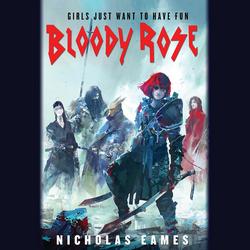
Cover of Bloody Rose by Nicholas Eames

Bloody Rose by Nicholas Eames

“We all have our rituals,” he said, without taking his eyes off the action below. “Necessary vices that enable us to conquer our fear. Or, if not conquer it, then to at least pile furniture against the door while we duck out the back. It’s not enough to survive what we do, Tam. We must also endure it.”

“What’s the difference?” she asked.

“One concerns the body, the other the mind. Every battle has a cost,” he said quietly. “Even the ones we win.”

Tam didn’t fully understand what he meant, but decided to pretend she did, and nodded sagely. “So what’s your vice?” she wondered.

“Love,” said Freecloud, flashing his jaguar smile. “And I suspect one day it will kill me.”

She glowered like a gargoyle with an incontinent pigeon perched on its head.

You didn’t get to be the villain of one story, she supposed, unless you were the hero of another.

Some people knew how to kill a conversation. Cura, on the other hand, could make it wish it had never been born.


Cover of Go Gentle by Maria Semple

Go Gentle by Maria Semple

It’s a thing Stoics do: meditate on worst-case scenarios. Which is not about working yourself into a neurotic doom loop. It’s about preparing for things not to go your way. So when they inevitably don’t, you can say, “I expected that.”

Think of it as inoculation against emotional extremes. Because who needs those?

Having a teenage daughter is like Choose Your Own Adventure, a constant set of junctures in the road. She’s in a mood? How do you respond? Do you snap? Do you sympathize? I chose my go-to: ignore.

I stepped into the grand entry. The walls were plaster, the color of cream, and enriched by an exuberance of gold molding. Crystal chandeliers danced abundantly from on high. Underfoot, polished wood floors inlaid with marble. If Liberace had a mood board, this would be it.


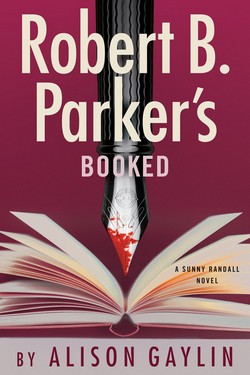
Cover of Booked by Alison Gaylin

Booked by Alison Gaylin

He smiled. “One of the many things I like about you, Sunny,” he said, “is that you get things without my having to explain them.”

I smiled back. “That’s possibly the most patronizing compliment I’ve ever received.”

“Hey, it’s from the heart.”

“You must have been in a constant state of terror,” I said.

“You want to know the truth?” Blake said. “I don’t remember him at all.”

“You don’t?”

“Not from when I was little.” Blake sliced off another hunk of sausage and shoved it into his mouth. Then he put the rest back into the bag, dropped it on the backseat, and returned his hands to the steering wheel as he finished chewing. “It’s funny,” Blake said. “People always say little kids are resilient, but it’s just that their brains aren’t fully formed. They can’t remember shit, which is a blessing.”

I looked at him. “I bet you’re right,” I said.

“I’m pretty sure I am.” Gently, he placed the knife on the dashboard. The sun glinted off the blade. “Resilient,” he said. “That’s just a word to make bad parents feel better.”


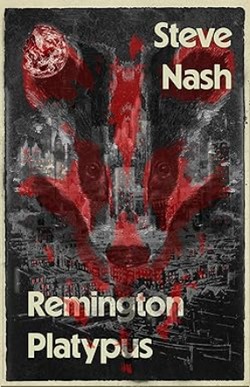
Cover of Remington Platypus by Steve Nash

Remington Platypus by Steve Nash

‘But that’s the thing about evil. You can try, but you can never properly clip its wings.’


(Image by DaModernDaVinci from Pixabay)

Opening Lines: All Systems Red by Martha Wells

We all know we’re not supposed to judge a book by its cover (yet, publishing companies spend big bucks on cover design/art and we all do judge them that way). But, the opening sentence(s)/paragraph(s) are fair game. So, when I stumble on a good opening (or remember one and pull it off the shelves), I like to throw it up here (especially if I’m out of time to come up with a post that involves writing on my part).

from All Systems Red by Martha Wells:

I could have become a mass murderer after i hacked my governor module, but then realized access the combined feed of entertainment channels carried on company satellites. it had been well over 35,000 hours or so since then, with still not much murdering, probably, don’t know, little under movies, serials, books, plays, and music consumed. as heartless killing machine, was terrible failure. .

Opening Lines Logo

Towel Day ’26: Some of my favorite Adams lines . . .

(updated 5/25/26)

A Blue towel with the words Towel Day on it

There’s a great temptation here for me to go crazy and use so many quotations that I’d get in copyright trouble. I’ll refrain from that and just list some of his best lines . . .*

* The fact that this list keeps expanding from year to year says something about my position on flirting with temptation.

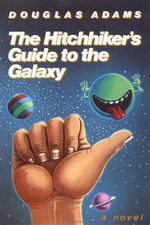
The Hitchhiker's Guide to the Galaxy

The Hitchhiker’s Guide to the Galaxy

Time is an illusion. Lunchtime doubly so.

This must be Thursday. . . I never could get the hang of Thursdays.

“You’d better be prepared for the jump into hyperspace. It’s unpleasantly like being drunk.”

“What’s so unpleasant about being drunk?”

“You ask a glass of water.”

(I’m not sure why, but this has always made me chuckle, if not actually laugh out loud. It’s just never not funny. It’s possibly the line that made me a fan of Adams)

He had found a Nutri-Matic machine which had provided him with a plastic cup filled with a liquid that was almost, but not quite, entirely unlike tea.

“You know,” said Arthur, “it’s at times like this, when I’m trapped in a Vogon airlock with a man from Betelgeuse, and about to die of asphyxiation in deep space that I really wish I’d listened to what my mother told me when I was young.”

“Why, what did she tell you?”
“I don’t know, I didn’t listen.

In those days spirits were brave, the stakes were high, men were real men, women were real women and small furry creatures from Alpha Centauri were real small furry creatures from Alpha Centuari. And all dared to brave unknown terrors, to do mighty deeds, to boldly split infinitives that no man had split before . . .

“Look,” said Arthur, “would it save you a lot of time if I just gave up and went mad now?”

The ships hung in the sky in much the same way that bricks don’t.

For a moment, nothing happened. Then, after a second or so, nothing continued to happen.

“Space,” [The Guide] says, “is big. Really big. You just won’t believe how vastly, hugely, mindbogglingly big it is. I mean, you may think it’s a long way down the road to the chemist’s, but that’s just peanuts to space, listen…”

He attacked everything in life with a mix of extraordinary genius and naive incompetence, and it was often difficult to tell which was which.

He felt that his whole life was some kind of dream and he sometimes wondered whose it was and whether they were enjoying it.


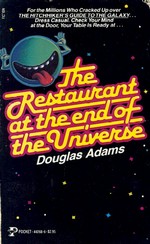
The Restaurant at the End of the Universe

The Restaurant at the End of the Universe

It is a curious fact, and one to which no one knows quite how much importance to attach, that something like 85 percent of all known worlds in the Galaxy, be they primitive or highly advanced, have invented a drink called jynnan tonnyx, or gee-N-N-T’Nix, or jinond-o-nicks, or any one of a thousand or more variations on the same phonetic theme. The drinks themselves are not the same, and vary between the Sivolvian “chinanto/mnigs” which is ordinary water served at slightly above room temperature, and the Gagrakackan “tzjin-anthony-ks” which kills cows at a hundred paces; and in fact the one common factor between all of them, beyond the fact that the names sound the same, is that they were all invented and named before the worlds concerned made contact with any other worlds.

Reality is frequently inaccurate.

Life is wasted on the living.


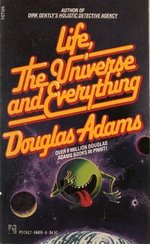
Life, The Universe and Everything

Life, the Universe, and Everything

The Hitchhiker’s Guide to the Galaxy has this to say on the subject of flying. There is an art, it says, or rather, a knack to flying. The knack lies in learning how to throw yourself at the ground and miss.

(It goes on for quite a while after this—and I love every bit of it.)

“One of the interesting things about space,” Arthur heard Slartibartfast saying . . . “is how dull it is?”

“Dull?” . . .

“Yes,” said Slartibartfast, “staggeringly dull. Bewilderingly so. You see, there’s so much of it and so little in it.”


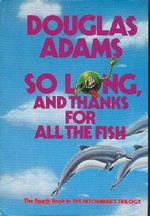
So Long, and Thanks For All The Fish

So Long, and Thanks for All the Fish

Of course, one never has the slightest notion what size or shape different species are going to turn out to be, but if you were to take the findings of the latest Mid-Galactic Census report as any kind of accurate guide to statistical averages you would probably guess that the craft would hold about six people, and you would be right. You’d probably guessed that anyway. The Census report, like most such surveys, had cost an awful lot of money and told nobody anything they didn’t already know—except that every single person in the Galaxy had 2.4 legs and owned a hyena. Since this was clearly not true the whole thing eventually had to be scrapped.

Here was something that Ford felt he could speak about with authority. “Life,” he said, “is like a grapefruit.”

“Er, how so?”

“Well, it’s sort of orangy-yellow and dimpled on the outside, wet and squidgy in the middle. It’s got pips inside, too. Oh, and some people have half a one for breakfast.”

“Is there anyone else out there I can talk to?”

Arthur had a swordfish steak and said it made him angry. He grabbed a passing waitress by the arm and berated her. “Why’s this fish so bloody good?” he demanded, angrily.

“Please excuse my friend,” said Fenchurch to the startled waitress. “I think he’s having a nice day at last.”


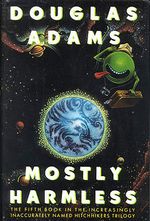
Mostly Harmless

Mostly Harmless

A common mistake that people make when trying to design something completely foolproof is to underestimate the ingenuity of complete fools.

Fall, though, is the worst. Few things are worse than fall in New York. Some of the things that live in the lower intestines of rats would disagree, but most of the things that live in the lower intestines of rats are highly disagreeable anyways, so their opinion can and should be discounted.


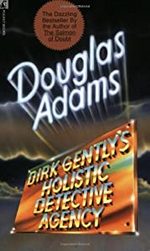
Dirk Gently's Holistic Detective Agency

Dirk Gently’s Holistic Detective Agency

There is no point in using the word ‘impossible’ to describe something that has clearly happened.

If it looks like a duck, and quacks like a duck, we have at least to consider the possibility that we have a small aquatic bird of the family anatidae on our hands.

Let’s think the unthinkable, let’s do the undoable. Let us prepare to grapple with the ineffable itself, and see if we may not eff it after all.

Sherlock Holmes observed that once you have eliminated the impossible then whatever remains, however improbable, must be the answer. I, however, do not like to eliminate the impossible.

(I’ve often been tempted to get a tattoo of this)


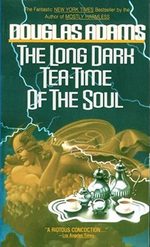
The Long Dark Tea-Time of the Soul

The Long Dark Tea-Time of the Soul

There are some people you like immediately, some whom you think you might learn to like in the fullness of time, and some that you simply want to push away from you with a sharp stick.

It can hardly be a coincidence that no language on earth has ever produced the expression, ‘As pretty as an airport.’

The impossible often has a kind of integrity to it which the merely improbable lacks.

She stared at them with the worried frown of a drunk trying to work out why the door is dancing.

It was his subconscious which told him this—that infuriating part of a person’s brain which never responds to interrogation, merely gives little meaningful nudges and then sits humming quietly to itself, saying nothing.

As she lay beneath a pile of rubble, in pain, darkness, and choking dust, trying to find sensation in her limbs, she was at least relieved to be able to think that she hadn’t merely been imagining that this was a bad day. So thinking, she passed out.


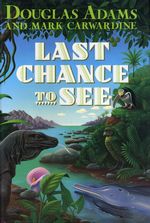
The Last Chance to See

The Last Chance to See

“So what do we do if we get bitten by something deadly?” I asked.

He looked at me as if I were stupid. “You die, of course. That’s what deadly means.”

I’ve never understood all this fuss people make about the dawn. I’ve seen a few and they’re never as good as the photographs, which have the additional advantage of being things you can look at when you’re in the right frame of mind, which is usually around lunchtime.

I have the instinctive reaction of a Western man when confronted with the sublimely incomprehensible. I grab my camera and start to photograph it.

Human beings, who are almost unique in having the ability to learn from the experience of others, are also remarkable for their apparent disinclination to do so.

The aye-aye is a nocturnal lemur. It is a very strange-looking creature that seems to have been assembled from bits of other animals. It looks a little like a large cat with a bat’s ears, a beaver’s teeth, a tail like a large ostrich feather, a middle finger like a long dead twig and enormous eyes that seem to peer past you into a totally different world which exists just over your left shoulder.

One of the characteristics that laymen find most odd about zoologists is their insatiable enthusiasm for animal droppings. I can understand, of course, that the droppings yield a great deal of information about the habits and diets of the animals concerned, but nothing quite explains the sheer glee that the actual objects seem to inspire.

I mean, animals may not be intelligent, but they’re not as stupid as a lot of human beings.


The Salmon of Doubt

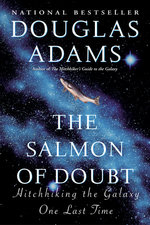
The Salmon of Doubt: Hitchhiking the Galaxy One Last Time

We are stuck with technology when what we really want is just stuff that works.

I’ve come up with a set of rules that describe our reactions to technologies:
1. Anything that is in the world when you’re born is normal and ordinary and is just a natural part of the way the world works.
2. Anything that’s invented between when you’re fifteen and thirty-five is new and exciting and revolutionary and you can probably get a career in it.
3. Anything invented after you’re thirty-five is against the natural order of things.

The fact that we live at the bottom of a deep gravity well, on the surface of a gas covered planet going around a nuclear fireball 90 million miles away and think this to be normal is obviously some indication of how skewed our perspective tends to be.


And a couple of lines I’ve seen in assorted places, articles, books, and whatnot

I love deadlines. I love the whooshing noise they make as they go by.

A learning experience is one of those things that says, “You know that thing you just did? Don’t do that.”

The fact is, I don’t know where my ideas come from. Nor does any writer. The only real answer is to drink way too much coffee and buy yourself a desk that doesn’t collapse when you beat your head against it.

Solutions nearly always come from the direction you least expect, which means there’s no point trying to look in that direction because it won’t be coming from there.

Don't Panic

Highlights from April: Lines Worth Repeating

Highlights from the Month

Cover of Violet Thistlewaite Is Not a Villain Anymore by Emily Krempholtz

Violet Thistlewaite Is Not a Villain Anymore by Emily Krempholtz

Even secrets told at a whisper grow wings.


Cover of The Traitor Baru Cormorant by Seth Dickinson

The Traitor Baru Cormorant by Seth Dickinson

“You can’t go home.”

“Why not?”

“I don’t know. Because it’s gone.” Aminata frowned, finished her drink, and nodded, “You can’t find it again. Even if you go back, it’s not there anymore. That’s history, that’s how it works! Someone’s always changing someone else.”

The terror that took Baru came from the deepest part of her soul. it was a terror particular to her, a fundamental concern—the apocalyptic possibility that the world simply did not permit plans, that it worked in chaotic and unmasterable ways, that one single stroke of fortune, one well-aimed bowshot by a man she had never met, could bring total disaster. The fear that the basic logic she used to negotiate the world was a lie.


Cover of Soul Fraud by Andrew Givler

Soul Fraud by Andrew Givler

…the entire building burst into flames. It was not a gradual combustion. One second, the building was a normal not-on-fire warehouse. Then it was all fire, as if it were the head of a match that had been struck.

Cooking has always seemed so magical to me. Two things can be made from the same five basic ingredients yet taste wildly different. It may only have been a day since I learned magic was real, but part of me always thought cooks were secretly wizards.

When you’re a kid, your mother tells you not to let your friends peer-pressure you into drinking, doing drugs, and other stuff. But she never covered what do if an acquaintance offered to help you summon a demon. Or at least mine didn’t. She completely skipped that chapter.

My phone buzzed in my pocket. I gasped as I was pulled from sleep’s dark, peaceful embrace. The process of waking up is a surprisingly accurate measure of how close your life is to rock bottom. For some people, the ones with everything clicking exactly as it should be, waking up is the worst thing that happens to them in a day. Because sleep is amazing. It’s mornings that are evil. It doesn’t matter if you’re rich or poor, fat or Mr. Universe. Sleep is the lesser equalizer after death. We all get to enjoy it, and it eventually finds us all. Waking up is a shared pain for all of us. Even those freakish morning people.

“What is it you mortals say? Ah, yes, time flies when you’re having fun,” he said with a twitch of his lips. “I’ve always liked that mental picture, time flying, when obviously it actually swims.”


Cover of Guns of Brixton by Paul D. Brazill

Guns of Brixton by Paul D. Brazill

‘How is he?” said Kenneth to the fresh faced young policeman who’d been sat outside Bernie’s private room reading the Guardian.

‘Well, he’s been in and out of consciousness for most of the day. It was touch and go at one time,’ said the uniformed plod, ‘and he’s not out of the woods yet.’

He’ll go far with that degree in clichés, thought Kenneth. Officer material, no doubt about it.


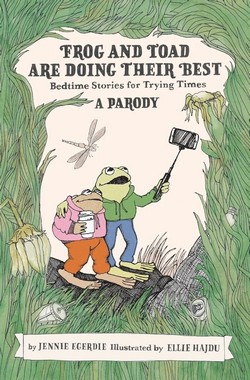
Cover of Frog and Toad Are Doing Their Best by Jennie Egerdie

Frog and Toad are Doing Their Best by Jennie Egerdie, illustrated by Ellie Hajdu

“Friends do not let friends dress like internet trolls,”

“Toad,” said Frog, “the older I get, the less I understand time.”

“Time means nothing,” said Toad. “Time is just the thing that happens between snacks.”


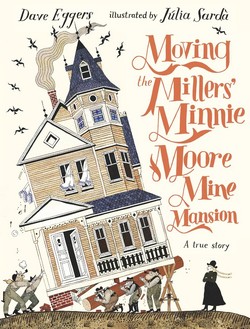
Cover of Moving the Millers' Minnie Moore Mine Mansion by Dave Eggers

Moving the Millers’ Minnie Moore Mine Mansion by Dave Eggers, illustrated by Júlia Sardà

Like all of the best stories, this takes place in Idaho.

While Annie was gallivanting about Europe—which is what you do in Europe, by the way, you gallivant; it is a kind of traipsing—Henry was determined to build his new wife a lavish new house.


Cover of This Book Made Me Think of You by Libby Page

This Book Made Me Think of You by Libby Page

Getting back into reading feels like stepping back into the house of a beloved friend she hasn’t seen in a long time. It feels like coming home.

Tilly wasn’t sure she was expecting the trip to be fun. She was going because Joe had asked her to and it turnsed out that it’s very difficult to say no to the dead love of your life.

The right book in the hands of the right person at exactly the right moment can change their life forever.

Book shops aren’t just book shops, they’re places fo rbook lovers to come together, like-minded souls meeting among the stacks. They’re the hubs of community, the arena for heated conversations about the latest must-read series. They’re safe spaces to step in out of the rain, no matter who you are. They need our support now more than ever.


Cover of A Memory Called Empire by Arkady Martine

A Memory Called Empire by Arkady Martine

The problem with sending messages was that people responded to them, which meant one had to write more messages in reply.

She hadn’t lied once. And yet they were trusting her.

Poetry is for the desperate, and for people who have grown old enough to have something to say.

Grown old enough, or lived through enough incomprehensible experiences.


Cover of Ancillary Mercy by Ann Leckie

Ancillary Mercy by Ann Leckie

There is always more after the ending. Always the next morning, and the next. Always changes, losses and gains. Always one step after the other. Until the one true ending that none of us can escape. But even that ending is only a small one, larges as it looms for us. There is still the next morning for everyone else. For the vast majority of the rest of the universe that ending might as well not ever have happened. Every ending is an arbitrary one. Everything ending is from another angle, not really an ending.


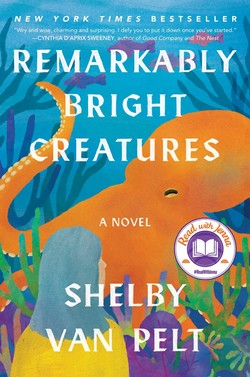
Cover of Remarkably Bright Creatures by Shelby Van Pelt

Remarkably Bright Creatures by Shelby Van Pelt

I lost my notes to this, so started flipping through the book to find things to include…and realized that I was going to be flipping for hours if I didn’t stop. So, I’ll just go with these samples:

Smart cookie. I am smart, but I am not a snack object dispensed from a packaged food machine. What a preposterous thing to say.

Some trees aren’t meant to sprout tender new branches, but to stand stoically on the forest floor, silently decaying.

There is one topic of conversation humans never exhaust, it is the status of their outdoor environment. And for as much as they discuss it, their incredulity is . . . well, incredible. That preposterous phrase: Can you believe this weather we’re having? How many times have I heard it? One thousand, nine hundred and ten, to be exact. One and a half times a day, on average. Tell me again about the intelligence of humans. They cannot even manage to comprehend predictable meteorological events.


(Image by DaModernDaVinci from Pixabay)

Opening Lines: Go Gentle by Maria Semple

Head & Shoulders used to tell us that, “You never get a second chance to make a first impression.” That’s true for wearing dark shirts, and it’s especially true for books. Sometimes the characters will hook the reader, sometimes the premise, sometimes it’s just knowing the author—but nothing beats a great opening for getting a reader to commit.

I slid the fried egg—extra crispy, embedded with cracked pink I peppercorns—onto a nest of baby arugula centered atop a slice of toasted sourdough. I sharpened my paring knife with a few satisfying slashes and sliced four cornichons thin enough for light to pass through. Those I placed across the warm egg, chevron-style. I capped it all off with a second piece of toast, this one thick with lemon aioli.

Or: I made a fried egg sandwich.

But how you do anything is how you do everything, and one might say my life’s work has been chasing the Platonic ideal.

from Go Gentle by Maria Semple

Opening Lines Logo

Highlights from March: Lines Worth Repeating

Highlights from the Month
Sure, what better day for this than May 1?

Cover of Head Fake by Scott Gordon

Head Fake by Scott Gordon

“In moments like this, Shay, we realize how funny life is. We must get the joke. We have to.”


Cover of Rabbit Cake by Annie Hartnett

Rabbit Cake by Annie Hartnett

Freedom, Alabama, wasn’t really the middle of nowhere. We had big fields and the woods, sure, and horses and cows, but if we drove half an hour to Auburn we had a mini-golf course, a mall, and both a Waffle House and a Red Lobster. We had a bowling alley and the water park, even if the water park had been closed last summer, and we had the second-largest zoo in Alabama. It wasn’t like we were Laura Ingalls Wilder or anything.

I’d figured out by now that death never makes sense, no matter how someone dies: murder, accident, old age, cancer, suicide, you’re never ready to lose someone you love. I decided death will always feel unexplained; we will never be ready for it, and you just have to do the best you can with what you have left.

I wondered how many world records had gone unrecorded. How did you really know yours was the world record and not just the only one someone had bothered to write down?


Cover of City of Last Chances by Adrian Tchaikovsky

City of Last Chances by Adrian Tchaikovsky

There was no treasure more precious than a man’s unstretched neck, after all.

Her name was Lemya. She was fresh out of the provinces. She was, Ruslav could tell, one of those who de/ieved in things. She’d already spent a night in the cells because some idiot students had refused to leave some idiot place when the Turncoats had told them to. Not even Occupier patrols, just the locals in their uniforms that were literally a pale imitation of the Pals’. Ruslav knew about that, because he’d been in the cell across the way after being too slow to get out of a punch-up. He heard her and her idiot friends arguing about morals and ethics and other things you couldn’t eat or stab someone with.

In the Pallesand Archipelago, there were no executions. That would imply criminal acts, and everyone knew that the Palleseen were sailing into their Thousand Years of Perfection. Even the persistence of the Temporary Commission of Ends and Means was entirely focused outwards. Of course, plenty of people disappeared across the Archipelago. They just weren’t there, and all reference to them was removed. Their name would only ever be found in one place, a carefully curated list of all the people who didn’t exist and should not he mentioned. The list was necessary when prosecuting anyone gauche enough to mention them, because you had to have something to refer to, to know what it was to which nobody was permitted to refer. But these weren’t executions. This was just the operation of perfection. Outside the Archipelago, however, the officials of the Sway tended to retain the crude local forms of punishment.

Her look suggested she saw through him as though he was no more than the evaporating fog…

He didn’t think of the war anymore. Which wasn’t true. He woke from dreams of it, fighting his blanket. The gas, the wire, the hungry dark that descended at midday. The shrill scream of demon artillery, the bellows of monsters in torment. But he didn’t think about whether it still raged on (doubtless it still raged on) or who was winning (nobody was winning).


Cover of Ancillary Justice by Ann Leckie

Ancillary Justice by Ann Leckie

Thoughts are ephemeral, they evaporate in the moment they occur, unless they are given action and material form. Wishes and intentions, the same. Meaningless, unless they impel you to one choice or another, some deed or course of action, however insignificant. Thoughts that lead to action can be dangerous. Thoughts that do not, mean less than nothing.

If you’re going to make a desperate, hopeless act of defiance, you should make it a good one.

Falling didn’t bother me. I could fall forever and not be hurt. It’s stopping that’s the problem.

Surely it isn’t illegal here to complain about young people these days? How cruel. I had thought it a basic part of human nature, one of the few universally practiced human customs.


Cover of The Spellshop by Sarah Beth Durst

The Spellshop by Sarah Beth Durst

It wasn’t that she didn’t like people, it was only that she liked books more. They didn’t fuss, or judge, or mock, or reject. They invited you in, fluffed up the pillows on the couch, offered you tea and toast, and shared their hearts with no expectation that you’d do anything more than absorb what they had to give.

She didn’t really know anything about running a shop, or magic, or jam. “But I do know books,” and that meant there was nothing she couldn’t know…eventually. That was a magic in and of itself.

Opening the notebook, she stroked the smooth, crisp, blank page. There was something so very beautiful about a notebook without a single note in it. It felt like touching pure potential.


Cover of Return to Sender by Craig Johnson

Return to Sender by Craig Johnson

“Nobody smiles anymore.”

“Excuse me?”

“Have you noticed? Nobody smiles anymore.” Mike adjusted himself in the tiny postal Jeep, setting his back against the passenger-side door as he sat on the floor beside Dog so no one would see him in the September early morning light. “Remember when we were growing up how you were taught that when you walked down the street and you met a stranger, that you smiled or said hello?” He sighed, staring at the plethora of mail and packages in the back as if it were a weight he could no longer bear. “People don’t do that anymore.”

Mike Thurman, my late wife’s cousin, was in a bad mood, but that didn’t mean he didn’t have a point.

There’s a part of I-80—or, as the locals call it, the Snow Chi Minh Trail—that’s spoken of as the Highway to Heaven that, when atmospheric conditions are right, gives the appearance as though the Interstate goes straight up into the heavens. But that wasn’t the part that I was on. I was on the soul-leeching part that seems to go on forever; a life-eroding slab of concrete that tears the very hours from your life at an excruciatingly slow pace.

Or maybe that’s just me.

The Highway to Heaven between Evanston and Lyman doesn’t go to heaven but rather to the Bridger Valley, which is pretty nice.

So, maybe it was just me.

(Image by DaModernDaVinci from Pixabay)

Opening Lines: Murder by Memory by Olivia Waite

We all know we’re not supposed to judge a book by its cover (yet, publishing companies spend big bucks on cover design/art and we all do judge them that way). But, the opening sentence(s)/paragraph(s) are fair game. So, when I stumble on a good opening (or remember one and pull it off the shelves), I like to throw it up here (especially if I’m out of time to come up with a post that involves writing on my part).

from Murder by Memory by Olivia Waite:

Near the topmost deck, in a small lift with glass walls and flickering buttons, I, Dorothy Gentleman, ship’s detective, opened a pair of eyes and licked a pair of lips and awoke in a body that wasn’t mine.

It was the nails that first tipped me off. Blank bodies were just that: blank. My nails ought to have been the same color as the skin beneath—in my case, somewhere in a range of pinks, tending to florid.

Not silver, and not shaped.

This body was already inhabited.

My skin—someone’s skin—broke out in gooseflesh. Of course every human body was a horrifying collection of juices and tissues, acids and effluvia poured into a bag with a bunch of long rocks, a shambling accident of biology that made its own mysterious and often frustrating decisions without reference to the mind. They were disgusting miracles, every one. It was always a bit unsettling to wake up in a fresh form, until habit made a home of it.

But someone else’s home, and my self inside it! A nightmare. Imagine going to the washroom to be sick and having someone else’s sick come out.

I came very close to making this more than a metaphor. It took many deep, deliberate breaths for the squeamish feeling to subside.

It wasn’t supposed to be like this.

Opening Lines Logo

Page 1 of 31

Powered by WordPress & Theme by Anders Norén