Month: February 2016 Page 2 of 4

Saturday Miscellany – 2/20/16

Odds ‘n ends over the week about books and reading that caught my eye. You’ve probably seen some/most/all of them, but just in case:

    This Week’s New Releases I’m Excited About and/or You’ll Probably See Here Soon:

  • Switcheroo by Aaron J. Elkins — A trip to Britain’s Channel Islands with Dr. Oliver? Don’t mind if I do.
  • Calamity by Brandon Sanderson — the final book in the Reckoners series. This should be great.

Lastly, I’d like to say hi and welcome to JAH and raulconde001 for following the blog this week. Thanks to Brenton Dickieson for the interaction.

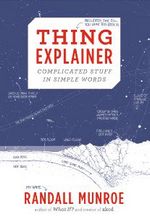
Thing Explainer by Randall Munroe

Thing ExplainerThing Explainer: Complicated Stuff in Simple Words

by Randall Munroe

Hardcover, 64 pg.

Houghton Mifflin Harcourt, 2015


I’m not sure what to say about this beyond just regurgitating the Publisher’s Description. If that’s not enough to make you want to pick this up for at least a glance, I don’t think I could say anything that will.

But, quickly, the idea behind the book is that using drawings/diagrams and the 1,000 most commonly used words to explain how various and sundry things work — from ball-point pens to the Large Hadron Collider, and many points in between and beyond.

The artwork is like what you see on xkcd, the humor is similar — more broadly appealing (I think), however. The material is educational. That’s about it in a nutshell. I guess I should state that the artwork isn’t like the stick figure comics, it’s the incredibly detailed diagrams that show up at other times.

To give you a taste, some of the entries I found most educational/interesting/amusing were: Shape Checker (padlock); Bags of Stuff Inside You (internal organs); Hand Computer (smart phone); Stuff You Touch to Fly a Sky Boat (airplane cockpit). From Cover to Cover (literally) Munroe’s drawings will be teaching you a little more about how things work.

This is not a sit down and read cover-to-cover kind of book, period. It’s a grab it every now and then, flip through until you get to a page or two (or six) that you haven’t read, or one you have and want to re-read. I’m just leaving this around for my kids (and myself) to pick up from time to time. I wish I could’ve got a picture of the expression on my youngest’s face just now as he was reading through the book, I could’ve not said a word and simply posted it — I’m not sure how much he understood, but he was fascinated. I’d gladly buy a sequel — actually, I could probably use one.

—–

4 Stars

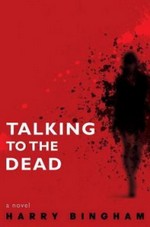
Talking to the Dead by Harry Bingham

Talking to the DeadTalking to the Dead

by Harry Bingham
Series: Fiona Griffiths, #1

Hardcover, 337 pg.
Delacorte Press, 2012

Read: February 16 – 17, 2016

One thing I need to do a better job of is remembering how I found out about a book/series/author that I need to try, this novel is a great example of why. I remember putting it on my TBR, and that there was something about it that made me move it ahead of the others — but I can’t tell you when or why I did so. Sometimes, like with this book, that drives me crazy. I just had to trust that I knew what I was doing when I picked it up. Thankfully, it didn’t take long to convince me that Fi Griffiths had something special going on — mostly it was the voice, the attitude, her humor as seen when she’s going through stacks and stacks of financial documents to make a case air-tight (before the inevitable guilty plea for ripping off a private school):

My desk is covered with paper. I loathe all banks and credit card companies. I hate every digit between 0 and 9. I despise every dopily run Catholic boys’ school in South Wales. If Brian Penry were in front of me now, I would try to force-feed him my calculator, which is as large and chewable as Bakelite phone.

It didn’t take too long before the merits of the case drew me in (not the drudgery of the case above, but the one that drove the novel’s action), and would have even without Fi’s narration. But it was a lock with her as a character. The grim nature of the killings grip the reader, the way they do Griffiths’ colleagues and superiors. What really impressed me was that it is one of the sickest, grossest descriptions of a corpse this side of a Bones episode — and Bingham doesn’t dwell on it — oh, he could’ve, and most authors would have. It’s there stark enough to give the reader the willies, in a just-the-facts-fashion, but Bingham doesn’t exploit the nature of the killing or the state of the body.

To put it charitably, Fi is quirky. To be more accurate, she’s suffering from a serious mental condition — she’s (mostly) got it under control, however. Social skills aren’t really in her wheelhouse — at least not automatically — which presents an additional challenge for her work. Early on, I kept picturing Diane Kruger’s performance from The Bridge, it diminished eventually, but I think Fi will always be Kruger-esque to me. We do eventually get actual information about her condition — which is nice, but we don’t need it to understand her enough to empathize with her. There’s an Author’s Note at the end with more details about the actual condition — don’t read it until the end. Get to know her absent the condition first.

Bingham creates a good bench of supporting characters — a potential boyfriend, a couple of supervisors (who have differing levels of concern for her), a former therapist, an old friend (former trainer/sensei-type), parents, sisters, and a few other detectives. One or more of these can be summoned from the bench with ease in the future, but we don’t get to spend a lot of time with any of them here — just enough to establish them. We spend some good time with her potential boyfriend, old friend/trainer/sensei and dad — I like them all and want to see more of them. But this is really Fi’s book and the narrative weight falls on her troubled, yet capable shoulders.

We hardly get an idea for what kind of men the bad guys are here — it’s just shadowy criminals, up to shadowy criminal things. I like the idea that we only get things through law enforcement eyes, not through the killer’s — that happens far too often for my taste. Like Fi says, I know this way we don’t get the full story, but I prefer not being in the mind of the sickos at work here. We, and the police, get most of the story in the end, and that’s good enough for me.

The book closes with a couple of the most heartfelt, moving scenes that I can think of in Detective Fiction (give me time, and I could probably make a decent list of competitors, still pretty sure this would be near the top — sure, that scene in Gone, Baby, Gone has this beat, but not many others would). I had a hard time believing that it would work as effectively given the fact this is a first novel for the character — but Bingham has laid a lot of ground work to get us ready for these moments, and it paid off well.

Talking to Strangers grabbed me in just the right way. I want to devote the next few days to just reading the rest if this series (I won’t, I know I need to pace myself, but… Oh, I really want to just binge). Fi is an early leader for favorite character of the year (a thing I just decided to do).

—–

4 Stars

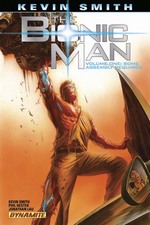
Some Assembly Required by Kevin Smith, Phil Hester and Jonathan Lau

Some Assembly RequiredThe Bionic Man, Vol 1: Some Assembly Required

by Kevin Smith, Phil Hester and Jonathan Lau (Artist)

Trade Paperback, 248 pg.
Dynamite Comics, 2012

Read: February 16, 2016


I was a big fan of The Six Million Dollar Man as a kid, and when I got a little older I stumbled onto — and devoured (repeatedly) — Martin Caidin’s Cyborg. Throw in a strong appreciation for Smith’s work? And I’m clearly the target audience for this (so why did it take me 3+ years to read it? Good question).

The main story hasn’t changed: Steve Austin is a test-pilot, horrifically injured — almost killed — when a test flight goes wrong. A team of experts save his life, rebuild him with bionics, and set him loose fighting for truth, justice, and the American way and so on.

The story was nothing special — good, solid action/adventure story. There were a couple of nice twists on the TV show’s story/characters. Just enough to keep it updated and fresh. I’d have appreciated something closer to Cyborg, but I understand why they made the choices they made. Austin goes up against his bionic predecessor, who has gone rogue and now is running around attacking and raiding technology companies. The battle scenes may have been a bit too big and epic — but they fit in with the current cinema trends, so, I guess they worked.

I was sure I’d seen Jonathan Lau’s art somewhere before, but from what I can tell, I haven’t. Which is a shame — it’s great. I’m not going to say that it’s my favorite comic art — but it’s exactly what I want comic art to look like. Which seems like a contradiction, but let’s move on. Yeah, some of the gestures are over-done, and a couple of the men are just too huge. But otherwise, dynamic, easy to tell character-from-character, nice detail, overall very attractive. I’d be willing to give a book a second look just because of his art in the future.

There are some nice references — visual and verbal — to the TV series that are pretty seamlessly worked in. Which I appreciated — looks like the next volume will be less subtle about it (which is not necessarily bad). I’m not going to say this was a great comic that leaves me chomping at the bit for the next, but it was worth the time and entertaining. Not much more to ask for.

—–

3 Stars

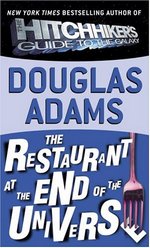
Reread Project: The Restaurant at the End of the Universe by Douglas Adams

I think WordPress’ spell-check might explode if I add another sentence or two to this….

The Restaurant at the End of the UniverseThe Restaurant at the End of the Universe

by Douglas Adams
Series: The Hitchhiker’s Guide to the Galaxy Trilogy, #2

Mass Market Paperback, 245 pg.
Ballantine Books, 1995

Read: February 13-15, 2016

If you’ve done six impossible things this morning, why not round it off with a breakfast at Milliways, the Restaurant at the End of the Universe?

I think in the past, I’ve enjoyed The Restaurant at the End of the Universe more than this time, but I’m not sure why. Which is not to say that I didn’t have a blast, I just usually have more fun. From the intricate — and death-defying — difficulty of making a good cup of tea; to the extreme lengths some people will go to for a dining experience; to perspective that a little cake can give; to considering what color a wheel should be or whether fire should be nasally-inserted — this book covers all the bases. While still episodic in nature, it seems less so than its predecessor — and far less so than its successor. It’s a stronger novel, not quite as funny, but still better than most “funny” or “light” SF than you’ll find.

[Gargravarr] had rather liked Zaphod Beeblebrox in a strange sort of way. He was clearly a man of many qualities, even if they were mostly bad ones.

Most of this book showcased the ex-President of the Galaxy, Zaphod Beeblebrox the First (how is great-grandfather was Zaphod the Fourth lies in one of the best lies Adams ever penned). Now Zaphod’s not my favorite character — actually, I typically dislike him as a character. As a joke-generator, a font of one-liners? He’s great. Probably most of the quotable lines in this book are his (even Arthur’s best line is immediately denigrated by him “Yeah, and don’t you wish you hadn’t?”).

We see the reason for his stealing of The Heart of Gold in the last book, we’re taken on a wild and twisty ride for him to complete his quest and then . . . it just stops. I’m sure it’s supposed to be in an absurd way or something, but it seems pointless (probably the point).

And then we’re off to Milliways. Ahhh, Milliways — this is an absolutely perfect part of the book. That this is the book’s title is absolutely fitting. There’s nothing about it I don’t like here — Max Quordlepleen’s banter (the oddly bittersweet introduction of him), Hotblack Desiato (and his tax plan), the Dish of the Day . . . I’m going to shut up before I just copy and paste the whole thing.

The rest of the book focuses on Arthur (and Ford, but, a little less), who I like, but don’t laugh at nearly as much.

“Poor Arthur, you’re not really cut out for this life are you?” [Trillian asked]
“You call this life?”

Something I’ve been thinking about this read-through is this: why Arthur? He’s one of Ford’s oldest friends on Earth — but we know he has multiple friends, he could’ve picked any of them — why Arthur? Surely, Ford would’ve had at least an inkling that Arthur would turn into the whiny Monkey-man that Zaphod can’t stand. It’s easy to see why Tricia McMillan would go off with Zapod as Phil over this wet blanket, well, towel. Trillian here has the same thought — and if we’re given a good explanation for that, I don’t remember it. Any of you have a guess (or a quotation) to justify Ford’s improbable choice?

Now, I may have sounded less that totally satisfied with this book — which is oddly true. I do think the Golgafrinchan Ark Fleet Ship B story is pretty “blah” and goes on far too long (into the next book). But it gives us gems like this:

It is a curious fact, and one to which no one knows quite how much importance to attach, that something like 85 percent of all known worlds in the Galaxy, be they primitive or highly advanced, have invented a drink called jynnan tonnyx, or gee-N-N-T’Nix, or jinond-o-nicks, or any one of a thousand or more variations on the same phonetic theme. The drinks themselves are not the same, and vary between the Sivolvian “chinanto/mnigs” which is ordinary water served at slightly above room temperature, and the Gagrakackan “tzjin-anthony-ks” which kills cows at a hundred paces; and in fact the one common factor between all of them, beyond the fact that the names sound the same, is that they were all invented and named before the worlds concerned made contact with any other worlds.

making it hard to complain too much.

There are a lot of laughs to be had here — I didn’t even mention Marvin’s contributions, which were just gold. And any time with Adams is worth it. A must-read follow-up to the classic, Hitchhiker’s Guide to the Galaxy.

—–

4 Stars

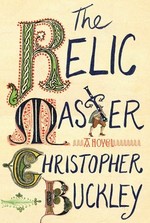
DNF – The Relic Master by Christopher Buckley

The Relic MasterThe Relic Master

by Christopher Buckley

Hardcover, 372 pg.
Simon & Schuster, 2015
Read: February 10 – 15

I would love to know what made Christopher Buckley think, “You know what the world needs? A satire about a Christian relic dealer in 1517…” I also wonder what would drive me to grab it (other than that’s what I do every time I see his name — since the 80’s). But I did, and I gave it the old college try.

The history is pretty good. But I wonder if I’m too critical, I’ve spent so much time recently listening to lectures, reading about, the religious atmosphere of the time — that might have hurt my appreciation for his take on the period (then again, most of his satire is contemporary and I lived through that without problems). In that light, I should say that I really appreciated his characterization of Johann Tetzel. But I just couldn’t care about the characters, the story — any of it. There was none of Buckley’s wit, or his voice — nothing that made me a fan of his other work. Honestly, I’m not sure how he could’ve kept those things with a historical fiction, but the book sure needed that. Yes, it’s entirely possible, that if I’d stuck with it a bit longer, I’d have sung a different song, but life’s too short and my TBR pile is too high.

So, for the first time since January 2011, I’m abandoning a book. I might come back to it at some point, I’d like to actually read it. But not now.

(not really a review, but I felt like I should say something)

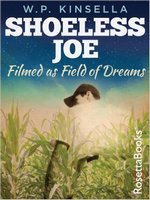
United States of Books – Shoeless Joe by W.P. Kinsella

Shoeless JoeShoeless Joe

by W.P. Kinsella

Author: Laura at 125Pages

This weeks United States of Books brings us to Iowa with Shoeless Joe by W.P. Kinsella. Entertainment Weekly says – Not only was this novel – adapted for Field of Dreams – set in Iowa, but Kinsella also attended the state’s other claim to fame: The Iowa Writers’ Workshop.

itsiowaI went into Shoeless Joe with such hope. I have not seen Field of Dreams, but love uplifting sports movies, so I thought I would love one in book form. But this was no uplifting sports movie, it was a strange tale of a man who builds a baseball field on his failing Iowa corn farm then leaves his wife and small child to kidnap famed writer J.D. Salinger and take him on a road trip. I’m sorry what? Where is my tale of a downtrodden man who has a vision and through that builds his dream on his farm? Instead I get a wacky buddy road trip comedy, complete with carnies and diner hold ups. The action on the farm is limited to the very beginning and the very end, and that is where the heart of the story was. A struggling man trying to save his farm and his family with a dream and pure gumption. Those parts were fantastic, but the rest was just ridiculous.

The plot had its moments, but they were sadly few and far between. The family parts were great, but the whole kidnapping road trip aspect totally lost me. The world created was the same, certain select parts were crisp and vivid, then it veered into crazypants territory. The writing was fine, sentence structure wise, but the story was so over the top I couldn’t really see any fine nuances. The characters were a mashup of amazing and then not, they started strong but then went downhill the more I read. I had no emotional tie to any of the characters. Ray was dismissive of the real world and the potential harm he was bringing to his wife and child.

“…what an outfield,” he says. “What a left field.” He looks up at me and I look down at him. “This must be heaven,” he says. “No. It’s Iowa,” I reply automatically.

Shoeless Joe is considered one of the greatest sports books written. I just didn’t see it. Less a book about baseball to me, and more a book about what too much Round-Up in a field will lead to. I do understand the baseball at the heart of the story and how it linked every part together, but failed to see the amazing parts as the random hostage taking of a reclusive writer and a road trip with said writer to pick up baseball ghosts took away from that for me. As did the husband and father endangering the future of his family by leaving them as their farm is about to be foreclosed on. Now, I don’t hate baseball and I know, national sport and all, but this book just didn’t do it for me.

  • Favorite lines – Pedestrians in the East behave like lemmings rushing dispassionately to their deaths—it takes a good ten minutes to make a left turn into the blinding rush of oncoming traffic, with pedestrians thronging suicidally into the intersections.

  • Biggest cliché – If you build it, he will come.

  • Have you read Shoeless Joe, or added it to your TBR?


  • Check out all of the #USofBooks posts here.

    —–

    2 1/2 Stars

Confessions of a Clumsy Christian: Unqualified by Jennifer Wilson

Confessions of a Clumsy Christian: UnqualifiedConfessions of a Clumsy Christian: Unqualified: Honest Answers to Real Questions About Being Good Enough for God

by Jennifer Wilson

E-book, 89 pg.
2016

Read:February 7, 2016

This was a tough one for me to write — in fact, I think I spent at least twice as long deciding what to write and then writing this as I did reading the book.

Jennifer Wilson had the kind of past that many of us have had — false starts with faith, personal problems, family problems, addictions, job woes, etc. — struggling from time to time with trying to be good enough to become a Christian — at some point, she realized she couldn’t and that God didn’t want someone who was good enough (who could be?), but someone “unqualified” to be a Christian. She talks about some of her problems, doubts and fears both before and after her conversion, in an effort to reassure others that “qualified Christians” just don’t exist.

Let’s get the easy stuff out of the way: Wilson writes in a charming, engaging manner — pleasant, breezy, conversational. This makes the book a quick and easy read — sometimes deceptively so, considering the topics covered. She comes across as very open and honest, very genuine.

There were plenty of typos and grammatical mistakes in the edition I read — none were too distracting, though, so you could get past it. You almost have to forgive the mistakes in the midst of an author telling you how often she has and continues to fail in various areas.

There are plenty of books I shouldn’t write — for example, novels that are supposed to go anywhere beyond the NaNoWriMo word count verification; books on care of felines; diet books — 2 of these may change in time, my fiction could improve or I could get in shape. If either happens, I’ll write those books. And at some point, Jennifer Wilson may be ready to write this book. She states, over and over again that she’s a new Christian. At one point, she describes herself as “barely an apprentice Christian.” I have to ask, why is she writing a book about it then? I’m not saying she shouldn’t ever — but maybe she should get some roots down. She wants to write about her past? Her coming to faith? Her struggles as a new Christian? Fine — more than fine, she’s helpful. But when she goes further than that, she gets herself in trouble.

John Murray once wrote, “The difference between truth and error is not a chasm but a razor’s edge.” I fear that Wilson spent so much time walking down the razor’s edge she must have really cut up her feet. For example, she advised a friend, “[God] is in pain, watching you, His precious daughter, suffer so much.” I don’t see any biblical writer speaking of God in this way. She writes, “God, my heavenly father, doesn’t want me, His daughter to suffer in pain.” Please tell that to Joseph, Job, Paul, and Jesus for starters. The Epistles are replete with instructions about suffering, about the purpose of suffering, of rejoicing in our suffering. I have to wonder, what God is she talking about?

Wilson’s clear that she doesn’t know the Bible very well — that right there should give her pause before weighing in on Biblical concerns, no?

I know she’s trying to be amusing in her writing — and she usually succeeds — but I think a little more care surrounding God, His works, and the ways He’s revealed Himself would be helpful. Self-deprecating humor, humor at the apparent vicissitudes of life, absolutely fair game. But there are some things that we ought to treat reverently even in the midst of irreverence.

There is a lot to be commended about this book — particularly when she describes her own struggles past and present. But the solutions suggested are frequently problematic, when not downright unbiblical. It’s written-well enough, I’m just pretty sure it shouldn’t have been written at this time. I wish Wilson’d waited until she was past the apprentice stage to write this. I’m not just saying that, I want to like this book — I’d like to recommend it to others, but I just can’t. Aimee Byrd (not just her, but she’s a good starting point) has been writing recently about the deplorable nature of Christian books marketed for and by women, sadly, this book is evidence that she knows what she’s talking about.

Disclaimer: I was given a copy of this book by the author in exchange for an honest review. She probably had something else in mind.

—–

2 Stars

Saturday Miscellany – 2/13/16

Odds ‘n ends over the week about books and reading that caught my eye. You’ve probably seen some/most/all of them, but just in case:

    This Week’s New Releases I’m Excited About and/or You’ll Probably See Here Soon:

  • Morning Star by Pierce Brown — the trilogy comes to a conclusion — and something tells me there’s a lot of death, destruction, and twists along the way. I’m hearing very good things about this.
  • Dead Is Better by Jo Perry — A ghost solving his own murder with a ghost dog by his side — okay, my paraphrase doesn’t sound nearly as good the description on Fahrenheit Press’ site, click the link and it’ll convince you.
  • Atlanta Burns: The Hunt by Chuck Wendig — Atlanta Burns’ senior year looks like it’ll be tough and violent and twisted — basically, like the rest of her life.
  • As Chimney Sweepers Come to Dust by Alan Bradley — A new Flavia de Luce novel means I’m even further behind.

Lastly, I’d like to say hi and welcome to Fictionophile and Aidan Reid for following the blog this week. Thanks to S. C. Flynn and Jayme the Scribbler for the interaction (and the reblog!).

The Batgirl of Burnside by Brenden Fletcher, Cameron Stewart & Babs Tarr

The Batgirl of BurnsideBatgirl Vol. 1: The Batgirl of Burnside

by Brenden Fletcher, Cameron Stewart (Writers), Babs Tarr (Artist)

Hardcover, 176 pg.
DC Comics, 2015

Read: February 10, 2016


My dabbling into The New 52 continues . . .

Like everyone who has at least one social network account, I was deluged by images of the new Batgirl uniform back in 2015 — and I dug it. I liked the Cassandra Cain incarnation of the character — but had missed just about all of them post-Barbara Gordon, who didn’t do much for me (I was a big Oracle fan, in my defense). So I decided to give this a shot when I saw the collection. Oh, so glad that I did — the best of the New 52 comics I’ve read so far.

Barbara Gordon’s in some sort of tiff with Dinah Lance (I’m assuming it’s Lance, didn’t care enough to check), she’s moving out of her old digs into a very trendy, hipster part of Gotham (the part that Nolan or Burton never showed) with a roommate she met doing physical therapy while working on a Master’s/Doctorate with a predictive algorithm that will probably go on to turn Gotham into Minority Report or will be Oracle. Doesn’t take her long to need to do the Batgirl thing, so she slaps together a new costume (her old equipment was no longer available) — the purple leather coat and sneaker thing — and gets to action.

(you can really tell I’m into detailed research here in that paragraph, can’t you? Well, maybe not today)

There’s a new gaggle of friends, mostly university based, who help her tremendously. There’s a romantic interest or two, conflict with the cops, some good stuff with Dinah, a brush with celebrity culture, and a few laughs. It’s light-hearted when it can be, kick-butt when it has to be. Which pretty much sums up Barbara, too.

The art? Wow. I don’t know how to describe it, but it makes you think of an animated show, it’s fun, it’s dynamic — it absolutely wouldn’t work for a lot of titles, but this one has enough spirit, enough joie de vivre, that it works perfectly. It supports and doesn’t distract from the story, just what you want from comic art.

I really dug this, and hope that this version of her sticks around for a bit (as I write this, I’m fully aware that she’s likely morphed at least once into something more Christopher Nolan-esque) — I’ll be looking for more of this one for sure.

—–

3.5 Stars

Page 2 of 4

Powered by WordPress & Theme by Anders Norén