Month: March 2017 Page 3 of 4

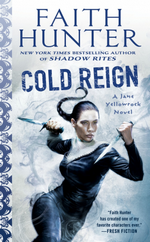
Cold Reign by Faith Hunter

Cold ReignCold Reign

by Faith Hunter
Series: Jane Yellowrock, #11

eARC, 384 pg.
Ace, 2017

Read: March 6 – 9, 2017


Lee Child (and others, I’m sure) has said something along the lines of the key to writing a long-running series is that in each book you give the readers exactly the same thing, only different. Here in book 11 of the Jane Yellowrock series, that’s exactly what Faith Hunter has delivered — Jane Yellowrock up to her neck in revenant vampires, schemes within schemes within schemes, and dealing with the Big Cat that shares her body — but in a new way, with different (yet the same) schemers, a different kind of revenant, and new challenges and revelations about her Beast.

The tricky part of this is coming up with something to say . . . I mean really, the fact that I’m still reading the series 11 books in pretty much demonstrates that I’m a fan and that I’m predisposed to like this — both in its sameness and differentness. I like spending time with Jane and the rest (particularly Eli, Alex and Bruiser), seeing her navigate through this wold, and beating people up/taking out vampires. The “same” stuff is as good as always (maybe even a little better), so what about the “different” stuff?

There’s a lot to cover on that front, actually — I can’t cover it all, that’s Hunter’s job (and she’s so much better at it). But I can do a little. This book takes place sometime after Curse on the Land (yay, multi-series continuity!), and long enough after Shadow Rites that Jane’s started to come to terms with her expanded household and all that it entails (please note the use of the word, “started” — I’m not sure she’s quite finished even at the end of this one). But that’s just the beginning. There are a handful of revenants popping up — but they’re not the kind that Jane is used to dealing with. And their presence might be signalling something significant.

The Youngers have evolved somewhat — Alex is maturing, and even getting out of the house a little — but he’s still the same dude. Eli — wow, we see so many sides of him here that we hadn’t before (maybe saw hints of, but not like this), I loved every bit of the Eli material here — and man, did he make me laugh. He also made me get a little bleary eyed at one point — something I couldn’t ever imagine that I’d say.

Beast does something that I don’t think we’ve seen before — she has something going on that she’s keeping from Jane. There’s something she knows, maybe something she did, that she’s blocked Jane’s knowledge of. That’s scary — kinda cool — but mostly scary. The repercussions of Beast doing things without the human part of her knowing, there’s a couple of books right thee.

Naturally, the biggest differences come from growth and changes to Jane herself — at one point, she says

My life was so weird I scarcely recognized it.

The only reason readers can recognize it is that we’ve followed the series — if someone made the strange decision to read Skinwalker and then jump to Cold Reign, I bet they’d barely recognize the protagonist. The changes in her abilities, her shifting (but not totally shifted) feelings towards vampires and their practices, her love life, her friends, her understanding of her past, etc., etc. — she’s come a long way, mostly for the good, I think. There’s even a sentence I identified in my notes as “possibly the sweetest, sappiest thing to come out of Jane’s narration.” I decided not to include it here, but fans will gush over it. I just know it.

None of that means that when it comes time for bringing the pain that Jane’s not up to it — in fact, thanks to recent events, she’s better at it than ever. Her use of the Gray Between (which is bordering on being over-used), is improved here — she’s able to handle it better and uses it to her great advantage. Yeah, she might be not be that recognizable, but she’s a better character for it.

The core of this book — plotwise, anyway — comes back to the looming summit with the European Vampires, while Leo continues preparing for it, some things start happening that make he and his Enforcers begin to think that maybe the EVs are already in New Orleans and doing what they can to undermine him before anything official happens. Hunter, like many authors, has really taken advantage of the long-lived nature of vampires and how they’ll use that for long-range planning. In Cold Reign we see that used very well — as I mentioned before, there’s a new kind of revenant running around New Orleans — and there’s no good explanation for how that’s happening (there’s a pretty diabolical explanation, however). This brings us back to the first time Jane stuck her toe in the water of Leo Pellisier’s plans, and the early defenses against insurgents that Jane mounted on his behalf. Plots and schemes that we thought we were done with (if only because the plotters and schemers were no more), are brought back up and put into a new light in a very convincing manner. If Hunter said that she’d been planning these moves since book 2 or so, I’d believe her — I’d also believe her if she said that she needed something for this book and took advantage of some of material from her early books. Either way, she does a very clever job of it.

There’s a little bit of Soulwood in Cold Reign. We get a mention or two of Nell Ingram. Rick LaFleur is around doing PsyLED stuff — without the rest of his team, sadly. Soul is seen a few times, but doesn’t do much (but what she does is pretty cool).

I’ve long enjoyed Jane’s calorie-rich dietary needs and the abandon with which she dives into her food — and I think I’ve noted with both books, how fun it is to watch Nell Ingram sample junk food. But I think in Cold Reign, Beast trumps them both — she eats her first taco. And I found it delightful, really, literally laughing out loud. I’ve decided that what Hunter’s fans need is a Food Network-style show featuring Jane, Nell and Beast trying various foods — I’d just love it.

The ending came a little quicker than I expected (possibly was confused thanks to the Soulwood preview at the end tweaking the percentage — but even without that, it seemed sudden). Which isn’t a bad thing, and probably says more about me than anything about the book — maybe I just wasn’t ready to say “see ya later” to Clan Yellowrock yet. Without spoiling much, there wasn’t a lot of resolution here — there was enough — but not as much as you might expect. The threat to Leo is still out there, and Jane et al. have their work cut out for them to prevent a European Vampire takeover.

Another winning tale of Vampire Politics, New Orleans weather, Magic, Big Cats and blood — lots and lots of blood. At this point, I’m not sure Hunter can do anything wrong with this series — and I hope she doesn’t prove me wrong anytime soon. Get your orders in now folks so you can dive on it on May 2.

Disclaimer: I received this eARC from Berkley Publishing Group via NetGalley in exchange for this post — thanks to both for this.
N.B.: As this was an ARC, any quotations above may be changed in the published work — I will endeavor to verify them as soon as possible.

—–

4 1/2 Stars

Saturday Miscellany – 3/11/17

Been one of those days, but it’s still Saturday, so posting it still counts 🙂

Odds ‘n ends over the week about books and reading that caught my eye. You’ve probably seen some/most/all of them, but just in case:

    A Couple of Book-ish Related Podcast Episodes you might want to give a listen:

  • Alan Dean Foster was interviewed on Hank Garner’s Author Stories podcast this week — some fascinating stuff from an author I’m sure you’ve read a little of.
  • The Writers Panel #319: Christine Lennon/Bob Daily, features some good stuff — I really liked what Daily said about characters/scenes (have used it a little already in looking at books). The story about getting his job on Frasier is pretty good, too, albeit off-topic for this blog.

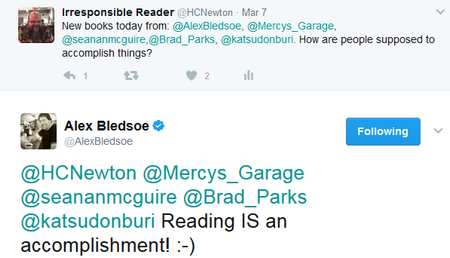
    After a couple of slow weeks on the New Release front, we get hit with this one…leading to: Bledsoe’s right. Get to work, people. This Week’s New Releases I’m Excited About and/or You’ll Probably See Here Soon are a good place to start:

  • Gather Her Round by Alex Bledsoe — the fifth Tufa novel looks to be the darkest so far. Really looking forward to this.
  • Silence Fallen by Patricia Briggs — I’m almost halfway done with this, and it’s a good one, folks (shock). Mercy’s kidnapped by a vampire, and well, Adam’s trying not to kill everyone in sight.
  • Magic for Nothing by Seanan McGuire — the new InCryptid novel is from Antimony’s point of view, and she’s getting to deal with the fallout from Verity’s live television surprise at the end of Chaos Choreography.
  • How the Hell Did This Happen? The 2016 Presidential Election by P. J. O’Rourke — title says it all, don’t it?
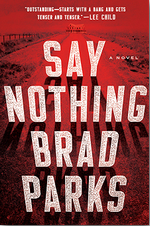
  • Say Nothing by Brad Parks — Parks’ first stand-alone is fantastic. Read my full take here.
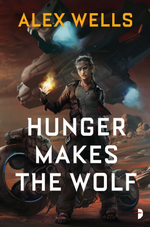
  • Hunger Makes the Wolf by Alex Wells — SF world, Biker Gang, and some strange sort of magic. Cool book. My full take on this one is right here.

Lastly, I’d like to say hi and welcome to five experts for following the blog this week.

I’m Curious: What Was the First Book That . . .

I am just having one of those weeks — seriously, it’s like my week is manifestation of Murphy’s Law, and the idea of me writing something new is laughable. So here’s a variation of a post I did a year ago — we’ve got some new regulars in the comments, and I’d like to hear what you all say.

Anyway. . .

This was asked awhile ago on some Facebook group I belong to and I thought the answers were interesting enough, I’d ask you:

If you can remember, what was the first book that destroyed you? (that is, which book left you an emotional wreck?)

For me, it was either: Where the Red Fern Grows (which I read most of several times, and all of a couple of times); The High King by Lloyd Alexander between the deaths and goodbyes, I still can’t do it dry-eyed; or Bridge to Terabithia — I can’t tell you anything about the plot (there were 2 kids, 1 girl and 1 boy, right?), the characters or anything, and I read it 2-4 times — all I can remember is emotional devastation.

Looking forward to hearing from you. Share the emotional scars we all know you have. 🙂

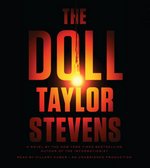
The Doll (Audiobook) by Taylor Stevens, Hilary Huber

This post was supposed to go up this morning, but I thought of a point or two I wanted to add. So during my morning break, I pulled it up on my app and the post vanished. Well, not the whole post — the tags, categories, and headline stuck around — but the actual content vanished. Thankfully, I don’t compose in WordPress, so I didn’t lose that much, just some minor tweaks. But still — any one else ever have this trouble with their app?

The Doll (Audiobook) The Doll (Audiobook)

by Taylor Stevens, Hillary Huber (Narrator)
Series: Vanessa Michael Munroe, #3

Unabridged Audiobook, 13 hrs., 47 min.
Random House Audio, 2013
Read: February 17 – 24, 2016


The novel starts with Miles Bradford witnessing Vanessa Michael Munroe being kidnapped — and in a most impressive way. He mobilizes he members of his private security team in town and begin looking for her — and Logan — immediately. Miles assumes (correctly) that if the object was to hurt Michael, he and Logan would be the top candidates to join here. If she’s being kidnapped to do a job, Logan would be the ideal candidate for a hostage — as long as someone has him, Michael will do whatever it takes to keep him alive. Ergo, since he knows Michael’s out of the country, but he’s not sure where, the best thing he can do is to free Logan from whoever took him, eliminating the leverage they have over Michael.

Meanwhile, Michael wakes up somewhere in Europe where she’s presented with this simple choice: do a job for this man she recognizes as The Dollmaker — or he’ll have Logan killed (and he threatens to do similar things to others Michael cares about). The job is to deliver a young woman into a life of sex slavery and torture. This particular young woman is a rising movie star who’s gone missing — the surrounding publicity makes her one of the best known faces in the wold. She needs transported over a few European borders without being seen or injured in any way. Doing this will repay a debt to The Dollmaker that Michael incurred in a previous case.

Just typing that makes it sound like Michael’s a monster for even considering delivering Neeva — and she certainly thinks so — but in the context, Michael can’t seem to do anything better (although she does hope that Logan will be rescued, giving her the opportunity to save Neeva). Michael also knows that no matter what happens, she and Logan are dead as soon as the girl is delivered (barring a successful rescue). Most of the book is a compelling race against the clock, followed by Michael’s hunt for revenge.

This is the first time that we really get to see Bradford’s operation outside of just him — I’d enjoy a novel or two about he and his team without Michael, I must say. The best parts of this book involve Miles and his team doing their thing.

Huber did a great job, as per usual — I honestly can’t think of anything to say about her work that I haven’t said before. Neeva frequently sounded like Anna Faris to me — which helped solidify the character. There is one thing that I’ve meant to say since the last book and forgot about until this instance — there’s a playfulness that creeps into Huber’s voice as Michael prepares to do something violent. I love that little touch. It says so much about the character (and I hope Stevens agrees with what it says) — it also speaks volumes about Huber’s attention to nuance.

A gripping tale — with some of my favorite moments in the series — even if I found some character choices hard to believe/stomach. With plenty of callbacks to earlier books to cement this in Michael’s story. Still, another good entry for Stevens, Huber and Munroe.

—–

3.5 Stars

Snotgirl, Vol. 1: Green Hair Don’t Care by Bryan Lee O’Malley, Leslie Hung

Snotgirl, Vol 1Snotgirl, Vol. 1: Green Hair Don’t Care

by Bryan Lee O’Malley (Script), Leslie Hung (Art)
Series: Snotgirl, #1

Trade Paperback, 144 pg.
Image Comics, 2017

Read: March 7, 2016


I don’t know what Bryan Lee O’Malley was doing here, really. Lottie Person is a fashion blogger, trend setter, and all around would-be Kardashian. She’s a little vapid, a little shallow, but pretty likable (don’t ask me how). Her actual life is a mess — she has horrible allergies — crazy horrible (hence the name), has been recently dumped, and maybe, just mayyyyybe killed somebody. She’s not sure — neither is the reader.

What follows (for about 80% of the book), is Lottie bouncing around between social engagements, possible hallucinations, and run-ins with her ex and his new girlfriend. Throw in a fashion-conscious cop and things get pretty interesting (and confusing).

I loved the art — it was a little strange to see this kind of art attached to O’Malley’s writing, but I really liked Hung’s work. Yeah, her white guys tend to look too much alike to easily tell the difference (that might be intentional) — but otherwise, I really liked it — everything jumped off the page, the drawings were filled with energy and life. Every time I thought about bailing because the story just wasn’t working, the art kept me in.

I just don’t know what to make of this — I enjoyed it, but man . . . I really wish I knew what was going on. I can handle it for a little bit longer — but not much. Volume 2 had better be a little clearer (or a little something else). I’m not going to wave potential readers off, but I’m not going to encourage anyone either.

—–

3 Stars

HER: The 1st Victor Locke Story by Michael RN Jones

HER: The 1st Victor Locke StoryHER: The 1st Victor Locke Story

by Michael RN Jones
Series: The Victor Locke Chronicles, #.5

Kindle Edition, 49 pg.
Fahrenheit Press, 2017

Read: March 7, 2017


So a couple of weeks ago, The Accidental Detective was released — and it looked good, and is sitting on my Kindle, begging for my attention.

Today, I had an extra minute or two on my hands and Fahrenheit Press was nice enough to provide this, the first story about Victor Locke and his psychologist for free. (hopefully you see this in time to head to amazon and grab it).

Locke is a fast-talking, genius of some sort who’s served time for computer hacking. Dr. Jonathan Doyle was his court-appointed psychologist upon his release. Locke’s no longer a client, but Doyle still sees him around. So when a couple of FBI agents drop in to his office to get his help finding Locke, it’s easy for him to connect them to Locke.

They have a task — go find a digital file that will bring great embarrassment to the British government, as well as the U.S.’. They provide no details about the file beyond what’s essential to find it. They also provide the Locke with a snazzy laptop (as he’s not permitted to have one any more). Seemingly on a lark, Locke takes their offer and begins searching.

The search obviously, leads to HER. The story isn’t that important in this case, it’s all about meeting the world, meeting Locke and Doyle. As such — it’s a hoot. There’s a strong voice that practically demands to be read quickly, breathlessly, like the fast-talking Locke (can you read breathlessly?). There’s a manic energy matching Locke’s logic and smarts, which explains why Doyle seems so intrigued by him.

As an advertisement for The Accidental Detective/encouragement to read it? This works really well — I’m in, and will work on getting to it soon. As a story in and of itself? Eh, maybe it works too hard at paying tribute to/updating a classic mystery story to really work. But man, it was fun. A great way to spend a half-hour or so.

—–

3 Stars

Pub Day Repost: Hunger Makes the Wolf by Alex Wells

Hunger Makes the WolfHunger Makes the Wolf

by Alex Wells
eARC, 326 pg.
Angry Robot, 2017
Read: January 6 – 10, 2016

Let’s just get this out there — this is a very cool novel. If you dig SF that’s not beholden to space ships and lots of future tech — and can even handle a little bit of magic, you’ll want to read this one.

Tanegawa’s World is a little forgotten backwater of a planet — think Tatooine — so forgotten that none of the colonists there really have a clue that there’s an interplanetary government, or what’s going on with any other planet. The company that runs the mines (and by extension, the farming communities that support the mines) runs the whole show. There are organizations of workers in individual towns, and there’s a loose network connecting them, for mutual assistance and support. And then there are the Ghost Wolves — a band of mercenary bikers. They are a law unto themselves, but have strong ties to the miner groups. They may be supported by/sympathized with by most people in the towns, but officially they’re outlaws.

Hob Ravani is the lowest ranked member of the Wolves — she’s made some serious blunders that required her to go through the training/probationary process twice. But she’s a full-fledged member now, and the leader, Nick Ravani (no blood tie, but he gave her his name), seems to trust her, even as he’s still testing her commitment following these blunders. Making a routine run with a couple of other Wolves, Hob finds the body of Nick’s brother lying dead in the sand, shot in the back several times. This discovery — and the ensuing investigation, retaliation, and the side-effects of both — will end up changing Tanegawa’s World and the lives of many of its people in ways that no one can expect.

Which is not to say that this is a big, global story. It’s not. This is about Hob and her immediate circle. They just find themselves (and, eventually, put themselves) in some critical areas — and also don’t realize just what they’re getting themselves into. Mag, the dead man’s daughter, is Hob’s estranged best friend, and will be the favorite character of many readers. There are Geri and Freki — twins who are only slightly senior to Hob when we meet them, they’re not really friends of hers, but they are allies she can count on when she needs to — and on this world, that might be more important. There’s Coyote, who I enjoyed immensely, and a couple of other Wolves that we spend time with, but most aren’t factors in the story. There’s one more person in her circle, the Bone Collector — I’m not even going to try to sum him up in a sentence, but he’s worth getting to know.

On the flip side we have Mr. Green, who is just creepifyin’ (as Mal Reynolds would say), a Weatherman (not like Al Roker) and a couple of cut-throat corporate types who just this side of wearing black hats and twirling their mustaches They are absolutely believable and not cartoon-y, but reek of “bad guy.”

There is something that could be magic going on here — it’s definitely seen as magic by some. It might be radiation-induced mutation. It could be some sort of world-spirit/alien entity doing something to people. It’s tough to say, and it really doesn’t matter — some individuals on Tanegawa’s World possess abilities that others don’t. The ultimate cause of those abilities makes no difference to the story, it’s interesting to speculate about (and to see why various groups adopt their interpretation and how they use it) — but at the end of the day, it just means that there are a few characters walking around with extra abilities which don’t define them, but are definitely helpful.

The plotting is good, the pacing is strong, and there’s a strong voice throughout the work. This is just an impression — I can’t quote anything to verify it (were I a professional, I’d make the effort), but while the voice is consistent and strong throughout, I think Wells is a bit more aggressive about it in the opening chapters. In sort of a “come on strong and get you into the world” then dial back to “now here’s the story.” Or maybe it’s “throw you into the deep end” and then let you swim undisturbed. Or maybe I acclimatized Or maybe I should stop trying to make this point and move on. My overall point on voice — both the narrative voice, and the individual characters — it that it was strong, clear and engaging — the kind that you want to spend 300 pages with. Wells demonstrates the chops to keep and build an audience, if they’ll just give the book a shot.

I’ve seen a lot of comparisons to Dune and this world — I’ve never been able to get through much of the first book, and nor the adaptations — so I can’t comment. There’s a lot of sand, so, I guess maybe. Tanegawa’s World feels like something out of O’Keefe’s Scorched Continent or Firefly — a mining/agricultural society in what might as well be the Old West with (some) better technology than we have. Arguably, this planet is a little less hospitable to humans and The Powers That Be are a shade more corrupt.

I’ve also seen a lot of talk about the biker gang aspect of the book. It didn’t feel as prominent as I’d have liked — it was there, but it didn’t seem that vital to the nature of the mercenary crew the Ravani leads. If I had to compare it to anything, the Ghost Wolves felt more like a UF werewolf pack than anything else. That may say more about what I’ve been reading than anything that Wells wrote, still I got more of a Briggs/Vaughn/etc. vibe to the group than a Kurt Sutter-vibe. Outside of a handful of individual members, I didn’t get a clear feel for the Wolves. It’s understandable, Wells had a lot balls in the air and was doing just a good job juggling them that I didn’t notice. In retrospect, however, I’d have appreciated a little more time with this aspect.

I feel like I’ve gone on too long here, but I haven’t touched all the things I want to say. There’s just so much going on in these few hundred pages! Despite all that, you don’t get bogged down in the worldbuilding, the details, the backstories, or anything — Hunger Makes the Wolf is a fun, fast, gripping read. I trust there’s a sequel on the way. There just has to be. Not that this isn’t a complete story — there’s just a lot of threads that beg to be picked up. Either way, you’ll want to read this one.

Disclaimer: I received this eARC from Angry Robot via NetGalley in exchange for this post — thanks to both for this opportunity.

—–

4 Stars

Pub Day Repost: Say Nothing by Brad Parks

Say NothingSay Nothing

by Brad Parks
eARC, 448 pg.
Dutton Books, 2017
Read: January 19 – 21, 2016

Since his debut novel, Faces of the Gone in 2009, I’ve considered myself a Brad Parks fan — but when I heard that he was going to step away from his series for a stand-alone, I got a little nervous. Maybe I wasn’t a Brad Parks fan — maybe I was just a Carter Ross fan. Honestly, the parts of the Carter Ross novels that he doesn’t narrate aren’t my favorite. Also, we all know all too well that for every Suspect or Mystic River, series writers can give us a The Two Minute Rule or Shutter Island — maybe grabbing this book was going to be a mistake.

Thankfully, it wasn’t.

While working on this post, I saw this from Sue Grafton talking about Say Nothing: “Terrific book. Truly terrific. Tension throughout and tears at the end. What could be better than that?” I’m a little annoyed by this, honestly. That’s pretty much how I was going to sum up things for this post. Frankly, I wish Grafton would focus her efforts on finding another 5 letters between X and Z rather than preemptively stealing my lines.

We meet Judge Scott Sampson a few minutes after the biggest crisis of his life has started — and a few minutes before he leans about it. Once you get to learn Sampson a little, you’ll see that the bar for biggest crisis for him is set a little higher than for most. He’s informed that his twin children have been kidnapped and is provided some pretty compelling reasons to believe that he’s under surveillance (and will soon be given even more reason to believe that). Basically, the message he gets is this: if you want to see you children alive and well, you will do what we tell you to with a case. There are a few tests he has to pass to demonstrate his compliance — tests that may do lasting damage to his career. But Sampson is eager to prove that he will do whatever he’s asked for his children, consequences notwithstanding.

This isn’t going to be an overnight escapade — in fact, for Sampson and his wife (how have I failed to mention Allison?), this is an ordeal of indefinite duration. The stress, the worry, the intense reaction to this situation begins taking its toll almost immediately. These pressures test their individual ethics, bring secrets to light, expose and exacerbate problems in their marriage, and generally bring them both to the breaking point. They are also both driven to discover their inner-Liam Neeson in order to get their daughter (and son) back — neither, really possess a particular set of skills fitting this goal, sadly. These attempts just make their personal and interpersonal woes worse — and their lives continue spinning out of their control.

There is a relentlessness to the pace that’s a pleasure — and a drain. Jack Reacher gets a good night’s sleep and enjoys coffee (and the less than occasional romantic interlude), Harry Bosch has jazz to relax him, Elvis Cole has that cat and Tai Chi — as intense as things may get, by and large these guys get a break. But for Scott and Allison — their children don’t stop being kidnapped, and whatever solace they might find in alcohol, sleep or family — it’s a temporary band-aid at best.

This doesn’t mean that it’s not an enjoyable read — Scott is a charming character and you will like him as you learn more about his life and family. You will not approve of every move he makes here (I guess you might, but I hope you don’t), but on the whole you will understand why he makes them and won’t judge him too harshly. Whoops, I was talking about tone here — I had fun with this, even as I was feeling a shadow of the pressure Scott and Allison are under, I even laughed once. There’s a real sense of peril when the narration focuses on the children — but it never feels exploitative.

Like most readers will, I had a couple of pretty compelling theories about who was behind everything (and why), and focused on the correct one pretty early on. Which didn’t stop me from being taken aback when it Parks revealed it — he really handled that well. Another weakness comes in the last couple of pages where Parks ties up a few loose ends, and a couple of them feel too tidy. But it’s instantly forgivable, and you want these characters to have something tidy after all they’ve gone through. On the whole, however, the characters and situations are complex and real (if heightened) — Parks nailed this whole thing. I think this will hold up to at least one repeat reading — the second read might even be more rewarding since you can appreciate what Parks is doing without being distracted by wondering what’ll happen.

The tears that Grafton mentioned? Yeah, she got that part right, too.

This is a thriller filled with real people and situations that you can believe. You’ll run the emotional gamut a time or two while reading this and will wish you could read faster just so you can make sure these kids make it home. I think I like the Carter Ross books more than this, but it’s in Say Nothing that Parks finds his stride as a crime fiction writer. Really well done.

By the way, It turns out that I am a fan of Brad Parks. Phew.

Disclaimer: I received this eARC from Dutton via NetGalley in exchange for this post — thanks to both for this, although my Primary Care Physician probably isn’t crazy about what it did to my blood pressure .

—–

4 1/2 Stars

Death Stalks Kettle Street by John Bowen

Death Stalks Kettle StreetDeath Stalks Kettle Street

by John Bowen

Paperback, 370 pg.
John Bowen, 2016

Read: February 6 – 7, 2017


Nothing against Adrian Monk — either in book or TV form — he was brilliant, fun, and his OCD was treated with sensitivity. But also for laughs — the combination wasn’t easy to pull off. But OCD isn’t really a laughing matter — just ask Greg Unsworth, the protagonist of John Bowen’s compelling cozy mystery. Greg wants to be normal, he doesn’t want to be kept awake because a tea cup might be out of alignment with the others, he doesn’t want to lock and relock and relock and relock his front door just to be sure it took, he wants to be able to cross the road when he wants to. Partially this would be for his sake, but mostly, it’s to help his brother out, because he’s really bothered with Greg’s OCD.

Beth Grue doesn’t believe in normal — she knows everyone is a little not-normal in their own way, she’s fully embraced her non-normality. She just wants everyone else to treat her as no more different than anyone else — cerebral palsy or no.

The two of them meet when they discover the dead body of one of Greg’s neighbors together, which leads to a fairly unlikely friendship. They understand the others struggles, they accept each other for what they are (well, almost, Beth isn’t as patient always as she wants to be). As the friendship develops, they begin to realize that the body they discovered was one of a pretty high number of accidental deaths in Greg’s neighborhood recently. Not only that, but someone has been sending Greg advance notice of these accidents (which casts a shadow on the whole “accident” idea, no?).

There’s a great subplot about Beth taking a class in mystery writing — which allows Bowen to comment on the genre, while helping Beth to think both about her novel in-progress and the murders she and Greg are convinced are being committed.

And the mystery? It was pretty well constructed, and the reveal was wonderful. There’s a handy red herring that was so obvious that the character might as well have been named Mr./Ms. Hareng Rouge. I didn’t mind him at all because Bowen used it well; our protagonists learn how to investigate (and how not to investigate) through wasting time with the false trail; and the way Greg discovered just how wrong he’d been was so much fun.

Right up until a couple of pages before the reveal of the killer I had a 3 competing theories — all of which seemed pretty likely (well, 2 of them did, anyway). I’m glad the killer is who it was, their motive — and best of all, how Bowen handled the reveal. One of the most satisfying conclusions to a mystery that I’ve read in ages.

It wasn’t perfect, but it got pretty close. I enjoyed the characters, their wants, their interaction, their fumbling attempts to solve the mystery – I can’t recommend this highly enough, really. It’s a cozy that has enough of an edge and dept to appeal to those who prefer their detectives a little more hard-boiled, without getting too messy, too violent, too un-cozy for the core audience.

—–

4 1/2 Stars

Mercy Thompson Audiobooks 1-3: Moon Called, Blood Bound, Iron Kissed by Patricia Briggs, Lorelei King

Rather than try to talk about these individually, I thought I’d save time and tackle them in one post. Let’s hope it works…

Moon CalledMoon Called

by Patricia Briggs, Lorelei King (Narrator)
Series: Mercy Thompson, #1
Unabridged Audiobook, 9 hrs., 14 min.
Penguin Audio, 2009
Read: December 23 – 38, 2016

Blood BoundBlood Bound

by Patricia Briggs, Lorelei King (Narrator)
Series: Mercy Thompson, #2
Unabridged Audiobook, 10 hrs., 2 min.
Penguin Audio, 2009
Read: December 28 – 30, 2016

Iron KissedIron Kissed

by Patricia Briggs, Lorelei King (Narrator)
Series: Mercy Thompson, #3
Unabridged Audiobook, 9 hrs., 11 min.
Penguin Audio, 2009
Read: December 30, 2016 – January 4, 2017


I’ve only posted about a couple of the books in this series, since I read most of the series before starting this blog, it feels strange not to have old posts to go back and steal from. How do I do this concisely, now? I mean this should be one of the longest posts I’ve written, if I was going to do it right.

But I’m not going to do it right, I’m going to do it quick. Simply: Mercy Thompson is a skinwalker of sorts, who was raised by a pack of werewolves (a pack led by the Alpha of North America, it should be noted), who has an English degree and works as a VW mechanic. When we meet her in Moon Called, she’s living near the Alpha of the Tri-Cities of Oregon, is friends with a vampire, knows a couple of the Fae who live on the (Fae) reservation nearby. Almost no one knows about her ability to shift into a coyote (other than these supernatural folks), and she has no intention of changing that. However, she finds herself in the middle of a few goings-on in the supernatural community and becomes a prominent player in the area.

In Moon Called Mercy discovers a group experimenting on werewolves — even creating some for the sole purpose of being guinea pigs. In Blood Bound, Mercy is called upon by the local vampires to pay a debt by helping them track and destroy a rogue über-vampire/serial killer. Then in Iron Kissed Mercy begins helping local Fae investigate a series of murders on the reservation, using her special abilities — in the end, she has to dance around Fae politics while trying to prove that a dear friend wasn’t behind the killings. Throughout this, she has a love life, some friends, helps the local pack with some internal issues, and finds herself in mortal danger frequently. All while maintaining her shop, sense of humor, and independence.

I love these characters — all of them, I can’t think of a single one of them I wouldn’t want to spend more time with. Mercy has an attitude, perspective and humor that I enjoy, and good taste in friends/acquaintances, too. Briggs’ approach to werewolves, vampires, etc. is fantastic and I frequently judge other UF writers by how they match up to Briggs’ approach.

There is a richness to Briggs’ writing and to the world she’s created that’s truly impressive. It takes me less than a chapter to feel absolutely at home in the books (this happened when I first tried Moon Called and has happened with every successive volume — not just in my going through them again on audio). What blew me away going through these books is how much of this series (and the spin-off series, Alpha and Omega) is established in Moon Called — she’s what, 14 books or so in and 98% of those books can be traced to this first one. Whether that’s because she’s good at going back and picking up details to flesh out or because she plotted things out so well, it really doesn’t matter — the material was there and she’s using it well. The world she established is so well-formed that she can keep playing in it without having to invent new things, change the rules she established, or anything else. I can’t think of another UF universe that was so well-built from book one.

King gives a really strong performance here — her characters are spot-on, the narrative stays engaging. Really, a bang up job, with one big flaw: she can’t pronounce local geographic names. Granted, most people who don’t live in Washington/Idaho/Montana(ish) aren’t going to notice, but man, it’s hard to listen to. If I have to hear her butcher “Coeur d’Alene” one more time . . . On the other hand, there’s this scene in Iron Kissed between Adam (local Alpha) and Ben (British werewolf who joined the pack because he had to leave England under suspicious circumstances) where Ben has to explain to Adam the psychological trauma Mercy’s suffered and how she’s reacting. When I first read the book, I was in shock a. because of the traumatic scene (really well written) and b. Ben’s more than capable and empathetic understanding/explanation. This time through, King’s performance just stunned me — it was so good. She nailed the whole thing and almost had me in tears in my cubicle.

I loved the books, I think the audiobooks are among the best I’ve heard — the only reason that I haven’t gone further in this series of audiobooks is that the library system here doesn’t have #4 (they do have the rest of the series, oddly enough), and I haven’t justified the expense for myself yet. For old fans of the books, or people looking for something new to listen to — these are well worth your time. Great material presented in a pretty compelling way.

—–

4 Stars

Page 3 of 4

Powered by WordPress & Theme by Anders Norén