

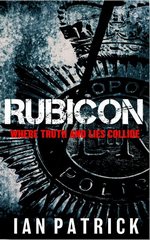
I won’t say that I saved the best for last — but I’ve saved one of the best for last. I’ve reposted my takes on his two gripping thrillers this week and now it’s time to hear from someone you can trust a lot further than DS Sam Batford. Not only is Ian Patrick a heckuva writer, he’s one of the nicest people I’ve interacted with online — always gracious and encouraging to me personally. That generous spirit is evident here, in addition to some of the best responses I’ve ever received to things I’ve asked. This is a great way to wrap up my involvement in Fahrenbruary.
Enough of my blather, on with a few questions for Ian Patrick.
| Tell us about your road to publication — was your plan/dream always to become a novelist, or was this a later-in-life desire (“well, I’ve got to do something when I retire . . . “)? | ||||
|
||||
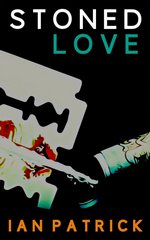
| Your novels are so full of of rich and interesting characters, outside of Sam Batford — which character in Rubicon or Stoned Love was the most fun/rewarding to write and why? | ||||
|
||||
| Batford seems to be an inherently unlikable/despicable character — he’s the kind of police officer that other detectives would work to bring down. I want to ask why you’d design someone like him — but instead, let me ask how much of a challenge is it to get into (and stay in) the mind of a character like that? And, how do you approach depicting a character like that in a way that you’ll get readers to want to spend time with him? | ||||
|
||||
| Is there a genre that you particularly enjoy reading, but could never write? Or are you primarily a mystery/suspense/thriller reader? | ||||
|
||||
| I’ve often heard that writers, or artists in general, will forget hundreds of positive reviews but always remember the negative — what’s the worst thing that someone’s said about one of your books, and has it altered your approach to future books? | ||||
|
||||
| This one’s not about you directly, but what is it about Fahrenheit Press that seems to generate the devotion and team spirit that it does (or at least appears to)? I don’t know that I’ve seen as many authors from the same publisher talk about/read each other’s books — or talk about the publisher — as much as you guys seem to. Is it simply contractual obligation, or is there more? | ||||
|
||||
| Thanks for your time — and thanks for the Batford novels, I can’t wait for #3 and hope you find continued success with them. | ||||
|


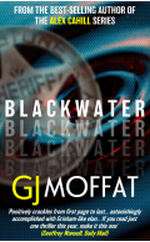
| Early went to [redacted]’s body and hunkered down in front of [redacted]. His skin was flaccid and his jaw and face swollen and misshapen from the effects of his injuries. His shirt was entirely soaked in blood.
Early shook his head, thinking: this is what men do. |
Take Walt Longmire (Deputy Longmire, before Lucian Connally’s retirement) throw him into Jesse Stone’s Paradise, and then tell a story imbued with the spirit of Fargo (movie or show), your results will be pretty close to GJ Moffat’s stunning Blackwater.
It’s a tale of violence, bloodshed, power, inevitability and death — what men do.
Deputy Sheriff Early Simms of Blackwater County is the son of the previous sheriff and probably the only member of the Department really fit for the job. A tragic accident in High School changed the direction of his life, and as a result he’s in the same dying New England area he grew up in. He’s made peace with this, and even seems to be happy — he’d be happier if his boss (and colleagues) cared a bit more about the job and his father wasn’t battling Alzheimer’s, sure. But this is his life.
And then everything changes in a couple of days — his old high school flame (and love of his life) returns to town, there’s an investigation into a corrupt public official, an investigation into an assault/attempted murder at a nearby jail, and a couple of brothers on a killing spree have come to the region. There’s also some drug running, spousal abuse, a pretty nasty bar fight. I don’t want to say that Early Simms is the only one investigating the crimes, in trying to preserve the peace — there are three (that we know of) other members of the Sheriff’s Department, some other local law enforcement officers and some FBI agents running around. But Early’s the only individual who’s in each of the stories — he’s the region of intersection in the Venn diagram of Blackwater (and frequently the most capable person around).
One of the criminals we meet in these pages (not saying which one) is clearly not an evil man. There’s some sort of undiagnosed (by the author or by any professional this criminal has ever encountered) mental health issue affecting him. Which does not lessen the evil he does and the trauma he inflicts on others. Part of me wants to know more about the whys, hows, wherefores, and whatnot about this disorder and is a little frustrated that Moffat doesn’t give us any of it. The other part of me is so glad that he didn’t succumb to temptation to get into tall that, instead merely showing his readers what was going on with this man, leaving it to us to do the work. There’s someone else who probably has some sort of Traumatic brain injury symptoms — not quite the same, but some of the same results.
We also see crime perpetrated by someone motivated by power, money and meanness. Also, there are some criminals who just don’t seem to have options, means or inclination to do anything but break the law. It’s up to Early to face down these people, no matter where on the spectrum they seem to be found, to prevent them from inflicting too much harm on the community.
How successful he is at that, well . . .
Moffat can write. That’s all there is to it. It took almost no time at all to recognize that. You get a strong sense of every character in just a few lines and his world is as fully realized as you could hope for. He presents the evil Early sees and fights against in this book fairly realistically, in a way that is as capricious and destructive as anything you see on the news.
So many times — almost every chance he gets — Moffat will do precisely what you don’t expect. What people just don’t do in this kind of book. He’ll put the characters in a situation you’ve seen dozens of times before, and just when you think “X will happen right after I turn the page,” B happens before you can turn the page. I realize there’s a danger in saying that — you’ll be looking for that kind of thing. But I expect that the same thing’ll happen to you as it did to me every time he pulled the rug out from under me — you’ll get sucked in by his writing and the characters (and possibly still be reeling from the last shock) and you won’t even think to expect that he’ll do it again.
I finished the book I was reading before this earlier than I expected to, and didn’t have the next on my list with me, so I took the opportunity to pay a visit to what I call my Kindle’s “Fahrenheit Ward” — where I stick all the Fahrenheit Press books that I buy without time to read — and I grabbed this. I’m so glad my timing worked out that way — this is exactly what I needed. I got sucked in by this immediately, and it was practically impossible to put down. Before I got to the novel’s final confrontation(s), I jotted in my notes, “Man, I hope this isn’t the first of a series — I don’t know if the community can survive another book.”
But if Fahrenheit published a sequel today? I’d shell out cash before the end day. I strongly expect you’ll feel the same way once you recover from Blackwater.
—–

Time to wrap up our Tour Stop for this book — I hope you’ve enjoyed it half as much as I have. I get a little long-winded below, sorry — but when I like a book as much as I did this one, it happens.
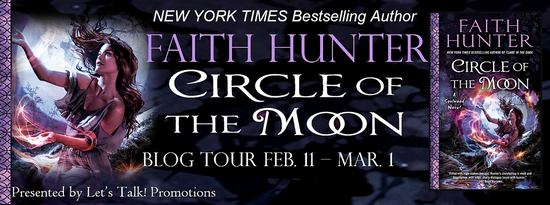
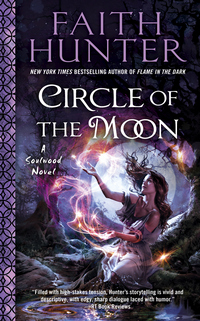 Circle of the Moon
by Faith Hunter
Series: Soulwood, #4
eARC, 400 pg.
ACE, 2019
Read: February 6 – 8, 2019

I’m going to have to talk about the events at the end of the previous book, Flame in the Dark, a little bit. If you haven’t read that — sorry. You may want to use the time you were about to spend on this post to purchase that/get it from your library instead.
So, with any of these Soulwood books there are three main threads to follow: 1. The PsyLED case(s) and storylines associated with the team; 2. The developments with God’s Cloud of Glory Church and Nell’s family; 3. Nell’s personal evolution as in independent woman and her supernatural development. These will all intertwine and effect each other — particularly the private lives of the PsyLED team and Nell’s own development. I want to touch on all these briefly to give you a good idea what to expect with this book.
Let’s start with God’s Cloud of Glory, which gets a lot less ink than we’re used to. But when they show up, it counts. It’s unclear how much of the church is really in favor of the changes occurring within it — it’s probably not as uniform as I’d been thinking. Which makes sense, any reformation is slow and complicated — and won’t be a straight line of progress, humans are messier than that. Whether this group will actually stumble into orthodoxy is hard to say, and it’ll definitely take years. We get to see a little of the pushback to the reforms here, but it’s nothing severe. I expect in a book or two, something will happen because of what we see in this book. The Vampire Tree on the Church’s land takes a different role in this book than we’ve grown accustomed to — and it’s probably the most important and intriguing development having to do with the Church in Circle of the Moon (possibly the most important in the book as a whole, too — time will tell).
We do learn some interesting things about Nell’s family and how they acted before Jane Yellowrock and the feds upended everything, too. I shouldn’t forget that…
As far as Nell goes, it’s been just a few weeks since she stopped being a tree and started being a human-ish person again. As you can see from the excerpt I posted earlier, things are going well for Nell and Occam, and things are moving quickly on the Mud coming to live with Nell front. But both are bringing their share of challenges for Nell. Her life is definitely not looking anything like what she’d envisioned and the changes aren’t easy for her — she mentions at one point her mixed feelings about coming into the twenty-first century. As much as she relishes some of these changes, none of them are easy.
Nell is forced to confront and re-evaluate her ideas about love, commitment, what it means to be in a romantic relationship. So much of her thinking is still that of a “churchwoman” as she’d put it. She knows other women, other men, don’t think of things in those terms and while she’s rejected her upbringing, she hasn’t yet replaced everything she wants to (she probably hasn’t even figured out everything she wants to change).Occam is the best person for her to be involved with right now (the cynic in me wants to say that he’s too perfect, but I like him too much to listen to my inner cynic) — his patience, kindness and understanding are what’s going to help her the most now.
I’m not gong to say anything else about Mud — but I’m a fan. I don’t think Hunter hit a false note with her character or any scene she was in. Mud’s a great character and knows exactly what she wants in this life (at least for now) and what she needs to do to get it. Primarily that involves manipulating and/or convincing her sister to do a few things — and Mud’s an expert at both of those.
As far a Nell and her powers go? Just wow. If you think the tree thing in the last book was revolutionary, just wait. There’s nothing as cataclysmic this time (thankfully — I’m not sure we readers could take it), but the implications of some of what Nell does in this book that aren’t yet known or seen, and the reverberations from them will be felt for a while.
So that brings us to PsyLED. Rick LaFleur wakes up in the middle of a very strange witch circle with no idea how he got there. He’d been called there somehow — as his cat. There’s a dead cat near and Nell picks up traces of vampires in the circle, too. Clearly, black magic is involved — but how and why, no one knows. It doesn’t take long before there are other circles being discovered — new and made in recent weeks. Rick and some of Ming’s vampires alike being called to them. Either of those happenings would be concerning — but the combination of them is mysterious and troubling. Also, why is Rick being called and nothing happening to the team’s other werecat? The questions and mysteries pile up quickly.
Some trouble in Knoxville law enforcement doesn’t help, either. Supernatural crimes/events — things like strange witch circles — aren’t being reported to PsyLED as they ought to be. The FBI and one particular agent (the witch that Nell met last time) are hovering on the fringes of the investigation in a way that speaks of more than mild curiosity. Changes and upheaval in the local vampire government — Ming of Glass is now a MOC, for example — feeds into some of the confusion.
It’s one of those situations where the more Nell and the team learn, the less they know. Everything points to big trouble, they just can’t figure out what kind of trouble — or even its source. Rick is going to have to explain a lot about things he’s previously been reluctant to discuss, for starters. And still, they may not figure out what kind of black magic is involved — and why — before it’s too late to save innocent/not-so-innocent lives.
This is the best PsyLED story this series has yet given us. Nell running off on her own isn’t going to crack this, solid procedure, a real team effort and some quick thinking (and a few lucky breaks) are the key to things working out. It’s probably the most exciting story, too. There’s a lot of action, there are more guns fired in this book by law enforcement than possibly in the first three books combined. Lainey and her magic, JoJo’s computer wizardry (legitimate and less than), Occam’s cat and trigger finger, Tandy’s abilities, plus Nell’s abilities (including offensive capabilities we haven’t previously seen) are going to have to work more in general and in combination with each other than they have in the series so far just to keep the team in the game — but for them to actually close this case and get some answers, they’re going to need extra help. I loved this part of the book and want to keep talking about it, but I’m going to hold back. I’ve often wondered if the team wasn’t wasting time in the past — not this time. Everything clicked for me with this story and I couldn’t be happier about the whole thing.
I’m pretty sure that I can’t say anything about the people behind the circles without ruining something. There’s some real evil afoot, I tell you what. There’s also a damaged soul (well, a few of them), some well-intentioned moves in the past that result in trauma and worse in the present, a mixture of aligned entities that don’t necessarily have the same ends in mind. You combine those things and you get a lot of damage, heartbreak, and death being dealt. Not only is this the best PsyLED story, it’s got the most compelling opponent(s) for the team yet.
I know that Rick has his detractors going back to early on in the Yellowrock books up until his involvement in this series. I haven’t checked as much as I should have to see if some of them have come around to him or not. I’ve never been as anti-Rick as others have been, but he’s never been a character I liked. As soon as he and Jane split, I would’ve been content to never think of him again — but Hunter had other ideas. I liked him in this role, but I’ve always preferred everyone else on the team (except Paka), and really hoped he’d be in the background for some time. Yeah, well, that’s absolutely not the case in this book. I won’t say that this book wholly rehabilitates the character for me — and I can’t imagine that the extreme anti-Rick contingent will be satisfied. But, I will say that it’ll be hard for people to not soften their opinion of him after this book. Hunter did a lot of good to his character in this book. For people who liked Rick and/or were positively-inclined toward him? You’re going to love this book.
Tandy does a couple of things in this book that intrigued me. Nell’s not the only paranormal on this team whose powers are developing in ways that may prove troubling. I wonder if it’s a coincidence that these two (and maybe others?) are changing, or if there’s another explanation — they’re changing each other, one is changing the other while they evolve themselves — or is there an outside party up to something? It’s also possible I’m reading too much into things.
This is largely an aside for people who are Yellowrock fans. Throughout this book, we brush up against Jane Yellowrock and what happened in Dark Queen, which seems to have happened while Nell was a tree (I think Dark Queen started about the same time as Flame in the Dark, but DQ ended a lot sooner than FitD), and Nell’s not really up on what’s going on with her friend yet. She knows a couple of the bullet points, but doesn’t really have the full picture. According to FaithHunter.net’s Reading Order, this novel actually happens after the next Jane Yellowrock novel. So, we’re about as confused as Nell is. Now, does this impact any of the interaction Nell, JoJo and the rest have with Jane, Alex or any of the vampires in Tennessee? No. But man, it makes me even more curious about what happens after Dark Queen — I didn’t think I could be more curious about that than I was, but man…this book has really intensified all that for me.
Okay, back to Circle of the Moon. I’ve given the first three books in the series 4 1/2 Stars each. I think this time I have to give in and toss that missing half star to the rating. The PsyLED story was great, we didn’t get bogged down in the Church/cult business too much, Mud just made me smile, and while I’m not comfortable with every choice Nell made in her personal and professional life (and a couple of the choices worry me long-term) — I like the fact that she’s making them. I can’t think of a single problem with this book, it satisfied every fan-impulse/desire I had, was a step up from previous installments in many ways, and told a solid and complete story that still drives the reader to want more. I can’t imagine a Hunter fan not liking this book — and it’s the kind of book that should get her some new readers, too.
Disclaimer: I received this eARC from Berkley Publishing Group via NetGalley in exchange for this post — thanks to both for this. My opinions remain my own and are the honest reactions of this particular reader.
—–

My thanks to Let’s Talk Promotions for the invitation to participate in this tour and the materials (including the book via NetGalley) they provided.
 A Burdizzo For A Prince
by Mark Rapacz
Kindle Edition, 332 pg.
Fahrenheit Press, 2017
Read: February 21 – 23, 2019
“Spit it out,” I said. I was hoping for an apology, or something. Not every day your best friend is pretty sure he wasn’t going to kill you, which means he was equally as sure he was going to–I think. Semantics were never my strong suit, but when speaking the language of death, these things matter.
J. J. was having a perfectly okay day–he was out getting some supplies for the week, walking around the small Midwestern town he was calling home, when his childhood best friend arrives without pomp or circumstance. This was not a happy reunion–the reason they hadn’t seen each other for years because J.J. was on the run from the Jersey crime family they both worked and killed for; and Jackie’s presence meant that J.J.’s hiding spot was blown and that Jackie had been sent to kill him. So much for that good day.
Not really a spoiler: Jackie doesn’t kill him, or the book would’ve been much shorter than it is. Instead, he aligns himself with his old friend and partner to survive. Almost immediately, it becomes clear that their former boss has expected Jackie to not follow through on things and sent in a ringer to clean up. It’s not long at all before J.J. has to abandon the home he’d made for himself, the life he was on the verge of building and a woman he might love (or not like terribly much–it’s one of those things), to voyage down the Mississippi with Jackie and a couple of allies.
Shortly after that, this stops being a story about a couple of hitmen trying to retire and becomes a tale of vengeance and blood. Lots of blood.
Rapacz has a dynamite style — it’s slick, it’s fast, it’s full of black humor. And despite some distaste I had for J.J. and his personal life and vocabulary, I really got into it. As Jules Winnfield reminds us, “Personality goes a long way,” and this novel has personality by the bucket.
Somewhere along the trek down the The Big Muddy, I think you can argue that Rapacz let his style run away with him and parts of the book become too much. At the same time, some of the best moments of the novel — not just stylistically, but plot and character-wise, are in the middle of this excess. So what do I know?
I didn’t end up liking it as much as I started off liking it — and that might be me, it might be Rapacz, maybe a bit of both. There were some real surprises, some moments of head scratching, and some great tension — and a fight scene or two that will burn themselves into your mind’s eye for at least a week. Which, given the fact that the title is about a castration device, is about what you should expect, right?
A Burdizzo For A Prince might not be your cup of tea — or you’ll love it — but you won’t forget this anytime soon.
—–

Man, I hope there are more of these on the way from Fahrenheit…fun books.
—
 The Death Pictures
by Simon Hall
Series: The TV Detective, #2
Kindle Edition, 282 pg.
Fahrenheit Press, 2018
Read: July 10 – 11, 2018
So here we are a few months after the events of The TV Detective, and while Dan Groves, TV reporter, and DCI Adam Breen aren’t working together any more, their friendship has grown and both of the careers are improving from their collaboration. So when there’s a serial rapist on the loose — one who made a point of leaving a calling card at the crime scenes to get public attention — both of their bosses are interested in them renewing their partnership (even if no one ever gets to hear about his calling card).
Around the same time, there’s a famous artist dying of cancer who is using his impending death as a launching pad for a contest of sorts — it raises money for charity, and raises his public profile a bit, too (not that it needed much). Dan has been tapped by his producer and the artist’s wife to help with the final part of the contest, and to do his final interview — most to be aired upon his death. This is so far from the rape case that it seems odd to spend time on it — until the artist dies under mysterious circumstances. A murder inquiry into a celebrity’s death obviously gets the police’s and public’s attention — although it’s really seen as more of a distraction from protecting women who are prospective targets of the rapist by Adam and his team. For the most part at this point, Adam and Dan tackle the murder investigation and his team handle the rapes, and Dan pretty much only covers the case as a reporter (with an inside track, of course), but not as an investigator.
Arrests are made pretty early on in both cases — it’s in the aftermath of the murder investigation and the contest that the latter part of the novel focuses on. The puzzle’s solution is clever, but the reader can see it coming (we do have a little more information than all the characters), but that only adds to the sense of drama leading up to the Reveal. I thoroughly enjoyed watching Dan through this story — both his official work as a reporter or with the police and his unofficial personal obsession with the puzzle.
As for the rape story? I don’t mean to sound cold, but there was something very cookie-cutter about the motivation and perpetrator. Horrible, yes; disturbing, yes, but nothing that hasn’t been on Law & Order: SVU an estimated 3,709 times — I’m not saying badly written or boring, just something I’ve seen before. But when Adam gets him in the interview room and he starts laying out his defense? That was utterly chilling. As I write this, I imagine the accused’s approach is not completely novel in Crime Fiction, but man . . . the way that Hall depicts this guy? Chilling.
Dan’s frequent work on the contest is reminiscent of his search for the Ted Hughes Memorial in The TV Detective, but is obviously tied more closely to the plot of this novel. I don’t recall another series doing something like this in book after book — I hope Hall continues it.
There’s something that happened to Dan in the past that was alluded to in the previous book and is talked around a good deal here. We’re not going to get more details on that in Book 3 (I bet), but I expect to see it wreak havoc on Dan’s life and various relationships soon. Similarly, there’s something that happens in this book to Adam — that will possibly do worse pretty soon. Both of these guys are ticking psychological bombs.
I have one gripe: the formatting. There are occasional — maybe even rare — white space breaks between sections of the story, but by and large they are conspicuously absent. Which is problematic when the perspective changes from character to character — what’s worse is when the perspective change introduces an entirely new character and you don’t know how this new name connects with anything. It honestly only caused a real problem for me once, but was frequently annoying.
I should stress when your complaint about a book has to do with Kindle layout (who knows what the paperback looks like), there’s a lot that’s working pretty well.
The Death Pictures is a solidly entertaining mystery novel that recaptures a lot of the high points of its predecessor, but isn’t just a repeat of it. This series has legs, that’s obvious, and I look forward to returning to it to see what happens next.
.
—–

Meet Dan Groves, a good reporter with a good dog. Which is enough reason to read the book, but there are others, too, as I was happy to discover.
 The TV Detective
by Simon Hall
Series: The TV Detective, #1
Kindle Edition, 290 pg.
Fahrenheit Press, 2018
Read: May 16 – 17, 2018
The first interview with a witness.
Or, as Breen had put it, ‘Initially a witness, anyway.’
‘Meaning?’ Dan asked, as they walked down the stairs from the MIR.
‘It’s remarkable how quickly a witness can become a suspect in this business.’
All it needed was a musical sting to emphasise the drama of the detective’s words. Dan was beginning to suspect his new colleague was a frustrated actor. He certainly enjoyed a little theatre.
Dan deposited the thought safely in his mental bank. It might just be useful.
Carter Ross, I. M. Fletcher, Annie Seymour, and Jack McEvoy are my favorite reporters who happen to find themselves in the middle of criminal investigations (“find themselves” is typically code for throw themselves into, slip past the all the blockades surrounding, etc.) — I think Dan Groves has added himself to the list. But I’m getting ahead of myself.
Dan Groves is a TV Reporter for Wessex Tonight, covering environmental news. With the Christmas holiday rapidly approaching, he’s forced to help cover the latest in a string of attacks on prostitutes. He and his cameraman/friend Nigel are found taking a less-than by-the-book approach to getting a colleague of the latest victim on camera (really, Nigel didn’t do anything — but he didn’t stop Dan, either). The story they aired was good, but their tactics were reported — between his editor’s need, his skill, and his editor’s fresh material for leverage — Dan’s taken off the Environment beat and made the program’s new crime reporter.
The problem is, he knows nothing about reporting on Crimes. And demonstrates it with a facepalm-worthy performance at his first crime scene (a murder, of course) after getting this assignment. So he pitches this idea to his editor, who in turn runs it by the local police. The police haven’t been looking good to the (and in the) press lately, Dan needs a crash course in detective work — so why doesn’t he shadow the investigation, giving the police some good coverage and PR while he learns on the job from the best around. DCI Breen — and (the underused) DS Suzanne Stewart — aren’t crazy about this idea, but they aren’t really in a position to argue with the brass, so they bring him on. Tolerating his presence largely at the beginning, but gradually finding ways to use him.
This is one of those cases that the police would probably be okay with not solving — at least most of the police. Edward Bray was in Real Estate — he owned many buildings, treated his tenants horribly and evicted them when he could find a way to make more money off of the land/building. He was heartless, notorious, and had an enemies list worthy of a, well, an unscrupulous land-owner. Yet, he also gave generously to a local hospice — so generously that many people had a reflexive notion to commend him while they suffered cognitive dissonance between his perceived nature as a shark, and his obvious and selfless good work with the hospice center. The list of suspects is long — former tenants, an employee, competitors he profited from and ruined, his own father — and the head of the hospice center who chafed under his authoritative hand.
So there’s the setup — a pretty good hook, I have to say. It’s an interesting pairing — Castle-ish, but not as goofy. I could totally buy this without suspending a whole lot of disbelief. The reactions of the other police officers help ground this. So who are the investigators?
First is Dan Groves — he seems to be a decent reporter, we’re told repeatedly that he has a history of looking out for the little guy in his news stories. He’s into the outdoors, hiking and whatnot. He’s very single and has been for some time — there’s a hint of something significant in his past that put him there, but we don’t get into that in this book. I’ve never read about a reporter not wanting the crime beat — it’s the most interesting, right? I just didn’t get his rationale for quite a while. But by the time we’ve heard about a few of his past stories, I guess I could see it (and have to admit that Environmental News sounds pretty dull, but wouldn’t have to be in the right hands). Lastly, Dan has a German Shepherd named Rutherford, who seems like a great dog. This speaks volumes for him.
DCI Adam Breen is your typical driven detective — stern, unbending (at first, anyway), not that crazy about the unusual staffing on his inquiry. He has a flair for the dramatic (as noted above — but it’s worse), seems to spend more time and money on clothing than most (somewhere, Jerry Edgar is fist pumping the idea that he’s not alone). We eventually get to know a little about him outside the job — and it seems to go well with the character we’ve met. He seems like the kind of detective most police departments could use more of. Breen will warm to Groves (and vice versa) and will find ways to use his strengths, as Groves finds ways to flex them.
DS Suzanne Stewart, on the other hand, is little more than a name and a presence. Hall needs to find a way to use her character in the future or drop her. This character is the biggest problem with the book. Not an insurmountable one, or one that greatly detracts from the book, but still. I get that Hall’s priority was establishing the relationship between Groves and Breen — and he nailed that. But he could’ve given us more of Stewart along the way. We could also use a little more development with Nigel and Dan’s editor, Lizzie — but I honestly didn’t notice how underused they were. Stewart stuck out to me.
Hall does a really good job of balancing the murder inquiry and dealing with the characters outside of the case — Breen off-duty, Dan’s blossoming personal life, another story or two that Dan works on. The suspects are well-developed and interesting — and there are times that you could totally buy all of them (well, maybe all but one) as the actual perpetrator. That’s really hard to pull off, many writers will start off with a long list of suspects and really only have one or two that you can believe being the killer after one conversation. They all have similar but individualized reasons to want Bray dead. Most of them also have strong alibis, because you don’t want this to be easy. The solution to the case is clever — and better yet, the way that Groves and Breen have to work together to get the solution proven is well executed.
Hall’s writing is confident and well-paced. He knows how to use characters and plot to strengthen each other. There are occasional turns of phrase that will really make the day of readers. I have a lot of “oh, that’s nice” notes throughout the book. This is a solid start to a series — the kind that makes me want to read more. I’m looking forward to finding out a little more about Dan’s history as well as seeing the relationship between he and DCI Breen grow and change (and be challenged, I assume). Good stuff.
—–
Powered by WordPress & Theme by Anders Norén