Category: 2018 Indie-Fever Challenge Page 1 of 10

REPOSTING JUST CUZ: Like a Champion by Vincent Chu

The post I had pretty much ready for today had to be scrapped, the more I thought about it, the less I agreed with it. And I was just too knackered to finish anything else. So…it’s time for a Summer Re-run.
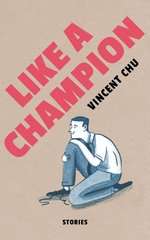

Cover of Like a Champion by Vincent ChuLike a Champion

by Vincent Chu

eARC, 238 pg.
7.13 Books, 2018

Read: January 31 – February 2, 2018

The man across from Henriette read a book. It was a very big book, a Hunger Games or Game of Thrones kind, with a sword and flame and chess piece on the cover. Dean had never read such a big book. The man was on the very last page and Dean felt guilty suddenly for spying on him during this personal moment, but he did not stop. It was not often, he reasoned, that he would get the opportunity to observe another person at the exact moment they finished a book, a big one at that. But, after the last page, the man, without so much as a satisfied nod or pensive stare, shut the thing and immediately put in his iPhone buds. This disappointed Dean.

That’s just one of any number of paragraphs throughout these stories that don’t advance the plot, reveal or describe much in the way of character — but man, the little bit of flavor they add to the story makes it worth it. And don’t you just want to shake the man who finished the book by the shoulders and ask what is wrong with him? The guy appears for one paragraph, and I have a strong reaction to him. With short stories, you don’t typically get to do that kind of thing the way you can with novels, because every word has to count — and typically, that’s what Vincent Chu does, but every now and then, he stretches a bit. Typically, like the best short fiction writers, Chu gets his bang for his buck when it comes to his words — tight, economical prose that strikes just the right tone each time.

But I’m getting ahead of myself. Like a Champion is a collection of eighteen short stories featuring all sorts of people — underdogs in one sense or another — getting a taste of victory. Some of this victory is very short-lived, some is quite Pyrrhic, but it’s there. The stories are varied in tone, in voice, in setting, in types of character — and that’s such a strength. Some will make you smile, some laugh, some are sad, some are tragic, some are somber, all are incredibly human.

There’s a lot I could talk about — if I could, I’d spend a few hundred words on “Squirrels”, the fourth story in the collection. I don’t know why, but that one sealed me appreciation for this book, and it stands out as a high point for me. There’s just something about it that worked for me, the same kind of thing that lead me to write three papers for three separate courses in college about one Updike short story. There were a couple of other stories that I could point to that were as as outstanding, but I’ll stick with “Squirrels” — a story about one man’s childhood basketball triumph in the midst of defeat — because I enjoyed it more.

With one exception (at least one that I noticed, I might have missed others), these are independent of each other. The two stories that are connected are so different in tone and subject matter that it takes you by surprise when you notice the connection — but it really works (and the connection is of a lesser importance, that not much changes if you don’t make the connection). It was a nice little touch, I would’ve liked a part three, however.

I’m not crazy about Chu’s depiction of older characters. Maybe if I only got one of the stories in this collection featuring an older character — I wouldn’t have commented. Or if I took a few more days to read this than I did, it wouldn’t have stood out to me as much, but when you get the same note or two being played so often with elderly characters it sticks out.

I don’t usually spend much time talking about the publisher of the books I post about, but when it comes to some indie presses, I should. A couple of months ago, I know I posted a link to a profile of 7.13 Books in a Saturday Miscellany, and before that I talked about another short story collection they put out. And come to think of it, I have one more book from them on my schedule in the coming weeks. If Like a Champion is indicative of what they are publishing (and it seems to be), there’s something in the water there, folks, keep an eye out for their books.

Like with every collection — be it full of short stories, essays, poems — there are some in this collection that don’t work for me — two because I didn’t get what he was going for; a couple that I’m pretty sure I got what he was going for, and just didn’t care for it. And I’m very sure that many people will get those I didn’t and will like the ones I didn’t care for — and even dislike the stories that I enjoyed, and maybe even someone’s nuts enough to not care for the ones that filled me with joy. There’s enough variety in these to appeal to all sorts of tastes — and that’s a compliment, Chu’s nothing if not versatile. But on the whole, this is a great collection of short stories, full of compassion, humanity, and talent. You’d do well to grab this one.

Note: I received a copy of this eARC in exchange for my honest opinions as expressed above.

—–

4 Stars

REPOSTING JUST CUZ: Death and Taxes by Mark David Zaslove: The most rootin’ tootin’ shoot ’em up about accountants you’ve ever seen

This seems like a good day to revisit this (sort of a shame there were no sequels)


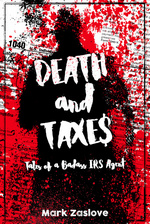
Death and TaxesDeath and Taxes

by Mark David Zaslove
Series: Tales of a Badass IRS Agent, #1

ARC, 219 pg.
Aperient Press, 2018

Read: August 13 – 14, 2018
I’m not sure I can go this book justice with a hand-crafted synopsis, I’ll just copy and paste from Zaslove’s site:

           Death and Taxes follows Mark Douglas, an ex-Marine turned IRS agent, who, along with auditing the weird and the profane, also spearheads weekend raids with his locked-and-loaded gang of government-sanctioned revenuers, merrily gathering back taxes in the form of cash, money order, or more often than not, the debtor’s most prized possessions.

Things turn ugly when Mark’s much-loved boss and dear friend Lila is tortured and killed over what she finds in a routine set of 1040 forms. Mark follows a trail dotted with plutonium-enriched cows, a Saudi sheik with jewel-encrusted body parts, a doddering, drug sniffing, gun-swallowing dog named The Cabbage, a self-righteous magician with a flair for safecracking, a billionaire Texan with a fetish for spicy barbecue sauce and even spicier women, and an FBI field agent whose nickname is “Tightass.” All of which lead to more and bloodier murders – and more danger for Mark.

Enlisting his IRS pals – Harry Salt, a 30-year vet with a quantum physical ability to drink more than humanly possible; Wooly Bob, who’s egg-bald on top with shaved eyebrows to match; Miguel, an inexperienced newbie with a company-issued bullhorn and a penchant for getting kicked in the jumblies – Mark hunts down the eunuch hit man Juju Klondike and the deadly Mongolian mob that hired him as only an angry IRS agent can. There will be no refunds for any of them when April 15th comes around. There will only be Death and Taxes.

This is hyper-violent (not that filled with blood and guts, really — there is some), a lot of guns, bombs, more guns. Sometimes played for comedic effect, sometimes it’s the good guys vs. the bad guys. Sometimes, it’s a little of both. It never got to the overkill point for me, probably because this felt more like a cartoon than a “realistic” thriller.* What was overkill for me was the hypersexualization of every woman under the age of sixty. I didn’t need to hear that much about every woman’s physical appearance — there are more gorgeous women with perfect (sometimes surgically enhanced) bodies in this guy’s life than an episode of Miami Vice.

But man, is this funny. There are sections — sometimes a sentence or two, sometimes several paragraphs long — that are the literary equivalent of a shot of espresso, they are so taught with action, cultural references, and humor that you just revel in them. This reminds me a lot of the John Lago Thrillers by Shane Kuhn — I think Kuhn shows more discipline in his plots and characters, but on the whole, these two are cut from the same cloth. The same energy, a similar style, similar sense of humor — and frankly, that stuff is catnip to me. I think the plot got a little convoluted, a little confusing — but it was worth working through.

Am I planning on reading Tales of a Badass IRS Agent, #2? Yeah, I will be keeping an eye out for it. This is a heckuva romp, and will entertain anyone who gives it a shot.

* Really, what thriller is realistic?

Disclaimer: I was provided with a copy of this novel in exchange for my honest opinion, which you see above.

—–

3 Stars

The Killer’s Christmas List by Chris Frost: There’s Nothing Holly and Jolly About This Christmas

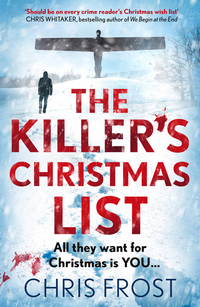
Cover of The Killer’s Christmas List by Chris FrostThe Killer’s Christmas List

by Chris Frost

DETAILS:
Series: DI Tom Stonem, Book 1
Publisher: Harpernorth
Publication Date: October 29, 2024
Format: eBook
Length: 320 pg.
Read Date: December 11, 2024
Buy from Bookshop.org Support Indie Bookstores

A Quick Note

For reasons he’s probably detailed somewhere (and I likely read/heard and forgotten), Chris McDonald wrote this under the pen name Chris Frost (and who knows, McDonald might be a pen name, too). But as he’s not being covert about it (his Twitter account uses both names), I’m going to talk about them as if they’re the same person, because McDonald’s work informs the way I reacted to this.

What’s The Killer’s Christmas List About?

Previous drafts of this have been over-complicated as I explain too much and yet try to be spoiler-free, or they’ve been so bland as to be useless (“A new DI is assigned to a holiday-themed murder. Detecting ensues.”). So I’m going with the crutch of the Publisher’s description of this “anti-cosy Christmas” mystery:

In the picturesque village of Kibblesworth, DI Tom Stonem is dreaming of a quiet Christmas alone.

But in the shadow of the Angel of the North, a body lies waiting. The dead man is posed with a child’s Christmas list in his pocket, and the first mysterious item – 1. No angel – is crossed off.

When a second body is found – a woman, stabbed in the abdomen after her work Christmas do – Stonem is convinced there’s a grim connection between the crime scenes and the seemingly innocent list. 2. Red partee dress. Could this be a murderer’s twisted code?

As a blizzard rages in the Tyne & Wear countryside, the body count is snowballing. Can Stonem stop the killer before they get everyone on their Christmas list?

He’s So Good at This…

This is a minor thing, but Frost is so good at this (like McDonald, see A Wash of Black)—I can think of other examples, too, but few are as smooth as Frost/McDonald is. Stonem is really introduced to us as he arrives on the crime scene as his first day on the job in this station. So we get a blend of our introduction to him, the other officers, and the crime all at once.

The skeleton of the series is established, the kind of detective Stonem is, the identities and character of those he works with, and the kind of crimes we’re going to be seeing—both for the rest of this series and the rest of this novel. It’s so economical, so organic, and efficient that I can’t help but admire it. You start off with the whole world for DI Tom Stonem delivered in a chapter or two, rather than getting it in dribs and drabs like most people do. I have no problem with that approach—but when you see it done like this, it just seems so right.

The Flashbacks

We get regular flashbacks to someone’s childhood throughout the book—it’s a child who doesn’t have a lot in life, and a couple of parents who need financial help, and probably addiction treatment (and a lot more, too). It’s clearly connected to the killings the book focuses on. But, of course, just how it is connected is held back.

As a story-telling tool, I typically don’t like this approach.* It just seems mawkish, usually ungraceful, and I really dislike the way it’s generally used to give us insight into a killer (or someone associated with the crime) without identifiying the person, it just grates on me like nails on a chalkboard**. However, the way that Frost used it ended up really working for me, and was some of the more effective writing in the novel. Good on him.

* I say that, but I probably get sucked in regularly. But at least I don’t think I like this approach.
** Readers of a certain age should ask their parents. And maybe suggest an updated comparison for me to use.

Spoilerish thought, maybe skip this paragraph: This did not go the way that Frost seemed to be telegraphing—it may be that he had a better idea partway through and changed things, but it was probably (and it makes him seem cleverer) that he faked the reader out. A couple of times in the case of this reader. I’m so glad that he did—not just because I enjoy it when an author fakes me out without cheating, but because the way it ended up works so much better than where I thought he was going.

Just how Christmas-y is This?

Not very. Christmas plays a role in motive, and the thing is set in the days leading up to December 25th. But there’s not a very holiday feel to this. Some Christmas mysteries (even involving murder, kidnappings, serial killers, and other acts of violence) still give you a Christmas cheer vibe or something like that. There’s so little of that here as to make it negligible. The holiday is important to the plot, but not to the “vibe,” for lack of a better word.

Basically, read this one whenever you get around to it. You don’t need to sip on egg nog with Andy Williams playing in the background to appreciate it.

So, what did I think about The Killer’s Christmas List?

This is not Frost at his best, I’m sorry to say. Something about the prose felt clunky and occasionally overwritten—maybe Frost and his editor got in some strange groove and didn’t read as critically as they could’ve in the last passes. Was anything so bad that it took me out of the book? No. I winced a little and moved on. But it’s kind of a shame. Also…there were a couple of lines of investigation I just can’t imagine an experienced detective (or one who’s watched more than 3 episodes of Law & Order) didn’t take from the get-go. It didn’t hurt Stonem or his team, it just felt weird not to at least have them mentioned. And I grumbled about it to the book, which thankfully didn’t reply.

But whatever.

The plot though? Really good. Frost’s storytelling makes up for my quibbles—the way he develops the story, the momentum he gathers, and the twists were really nicely done. I’d sussed out the killer ahead of time (but I couldn’t have been wronger about motive)—and Frost convinced me I was wrong until he got to the reveal.

I liked Tom Stonem—he’s not as instantly compelling as Erkia Piper was, but it didn’t take too long for me to appreciate him, and I think in future books, I’ll end up liking him as much as, if not more, as Piper. And I’m really curious about where Frost intends to take him. Some of the rest of the team will be fun to hang out with, too. They’re not the typical detective team that I meet in British Police Procedurals (which frequently feel interchangeable between series).

The Killer’s Christmas List was a solid and quick read that was pretty satisfying. I’m looking forward to more of these.

This post contains an affiliate link. If you purchase from it, I will get a small commission at no additional cost to you. As always, the opinions expressed are my own.
Irresponsible Reader Pilcrow Icon

Reposting Just Cuz: Death and Taxes by Mark David Zaslove: The most rootin’ tootin’ shoot ’em up about accountants you’ve ever seen

Like the Wolfe quotation from earlier today, it felt like this was a good day to re-run this:

Death and TaxesDeath and Taxes

by Mark David Zaslove
Series: Tales of a Badass IRS Agent, #1


ARC, 219 pg.
Aperient Press, 2018

Read: August 13 – 14, 2018
I’m not sure I can do this book justice with a hand-crafted synopsis, I’ll just copy and paste from Zaslove’s site:

Death and Taxes follows Mark Douglas, an ex-Marine turned IRS agent, who, along with auditing the weird and the profane, also spearheads weekend raids with his locked-and-loaded gang of government-sanctioned revenuers, merrily gathering back taxes in the form of cash, money order, or more often than not, the debtor’s most prized possessions.

Things turn ugly when Mark’s much-loved boss and dear friend Lila is tortured and killed over what she finds in a routine set of 1040 forms. Mark follows a trail dotted with plutonium-enriched cows, a Saudi sheik with jewel-encrusted body parts, a doddering, drug sniffing, gun-swallowing dog named The Cabbage, a self-righteous magician with a flair for safecracking, a billionaire Texan with a fetish for spicy barbecue sauce and even spicier women, and an FBI field agent whose nickname is “Tightass.” All of which lead to more and bloodier murders – and more danger for Mark.

Enlisting his IRS pals – Harry Salt, a 30-year vet with a quantum physical ability to drink more than humanly possible; Wooly Bob, who’s egg-bald on top with shaved eyebrows to match; Miguel, an inexperienced newbie with a company-issued bullhorn and a penchant for getting kicked in the jumblies – Mark hunts down the eunuch hit man Juju Klondike and the deadly Mongolian mob that hired him as only an angry IRS agent can. There will be no refunds for any of them when April 15th comes around. There will only be Death and Taxes.

This is hyper-violent (not that filled with blood and guts, really — there is some), a lot of guns, bombs, more guns. Sometimes played for comedic effect, sometimes it’s the good guys vs. the bad guys. Sometimes, it’s a little of both. It never got to the overkill point for me, probably because this felt more like a cartoon than a “realistic” thriller.* What was overkill for me was the hypersexualization of every woman under the age of sixty. I didn’t need to hear that much about every woman’s physical appearance — there are more gorgeous women with perfect (sometimes surgically enhanced) bodies in this guy’s life than an episode of Miami Vice.

* Really, what thriller is realistic?

But man, is this funny. There are sections — sometimes a sentence or two, sometimes several paragraphs long — that are the literary equivalent of a shot of espresso, they are so taught with action, cultural references, and humor that you just revel in them. This reminds me a lot of the John Lago Thrillers by Shane Kuhn — I think Kuhn shows more discipline in his plots and characters, but on the whole, these two are cut from the same cloth. The same energy, a similar style, a similar sense of humor — and frankly, that stuff is catnip to me. I think the plot got a little convoluted, a little confusing — but it was worth working through.

Am I planning on reading Tales of a Badass IRS Agent, #2? Yeah, I will be keeping an eye out for it. This is a heckuva romp and will entertain anyone who gives it a shot.

Disclaimer: I was provided with a copy of this novel in exchange for my honest opinion, which you see above.

—–

3 Stars

Reposting: Bearded by Jeremy Billups: A Charming Picture Book about a Bearded Bear

Local Artist, Picture Book Writer and All-Around Good Guy, Jeremy Billups’ third book is scheduled to release today. It’s called Bearded Too, the sequel to this here book. I’ll post about Too soon, but in the meantime, here’s a look back at Bearded.

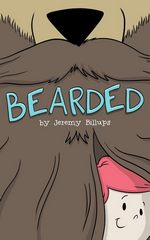
Bearded

by Jeremy Billups
Hardcover, 34 pg.
Billups Creative, LLC, 2015
Read: September 5, 2018
Picture books about bears are everywhere—I have a hard time believing many kids get out of the picture book stage without exposure to at least 4 of them (and that’s before they’re at the Pooh or Paddington stage). But how many of those bears have been bearded?

Enter Jeremy Billups and his little book.

This is the story of a little red-haired girl (no, not that one) traveling the world with her bearded bear, having all sorts of adventures and meeting a bunch of different animals. There really isn’t a lesson, moral or much of a plot—just a bunch of quick looks at the pair. A few quick lines and a picture on each pair of pages.

The art is simple and arresting. They just pop off the page—this is one of those times I wish I had the necessary vocabulary to describe why I like the drawings, but I don’t. I bought a print of what turns out to be page 16 before I even picked up the book to flip through. I’ve bought a handful of prints this year, and it’s my absolute favorite—I like it even more now that I’ve read the book. Also, If you ever see a better picture of someone making buffalo wings, I’ll eat my hat.

Oh, and the endorsements on the back cover are a lot of fun. If that doesn’t convince you to try it out, I can’t imagine what will.

Great art, cute story, fun rhymes—everything you want in a picture book. Even better—animals with beards are the best animals that aren’t dogs. This is a charming little book that’s sure to please.

—–

4 Stars

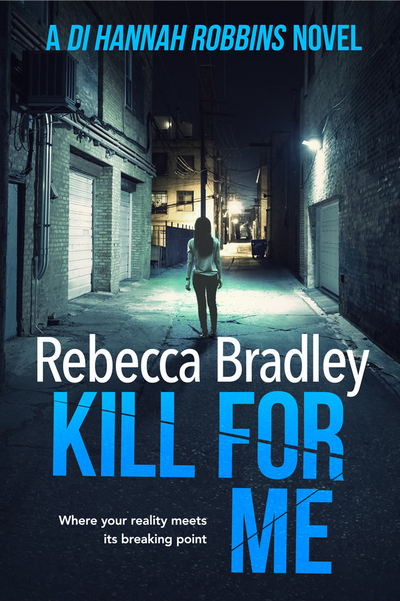
BOOK SPOTLIGHT: Kill for Me by Rebecca Bradley

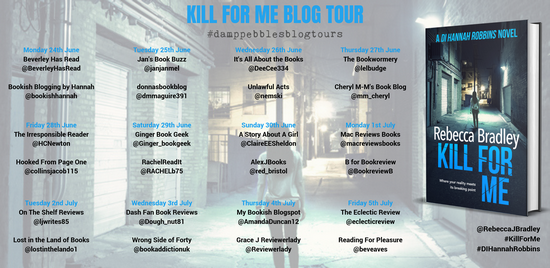
Today I welcome the Book Tour for the gripping and powerful Kill for Me by Rebecca Bradley. Along with this spotlight post, I’ll be giving my take on the novel here in a bit. But before I get to talking about the book, let’s start by learning a little about this here book, okay?

Book Details:

Book Title: Kill for Meb by Rebecca Bradley
Release date: February 14, 2019
Format: Ebook/Audiobook
Length: 275 pages

Book Blurb:

A deadly game. An unstoppable killer. The perfect alibi.

Lucy Anderson is late collecting her daughter from nursery. A mistake that could prove fatal.
Her daughter is gone and there is only one way Lucy can get her back. The ransom is simple, she has to kill someone…

And this is just the beginning. A deadly game with a domino effect has started as the real killer forces others to do his bidding.

Can detective inspector Hannah Robbins find the killer’s next puppet before they’re forced to strike or will this be the case where her opponent has found the perfect way to kill?

Pick up Kill For Me for impossible choices and moral dilemmas and see where you would fall.

For fans of Peter James and Angela Marsons

About Rebecca Bradley:

Rebecca BradleyRebecca Bradley is a retired police detective. She lives in the UK with her family and her two cockapoo’s Alfie and Lola, who keep her company while she writes. Rebecca needs to drink copious amounts of tea to function throughout the day and if she could, she would survive on a diet of tea and cake while committing murder on a regular basis, in her writing of course.

She writes the DI Hannah Robbins police procedural series and has also released a standalone novel, Dead Blind, about a cop who acquires prosopagnosia, also known as face blindness.

To receive a free novella sign up to her readers’ club and you will be able to download the prequel to Hannah Robbins series. Find it on the blog at rebeccabradleycrime.com You’ll also be provided exclusive content and giveaways.

Rebecca Bradley’s Social Media:

Twitter ~ Facebook ~ Website ~ Instagram ~ Amazon Author Page

Purchase Links:

Amazon UK ~ Amazon US


My thanks to damppebbles blog tours for the invitation to participate in this tour and the materials (including a copy of the novel) they provided.

Fahrenbruary Repost: Stoned Love by Ian Patrick: No Sophomore Slump in Sight with this Thriller.

Stoned LoveStoned Love

by Ian Patrick
Series: Sam Batford, #2

Kindle Edition, 246 pg.
Fahrenheit Press, 2018
Read: September 14 – 15, 2018

I need to blend in where I shouldn’t belong. The best undercover officers have no air of ego or the appearance of a police mannequin. After all, one sniff of pig and your ass is bacon. I’ve no intention of being served up at any criminal’s barbecue.

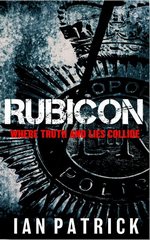
How do you follow up 2017’s Rubicon, the twisty, morally ambiguous (at best) tale of an undercover cop? Well, if you’re Ian Patrick, you do it by bringing that shady cop back and putting him in a tighter spot with threats (physical, legal and career) on all sides.

Sam Batford has had a little time off to recuperate and get his head on straight after Rubicon — hopefully giving the heat on him a little time to cool down, and maybe give Big H time to move on from the setback Batford dealt him.

The Met has a new assignment for him — working with the same DCI as he did last time, DCI Klara Winter. During the last assignment, she wasn’t sure she could trust Batford — now she’s convinced that she can’t. In fact, while she wouldn’t mind taking down the criminals that Batford infiltrates, her main objective is to arrest Batford and his Superintendent Mike Hall, a pair she’s convinced are dirty. She’s right, of course, but that’s beside the point.

Ostensibly, Batford’s assignment is to infiltrate a group that’s supposedly planning a major armed robbery and will need a driver of some sorts. But the clock is ticking so he doesn’t have time to do this carefully. Winter has someone already embedded with the crew giving her information, and their primary purpose is to get dirt on Batford and Hall. Which sounds good, but when you get a couple of guys as cagey and wily as this pair, that’s no easy task.

At the same time, Hall’s told Batford that between family and work stresses, this is his last hurrah. Now, he’d like to start his retirement with a sizeable bankroll, and trusts that Batford will find a way to make the both of them some money from just whatever it is that this crew is up to. The crew’s leader, who goes by the cuddly moniker of Razor, is a long-time “unauthorized informant” of Hall’s. And now, he’s sending Batford in to get him arrested. Which seems odd, but it does give Hall enough of an inside track to help Batford.

So, essentially, Batford needs to find a way to get rich off these criminals, hopefully get enough evidence for some arrests, stop them from pulling off whatever they’re trying to — and avoid getting arrested himself (not that he knows he’s being targeted for that). Oh, yeah, and Big H hasn’t moved on, forgotten or forgiven him — in fact, he has an active contract out for Batford’s life, and there are people trying to collect on that. Sounds like a pretty rough time for him.

In Rubicon, there was a question (at least for me) throughout — just how bent is Batford? Will he actually do law enforcement, or is he just out for himself? What are the limits for him? Will he have any success in either his criminal or police activities? In Stoned Love, the questions are different — we know he’s bent pretty far. So it’s just will Batford survive? Will Winter arrest him? Will Hall use him to save his own skin? Will Razor do something to him? Will Big H’s killers eliminate him?

This changed the dynamic of the book for me, and made it a lot easier for me to enjoy this novel and cheer on Batford. There’s no moral or legal gray area any more. Like Michael Corleone or Hannibal Lechter, Sam Batford is a despicable character that the reader wants to find success. Thankfully, he’s nervy enough and clever enough, that there’s a pretty good chance that he will. At least for a while.

Winter is manipulative, deceptive and devoted more to her career than anything else. But she’s, technically, the good guy here. Everyone else is the kind of criminal that the police are supposed to stop, not become. But because we’re in Batford’s head, and Winter’s primarily seen as an obstacle for him to overcome, the reader roots for him and against her — knowing the whole time that it should be the other way around.

There’s frequent and repeated commentary on the effects of Brexit, budget cuts, personnel cuts and other moves by the British government that are impacting the police services throughout the novel. Patrick is a former police officer and if these aren’t his actual views coming forth through Batford, he’s a better author than I think. If Batford’s diagnosis of what’s going on with the police in Britain is accurate, it sounds pretty frightening.

It’s a minor thing — I only noticed this as I started to write this post, and I’ve recently had a bad experience with reading a novel that couldn’t pick a verb tense, so I was primed — but Patrick’s use of the present tense for these books is a subtle, and incredibly effective way of cranking up the tension, propelling the action forward, and pushing the reader to keep up with the pace of the book. I should’ve picked up on it with Rubicon, and am a little annoyed with myself for taking this long to notice.

I enjoyed Rubicon, but I appreciated what Patrick was doing and how he was doing it more. With Stoned Love, I still admired and appreciated his skill and aims, but I enjoyed the story more — I resented things like work and family for preventing me from finishing this as quickly as I wanted to, and absolutely relished an airline flight that meant I had uninterrupted reading time*. I think Stoned Love is an all-around better effort (which is saying something) and makes me very excited to see what comes from Ian Patrick next.

Not everyone enjoys reading books where the police are just as dirty as those they’re supposed to be stopping — and I understand that — but if you’re someone who can embrace a tarnished knight, someone who seems to be law enforcement malgré lui, you don’t want to waste any more time, get your hands on Rubicon and Stoned Love and prepare to be impressed.


* I also really appreciated having this to focus on rather than the fact that I was in a giant metal tube that has no business being that far off the ground, but that’s another story.

—–

4 1/2 Stars

Fahrenbruary Repost: Rubicon by Ian Patrick: A thrill-ride that will stay with you long after the action ends.

I bought this shortly after it was released, and then let it collect e-dust on my e-reader, and pretty much used Damp Pebbles’ Book Tour for this as my excuse to read it. I wasn’t over the moon with this one, but I liked it a lot. And then I spent months thinking about it until the sequel came out. Batford’s the kind of character that will not move out of your headspace like any respectable character does when you start a new book. Rather, he’ll take up residence — scratch that, he’ll squat there, not allowing the lease holder to get comfortable sharing the space with him…. I think this metaphor has gotten out of hand, so I’m going to shut up and get on with the post.

RubiconRubicon

by Ian Patrick
Series: Sam Batford, #1

Kindle Edition, 232 pg.
Fahrenheit Press, 2017
Read: May 31 – June 2, 2018

. . . there’s no money in policing unless you cross the line.

But that doesn’t mean that Sam Batford isn’t going to try.

Batford is an undercover police officer who’s after a kingpin of some repute and his guns and drugs importing. DCI Klara Winter is a no-nonsense head of a task force going after the same kingpin, Big H, more directly — phone taps, applying pressure to associates, interrogations, etc. Batford is assigned to her task force to supplement their intelligence. Neither want this assignment, and work to undermine it immediately. They do actually help each other out — but it’s almost despite their best efforts. Their mutual dislike, distrust and antagonism is one of the more interesting dynamics that I’ve run across lately.

We see most of the novel through Batford’s eyes, with the occasional glimpse from Winter’s perspective. It doesn’t take much to get a strong sense of Winter’s personality and thought process. Just from the volume, the reader ends up seeing things Batford’s way — whether or not they should.

Batford infiltrates Big H’s organization — at least to a degree — for one job. A large one, no doubt, one that would secure Winter’s career (and would do his own some favors). Like most undercover officers (especially in fiction), he cuts many legal and ethical corners to do so. There’s some question — as there should be — whether or not Big H really trusts him, and the constant testing, evaluation and insecurity makes for great reading — it’s an atmosphere you can almost feel through the words.

So Batford is doing what he can to get enough information to take down Big H, to gain his trust (and therefore access), to disrupt the flow of drugs and guns — and mostly to stay alive. If he can find a way to make a little money while he’s at it . . . well, he might as well. Winter just wants enough evidence to make some arrests — and maybe some headlines — so she can get the budget to keep her team working.

This is not a book for the squeamish — there are a few scenes I know that would cause some of my friends and readers to throw the book down in disgust (the same scenes will cause other friends/readers to fist pump their excitement — I’m not sure which of these bothers me more). There’s one scene in particular that made me think of the dental scene from Marathon Man (I’ve never watched the movie just in case they nail that scene from the novel).

There were two . . . I don’t want to say problems for me, but things that kept me from going over the moon with Rubicon: Batford works his way into this assignment by worming his way in to the trust of one Big H’s associates while they’re in Bali. Do Metropolitan Police Undercover Officers really get to globe-trot the way that Batford does? Is that a bit of Artistic License? Is it a sign of just how far outside the lines that Batford colors? Does it tell us that he’s not just a Metropolitan Police Officer? It’s a minor point, I admit — and it’s really easy to accept as kosher (but that doesn’t mean I don’t wonder), because watching Batford’s machinations there is fascinating.

Secondly, Batford displays a very particular vocabulary — I’m not sure if it’s London slang, or Ian Patrick-slang. I could believe either. I will admit that there were periods that the slang got in the way of the story. That’s probably on me — and some of it is Shaw’s two countries separated by a common language phenomenon. With a little bit of work, and a small amount of guesswork (and a willingness to go back and revisit a passage later), it was all accessible enough and perspicuous.

There’s a lot about this book that I’m not sure about — I’ve been chewing on it for a couple of days, and it’s going to take a few more at least. Patrick’s characters take a little chewing, I think. It’d be easy to put Batford in the “murky anti-hero” category and move on — but I’m not sure he fits there; I’m even less sure where Winter fits — she’s not the straight-laced cop you’re at first tempted to label her, nor is she just the figure that makes life difficult for our anti-hero to do what he wants (although she functions pretty well that way). But even if/when I decide how to categorize these two — then I have to decide what I think of them as these characters — are they good people? No. That’s easy. Are they good fictional beings in their particular roles? My gut says yes, and my brain leans that way, but I’m still working on that.

Either way, I’m enjoying chewing on the novel and these ideas — and I’m definitely getting my money’s worth out of this book, just having to think about it this much.

There is part of this evaluation that’s easy — the writing? Gripping. The pacing? Once it gets going, it’s a runaway train that you’re just hoping you can hang on to long enough to get through to the end. The narrative voice is as strong as you could ask, and even when you’re thinking this cop might be more deserving of a being handcuffed on his way to a long incarceration than his targets, you’ll need to hear his singular perspective on the events around him.

Strong writing (some of my favorite sentences of the year are in this book), characters that demand thinking about, a plot that you can’t wrap up in a tidy bow — this isn’t your typical thriller. Whether it’s your cup of tea or not, it’s one that you won’t forget easily.

—–

4 Stars

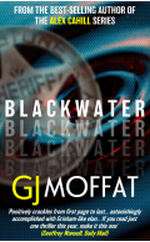
Fahrenbruary Repost: Blackwater by GJ Moffat: A Brutal and Gripping American Crime Story

BlackwaterBlackwater

by GJ Moffat

Kindle Edition, 292 pg.
Fahrenheit Press, 2017
Read: December 14 – 15, 2018

           Early went to [redacted]’s body and hunkered down in front of [redacted]. His skin was flaccid and his jaw and face swollen and misshapen from the effects of his injuries. His shirt was entirely soaked in blood.

Early shook his head, thinking: this is what men do.

Take Walt Longmire (Deputy Longmire, before Lucian Connally’s retirement) throw him into Jesse Stone’s Paradise, and then tell a story imbued with the spirit of Fargo (movie or show), your results will be pretty close to GJ Moffat’s stunning Blackwater.

It’s a tale of violence, bloodshed, power, inevitability and death — what men do.

Deputy Sheriff Early Simms of Blackwater County is the son of the previous sheriff and probably the only member of the Department really fit for the job. A tragic accident in High School changed the direction of his life, and as a result he’s in the same dying New England area he grew up in. He’s made peace with this, and even seems to be happy — he’d be happier if his boss (and colleagues) cared a bit more about the job and his father wasn’t battling Alzheimer’s, sure. But this is his life.

And then everything changes in a couple of days — his old high school flame (and love of his life) returns to town, there’s an investigation into a corrupt public official, an investigation into an assault/attempted murder at a nearby jail, and a couple of brothers on a killing spree have come to the region. There’s also some drug running, spousal abuse, a pretty nasty bar fight. I don’t want to say that Early Simms is the only one investigating the crimes, in trying to preserve the peace — there are three (that we know of) other members of the Sheriff’s Department, some other local law enforcement officers and some FBI agents running around. But Early’s the only individual who’s in each of the stories — he’s the region of intersection in the Venn diagram of Blackwater (and frequently the most capable person around).

One of the criminals we meet in these pages (not saying which one) is clearly not an evil man. There’s some sort of undiagnosed (by the author or by any professional this criminal has ever encountered) mental health issue affecting him. Which does not lessen the evil he does and the trauma he inflicts on others. Part of me wants to know more about the whys, hows, wherefores, and whatnot about this disorder and is a little frustrated that Moffat doesn’t give us any of it. The other part of me is so glad that he didn’t succumb to temptation to get into tall that, instead merely showing his readers what was going on with this man, leaving it to us to do the work. There’s someone else who probably has some sort of Traumatic brain injury symptoms — not quite the same, but some of the same results.

We also see crime perpetrated by someone motivated by power, money and meanness. Also, there are some criminals who just don’t seem to have options, means or inclination to do anything but break the law. It’s up to Early to face down these people, no matter where on the spectrum they seem to be found, to prevent them from inflicting too much harm on the community.

How successful he is at that, well . . .

Moffat can write. That’s all there is to it. It took almost no time at all to recognize that. You get a strong sense of every character in just a few lines and his world is as fully realized as you could hope for. He presents the evil Early sees and fights against in this book fairly realistically, in a way that is as capricious and destructive as anything you see on the news.

So many times — almost every chance he gets — Moffat will do precisely what you don’t expect. What people just don’t do in this kind of book. He’ll put the characters in a situation you’ve seen dozens of times before, and just when you think “X will happen right after I turn the page,” B happens before you can turn the page. I realize there’s a danger in saying that — you’ll be looking for that kind of thing. But I expect that the same thing’ll happen to you as it did to me every time he pulled the rug out from under me — you’ll get sucked in by his writing and the characters (and possibly still be reeling from the last shock) and you won’t even think to expect that he’ll do it again.

I finished the book I was reading before this earlier than I expected to, and didn’t have the next on my list with me, so I took the opportunity to pay a visit to what I call my Kindle’s “Fahrenheit Ward” — where I stick all the Fahrenheit Press books that I buy without time to read — and I grabbed this. I’m so glad my timing worked out that way — this is exactly what I needed. I got sucked in by this immediately, and it was practically impossible to put down. Before I got to the novel’s final confrontation(s), I jotted in my notes, “Man, I hope this isn’t the first of a series — I don’t know if the community can survive another book.”

But if Fahrenheit published a sequel today? I’d shell out cash before the end day. I strongly expect you’ll feel the same way once you recover from Blackwater.

—–

4 Stars

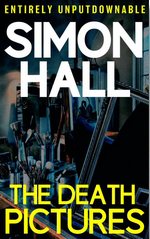
Fahrenbruary Repost: The Death Pictures by Simon Hall: A Solid Sequel featuring a Procedural and a Puzzle

Man, I hope there are more of these on the way from Fahrenheit…fun books.

The Death PicturesThe Death Pictures

by Simon Hall
Series: The TV Detective, #2

Kindle Edition, 282 pg.
Fahrenheit Press, 2018
Read: July 10 – 11, 2018
So here we are a few months after the events of The TV Detective, and while Dan Groves, TV reporter, and DCI Adam Breen aren’t working together any more, their friendship has grown and both of the careers are improving from their collaboration. So when there’s a serial rapist on the loose — one who made a point of leaving a calling card at the crime scenes to get public attention — both of their bosses are interested in them renewing their partnership (even if no one ever gets to hear about his calling card).

Around the same time, there’s a famous artist dying of cancer who is using his impending death as a launching pad for a contest of sorts — it raises money for charity, and raises his public profile a bit, too (not that it needed much). Dan has been tapped by his producer and the artist’s wife to help with the final part of the contest, and to do his final interview — most to be aired upon his death. This is so far from the rape case that it seems odd to spend time on it — until the artist dies under mysterious circumstances. A murder inquiry into a celebrity’s death obviously gets the police’s and public’s attention — although it’s really seen as more of a distraction from protecting women who are prospective targets of the rapist by Adam and his team. For the most part at this point, Adam and Dan tackle the murder investigation and his team handle the rapes, and Dan pretty much only covers the case as a reporter (with an inside track, of course), but not as an investigator.

Arrests are made pretty early on in both cases — it’s in the aftermath of the murder investigation and the contest that the latter part of the novel focuses on. The puzzle’s solution is clever, but the reader can see it coming (we do have a little more information than all the characters), but that only adds to the sense of drama leading up to the Reveal. I thoroughly enjoyed watching Dan through this story — both his official work as a reporter or with the police and his unofficial personal obsession with the puzzle.

As for the rape story? I don’t mean to sound cold, but there was something very cookie-cutter about the motivation and perpetrator. Horrible, yes; disturbing, yes, but nothing that hasn’t been on Law & Order: SVU an estimated 3,709 times — I’m not saying badly written or boring, just something I’ve seen before. But when Adam gets him in the interview room and he starts laying out his defense? That was utterly chilling. As I write this, I imagine the accused’s approach is not completely novel in Crime Fiction, but man . . . the way that Hall depicts this guy? Chilling.

Dan’s frequent work on the contest is reminiscent of his search for the Ted Hughes Memorial in The TV Detective, but is obviously tied more closely to the plot of this novel. I don’t recall another series doing something like this in book after book — I hope Hall continues it.

There’s something that happened to Dan in the past that was alluded to in the previous book and is talked around a good deal here. We’re not going to get more details on that in Book 3 (I bet), but I expect to see it wreak havoc on Dan’s life and various relationships soon. Similarly, there’s something that happens in this book to Adam — that will possibly do worse pretty soon. Both of these guys are ticking psychological bombs.

I have one gripe: the formatting. There are occasional — maybe even rare — white space breaks between sections of the story, but by and large they are conspicuously absent. Which is problematic when the perspective changes from character to character — what’s worse is when the perspective change introduces an entirely new character and you don’t know how this new name connects with anything. It honestly only caused a real problem for me once, but was frequently annoying.

I should stress when your complaint about a book has to do with Kindle layout (who knows what the paperback looks like), there’s a lot that’s working pretty well.

The Death Pictures is a solidly entertaining mystery novel that recaptures a lot of the high points of its predecessor, but isn’t just a repeat of it. This series has legs, that’s obvious, and I look forward to returning to it to see what happens next.

.

—–

3.5 Stars

Page 1 of 10

Powered by WordPress & Theme by Anders Norén