

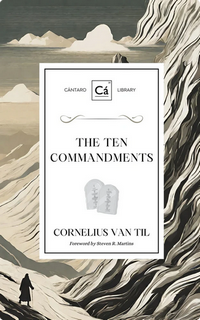
 The Ten Commandments
DETAILS:
Publisher: Cantaro Publications
Publication Date: January 1, 2024
Format: Paperback
Length: 204 pg.
Read Date: February 9, 2025


What’s The Ten Commandments About?
Well, as the title suggests, it’s about The Ten Commandments–it’s an exposition of them, and a brief explanation of what the Moral Law is and how it functions by Cornelius Van Til, who taught the course on Christian Ethics at Westminster Theological Seminary in its early days.
Like many of his works, until this edition, it was unpublished. It’s the curriculum from that class, really. It’s as close to attending Van Til’s course as we’re going to get.
We get one chapter on the nature and use of the Law in the Christian life (and throughout Scripture) and then a (generally) brief chapter on each commandment.
Miscellaneous Observations
There are a handful of things that an academic reviewer would spend time on, or if I wanted to get into his arguments, I would devote paragraphs to. But I’m not, so I’m just going to list off thoughts I had along the way:
 When it comes to the First Commandment (leading to a discussion of God’s existence and atheism) and the Third Commandment (God’s self-revelation via His name and other means), Van Til the apologist comes to the fore. He spends a disproportionate amount of time on these two–I’m not complaining, I’m simply noting. Any students who took his Ethics class before Apologetics (assuming that was possible) probably had a leg up on those who went right into Apologetics.
His discussion of the 4th (Sabbath) didn’t lead to as many specific practical applications as I was hoping (if only for curiosity’s sake, I wanted to see his take on some things). But pound-for-pound one of the best brief discussions on the day change, external vs. internal/spiritual observance of the day.
I really appreciated his discussion of the Sixth Commandment (Human Life), we need more like it.
It boggled my mind that he saw the necessity of labor unions and protests–in a fallen world, such things are necessary for protection against the fallibility of our fellow man. (I think I agree with him, just didn’t expect it from him)
His discussion of the 9th Commandment (Truth) didn’t get take the apologetic turn that I expected (although it’s there), and was helpful–but I could’ve used more.
The chapter on the 10th Commandment (Contentment) was too brief, but what was there was excellent.
So, what did I think about The Ten Commandments?
It wasn’t bad–it was pretty good, actually. I had hoped for a little more depth–and I got it occasionally, but not as often as I’d hoped.
It’s also pretty clear and easy to understand–this is a great bonus. Van Til enjoys (even among his most ardent of supporters/students) the reputation for not being a very clear writer. But I didn’t get a trace of that here.
This is a slightly uneven, but helpful and sound introduction to and overview of the Ten Commandments and their use in the Christian life. It’s in line with what you’d find in Calvin, Turretin, Hodge, and the like. Maybe a little more accessible because it was written in the early 20th Century.

This post contains an affiliate link. If you purchase from it, I will get a small commission at no additional cost to you. As always, the opinions expressed are my own.

1 Pingback