

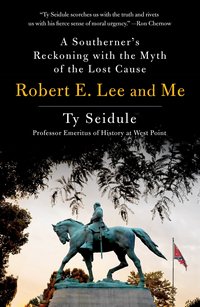
 Robert E. Lee and Me:
A Southerner’s Reckoning with the Myth of the Lost Cause
by Ty Seidule
DETAILS:
Publisher: St. Martin's Griffin
Publication Date: January 26, 2021
Format: Paperback
Length: 256 pg.
Read Date: September 15-18, 2025


As a retired U.S. Army officer and as a historian, I consider the issue simple. My former hero, Robert E. Lee, committed treason to preserve slavery. After the Civil War, former Confederates, their children, and their grandchildren created a series of myths and lies to hide that essential truth and sustain a racial hierarchy dedicated to white political power reinforced by violence. But for decades, I believed the Confederates and Lee were romantic warriors for a doomed but noble cause. As a soldier, a scholar, and a southerner, I believe that American history demands, at least from me, a reckoning.
What’s Robert E. Lee and Me About?
Ty Seidule grew up idolizing (he might argue nearly-literally) Robert E. Lee and his story and legacy. Everywhere he went growing up, there was Lee’s shadow. When he went to college, and then when he was in the Army and served in various capacities and places, it was still there.
At some point, as a historian and patriot, some things started to strike him as odd with what he was seeing. He rolled up his sleeves, did the work and, well…some things started to change.
Here, he looks at where the shadows of The Lost Cause and Lee were cast in the various places he lived over the course of his life and career—and what he, and others, should learn from that.
My Sole Complaint
I think I really only have one. It’s repetitive—no, not the fact that this is really a series of X was pro-Confederacy or racist; Y may have looked to be about history, but if you look at the context, it’s about downplaying such-and-such or ignoring what Robert E. Lee did. That’s the kind of repetitiveness the book is built on—anyone who reads the back of the book knows that’s what you’re going to get.
But Seidule uses certain phrases over and over again; he describes particular figures in the same way over and over again—that kind of thing. It’s hard to put up with—and it’s hard to resist the impulse to skim.
And I don’t want to skim a book like this—not with this topic, not with the kind of details he provides. But too often his writing makes that attractive.
So, what did I think about Robert E. Lee and Me?
The Lost Cause became a movement, an ideology, a myth, even a civil religion that would unite first the white South and eventually the nation around the meaning of the Civil War. The Lost Cause might have helped unite the country and bring the South back into the nation far more quickly than bloody civil wars in other lands. But this lie came at a horrible, deadly, impossible cost to the nation, a cost we are still paying today. The Lost Cause created a flawed memory of the Civil War, a lie that formed the ideological foundation for white supremacy and Jim Crow laws, which used violent terror and de jure segregation to enforce racial control. I grew up on the evil lies of the Lost Cause.
This is a hard book to read. Ignoring my problems with the way that Seidule put things—it’s just tough to read. The extent to which he shows how the Confederacy may have lost the Civil War, but won the narrative—not just in the thinking and speech of the Confederacy’s descendants, but of the US’, too.
Could it have been a little less about him and a little more about everything else? Sure—but framing things in terms of his life and service was a pretty nice move. It gave him something good to hang things on, and kept it from being a diatribe. (and really, I’m betting the percentage of text would show that it’s not that much about him).
I strongly recommend this book—primarily to those who rankle at the idea behind it. Those who have a reflex toward a “State’s Rights” explanation for the Civil War, those who want to talk about the character of Robert E. Lee and how noble he was for choosing the side he did (esp. when you look at what other people in his family did); those who are inclined to look at the idea of Southern Christian culture, etc. I’m not promising that it’ll convince you to shed all of that, but I think it’ll make you think and re-examine a few things. It’s not terribly long ago that I’d have counted myself among you—while Seidule wasn’t part of that change, he sure could’ve been had I read him earlier.
The rest of you will probably enjoy it, too—but it’s just confirmation of your biases, and more evidence to roll out to support those biases. Neither of which is necessarily a bad thing, but the book won’t be as meaningful for you.
It’s a powerful read that will stick with you for a while.
More and more people, especially white Americans, seemed to accept the reality of systemic racism in the United States, epitomized by the Confederacy and the Lost Cause myth. Was this the clarion call that would result in change? Would the country recognize its foundational problem and act?
Racism is the virus in the American dirt, infecting everything and everyone. To combat racism, we must do more than acknowledge the long history of white supremacy. Policies must change. Yet, an understanding of history remains the foundation. The only way to prevent a racist future is to first understand our racist past.

This post contains an affiliate link. If you purchase from it, I will get a small commission at no additional cost to you. As always, the opinions expressed are my own.

1 Pingback