

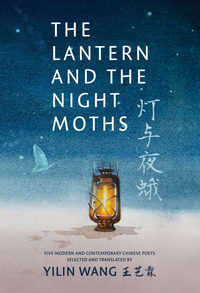
 The Lantern and the Night Moths
edited and translated by Yilin Wang
DETAILS:
Publisher: Invisible Publishing
Publication Date: April 2, 2024
Format: Paperback
Length: 101 pg.
Read Date: November 21, 2025


What’s the Publisher’s Description of The Lantern and the Night Moths?
“the lantern light seems to have written a poem;
they feel lonesome since i won’t read them.”
—“lantern” by Fei Ming
The work of Tang Dynasty Classical Chinese poets such as Li Bai, Du Fu, and Wang Wei has long been celebrated in both China and internationally, and various English translations and mistranslations of their work played a pivotal yet often unacknowledged role in shaping the emergence and evolution of modern Anglophone poetry.
In The Lantern and the Night Moths, Chinese diaspora poet-translator Yilin Wang has selected and translated poems by five of China’s most innovative modern and contemporary poets: Qiu Jin, Fei Ming, Dai Wangshu, Zhang Qiaohui, and Xiao Xi. Expanding on and subverting the long lineage of Classical Chinese poetry that precedes them, their work can be read collectively as a series of ars poeticas for modern Sinophone poetry.
Wang’s translations are featured alongside the original Chinese texts, and accompanied by Wang’s personal essays reflecting on the art, craft, and labour of poetry translation. Together, these poems and essays chart the development of a myriad of modernist poetry traditions in China that parallel, diverge from, and sometimes intersect with their Anglophone and Western counterparts.
The Poetry
There’s 28 poems (I think, I counted quickly) in this collection. Five of them I resonated with and really enjoyed—well, maybe four of them. But I “got” five. The rest of them? Not so much.
That’s not to say they were bad—most of them I thought were great for 50-66% of the stanzas, and then the rest just felt like a different poem. Many of the other half/third were pretty good, too. I just didn’t get what they have to do with the other stanza(s). I have to say that I found that incredibly frustrating.
Chinese poetry shouldn’t work like Western poetry—I wouldn’t want it to. I want it to seem strange—and these succeeded in that. But (beyond the bits I didn’t get), the collection and individual poems felt more “other” than I anticipated, which struck me as a positive and a negative.
The Essays
The first couple of these were a lot more personal than I assumed they’d be, given the description of the book. I found that a little off-putting, to be honest. The first essay, in fact, made me wonder how much Wang was translating and how much she was trying to do something else—maybe even paraphrasing.
But the latter essays clicked with me, and I really appreciated Wang describing some of her choices, some alternative ways she could’ve translated something, and why she opted for the direction she did. I learned a lot and appreciated the practically-impossible task she took on by translating these poems.
So, what did I think about The Lantern and the Night Moths?
This is not going to go down as one of my favorite poetry collections, period. I do think I would return to four of these poems (and yes, I have a list for future use).
That said, this was simply fascinating as an experience—to read a poem (and to look at the Chinese original and boggle at how those characters become the English versions) and then to read about the impact they made on this poet/translator and some of the choices made to get it into a format that English readers can appreciate. It’s something I know I’m not going to see often (if ever).
People more in tune with translation, poetry, or Chinese culture will appreciate and enjoy this more than I did. But I’m so glad that I read this—and that Shannon Knight recommended it to me. The reading of this book is an experience that I relished.
This post contains an affiliate link. If you purchase from it, I will get a small commission at no additional cost to you. As always, the opinions expressed are my own.

KWHR
Poetry is a beast to translate given the medium conveys the message so intrinsically, and the laws of one language’s poetry do not often translate neatly into another language’s laws of poetry. Still, very grateful for those translators who undertake the task to convey, as best they can, the poetic heart of one language into another. I’d be curious what different subjects are covered in this selection.
HCNewton
And hearing this translator’s take on the task is my favorite part of the book. Subjects? I’ll get back to you on that.