

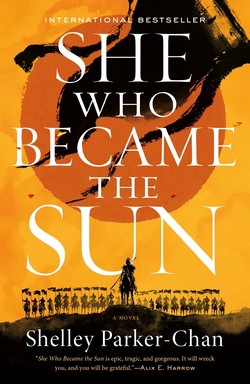
 She Who Became the Sun
DETAILS:
Series: The Radiant Emperor, #1
Publisher: Tor Books
Publication Date: June 28, 2022
Format: Paperback
Length: 411 pg.
Read Date: January 8-10, 2026


What’s She Who Became the Sun About?
This is an epic saga about a China-that-Could-Have-Been back in the 1340s. We follow (well, several people, but let’s focus on a couple of primaries) a young girl who assumes her dead brother’s identity and becomes a monk. This brother had been predicted to rise to greatness (as he was practically starving due to drought and famine, this was quite the fortune to receive). Zhu eventually becomes involved with the rebellion against Mongol rule, and begins to find her way to a new life—one of greatness and power.
On the other hand, we follow General Ouyang, one of the main leaders of the forces set to put down the rebellion. Ouyang is the one member of his family who survived the Khan’s wrath—as a eunuch. He is trusted by some in power, while many others consider him defective and untrustworthy, despite his victories and viciousness.
When these two meet on opposing sides of the conflict—both their lives are set in new directions, and the fate of a nation may be, too.
A Question of Genre
At a couple of points along the line—the last time was about the 2/3 point, I put in my notes, “Where’s the Fantasy?” (I wrote that larger than usual that last time). The elements are just not there—at least not as much as you’d expect in something shelved in that part of a store. In talking with a friend about it, I started calling it the La Croix of Fantasy novels.
It’s there, if you can really focus on it and hope. I have been assured that the Fantasy elements are stronger in the second part of the duology—but not much.
If this had been sold as General Fiction, or Alternate History or something—no one would’ve objected. And I wouldn’t have been distracted by wondering when magic or a dragon or something would come up.
As a fictionalized 14th-century China with a couple of tweaks—this is a great world, and the setting (place and time) is great.
What does this book tell us about humanity?
I’m not entirely sure that this book has much to say about people in general. It has something to say about particular characters—and that can be applied to some, but not all.
Zhu starts off wanting to survive—with the thought that she could claim her brother’s fortune. It’s debatable, but I do think she has some sort of genuine Buddhist convictions—if only because that’s what she’s supposed to believe. Before ordination, she’s given some permission to not be that devout. And her convictions turn to herself—there may be some vague faith about things in general, but ultimately she’s convinced of her own abilities (and if she has to pay for that in lifetimes to come, she’s ready to accept it).
At one point, Zhu—in the midst of trying to encourage someone else—gives sort of her personal mission statement.
“But you know what’s worse than suffering? Not suffering, because you’re not even alive to feel it… Learn to want something for yourself, Ma Xiuying. Not what someone says you should want. Not what you think you should want. Don’t go through life thinking only of duty. When all we have are these brief spans between our nonexistences, why not make the most of the life you’re living now? The price is worth it.”
Without getting into the rightness or wrongness of her choices throughout the book (and she has plenty of both). I’ve come to think of Zhu as a Walter White character. She starts off as clever and resourceful, looking to do the “right thing.” But at a certain point, she realizes how clever and resourceful she is—and what kind of success can come from that, and her pride (warranted or not)—pride that can (should?) be seen as arrogance—starts to fuel her.
On the other hand, we have Ouyang. He is trapped by Fate. Or his idea of it—expectations of honor, family obligation, and therefore Destiny. He comes close to rebelling—or at least pushing against it—but is it close enough? He exercises agency and free will throughout—but it almost seems like he doesn’t think he can. Early on, he seems more lawless, more independent (for lack of a better word)—but by the end, he seems more constrained. Sort of the flipside.
In the book club meeting, the question was asked, “Does greatness necessitate cruelty in this world?” I’ve been chewing on that a lot. I don’t think so—I think there are a couple of examples of greatness (those perceived to be great, anyway) without cruelty. But by and large, the answer in this particular world is a resounding, “yes.” Or at least just about everyone thinks it’s the case. No one looking for greatness, or who happens to be in a position of greatness here can make it without cruelty. It is the epitome of a dog-eat-dog world, and as Norm Peterson would say, everyone is wearing Milkbone underwear.
Why did I pick this up? Why did I keep reading?
I picked this up because it was the month’s pick for the Fantasy Book Club. And for quite a while, that was what kept me going. There were moments that made me think, “Oh, now we’re getting somewhere,” but that didn’t last for long. But curiosity and investment in a couple of secondary characters set in.
Also, I had to answer the question, “Where is the Fantasy?”
So, what did I think about She Who Became the Sun?
I’m really not sure. There was so much that worked here—but I’m not sure how satisfied I was with it in the end.
Parker-Chen can write some glorious lines—they can do more with one sentence of description than many authors can do in paragraphs. And getting to read them do more of that (if I get around to the sequel or wait until a new work) would be a treat.
For a book about war, it’s a relatively bloodless novel. Battles that take out thousands—conquer cities can take less than a page. If you want combat, you’re going to need some one-on-one situations—and there aren’t many. Battle, warfare, is the context of these events—it’s not the focus. Which is a pretty cool thing to see.
As much as I found the characters to be rich and complex (and I spared us all my bloviating about more of them—including the two or three that I like a lot more than those I talked about)—I’m not sure they’re enough to get excited about, alone. But this is a novel about more than the characters and the plot. There’s a lot going on about the nature of fate/destiny, gender, sexuality, morality, ancestry/ethnicity…
Is this a good read? Yes. Could it be better? Oh, yes. But a lot of that has to do with my expectations (magic, creatures, etc.). I just wanted a little more out of the book. If you go into this with the right expectations, you’ll probably get a lot more out of it and appreciate it more than I did. It’s worth the effort.
This post contains an affiliate link. If you purchase from it, I will get a small commission at no additional cost to you. As always, the opinions expressed are my own.






 Sifa Elisabeth’s
My Favorite Theology/Christian Living Books of 2025
By HCNewton
On January 11, 2026
In News/Misc., Theology/Christian Living
It’s finally time to wrap these lists, with my favorites in Theology and Christian Living (and related things). There’s some overlap in some of these titles, which just shows what kinds of things I was thinking about this year, I guess. I didn’t read as many books along these lines as I expected to/usually do–mostly because the ones I did read took some work to get through (and I had too many “project reads”). But these would’ve floated to the top in any year.
As always, re-reads don’t count for these lists.
(in alphabetical order by author)
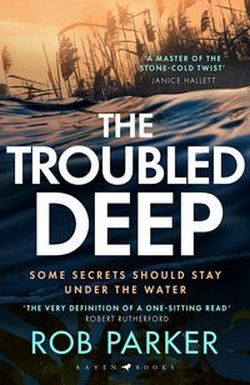
by Michael P. V. Barrett
Barrett writes brief devotional meditations on some Old Testament passages (I’m not sure how brief because I read electronically, but they didn’t take terribly long to read). Which is good enough for a book–but Barrett writes with a depth that I don’t think I’ve come across in a devotional before. He gets to the heart and the nitty-gritty of the passages he looks at–and writes in a way that the reader will find application for their life, understanding of the passage, and a new/renewed reason to worship and serve the One who bought them.
The only thing that impressed me–almost every week–as much as the content was Barret’s ability to accomplish it so briefly.
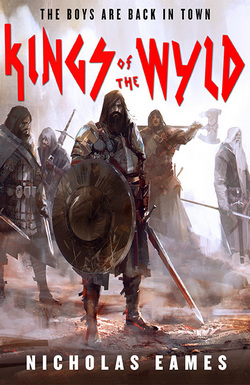
by Mitchell L. Chase
My original post
I personally benefited from Chase’s definition of “wisdom” and how to find it in Scripture. I really appreciated his unwillingness to make Proverbs, Ecclesiastes, Song of Songs, and James the epicenter of his discussion, but to look for it throughout the Scriptures (see above). Tackling the topic of wisdom from a Redemptive Historical point of view rather than a Systematic perspective (which is what I’m used to, as I expect most are), really helped me to see the breadth of it—and even to help with my Systematic understanding of it (as it should).
All in all, this is a truly helpful and insightful read.
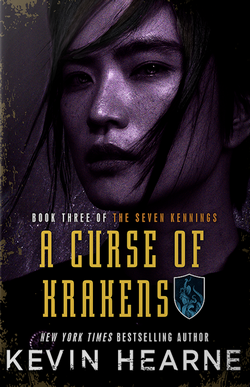
Why the Love of Money Is the Root of Racism and How the Church Can Create a New Way Forward
by Malcolm Foley
I’ve tried on at least four occasions to write a post about this book, and keep failing. I’m going to keep trying, but in the meantime, I’ll just say that this is one of the best books I read in 2025 regardless of genre/topic. Foley starts with Ida Wells’ point tying racism to money, and expands on that. He traces the connection between the love of money (which we know to be the root of all sorts of evil) and racism/racism-friendly policies and attitudes throughout U.S. History–particularly after the Civil War. And how the Church, to her shame, participates in those.
Then he points the way forward–using a variety of theological tools. Including the Westminster Larger Catechism’s teaching on the Eighth Commandment. It’s inspiring, it’s convicting, it’s full of hope.
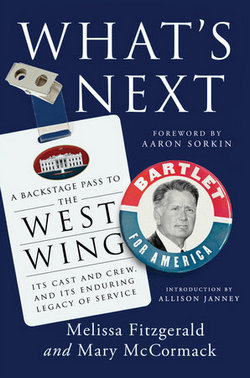
by Carmen Joy Imes
My original post
Is this the most rigorous, robust work that I’ve ever read on The Church? No. Is this the most technical, theological work I’ve come across? No. Did this take a lot of effort to get through? No (and what a relief). Is this perhaps the most passionate work on the subject I’ve read? Yes. Is it perhaps the most persuasive about the need for individual believers (particularly in an individualist culture) to be involved with the Church? Also, yes.
It’s warm, it’s approachable, it’s learned in a non-off-putting way. Imes is a great guide through the topic and a fun companion through the stroll. She pointed out some things I hadn’t thought of before—and helped me grasp a couple of texts that I’ve struggled with for years.
by C. S. Lewis
There’s a lot of this book that I disagree with–but I appreciate the way that Lewis got to his conclusions. I also admit that Lewis might be closer to right than I am on those points. But the opening letter on prayer is one of the best things I’ve read on the topic, and while the rest of the book doesn’t reach those heights, I truly enjoyed and benefited from considering them. This is one of those books by him I hadn’t gotten around to reading in the past until my little Lewis-immersion project last year. It won’t be the last time.
by Zacharias Ursinus
As this is written by one of the chief authors of the Heidelberg Catechism, it’s impossible to get a more authoritative take on it. This is essentially the director’s cut of the catechism. Sure, we all know the answers, but how’d you get to that answer? Well, you think like so….
This is a treasure for anyone trying to understand and use the Heidelberg Catechism for personal use or for trying to raise the generation to follow.
by Drew Poplin
My original post
I hate the fact that books decrying the sin (or, in Poplin’s argument, heresy) of racism need to be written now. But the need for them is pretty clear to anyone in the American Church. This brief (perhaps too brief) book is a compelling read, calling racism what it is, an attack on God and His creation. Convicting, and hopefully convincing. It’s well worth the time to read.
by O. Palmer Robertson
Did this floor me as much as the first volume of this set (on the Gospels) did? Nope. But am I going to study Acts or Paul’s letters without consulting this in the future? Bigger nope. Robertson first traces the development of revelation and the Church’s understanding of it through Acts, then he spends the bulk of the book watching Paul’s themes develop and change over the course of his career–never contradictory, never inconsistent, but starting with certain emphases that develop into new ones given the events of his life and the needs of the Church throughout the First Century. It’s really a handy book to work through and to keep on hand for future use.
by Mikel Del Rosario
My original post
Del Rosario’s approach to the subject alone could put him on this list–let’s take an in-depth look at two passages and see what Jesus is claiming for himself in both. Let’s consider what the original audience heard–and seek to understand that by the way they reacted. Then let’s consider the implications of both. Del Rosario writes clearly and compellingly. The text—even when it gets technical—is straightforward and approachable by people who aren’t historical scholars.
Not only does reading this help buttress the confidence a reader has in the passage and Jesus’ claims in them, but Del Rosario gives his readers a model to follow when they come across similar passages.
by Cornelius Van Til
My original post
This is some pretty clear writing from a man widely considered not to be terribly clear all the time. Some of the commandments don’t get the same level of attention as others–and it makes sense given who Van Til is and his own driving focus.
It’s a very sound introduction, in line with the bulk of the Reformed stream of thought on the Law and its usage from the time of the Reformation forward. But a little more approachable given the length and the fact it was written in the 20th Century.