

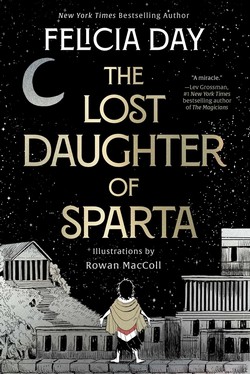
 The Lost Daughter of Sparta
by Felicia Day, illustrated by Rowan MacColl
DETAILS:
Publisher: Gallery Books
Publication Date: March 17, 2026
Format: Hardcover
Length: 193 pg.
Read Date: March 21, 2026


The Origin of the Book
Day explains this better in the book, but I bring this up because it’s kind of a key to thinking about this book. Day came across a reference to a curse that was imposed on Helen of Troy and her sisters—which led to her rethinking Helen. As she looks into that some more, she reads about Helen’s sister Philonoe being made immortal by Artemis. And that’s it. No details provided.
Which gets her imagination percolating and us getting this graphic novel.
What’s The Lost Daughter of Sparta About?
Whereas big sister Helen was a legendary beauty (literally), Philonoe was born with a birthmark denoting her as ugly—think Gorbachev’s scalp birthmark but covering about half her face. She’s sent to live with goatherds for most of her life, but is brought back by her parents following the Trojan War to get married.
Her future husband is a prince of Gla. If he has a redeeming quality to him, Day didn’t do a great job of making sure we saw it. Her mother reveals to her the nature of the curse that Aphrodite had put upon her and her sisters.
Philonoe goes to Aphrodite’s to ask for help with this curse and is sent on a quest to retrieve three items. Due to a previous sacrifice to Artemis, that goddess is paying attention to her, too. Artemis plays Ghosts of Sister Present with her, letting her see how things are going for them in a way to help her learn about the world.
What did I think about the art?
I’m of two minds when it comes to the art. It’s not the cleanest, most attractive, or most consistent art you’ve come across. But there’s a charm to it—the more I read, the more I enjoyed it.
I know MacColl is capable of cleaner work—I’ve checked out their website and have seen it. So what I’m trying to talk about has to be intentional. There’s part of me that sees some similarities between the art and figures on Grecian Urns I’ve seen in books.
So, what did I think about The Lost Daughter of Sparta?
There’s just nothing subtle about the storytelling, or the dispensing of the moral(s) of the story. It might have been a bit more effective if it were.
Still, it’s hard to fault the moral(s) she’s dispensing—particularly if her daughter is the primary target audience.
This isn’t a feminist re-imagining of a classic character, like so many we’ve seen. Philonoe is a blank slate as far as history and literature are concerned, so Day has the freedom to draw whatever she wants on it—and she’s taken advantage of it. There’ve been so many interpretations of Aphrodite and Artemis over the centuries that one more isn’t notable (and Day likely echoes as many as she diverges from)—the two of them are rather amusing together.
It’s a classic hero’s journey that is full of commentary on Greek heroes and how they are used by the Olympians. I’d have liked to see a bit more of that, really. But what Day gave us was pretty effective.
It’s a fast read with some fun turns—it’s not perfect, but what is? Is Day capable of better? Yes. Can you feel her investment in the project on every page? Yeah, pretty much.
I’m glad that I read The Lost Daughter of Sparta, and I assume anyone the premise appeals to will be, too. I’d suggest checking it out.
This post contains an affiliate link. If you purchase from it, I will get a small commission at no additional cost to you. As always, the opinions expressed are my own.

Read Irresponsibly, but please Comment Responsibly