

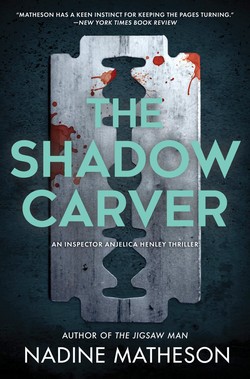
 The Shadow Carver
DETAILS:
Series: DI Anjelica Henley, #4
Publisher: Hanover Square Press
Publication Date: March 10, 2026
Format: Hardcover
Length: 420 pg.
Read Date: June 27-30, 2026


What’s The Shadow Carver About?
There seems to be a new serial killer active in London, with a particularly creepifying signature—they’re taking scalps as trophies. They’re also doing a pretty good job of making sure the public knows about the killings to a level the police might not be willing to provide (at least not as soon as the killer is). Oh, and the target? Criminals who seem to have gotten away with it due to court findings. There’s a certain amount of popular acclaim for the killings, because of that.
Still, even the worst of English society don’t deserve to be scalped. So DI Anjelica Henley and her team—plus a detective seconded to them—are on the hunt. One victim interacted with Henley just before dropping off the map, and she might be the last person to see them alive—which adds a level of pressure (and a conversation with other detectives about her possible connection to the case).
Throughout it all, Henley is preoccupied by another case. Despite the heinous crimes that she needs to stop, a good chunk of her mind is spinning on the death of her mentor, friend, boss, Harry Rhimes. Henley has questions about it—as does Harry’s wife, Eloise. Eloise is putting some pressure on Henley to get some answers for her—and Henley wants them for herself, too. But first, she does have to do her job.
The rest of the team is dealing with their own distractions as well—most of them are doing a better job of focusing on the work, however (which isn’t to say that Henley’s doing a bad job; she’s just not at her best). This feels like one of the truest depictions of police detectives in a procedural. Yes, they want to catch a killer—but they also want to care for their sick wives, adopt a child, hit on a colleague, or something else. It turns out, these detectives are people. Driven, but they do things other than work.
Why did I pick this up? Why did I keep reading?
I picked this up because Nadine Matheson is one of those authors I want to stay up-to-date on, even if she steps away from this series (which I hope is a long time off). The way she gets into the mind of the criminals as well as the police is one of the things that sets her work apart from others, and I can’t get enough.
I kept at it because…well, for those reasons. Yes, I’m interested to an extent, in the case that’s distracting Henley (and will be more interested once it’s the primary focus). Yes, I’m interested in following the other team members (with an eye on Ramouter and his wife’s disease). But in this particular book it’s not just about the “whodunit?” but the “how are they going to figure it out?” This case seems twistier than normal for them on that front, and I just loved watching it.
What does this book tell us about humanity?
To be human is to seek justice. We all (or almost all), from toddlers on up, have some sort of idea of justice, rightness, fairness. And when we see it violated time and again by the processes we trust to protect it and execute justice, it makes us angry, it leads us to give up, it drives us to some sort of action.
Many times this ends in positive actions—like Henley and her team joining the police service and trying to enforce the laws. Other times it gets twisted and results in the kind of vigilantism we see here. And sometimes people who are upset and don’t know how to best react to injustice can get their minds and morality manipulated. We see examples of all three at work in this novel.
Honestly, there’s something appealing, or relatable, in each experience, and readers may be surprised at who they sympathize with at various points in the novel. (hopefully not by the end, but, you never know)
So, what did I think about The Shadow Carver?
I will admit I got a little frustrated at Henley spending as much energy (especially mental) on Rhimes, and dealing with personnel issues with a vigilante to find. And I wasn’t crazy about the way the new/temporary team member worked and interacted with the others. I think I was supposed to react that way for the latter, at least I hope so—Matheson seemed to point the reader that way.
But setting those reactions aside? This was gripping. Like I said before, the way that Matheson drives into the psychology of the characters—victims, police, perpetrators, and others—is the big draw for this series, and definitely is the case for this book.
Although, you sorta want to see what’s going on with the scalping, too.
As outlandish as much of the book seemed—it also felt incredibly grounded. These investigators come across as real people, with real concerns and motivations, and just getting to watch them is satisfying in a way that’s hard to articulate.
The Shadow Carver features a good, twisty plot, is populated with well-conceived and three-dimensional characters, and the resolution to the case is well-executed. Like always, Matheson delivers a good one.
This novel (as the others) would serve as a good jumping-on point for the series, but will reward those coming back for more well.
Either way, it’s a good ‘un.
This post contains an affiliate link. If you purchase from it, I will get a small commission at no additional cost to you. As always, the opinions expressed are my own.


Read Irresponsibly, but please Comment Responsibly