

I could’ve titled this “In Which I Castigate My 10-Year-Old Self,” and there will be some of that, but it seemed a bit too self-flagellating.
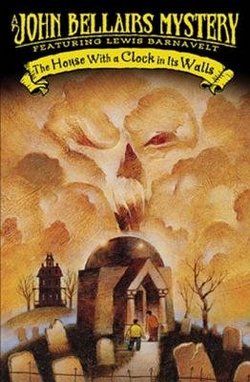 The House with a Clock in Its Walls
DETAILS:
Series: , #1
Publisher: Puffin Books
Publication Date: August 03, 2004 (this edition, originally 1973)
Format: Paperback
Length: 179 pg.
Read Date: September 12, 2026


On the first Monday after Labor Day, Lewis started going to school in New Zebedee and, before long, he had forgotten all about the mysterious clock in the walls. He had troubles enough of his own.
They weren’t new troubles. They were the troubles that a fat boy who can’t play baseball carries around with him from place to place. Lewis had always been overweight. He couldn’t remember a time when he hadn’t been. All his life—all ten years of it—he had been listening to children who chanted:
Fatty, fatty, two by four
Can’t get through the kitchen door.
What’s The House with a Clock in Its Walls About?
Ten-year-old Lewis, recently orphaned, moves to New Zebedee, MN to live with his Uncle Jonathan, a man he’s never met (although he has heard about him from other family members). Jonathan is a large, hirsute man, with a big presence, a good sense of humor, and a kind heart.
He also lives in a strange mansion. Lewis likes the mansion part immediately—and the more he learns about the strangeness, the more he’s drawn to it, too.
Jonathan’s neighbor, Mrs. Zimmermann, spends a lot of time at his house—which is good; she enjoys cooking for them. And the three regularly play poker and other things like that. It turns out that Uncle Jonathan and Mrs. Zimmermann are witches (she’s more powerful and better educated in it, however). Lewis is intrigued and loves talking about it with them—and enjoys the demonstrations he sees.
Lewis makes one friend at school, but is afraid they’re growing apart (the friend is an athlete who was pleased to hang out with Lewis when he had a broken arm, but as it heals, he’s ready to get back to sports). In an attempt to keep his friend, Lewis studies up on a big spell and shows off for his friend by attempting to raise the dead on Halloween.
The after-effects of that spell are huge—and just might bring about the end of the world.
As Neville Barnes would say, “You know, for kids.”
Wow, Times Have Changed
Okay, this was published longer ago than I’m comfortable with (see below), but it does a good job showing how much the standards have changed. Back when I was a kid (walking to school uphill in the snow both ways—literally, I mean, we also walked down the other side of the hill, but still…) this was shelved in the “Juvenile” section; today, it’s probably in the “Middle Grade” section. Regardless—there are references to drinking and smoking* throughout. There’s even a joke about the bus arriving on time only because they got the bus driver drunk! I just don’t see anyone publishing that today.
The banter that Uncle Johnathan and Mrs. Zimmermann engage in is frequently nasty and belittling—but it is clearly delivered in affection. Consider me a fan, but it feels like something from another time.
I should stress that the smoking and drinking depicted are moderate. But outside of irresponsible, if not “bad guy,” adults, I just don’t see that kind of thing happening in Middle Grade publishing today. I’m not sure we’ve gained a lot by that. (I’m not sure we’ve lost that much, either, to be fair)
* I’m told that the author who took over for Bellairs had Uncle Jonathan quit smoking for health reasons
Edward Gorey’s Illustrations
This is the one thing I remember from flipping through these books on the library shelves when I was a kid: these illustrations. Simply put, Gorey’s illustrations are a little odd. And potentially unnerving for a child in a pre-Internet and CGI animation era.
The faces are squished. Lewis looks like a thirty-year-old shrunk in the dryer (somehow, at the same time like a rough draft of Bobby Hill). But I love them. My only complaint is that there weren’t more of them. I don’t need every other page to have been an illustration, but two per chapter would’ve been nice.
Why did I pick this up? Why did I keep reading?
I picked this up for two reasons: 1. I needed a book released the year I was born for a Reading Challenge. 2. A (younger) friend has been reading everything John Bellairs wrote this year and raving about this trip down memory lane. You put the two together and…well, I just had to try it, right?
(also, I just wasn’t up for Breakfast of Champions)
Why did I stick with it? It’s so brief that I really didn’t have much of a chance to decide to DNF. Also—why would I? Within a chapter, I was questioning many of the literary choices I made in the early ’80s. I looked at this (and other books by Bellairs) several times at the library, considering whether or not to check them out—I can picture the shelf they were found on clearly—but I never did. I think I was put off by the “scariness” of them. Sure, Danny Dunn and the Anti-Gravity Paint was absolutely worth the 13th re-read, but…I could’ve easily squeezed this in. I was having a ball reading this at my not-that-advanced age and in seeing how it would—and likely still does—get younger readers hooked.
So, what did I think about The House with a Clock in Its Walls?
Lewis was silent. He had always thought that courage had something to do with riding your bicycle through bonfires and hanging by your knees from the limbs of trees.
Lewis, it must be said, is a strange little boy. He reads himself to sleep working through John L. Stoddard’s lectures from the 1880s (early travelogues). I don’t know how many of them he reads over the course of the book, but there were 10 volumes, and there’s reason to believe he read at least a couple of them. He cannot hit a baseball, field, or run—in short, he cannot play baseball, and is constantly the last to be picked (even by the kind children)—eventually doesn’t get picked at all (even by the kind children). He doesn’t even bother to try football (probably for the best)—we don’t hear about other sports, but I’m willing to bet if the book lasted through more seasons, we’d hear more about his lack of ability. And as the new kid in school, living in a strange house with an odd uncle, who cannot play sports, and who has odd interests…well, let’s just say he doesn’t really have much of a social life outside of his uncle and his neighbor.
The one friend he does make is a little too weirded out by the whole resurrecting-the-dead thing (understandably, it should be stressed) to stick with him.
In other words, Lewis is the kind of character that lonely, bookish children would gravitate to. You put him in a creepy yet wonderful house with magical interior design, and a couple of adults who treat him almost as an equal? Sounds great—who wouldn’t want a life like that? Throw in his studious nature helping him to figure out how to do magic like raising the dead? Every young nerd in the world wants something like that.
The one false note when it comes to our friend Lewis is that he doesn’t seem too broken up by his parents’ death. I get Bellairs not wanting to weigh down the entire book with grief or anything. But…a thought or two here and there for them, wouldn’t have been too morose. Also, how does a child like Lewis not think of trying to go back home to Minnesota and trying out his whole raising-the-dead thing on his mom? This risk would be worth it, right?
For me, however, the highlight of the book is the light touch that permeates everything. There’s a sense of play competing with the spookiness to dominate the book (and it wins). The dangers—and loneliness—of existence and the strange, magical mysteries of Jonathan’s mansion are best combated with some milk and a chocolate-chip cookie in hand. The graver dangers of the end of the book are taken on with an activity that could’ve been the inspiration for New Girl‘s True American game. A sense of play, absurdity, and chocolate-chip cookies is not only a recipe for a fun book, but it’s also a great foundation to build a personality on.
I had a blast with this. I encourage parents/other relatives of children of the target age to seek it out on their behalf—and adults who like to pretend they are when they read to seek it out for themselves.
This post contains an affiliate link. If you purchase from it, I will get a small commission at no additional cost to you. As always, the opinions expressed are my own.

Christine
I remember reading this one as a kid, and when my son was around 10, I read it to him as part of our 1001 day reading streak. He loved it, weirdness and all.
HCNewton
1001 reading streak?!?!?! Whoa.
Prime reading for a 10 year old.
Christine
It was a long time ago – he’s 26 now! But we both remember it really fondly.
KWHR
So delighted to hear you enjoyed it! Yeah, he resonates with the lonely bookish kids. And yes, it is hard to imagine this getting published in juvenile fiction today.
I don’t remember where I read it, but one person commented that they appreciated the realism of his friendship with the school athlete and how the result of their relationship. Childhood friendships do not always have a happy ending.
Some of the later books get a little more into his thoughts about his parents and their deaths. It isn’t a persistent plot point, but it does come up occasionally in some of the other books. For whatever reason, Bellairs’ protagonists don’t fair well with their mothers. The Johnny Dixon series the main character has lost his mother as well (a lot more detail is given to his feelings on that matter). In the Anthony Monday series, Anthony’s mother is overbearing and perpetually an anxious anchor hanging over him like a source of dread rather than comfort. But I do feel their deaths are more of a “moving the plot” contrivance for Barnavelt, while by the time Bellairs writes Johnny Dixon, there is more reflection on the impact of familial loss.
Again, glad you enjoyed it!
HCNewton
Good note about the realism in the friendship with the athlete–I did like the way Lewis reacted once the friendship was over (and understood the impulse to save it).
Good to know we do get a little more about the deaths in the future. But yeah, it seems Bellairs falls fully in the “parents are a hindrance to juvenile adventure” camp.